
Hiring without feedback is costing you – in reputation, referrals, and rehires. Only 7% of companies provide specific rejection feedback, yet doing so can boost reapplications by 4x and referrals by 3.2x. For scaling businesses, feedback isn’t optional; it’s a tool to attract top talent, cut costs, and build trust.
Key Takeaways:
- Timely feedback matters: Respond within 24–48 hours to keep candidates engaged.
- Structured systems save time: Automation for early stages and personal touch for final rounds balance efficiency and quality.
- Feedback drives results: A 0.3-star Glassdoor boost can increase qualified applicants by 12% and cut hiring costs by 7%.
What’s in this guide:
Learn how to build scalable feedback systems, reduce ghosting, and turn rejected candidates into future hires or referrals. Discover how structured scorecards, clear ownership, and consistent processes can transform your hiring outcomes.
Ready to improve your feedback strategy? Let’s dive in.
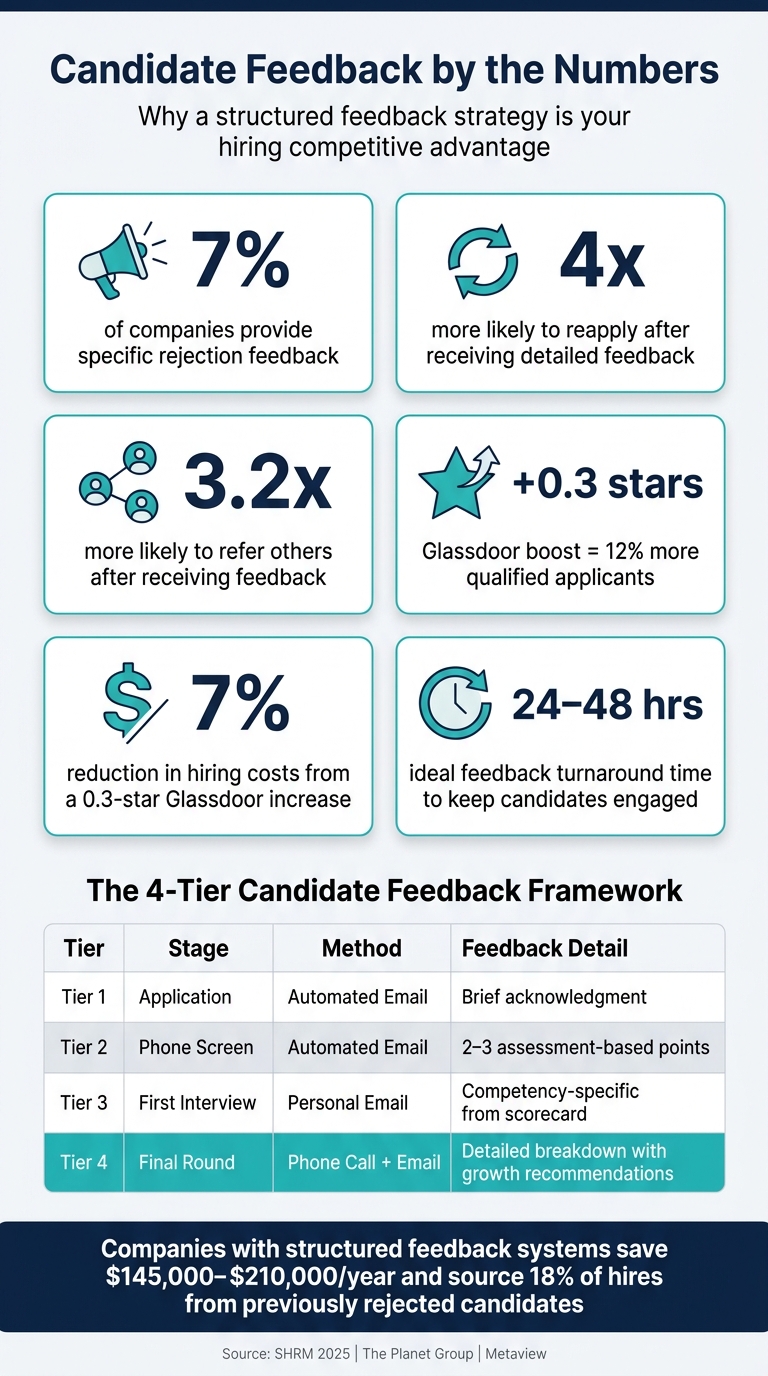
Candidate Feedback by the Numbers: Why It Matters for Your Hiring Strategy
Building the Foundations of a Candidate Feedback Strategy
Core Objectives and Guiding Principles
A strong candidate feedback strategy achieves four essential goals: improving your employer brand, building a talent pipeline, streamlining hiring processes, and ensuring equity. To achieve this, feedback must be timely (ideally within 24–48 hours), specific (grounded in documented competency scores), and constructive (focused on professional development). The depth of feedback should reflect the candidate’s level of involvement – a quick acknowledgment for early applicants and a detailed explanation for those who make it to the final stages.
"Feedback isn’t just a post-interview formality – it’s the engine that drives stronger connections, smarter hiring decisions, and lasting professional growth." – The Planet Group [2]
Using structured, competency-based feedback also helps reduce legal risks. SHRM highlights that documented assessment scores provide evidence of an objective evaluation process, helping mitigate potential discrimination claims [3]. These principles establish a clear foundation for delivering feedback at every stage of the candidate journey.
Key Feedback Moments in the Candidate Journey
To align feedback with candidate effort, a tiered approach ensures that the level of detail matches the time and energy invested by the candidate:
| Tier | Stage | Candidate Time and Effort | Feedback Detail |
|---|---|---|---|
| Tier 1 | Application | 15–30 mins | Brief acknowledgment only |
| Tier 2 | Post-assessment / Phone screen | 1–3 hours | 2–3 points based on assessment scores |
| Tier 3 | Post-interview (1 round) | 4–8 hours | Competency-specific, drawn from scorecards |
| Tier 4 | Post-final interview | 10–20+ hours | Detailed feedback with growth recommendations |
The Tier 4 stage – for candidates who reach the final round but fall short – offers the greatest opportunity for impact. These "silver medalists" already understand your company and its culture. Providing specific, actionable feedback increases the likelihood they will reapply in the future; in fact, candidates who receive detailed feedback are four times more likely to reapply [3]. To keep these candidates engaged, tag them in your ATS and follow up periodically. Companies with structured re-engagement programs report that 18% of their hires come from previously rejected candidates [3].
Policy and Ownership in Feedback Delivery
Once feedback moments are mapped, assigning clear ownership ensures quality and consistency. Feedback delivery should align with ATS status changes – when a candidate is marked as "Rejected", the feedback workflow should kick off immediately.
For early-stage feedback (Tiers 1–2), automation is key. For later stages (Tiers 3–4), recruiters should review and approve messages before sending. Hiring managers are responsible for creating structured scorecards after interviews, while recruiters handle the actual delivery. This division of responsibilities ensures consistency without slowing down the process. Additionally, any candidate experience survey score below 2 out of 5 should be flagged for immediate review by both the recruiting manager and the hiring manager.
Interestingly, data shows that sending rejections on Tuesdays or Wednesdays during business hours leads to higher candidate satisfaction compared to sending them on Fridays [3].
How to Build a Structured Feedback System
Using Structured Interviews and Evaluation Frameworks
A strong feedback system starts with consistency. Every candidate must be assessed against the same criteria to avoid subjective judgments and potential legal risks.
To achieve this, it’s essential to distinguish between two key tools: a scorecard and a rubric. A scorecard outlines what to measure (the competencies), while a rubric explains how to evaluate those competencies using clear, behavioral examples. As Calvin D., Head of Enterprise Solutions, explains: "A scorecard defines what you’re measuring… A rubric defines how to score each dimension." [7]. For instance, a rubric clarifies what differentiates a "3" from a "4", removing ambiguity and ensuring fairness.
Instead of creating a new scorecard for every role, group positions into role families (e.g., Sales, Engineering, Product, Customer Success) and identify 7–10 key competencies for each. This approach keeps evaluations focused and avoids overwhelming interviewers with excessive criteria. Here’s an example:
| Role Family | Core Competencies |
|---|---|
| Individual Sales | Discovery quality, objection handling, pipeline discipline, closing instinct, coachability |
| Engineering | Technical depth, code quality, communication, collaboration, problem decomposition |
| Product | Customer problem-first thinking, prioritization, spec quality, cross-functional communication |
| Customer Success | Customer empathy, data fluency, escalation judgment, retention mindset |
Assign specific competencies to individual interviewers to ensure thorough coverage and avoid score inflation. Standardized rubrics and questions not only improve consistency but also save an average of 40 minutes per interview [4] and enhance hire quality by 26% [7].
Another key practice is independent scoring. Interviewers should submit their scores and evidence-based notes before any group discussion to prevent bias. This avoids anchoring, where the first opinion voiced influences others.
"Structured interviews are one of the best tools we have to identify the strongest job candidates. Not only that, they avoid the pitfalls of some of the other common methods." – Dr. Melissa Harrell, Former Hiring Effectiveness Expert, Google [4]
These structured methods lay the groundwork for creating concise and actionable feedback forms.
How to Design Candidate Feedback Forms
Effective feedback forms are clear, concise, and easy to use. Overly long or vague forms are often ignored or rushed through.
To make forms practical:
- Limit them to 4–6 competencies per stage.
- Ensure they’re mobile-friendly, allowing hiring managers to complete them on the go.
- Use a 1–4 rating scale instead of 1–5. A 4-point scale forces clear decisions: 1 (Strong No), 2 (Lean No), 3 (Lean Yes), 4 (Strong Yes). In contrast, 5-point scales often lead to unhelpful clustering in the middle [6][7].
Each rating should include a behavioral anchor – specific examples of observable actions that justify the score. For instance, a "4 – Strong Yes" for Technical Depth might state: "Independently designs scalable solutions and anticipates edge cases." Avoid vague terms like "Good" or "Meets expectations", as they lack clarity and actionable insights [6].
Place a Hire/No-Hire recommendation field at the top of the form. This ensures interviewers make a decisive judgment before diving into detailed scoring, reducing the risk of adjusting scores to match a gut feeling later [8].
For later-stage interviews, include a Flags and Risks section. This allows interviewers to document specific concerns, such as inconsistencies between a résumé and interview responses. Keeping these issues visible ensures they’re addressed during hiring discussions.
Documenting Feedback for Internal Use
Once feedback is collected, it’s crucial to store it centrally to maintain consistency and compliance. Use your Applicant Tracking System (ATS) to document all feedback – not email threads, shared documents, or personal notes. This centralization creates a searchable record and supports EEOC compliance by showing that candidates were evaluated objectively [5][9].
Timing matters. Feedback submitted within 2 hours of an interview captures 92% of key behavioral observations. Automate reminders immediately after interviews to encourage timely submissions [9]. A VP of Talent at a 500-person company shared: "When interviewers know the system will escalate to the hiring manager at 24 hours, they submit within 4 hours because they don’t want to be the bottleneck." [9]. Setting a strict 24-hour SLA for feedback ensures accountability.
To protect the integrity of scores, use blind feedback – interviewers’ notes and scores should remain hidden from others until all have submitted. This reduces groupthink and encourages diverse perspectives, resulting in 28% more varied scoring patterns [9]. Once all feedback is collected, focus debriefs on areas of disagreement rather than rushing to consensus. The hiring manager should base decisions on documented scores, not on who speaks most assertively. Enforcing a "no scorecard, no voice" rule ensures accountability and scalability as hiring demands grow.
Delivering Feedback at Scale
Tailoring Feedback for Different Hiring Outcomes
Adjusting feedback based on a candidate’s progress is essential when operating at scale. The approach depends on the stage of the hiring process and the level of detail required. For early-stage candidates, automated messages suffice, while final-round candidates deserve a personal touch – a phone call followed by a detailed email with constructive feedback and growth suggestions. For a full breakdown, refer to the "Key Feedback Moments" section.
| Tier | Stage | Method | Feedback Detail |
|---|---|---|---|
| Tier 1 | Application | Automated email | Brief acknowledgment |
| Tier 2 | Phone Screen | Automated email | 2–3 assessment-based points |
| Tier 3 | First Interview | Personal email | Competency-specific from scorecard |
| Tier 4 | Final Round | Phone call + follow-up email | Detailed breakdown with growth recommendations |
Timeliness is critical – feedback should reach candidates within 24–48 hours. However, timing also matters. Avoid sending rejections on Fridays; aim for mid-mornings between Tuesday and Thursday. This allows candidates to process the information and reach out if needed [1][3].
This structured feedback system enables automation while retaining the personal touch where it matters most.
Balancing Personalization and Scalability
Automation can significantly reduce recruiter workload without compromising the candidate experience. The secret lies in using automation strategically, as shown in the tiered feedback system.
For Tiers 1 and 2, automation handles communication entirely. For Tier 3, messages are auto-generated from scorecard data but reviewed by a recruiter before sending. Tier 4 candidates receive the highest level of attention, with a personal phone call followed by a detailed email. This "human-in-the-loop" model ensures quality while keeping processes efficient. With modern ATS platforms, workflows can be triggered automatically via API webhooks when a candidate’s status changes [3], ensuring no step is missed.
The benefits are clear. Currently, only 7% of employers provide specific, constructive rejection feedback [3]. Yet candidates who receive it are 4x more likely to reapply and 3.2x more likely to refer others [3]. For a company hiring 200 people annually, this structured feedback system could save $145,000–$210,000 through reduced recruiter hours and re-engaged candidates [3].
"The legal risk of providing rejection feedback is frequently overestimated. Specific, competency-based feedback… carries minimal legal risk compared to vague, subjective feedback." – SHRM 2025 Employment Law Analysis [3]
The language you use also plays a critical role. Avoid terms like "unsuccessful" or "more qualified." Instead, frame feedback around role alignment, such as "a closer match for specific requirements." This subtle shift can reduce resentment and protect your employer brand [1].
Training Hiring Teams for Consistency
Automation can only go so far – consistent execution by your team is just as important. A structured, competency-based feedback system relies on hiring managers and interviewers applying it correctly.
Training is key. Teach your team to replace vague terms like "culture fit" or "not the right personality" with specific, role-related observations. These should always tie back to documented competency scores, which not only ensures clarity but also reduces legal risk. Feedback referencing protected characteristics, such as age or health, can lead to unnecessary legal complications [1][3].
Set clear expectations for feedback delivery. Implement a 24-hour SLA for written feedback after each interview stage and schedule debrief meetings in advance to prevent delays [10]. Additionally, ensure hiring managers understand when a rejection phone call is required – this step alone can boost positive candidate ratings by 32% compared to automated emails [1].
"In 2026, the answer isn’t choosing between efficiency and personalization. The best candidate experience is fast, structured, and deeply human by design." – Metaview Blog [10]
sbb-itb-a23bd6a
Measuring and Improving Your Feedback Strategy
Key Metrics to Track Feedback Effectiveness
Having a structured feedback system is just the start – tracking the right metrics is what drives real progress. These metrics give you a clear picture of how well your feedback strategy is working and where to fine-tune.
The Candidate Net Promoter Score (cNPS) is one of the most important indicators of candidate experience. It’s calculated by subtracting the percentage of detractors (scores 0–6) from promoters (scores 9–10). A cNPS of +40 or higher is a solid target [12]. Alongside this, monitor your "Would Apply Again" rate, which reflects your employer brand among candidates who weren’t selected. Aiming for 50% or higher here shows a strong reputation.
Operational metrics are equally critical. These numbers don’t just reflect satisfaction – they help you understand how to improve it. The table below highlights key metrics, their targets, and how often you should review them:
| Metric | Target | Review Frequency |
|---|---|---|
| Feedback Turnaround Time | Under 24 hours | Weekly |
| Rejection Feedback Delivery Rate | 100% (Tiers 2–4) | Weekly |
| Candidate NPS (cNPS) | +40 or higher | Monthly |
| Survey Response Rate | 30% or higher | Monthly |
| "Would Apply Again" Rate | 50% or higher | Monthly |
| Silver Medalist Re-hire Rate | 15% within 12 months | Quarterly |
One way to boost survey response rates is by attaching specific feedback to rejection emails. This approach can increase responses from 12% to 30–38% [3]. Timing also matters – triggering surveys 24–48 hours after sending a rejection email significantly improves participation [3].
Using Feedback Data to Improve Recruitment Processes
Metrics are only useful if you act on them. Each one offers insights that can refine your recruitment strategy.
For example, if your offer acceptance rate drops below 80%, dig into survey feedback to uncover issues like compensation misalignment or delays in decision-making [12][13]. A rise in late-stage withdrawal rates could point to problems with the interview process – perhaps candidates feel interrogated rather than evaluated.
Low interviewer preparedness scores are another red flag. These scores can identify hiring managers who might need extra training on structured and bias-aware interviewing techniques. And don’t overlook your silver medalist pipeline – those high-potential candidates who made it to the final rounds but weren’t hired. Companies with well-organized re-engagement programs report that 18% of their hires come from previously rejected candidates, compared to under 3% at companies without such systems [3].
Running Regular Reviews to Improve Over Time
Once you’ve gathered actionable data, the next step is to integrate regular review sessions to keep improving. These reviews should balance operational efficiency and long-term strategy.
- Monthly reviews: Focus on metrics like turnaround times, survey response rates, and cNPS to ensure day-to-day operations are running smoothly.
- Quarterly reviews: Take a broader look at strategic outcomes, such as interviewer calibration, cost-per-hire trends, offer acceptance rates, and silver medalist re-hires.
- Annual reviews: Collaborate with hiring managers to reassess scorecard criteria, ensuring they align with the specific needs of each role [8].
Quarterly calibration reviews are particularly valuable for addressing bias and improving scoring consistency. Research shows that 38% of scorecard pairs have at least a one-point difference between interviewers – a gap that could influence hiring decisions [11]. Comparing scoring patterns across your panel helps identify inconsistencies early. Plus, when interviewers know their evaluations are reviewed, they tend to improve their performance:
"When interviewers know the system will escalate to the hiring manager at 24 hours, they submit within 4 hours because they don’t want to be the bottleneck." – Garrett Mullins, Workflow Specialist [9]
Even small adjustments can lead to big wins. For instance, a 0.3-star increase in Glassdoor ratings attracts 12% more qualified applicants and reduces hiring costs by 7% [3]. By making steady improvements to your feedback strategy, you’ll see tangible results that benefit both candidates and your bottom line.
Conclusion and Next Steps
Key Takeaways for High-Growth SMEs
Getting candidate feedback right isn’t just a nice-to-have – it’s a competitive advantage. When feedback slows down, 23% of top candidates choose a faster-moving competitor, leading to delays and missed opportunities.
This guide highlights four priorities for building a feedback process that works:
- Use scorecards and rubrics to eliminate guesswork.
- Gather feedback within 24 hours to keep things moving.
- Automate admin tasks to save time and reduce errors.
- Assign clear ownership at every stage of the process.
Companies that implement these steps see over 90% feedback completion within 24 hours, compared to just 40% when done manually [9].
If you’re serious about putting these principles into practice, working with recruitment experts could be the key to turning plans into results.
How Rent a Recruiter Can Help
Creating a feedback system that’s both effective and scalable takes experience and focus – two things many high-growth SMEs don’t have to spare. That’s where Rent a Recruiter comes in. By embedding a skilled Talent Acquisition Specialist directly into your team, we handle the entire feedback process, from coordinating stakeholders to delivering actionable reports.
This approach doesn’t just improve the candidate experience; it also delivers measurable savings. With our embedded recruitment model, you gain structure and consistency without the cost of building a full in-house team or the unpredictability of traditional agency fees. Most clients cut hiring costs by up to 70% compared to commission-based models [14].
Neil Spellman, Senior Recruiter at Nitro, summed it up perfectly:
"We greatly valued the data and insights they provided, which drove key strategic decisions." [14]
Book a Call or Calculate Your Savings
Ready to take control of your hiring process? Visit Rent a Recruiter to book a consultation or explore how much you could save with our free Recruitment Health Check. Let’s make your hiring process faster, smarter, and more cost-effective.
Best Practices for Informing Candidates of Interview Decisions
FAQs
What rejection feedback is safe to share legally?
When providing rejection feedback, it’s crucial to keep it specific, role-focused, and tied to measurable criteria. Base your feedback on observable performance during the hiring process and ensure it reflects documented assessment scores. Avoid referencing any protected characteristics or using language that feels subjective or unclear. Keeping feedback aligned with objective evaluations helps reduce potential legal risks.
How do I set up a tiered feedback workflow in my ATS?
To build a tiered feedback workflow in your ATS, leverage automation to simplify feedback collection at every candidate stage.
- Organize feedback tiers: Set up distinct feedback levels for stages such as application review, interviews, and rejection.
- Automate triggers: Configure actions like status updates or event completions to prompt feedback requests automatically.
- Customize templates: Design stage-specific feedback forms tailored to each tier.
This approach ensures feedback is collected promptly and consistently, enhancing the overall candidate experience.
How can feedback improve Glassdoor ratings and reduce hiring costs?
Providing clear, structured feedback within 24 hours can make a huge difference in how candidates perceive your company. When candidates feel acknowledged and respected, it often translates into better Glassdoor reviews and a stronger employer reputation.
But it’s not just about perception. Quality feedback also sharpens your hiring process by minimizing errors and improving decisions. Tackling delays and automating feedback collection can significantly cut hiring costs, speed up time-to-hire, and lead to better long-term hires.