
If your team is taking close to 49 days to fill specialist roles, the issue is often not talent supply. It is poor channel fit and too much screening work.
I see the case for niche job boards in simple commercial terms: better-fit applicants, fewer wasted screening hours, and lower hiring spend. For scaling SMEs in SaaS, Technology, IT, Fintech, Engineering, Security, Insurance, and Professional Services, that can mean 20% to 35% shorter time-to-hire, 38% lower cost-per-hire, and far less drag on HR and leadership time.
In plain terms, this article shows you:
- Why broad job boards slow lean teams down
- How niche boards cut irrelevant applications
- What to track by role family and location
- When embedded recruitment helps you turn sourcing into a hiring system
- How Rent a Recruiter fits when team capacity is the blocker
If you are hiring specialist talent in the U.S., the fastest path is often not more reach. It is better targeting, tighter screening, and enough recruiting capacity to keep the process moving.
Niche Job Boards vs. General Platforms: SME Hiring Stats
Where SMEs lose time when hiring for specialized roles
Too many irrelevant applications create screening bottlenecks
Most SMEs do not have a sourcing problem first. They have a screening problem.
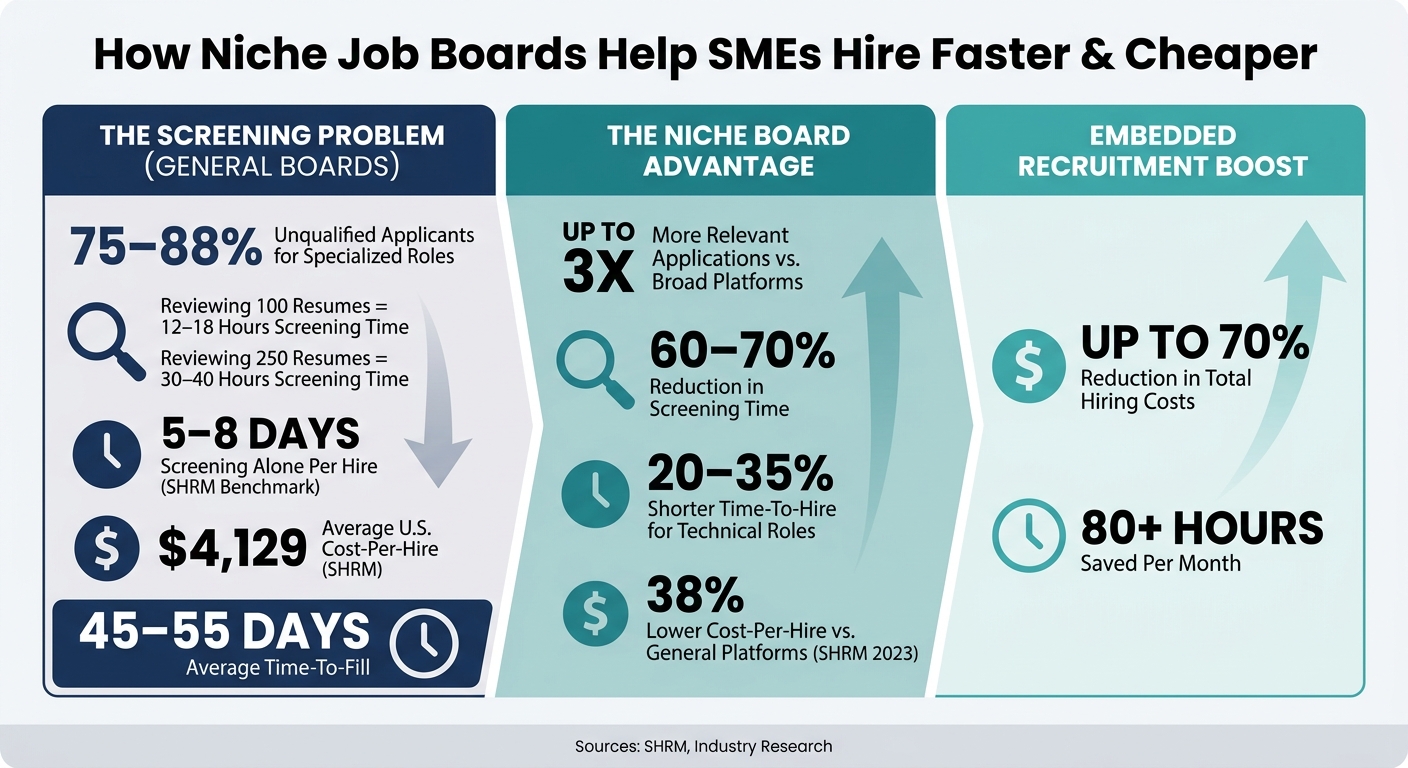
Research shows 75% to 88% of applicants for specialized roles are unqualified, which means a team reviewing 100 resumes may only find 12 to 25 worth a second look [2][6]. That sounds frustrating because it is. Your team can spend hours working through a pile of applications and still come away with only a small shortlist.
The time cost adds up fast. Screening 100 resumes can take 12 to 18 hours. At 250 resumes, that climbs to 30 to 40 hours before interviews even start [11]. SHRM also benchmarks screening at 5 to 8 days per hire [12]. That is before interview rounds, stakeholder feedback, or offer management enter the picture.
For a lean team running several open roles at once, this becomes a serious drag on hiring speed. One role gets delayed, then another, and soon your managers are waiting while work piles up. In that kind of setup, targeted sourcing beats volume. More applications do not help if most of them are the wrong fit.
Specialized roles need targeted visibility
Specialized hiring is a different game. Roles in software engineering, data analytics, product management, compliance, and technical sales all face the same issue: the qualified talent pool is small and selective. These people do not respond well to bland job ads or broad messaging. They look for role-specific language, clear skill requirements, and context that shows you understand the job.
On broad platforms, SME job posts sit beside high-volume enterprise listings and paid placements from known brands. A U.S. SME hiring a data engineer may appear next to openings from major tech firms. That makes it harder to get in front of the right people and often leads to fewer relevant applicants, which then forces more outbound sourcing to close the gap [3][5][7][4].
For SMEs, the issue is not reach alone. It is reaching the right people before your team burns time on the wrong ones.
SHRM recommends niche job boards for hard-to-fill roles and specialized positions because they help employers cut through the clutter of general marketplaces [10][8]. For hiring leaders, that matters because better channel fit can mean less screening time, fewer delays, and lower spend per hire.
Small teams need hiring channels that scale without agency-level costs
In many SMEs, hiring as you scale sits on top of everything else. A single HR generalist may be handling payroll, benefits, compliance, and recruitment at the same time. Then three or four specialist roles open at once, maybe a product manager, two engineers, and a compliance lead. Suddenly, that same person is expected to write job ads, screen candidates, schedule interviews, and keep communication moving across every process [3][4][7].
That is where the model starts to crack. Internal capacity gets stretched, hiring slows down, and managers lose time chasing updates instead of running their teams.
Cost-per-hire also becomes harder to ignore when several specialist roles open together. SHRM puts the average U.S. cost-per-hire at $4,129 [13]. Add agency fees on top of that, and repeated specialist hiring can put real pressure on an SME budget. Across several open roles, the spend builds fast and can turn into a budget issue long before the hiring plan is complete.
That is why SMEs need hiring channels that cut both screening time and spend. If a channel helps you reach better-fit talent earlier, your team spends less time sorting through poor matches and less money fixing a slow process later.
sbb-itb-a23bd6a
How niche job boards help SMEs hire faster
Once you pick the right channel, hiring speed tends to improve fast. For SMEs, niche job boards cut through the noise and put your role in front of people who are already much closer to the brief. That gives you a shorter path from job post to shortlist.
Targeted talent pools improve applicant quality
Candidates who visit a niche board are usually looking for roles that match their background. They start closer to your requirements from the first click. That matters when your team doesn’t have hours to burn on poor-fit applications.
Research supports this. Niche boards can generate up to 3x more relevant applications than broad platforms and can cut screening time by 60 to 70% by reducing irrelevant applications. [1][15] For lean hiring teams, that drop in early-stage filtering can save serious time and keep hiring moving.
Better applicant fit shortens time-to-hire
When more of your applicants fit the role, every stage of the funnel gets tighter. Screening moves faster. Shortlists come together sooner. Interview rounds stay focused on fit, not basic qualification checks.
Industry analysis shows organisations filling technical roles 20 to 35% faster when using niche platforms, compared with average fill times of 45 to 55 days on general boards. [14] For scaling companies in SaaS, Technology, IT, Fintech, Engineering, Security, Insurance, and Professional Services, that kind of time saving has a direct business effect. Open roles stay vacant for less time, hiring teams spend fewer hours chasing weak leads, and delivery pressure is easier to manage.
Better fit also lowers offer drop-off and cuts restart risk. [16]
Focused visibility improves ROI for SME hiring teams
On a broad job board, your post competes with enterprise vacancies, sponsored listings, and employers with much deeper ad budgets. On a niche board, you get more visibility with the right audience without paying for premium placement. [8]
That changes the economics of sourcing. One 2023 SHRM benchmark found 38% lower cost-per-hire for employers using niche boards compared with those relying mainly on general platforms. [9] If you’re managing a tight hiring budget across several open roles, that matters. Every sourcing dollar should bring in qualified applicants, not generic traffic.
The next step is turning that visibility into a repeatable hiring process.
How to use niche job boards as a repeatable hiring channel
Treat niche job boards as a repeatable hiring channel, not something you try only when hiring slows down.
Choose boards based on role, sector, and U.S. hiring location
Use three filters: role, sector, and location.
If you’re a SaaS company hiring a senior Product Manager in Austin, you need a board with strong U.S. tech and product traffic. If you’re hiring a compliance lead in fintech, you need a board that attracts people who know U.S. regulatory requirements.
Location matters just as much. Remote, hybrid, and on-site roles need different positioning. A fully remote engineering job should appear on boards that let you target U.S.-based remote talent. A hybrid role in Denver needs reach in that local market. Start with 2 to 3 boards per role family and track which ones lead to qualified interviews.[9]
Once you’ve picked the right boards, the next step is simple: write the ad for the people you want to reach.
Write job ads for specialist audiences to improve conversion
Specialist candidates don’t read every line. They scan for tools, scope, and pay first.
For U.S. hiring, use clear industry language, state the work model up front, and spell out the requirements that matter most. Keep the ad focused. Use 5 to 7 outcome-based bullets. Be explicit about technical requirements. Include a salary range in U.S. dollars, such as $120,000 to $145,000 base, plus equity, because pay transparency lifts conversion and cuts drop-off from strong-fit candidates.[19]
Keep the application short and mobile-friendly. In most cases, you only need:
- Name
- Contact details
- A resume or LinkedIn profile
- 3 to 5 role-specific questions
That small change can save time on both sides and help you get more finished applications from the right people.
Track the metrics that show speed and cost impact
If you want this channel to work again and again, you need to measure which boards lead to qualified interviews and faster hires.
Track:
- Time-to-hire
- Qualified applicants per posting
- Application-to-interview ratio
- Interview-to-offer ratio
- Source of hire
- Cost-per-hire[17][18]
Tag every candidate by source so you can compare board performance side by side. Then cut the boards that don’t produce qualified interviews.
Review results by role type, not just in aggregate, or rate your recruitment process to identify further efficiency gaps. A board that works for engineering may fall flat for insurance operations or professional services. That’s where the commercial value shows up. You spend less, waste less recruiter time, and keep your team focused on channels that produce hiring outcomes.
Combining niche job boards with embedded recruitment support
Once you know which niche boards bring in qualified candidates, the next issue is execution.
For many growth-stage SMEs, the problem is simple: there just aren’t enough hours in the day to screen applicants, schedule interviews, and keep track of pipeline health across several open roles at the same time. The pressure isn’t only about finding people. It’s about running the process well, every single week.
That’s where embedded recruitment comes in.
How embedded recruiters turn niche sourcing into a repeatable system
Embedded recruiters turn niche sourcing from a one-off effort into a managed hiring system.
An embedded recruiter works inside your team, using your tools, ATS, employer brand, and communication channels. They handle sourcing, screening, interviews, and reporting from within your business. That means faster, more consistent execution across every open role.
They also bring structure to the process. Intake is standardised for each role. The same screening criteria is applied across every applicant. Source data is tracked, so you can see which boards are leading to qualified interviews and which ones are wasting budget.
Over time, your team keeps that process knowledge. So you’re not just filling roles, you’re building a hiring function with talent acquisition strategies that make it easier to run.
Where Rent a Recruiter fits for scaling companies
Rent a Recruiter uses this embedded model for high-growth SMEs that need hiring support straight away. Their embedded recruiters work inside your team and can be integrated within days, helping with roles in technology, SaaS, fintech, engineering, and professional services. [20]
Fixed monthly pricing keeps costs predictable. [20] Companies can cut hiring costs by up to 70% and save more than 80 hours a month. [20] If you’re already spending on niche job boards, that mix can help you get more from that spend.
Put plainly, you don’t just get more candidates. You get more control over how hiring runs as demand grows.
Conclusion: Faster hiring starts with better targeting and stronger hiring capacity
Specialized roles aren’t filled faster by putting your ad in front of more people. They’re filled faster by getting in front of the right people.
That’s the problem with broad job platforms. They can drive volume, but for a lean SME team, volume without fit just creates more screening work. You spend hours reviewing applicants who were never right for the role in the first place. Niche job boards reduce that drag by putting your roles in front of people who already know the job, the sector, and what’s expected.
Employers using niche boards report 38% lower cost-per-hire than those relying mainly on general platforms [9]. For SMEs dealing with long fill times, that kind of gain matters.
Still, sourcing is only one part of the picture. Someone has to keep the process moving. Screening, scheduling, follow-up, and pipeline tracking all take time. If your team doesn’t have the bandwidth to run that well, even a strong applicant pool can slow to a crawl. That’s where embedded recruitment comes in. It turns sourcing into a hiring process you can run with more control and less delay.
If your hiring team is stretched, embedded support helps keep roles moving. If you’re a growth-stage SME paying for job boards but not getting the speed or quality you need, start here: audit which roles are best suited to niche targeting, then compare your current time-to-hire and cost-per-hire with what a tighter sourcing approach could produce. If team capacity is the blocker, book a call with Rent a Recruiter to build a faster, more predictable hiring process.
FAQs
How do I choose the right niche job boards?
Start by identifying where your target talent gathers. For specialised roles in technology, engineering, or biotech, that usually means industry-specific forums, communities, and professional associations, not broad platforms that flood your team with poor-fit applicants.
The goal is simple: match the channel to the role.
Then track applicant-to-submit and offer acceptance rates. Those two numbers tell you far more than raw application volume ever will. A job board that sends 200 applicants but only 3 worth submitting wastes time and adds cost. A smaller channel that produces fewer applicants, but more people your hiring team actually wants to meet, is often the better bet.
Prioritise boards that consistently deliver strong-fit candidates, not just a high number of clicks or applications.
Which hiring metrics should I track first?
Start with the Big Four: cost per hire, time to fill, offer acceptance rate, and 90-day retention.
Together, they show four things that matter to the business: what hiring costs you, how fast you can fill roles, how strong your offer is in the market, and whether new hires stick.
Get those in place first. They give you a clean view of hiring performance without drowning your team in reporting.
Once those are running, add funnel metrics like source of hire and candidate conversion rates. That’s where you start to spot bottlenecks, cut wasted spend, and see which channels are actually paying off.
When does embedded recruitment make sense?
Embedded recruitment makes sense when your internal hiring capacity is stretched or you need to scale fast, like after funding, during product launches, or when seasonal hiring demand kicks in.
It’s a smart move when hiring delays are slowing the business, agency fees keep climbing, or resume screening and other admin work are eating up your team’s time. An embedded recruiter gives you flexible support at a lower fixed cost, while helping you hire faster with more structure and consistency.