
Writing job descriptions that attract diverse, qualified candidates is not just good practice – it’s smart business. Research shows that inclusive job descriptions can increase applications by over 30%, reduce screening times, and expand your talent pool. Yet, many companies unintentionally create barriers through biased language, unclear requirements, or inaccessible postings.
Here’s what you need to focus on:
- Language: Use gender-neutral terms, avoid jargon, and simplify phrasing to remove bias.
- Structure: Standardize sections, separate must-have from nice-to-have qualifications, and focus on measurable outcomes.
- Transparency: Include salary ranges, benefits, and clear application processes.
- Accessibility: Offer accommodations and ensure compliance with ADA standards.
Scaling companies can embed these practices into their hiring workflows for consistent results. Tools like Textio or embedded recruitment support can help you implement these changes seamlessly, saving time and improving hiring outcomes.
The result? A better candidate experience, stronger employer brand, and measurable hiring success.
7 Tips for Using Inclusive Language in Job Descriptions
sbb-itb-a23bd6a
Language and Tone Checklist
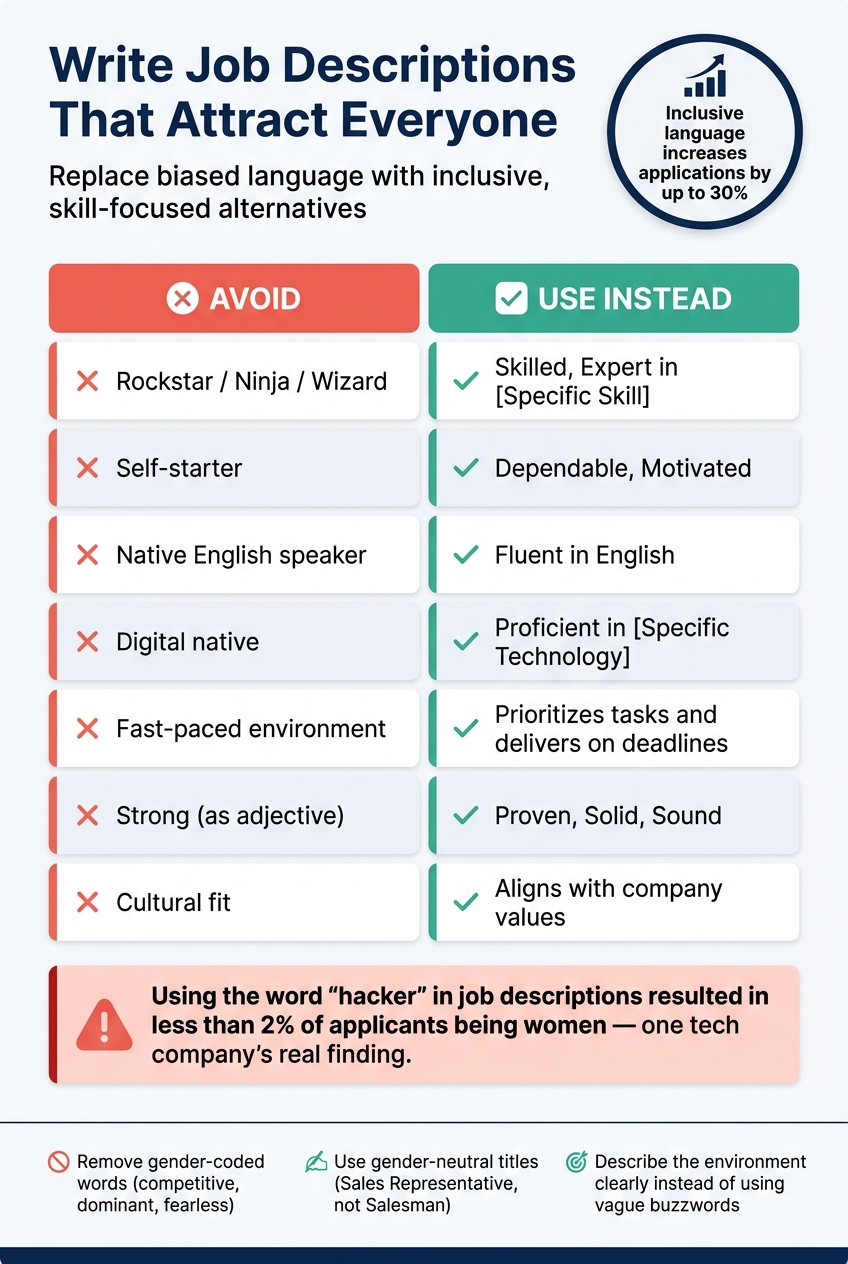
Inclusive vs. Exclusionary Job Description Language: Side-by-Side Guide
The words you use in a job description can have a profound impact on who feels encouraged to apply. Even small adjustments, like removing gender-coded terms, can increase applications by 29%-30% [6][3]. The checklist below helps you refine your language to create an inclusive and approachable tone, setting the stage for better-structured and more effective job postings.
Use Gender-Neutral Language
Opt for gender-neutral terms to ensure all candidates feel included. For example, replace "he/she" with "they" or directly address the candidate as "you." Statements like "You will manage a portfolio of accounts" remove gender implications and make the role more accessible [7]. Similarly, update job titles to be neutral: use "Sales Representative" instead of "Salesman", "Foreperson" instead of "Foreman", and "Chair" rather than "Chairman."
Remove Gender-Coded or Exclusionary Words
Some words carry unconscious biases that can deter diverse applicants. Terms like competitive, dominant, or fearless are often perceived as masculine-coded and may discourage women and non-binary candidates from applying. Striking a balance is essential.
"A job description is never going to be just a single word. It’s how you’re balancing some of that biased language throughout… to make sure that you’re getting to, in the end, a neutral tone." – Jessica Khoshnood, Senior Customer Marketing Manager, Textio [7]
Avoid trendy terms like "rockstar", "ninja", or "wizard." For example, one tech company discovered that using "hacker" in job descriptions resulted in less than 2% of applicants being women [8]. Instead, focus on precise, skills-based hiring language: "expert in Python" or "skilled at cross-functional collaboration" communicates value without alienating qualified candidates.
Simplify and Clarify Language
Jargon and unexplained acronyms can create barriers for candidates, especially those new to your industry. Instead of saying "leverage synergies", use straightforward descriptions of the role’s expectations. As Jessica Khoshnood explains: "Plain speech, really describing what you’re trying to say, is always going to get you further." [7]
Be mindful of ableist or age-coded terms. For instance, "digital native" suggests a preference for younger candidates, whereas "proficient in [specific platform]" is inclusive. Similarly, phrases like "fast-paced environment" or "high-pressure" can discourage neurodivergent candidates who thrive in structured settings. A better approach is to describe the work environment clearly: "Prioritizes tasks and communicates progress using project management tools." This kind of clarity sets the foundation for more structured content.
Use a Positive and Welcoming Tone
Focus on what candidates can achieve and contribute, rather than framing the role around challenges. Avoid extreme language like relentless, obsessed, or always-on, which may appeal to a narrow audience while excluding highly qualified candidates who value balance. Highlight measurable responsibilities and contributions to strike a professional yet inviting tone. This approach aligns with broader diversity and inclusion goals, which are explored further in upcoming sections.
| Avoid | Use |
|---|---|
| Rockstar / Ninja / Wizard | Skilled, Expert in [Specific Skill] |
| Self-starter | Dependable, Motivated |
| Native English speaker | Fluent in English |
| Digital native | Proficient in [Specific Technology] |
| Fast-paced environment | Prioritizes tasks and delivers on deadlines |
| Strong (as an adjective) | Proven, Solid, Sound |
| Cultural fit | Aligns with company values |
Structure and Content Checklist
The way you structure a job description has a direct impact on who applies – and how confident they feel doing so. Research highlights a key disparity: women often apply only if they meet 100% of the requirements, while men tend to apply when they meet just 60% [9][5]. A well-organized job description can help bridge this gap and encourage more diverse applications. Below are steps to create clear, effective job descriptions that align with earlier language and tone recommendations.
Write Clear and Specific Job Titles
Your job title sets the tone for the entire listing. It needs to be precise, industry-standard, and easy to find in search results. For example, "Senior Project Manager" is far more effective than "Project Lead", as it clearly communicates the role’s seniority and function. Ambiguous titles can confuse candidates, especially those from different industries.
"Using terms like this [Marketing Hero or Design Rockstar] can deter candidates from applying as it’s empty terminology and quite often associated with a negative workplace." – Areej AbuAli, Founder, Women in Tech SEO [9]
Avoid quirky or unclear titles like "Tech Ninja." Instead, opt for straightforward ones like "Software Engineer" that clearly define the role and improve search visibility.
Beyond the title, ensure the job description outlines clear, measurable expectations for the role.
Write Action-Oriented Responsibilities
When detailing responsibilities, focus on measurable outcomes. A section titled "How You’ll Make an Impact" can outline what success looks like within the first 90 days, making the role’s expectations more tangible [10][5]. Start each responsibility with strong action verbs like leads, manages, builds, coordinates, or delivers. This approach shifts the focus from vague duties to meaningful contributions.
By framing responsibilities as outcomes rather than prescribing behaviours, you reduce bias and keep the focus on skills and results.
Standardize Job Description Sections
Consistency across job postings isn’t just about convenience – it’s about fairness. For instance, including salary details in some listings but not others creates unequal access to information. A standardized template ensures all candidates have the same clarity, while also streamlining the screening process for recruiters. For more tools, explore our recruitment resources.
"A clear and comprehensive job description will not only set expectations for the role’s responsibilities, but also support fairness in hiring and performance evaluations, contributing to a culture of transparency and trust." – Carmen Amador Barreiro, People Builders Community Lead, Oyster [1]
Here’s a template to ensure consistency across all job postings:
| Section | Purpose |
|---|---|
| Job Title | Ensure clarity and searchability with standard, recognizable terms [9] |
| Job Overview | Provide a concise summary to align candidate expectations [10] |
| Impact / Responsibilities | Highlight outcome-focused duties using action-oriented language [10][5] |
| Key Competencies | Clearly separate must-haves from nice-to-haves [10][2] |
| Salary & Benefits | Promote transparency and help reduce wage gaps [10][4] |
| Application Process | Outline each step so candidates know what to expect [10][9] |
Using a consistent structure not only improves clarity for candidates but also helps recruiters focus on assessing fit rather than deciphering unstructured information [4].
Requirements and Selection Criteria Checklist
Creating a clear and structured requirements section in your job descriptions is essential for reducing bias and attracting a broader range of candidates. This section often hides unintentional barriers, particularly for underrepresented groups who may hesitate to apply unless they meet every listed qualification [5][11]. Refining this part of your job description can significantly impact your hiring outcomes.
Separate Must-Have from Nice-to-Have Qualifications
Limit your "Required Skills" list to 3–5 absolute essentials. Here’s a simple way to decide: if removing a requirement wouldn’t fundamentally alter the role or lead to serious issues, it should go under "Preferred Qualifications" instead [2]. Focus only on qualifications that are truly critical to the job.
"Writing inclusive job descriptions isn’t just a ‘nice to have’ or a box-checking exercise. It is a strategic business move." – Brittany Knowles, CareerCircle [2]
This distinction can broaden your candidate pool without compromising on quality. By clearly separating must-haves from nice-to-haves, you make the hiring process fairer and more inclusive.
Focus on Skills Over Proxies
After identifying essential qualifications, prioritise skills over traditional proxies like degrees. Degree requirements often fail to directly measure the competencies needed for the job. As of 2025, 85% of employers report adopting skills-based hiring, and 71% agree that skills assessments are more reliable predictors of success than resume reviews [11].
Instead of listing "Bachelor’s degree required", specify the actual skill or experience you need, such as "Experience managing cross-functional teams across time zones." Reserve degree requirements for roles where they are legally necessary, like medicine or law [2]. This shift not only widens your talent pool but also leads to hires who often stay longer and perform better in their first year [2].
Remove Biased Filters
Some seemingly neutral requirements may unintentionally exclude certain groups. For example, phrases like "thrives in a fast-paced environment" can deter candidates who excel in structured settings. Instead, focus on the specific demands of the role [5][2]. Similarly, physical requirements like "must lift 30 lbs" can be reframed as "moves items between locations" to ensure inclusivity and compliance with ADA standards [2].
Specialised certifications for software that aren’t directly relevant to the job can also act as unnecessary barriers. Always evaluate whether these filters are genuinely essential or if they exclude qualified candidates.
| Criteria Type | When It Qualifies | Examples to Reconsider |
|---|---|---|
| Must-Have (Essential) | Role exists to perform this function; significant impact if unmet | "B2B sales experience", "Ability to manage projects end-to-end" |
| Nice-to-Have (Marginal) | Performed infrequently; can be reassigned; supports but doesn’t define the role | "Specific software certifications", "Infrequent travel", "Physical lifting requirements" |
Accessibility, Transparency, and Inclusion Signals Checklist
Creating an inclusive job description goes beyond just the wording. It’s about showing candidates that your organization is authentic in its commitment to accessibility, transparency, and inclusion. By addressing these areas, you can demonstrate that your workplace is genuinely welcoming – not just ticking boxes.
Include Salary Ranges and Benefits Information
Posting a salary range isn’t just about compliance – it’s about respect. States like California, Colorado, New York, Washington, and Illinois now require salary disclosure in job ads as of 2026 [14]. But even where it’s not legally mandated, withholding this information can damage trust with candidates.
"Stating the salary range upfront… shows respect for the candidate’s time and attracts people who know their worth." – Jasmine Makkar, Marketing Professional [5]
Alongside salary, outline your benefits package. Highlight key perks like remote or hybrid options, flexible hours, health insurance, or other role-specific benefits. This transparency allows candidates to assess if the role aligns with their needs and shows that your company values diverse lifestyles and priorities [1][15].
Being upfront about pay and perks is just one part of building trust. Reinforcing your commitment to diversity and inclusion is equally important.
Add Equal Opportunity and DEI Statements
While an Equal Employment Opportunity (EEO) tagline is a legal requirement, it’s the personal touch that resonates. A short, thoughtful statement about your company’s commitment to diversity can make all the difference. Candidates can quickly spot generic, copy-paste language, so make it count. Your job description should reflect the same inclusive tone and values highlighted earlier in the posting.
"Job descriptions set the tone for your organization’s culture by signaling your company values and priorities to potential candidates." – Carmen Amador Barreiro, Organizational and Business Psychologist [1]
Instead of tacking on a vague DEI statement, connect it to your values. A phrase like, “We actively encourage applications from people of all backgrounds, identities, and experiences,” is straightforward and impactful. Avoid corporate jargon that feels empty or insincere [1][12]. For more recruitment tips and resources, consider joining an industry community.
This clear expression of your values lays the groundwork for accessibility commitments.
Provide Reasonable Accommodations Information
Including an accommodations statement is essential – not just for ADA compliance but to show genuine support for neurodivergent candidates, individuals with disabilities, and veterans [2][13].
"Building in accessibility can serve as a welcome mat for individuals with disabilities and also reduce the need for accommodations." – Job Accommodation Network (JAN) [13]
Make the process for requesting accommodations simple and stress-free. Offer multiple ways to get in touch – email, phone, or text – and communicate interview details at least 48 hours in advance. Ensure your application portal is accessible to everyone [13][15].
Using This Checklist at Scale
A checklist is only effective if it becomes a consistent part of your hiring process – not just something you use occasionally. As hiring demands grow, the gap between good intentions and actual implementation can widen. The best way to close that gap is to embed inclusive practices directly into your workflows, making them a natural part of the process rather than an afterthought.
Build the Checklist into Your Hiring Process
To make the checklist a seamless part of your hiring, integrate it directly into your Applicant Tracking System (ATS). Instead of treating it as a standalone document, convert it into a standardized job description template. This ensures every new role includes key prompts for inclusivity, such as:
- Gender-neutral language
- Clear distinctions between must-have and nice-to-have qualifications
- A field for accommodations statements
- Salary range input fields [1][16]
For added consistency, consider using tools like Textio or Gender Decoder. These AI-powered platforms can automatically flag biased language, helping your team maintain a consistent approach across all job postings [1][16].
Run Regular DEI Audits on Job Descriptions
Creating inclusive job descriptions is just the beginning. To stay effective, you need to regularly audit your recruitment process and update them. Language evolves, company priorities shift, and legal requirements change. For instance, by 2025, 15 U.S. states and Washington, D.C. required salary disclosure in job postings [11].
Track candidate drop-off rates by protected group at different hiring stages – Applied, Screened, First Interview, Final Interview, and Offer. If you notice patterns where diverse candidates exit the process, dig deeper. It might not just be the job description; the issue could lie in the later stages of your hiring process. The EEOC reported 88,531 discrimination charges in FY 2024, marking a 9.2% increase from the previous year. This highlights the importance of proactive audits to ensure inclusivity at every step [11].
Use Recruitment Support to Apply the Checklist Consistently
Even with templates and tools, maintaining consistency can be challenging, especially when your team is stretched thin. This is where embedded recruitment support can make a real difference. A dedicated recruiter working as part of your team can take full ownership of the job description process – ensuring the checklist is applied consistently across all roles, departments, and locations.
With Rent a Recruiter, you get exactly that. Their embedded recruiters integrate into your team to bring structure and consistency to your hiring. For companies experiencing rapid growth and managing a surge in open roles, this approach ensures inclusive hiring practices are applied from the start, across every job posting.
"Writing thoughtful, inclusive job descriptions isn’t just about compliance; it’s a strategic move to build a more innovative and effective team." – HireZapp [5]
Conclusion
Inclusive job descriptions are more than just a good practice – they’re a smart business move. Done right, they help you attract a broader pool of qualified candidates, simplify the screening process, and build a strong employer brand from the very beginning. This is a critical component of hiring as you scale, where maintaining quality and culture becomes increasingly complex.
Here’s the reality: while 72% of managers think their job descriptions hit the mark, only 36% of candidates agree [17]. That gap highlights the importance of refining your approach. When job descriptions focus on skills and inclusivity, companies see longer employee tenure and lower first-year turnover [2], giving them a clear edge in scaling efficiently. Plus, staying compliant with federal standards like ADA and OFCCP requirements reduces risks as your business grows.
FAQs
How do I spot biased words in a job description?
When crafting job descriptions, watch out for words or phrases that might unintentionally exclude potential candidates. Gendered terms like “rockstar” or “ninja” can alienate applicants who don’t identify with those labels. Similarly, avoid age-specific language such as “recent graduate”, which could deter experienced professionals.
Be mindful of ableist language, too. Words like “type” or “speak” can imply physical requirements that may not actually be necessary for the role. Additionally, phrases like “native English speaker” can create unnecessary barriers for highly qualified individuals who are fluent but not native speakers.
To make your job descriptions more inclusive, ensure that physical abilities and qualifications are genuinely relevant to the role. Clearly distinguish between “required” and “preferred” skills so candidates can better assess their fit without being discouraged. This approach broadens your talent pool and promotes fairness.
What counts as a must-have vs. nice-to-have requirement?
Must-haves are the qualifications and skills a candidate needs to hit the ground running. These are the non-negotiables – think of them as the core requirements for someone to perform the role effectively from day one. To pinpoint these, ask yourself: Did the best hire for a similar role absolutely need this skill? Or, Could this be learned within three months on the job?
On the other hand, nice-to-haves are the extras. These are skills or experiences that might elevate a candidate’s performance but aren’t critical to their success in the role.
By clearly separating these two categories, you not only streamline the hiring process but also create a more inclusive job description. This approach encourages a broader range of candidates to apply, including those who might be an excellent fit but lack some of the "nice-to-have" extras.
What should an accommodations statement include?
An effective accommodations statement should clearly communicate your organization’s commitment to supporting qualified applicants and employees with disabilities. Be sure to include a designated contact person or department along with multiple ways to get in touch, such as an email address, phone number, or TTY. Make this information easy to find by prominently displaying it on your careers page and within your online application system, ensuring accessibility for all candidates.