Hiring the right people can make or break your business growth. But should you build an internal team or rely on external recruitment partners?
Here’s the bottom line: In-house recruiting works well for steady, predictable hiring needs and maintaining alignment with your company’s values. Outsourced recruitment excels when you need speed, specialized talent, or the ability to scale hiring without long-term costs.
Key Takeaways:
- Cost: In-house teams come with fixed overheads (salaries, tools, office space). Outsourced models like RPO or Recruitment-as-a-Service (RaaS) have variable costs, saving up to 71% compared to contingent agencies.
- Control: In-house teams offer full ownership of the hiring process, while external providers bring expertise and access to global talent pools.
- Scalability: Outsourced recruitment is ideal for handling hiring spikes or niche roles. In-house teams often struggle when demand fluctuates.
- Speed: External providers can cut time-to-hire by up to 40%, but in-house teams ensure direct communication and alignment with internal priorities.
Comparing Different Recruitment Models:
| Factor | In-House Recruiting | Outsourced Recruitment (RPO/RaaS) |
|---|---|---|
| Cost Structure | Fixed (salaries, tools, overhead) | Variable (monthly fees or per hire) |
| Best For | Steady, repeatable roles | High-growth, technical, or niche roles |
| Time-to-Hire | ~44 days | Up to 40% faster |
| Scalability | Limited by internal capacity | High, on-demand support |
| Talent Pool | Local or known networks | Global, includes passive candidates |
For most scaling companies, a hybrid approach works best. Use internal teams for consistent hiring and brand alignment. Turn to external providers for speed, specialized roles, or when hiring volumes surge. The right balance depends on your growth stage, hiring needs, and budget priorities.
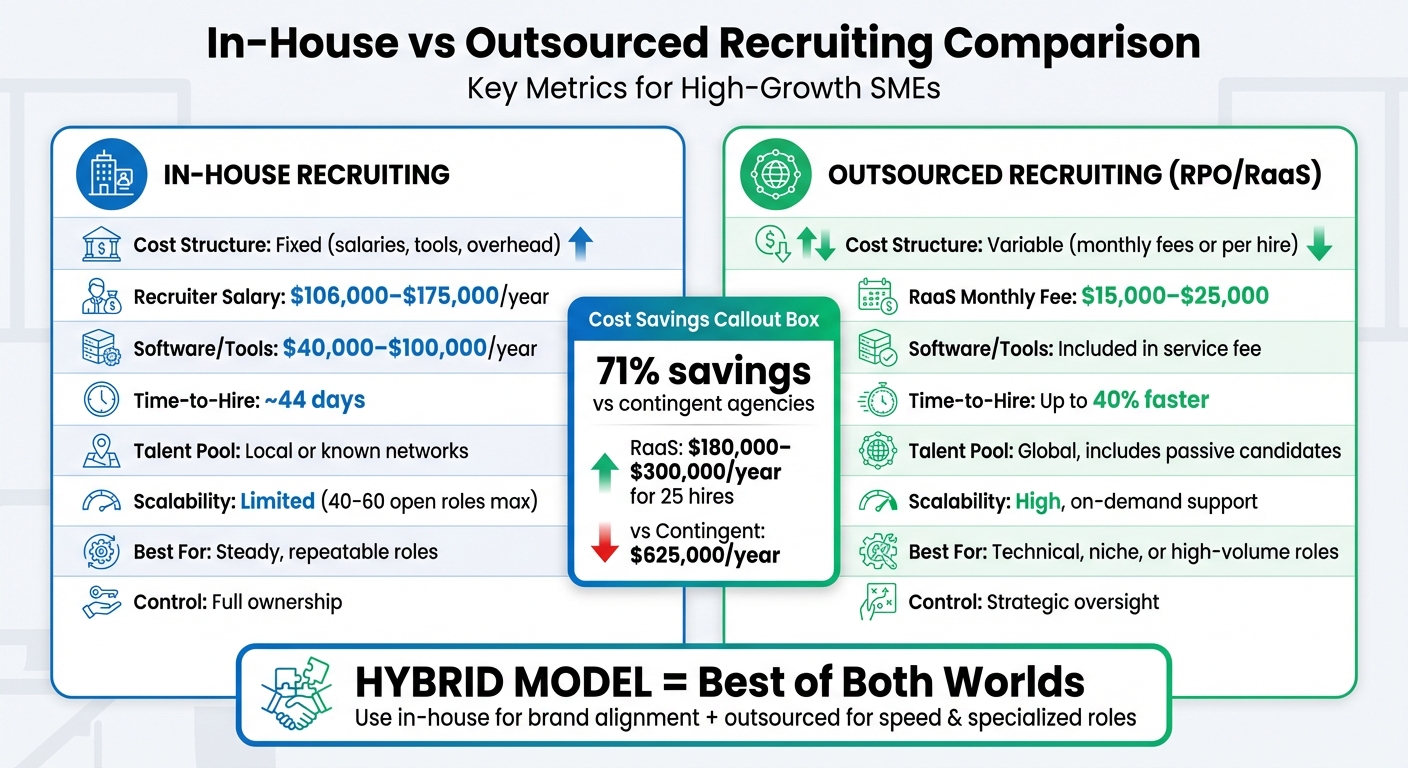
In-House vs Outsourced Recruiting: Cost, Speed, and Scalability Comparison
Should You Outsource or Keep It In-House? Pros, Cons & Real Talk – The Daily Dose | Ep665
sbb-itb-a23bd6a
Cost Comparison: Fixed vs Variable Recruiting Expenses
Building an in-house recruiting team means committing to fixed costs, regardless of how much hiring you actually do. These costs include recruiter salaries, which range from $106,000 to $175,000 per year, recruitment software expenses between $40,000 and $100,000 annually, and additional outlays for office space, equipment, and training [6].
Outsourced recruitment flips this model. Instead of paying fixed salaries, you incur variable costs based on your hiring activity. Contingent agencies charge 20% to 30% of a candidate’s first-year salary [6], while Recruitment-as-a-Service (RaaS) providers offer flat monthly fees ranging from $15,000 to $25,000 [6]. These models ensure you’re not paying for unused resources during hiring slowdowns. This shift in cost structure opens the door to significant savings and a closer look at hidden expenses.
The numbers speak for themselves. Let’s say you’re hiring 25 people in a year, each earning an average salary of $100,000. Using contingent agencies, your annual recruiting costs would hit $625,000. An in-house team with two recruiters and the necessary tools would cost between $262,000 and $475,000. In contrast, a RaaS model would cost only $180,000 to $300,000 – a potential savings of up to 71% compared to contingent agencies [6].
"Most companies hemorrhage 40-60% more on recruiting than necessary because they’ve never run the real numbers" [6].
Joel Carias, Founder & CEO of Alivio Search Partners, highlights how hidden costs can further erode your budget. A single bad hire can set you back $124,000 [6]. And leaving a revenue-generating role like an Account Executive vacant for just four weeks could cost your business $60,000 in pipeline losses [6].
Overhead Costs and Savings Breakdown
The financial picture becomes even clearer when you break down the overhead. In-house teams come with underestimated costs, including not only salaries but also management time, software subscriptions, and the hours hiring managers spend on interviews. For instance, the time spent interviewing alone can cost $540 to $1,080 per hire [6]. Outsourced models, on the other hand, bundle these expenses into their fees, simplifying costs and management.
| Cost Category | In-House Recruiting | Outsourced / RaaS |
|---|---|---|
| Primary Cost Structure | Fixed (Salaries & Benefits) | Variable (Monthly Fee or Per Hire) |
| Recruiter Salary | $106,000–$175,000 (including benefits) [6] | Included in service fee |
| Software/Tools | $40,000–$100,000/year (ATS, LinkedIn) [6] | Included in service fee |
| Office/Infrastructure | $10,000–$30,000 per employee/year [8] | $0 (Provider overhead) |
| Training/Certifications | ~$1,300 per employee/year [8] | $0 (Provider responsibility) |
| Scalability | Low (Hard to hire/fire internal staff) | High (Scale up/down with demand) |
This breakdown highlights how outsourced models provide flexibility that fixed-cost in-house teams can’t match. During hiring spikes or slow periods, outsourced recruitment adapts to your needs. In-house teams, however, remain a fixed expense in a variable-demand environment [6]. With RaaS or contingent models, you only pay when actively hiring, making your recruiting budget more predictable and better aligned with your business goals.
Control and Quality: Internal Alignment vs External Expertise
After diving into cost considerations, let’s shift gears to examine how control and quality differ between in-house and outsourced recruitment models.
When you opt for an in-house recruiting team, you take full ownership of your hiring process. This means your employer brand and candidate experience are entirely within your control. Internal recruiters are deeply embedded in your organization, aligning closely with your company’s culture. This integration allows for a more tailored selection process, ensuring new hires not only meet skill requirements but also contribute positively to your workplace environment. And it’s not just a nice-to-have – 77% of job seekers prioritize company culture when deciding where to apply [1].
On the other hand, outsourced recruitment providers bring a different kind of advantage: specialized expertise and access to wider talent pools. For roles that are highly technical, executive-level, or otherwise tough to fill, external partners can tap into global networks and advanced technologies. This can cut time-to-fill by up to 40%, with some roles being filled in under a month, while achieving up to 98% hiring accuracy [2].
The Trade-Offs
Each approach has its strengths and challenges. In-house teams are excellent for fostering cultural alignment and building long-term hiring strategies, but they often operate within limited local markets and existing networks [1][3]. Meanwhile, external recruiters leverage cutting-edge tools – like AI-driven applicant tracking systems – and broader reach, which can be especially beneficial for small-to-medium enterprises that may lack the resources to implement such technologies on their own [2]. The key challenge? Ensuring external recruiters represent your company values accurately.
"In-house recruiters are often better positioned to assess cultural fit, which is critical for retention." – Escalon [9]
Getting it wrong can be a costly mistake. A bad hire could cost up to five times the employee’s annual salary when you factor in recruitment expenses, training, and lost productivity [9]. To mitigate these risks, structured interviews and clear evaluation scorecards are essential [9]. Many high-growth companies are finding success with hybrid talent acquisition strategies: internal recruiters focus on brand alignment and final hiring decisions, while external partners handle high-volume sourcing and initial screening [9].
Advantages and Disadvantages of Each Model
To further clarify how these models stack up, here’s a side-by-side look at their benefits and limitations:
| Feature | In-House Recruiting | Outsourced Recruiting (RPO) |
|---|---|---|
| Cultural Alignment | High – recruiters live the company values daily [1] | Variable – requires extra effort to ensure alignment [1] |
| Talent Pool | Often limited to local markets or known networks [1][3] | Access to global talent pools and niche networks [1][3] |
| Speed | Slower; average 44 days to fill a role [1] | Faster; can often provide qualified candidates in days [1] |
| Expertise | Generalist knowledge across all departments [3] | Deep specialization in niches (e.g., Tech, IT, Marketing) [3] |
| Control | Full control over brand voice and candidate experience [9] | Strategic oversight remains with the client, but execution is delegated [3] |
| Technology | May lack budget for advanced AI tools | Uses latest recruitment tech and data analytics [2] |
| Best For | Steady, repeatable, non-niche roles | Technical, executive, or high-growth spikes [2] |
Each model offers distinct advantages, and the right choice depends on your company’s unique hiring needs and growth stage. Balancing cultural fit, speed, and access to talent is the key to making the best decision.
Scalability and Flexibility: Steady Teams vs On-Demand Support
In a high-growth environment, scalability isn’t just a nice-to-have – it’s essential. In-house recruiting teams often face capacity limits, with most internal recruiters managing only 40–60 open roles effectively [11]. Once this threshold is crossed, quality takes a hit. Screening becomes rushed, and time-to-fill can drag beyond 60 days [12].
Scaling an internal team isn’t quick or easy. You’re looking at weeks or months to hire, onboard, and train new recruiters. And while you’re building that capacity, fixed costs like salaries, benefits, and software subscriptions keep piling up, regardless of whether you’re hiring five people or fifty. This creates financial risk during slower hiring periods [10].
"Internal TA teams break on capacity, not capability: Strong recruiters become bottlenecks when the system around them doesn’t scale." – Workfully [11]
Outsourced solutions, like Rent a Recruiter, tackle this differently. They offer on-demand capacity – scaling up when hiring spikes and scaling down when things slow. No need to commit to permanent staff. This burst-capacity model lets you ramp up sourcing and screening efforts quickly and efficiently [4][10].
Managing Hiring Spikes and Long-Term Requirements
For high-growth SMEs, recruitment needs can be unpredictable. Whether you’re scaling after securing funding, launching a new product, or entering new markets, hiring volumes can surge unexpectedly. In-house teams, often optimized for steady hiring, may struggle to adapt quickly.
This is where on-demand models shine. Instead of scrambling to expand your internal team, you can bring in external support exactly when you need it. It’s a game-changer for handling temporary spikes, filling unexpected vacancies, or hiring in new geographic regions where your team lacks local connections [4]. Companies using this approach often cut hiring costs by up to 70% compared to traditional commission-based agencies and save over 80 hours per month in administrative tasks.
For long-term scalability, a hybrid model often works best. Let your internal team focus on strategic priorities like employer branding, cultural alignment, and final hiring decisions. Meanwhile, external partners can handle high-volume tasks such as sourcing, initial screening, and coordinating interviews during busy periods. This strategy balances the control of an internal team with the flexibility of external support – allowing you to scale without adding permanent overhead.
Speed and Efficiency: Response Times vs Network Reach
In-house recruiting teams shine when it comes to direct communication. Their ability to provide immediate feedback helps them adapt quickly to changing candidate responses or shifting manager requirements. This agility can be a major advantage in dynamic hiring situations [7].
But speed isn’t just about communication. On average, in-house methods take around 44 days per hire [1]. In contrast, outsourced recruiting leverages pre-vetted talent pools, cutting time-to-hire by as much as 40% [7].
"In-house recruiters may take longer to fill positions due to their workload and internal processes because they could be also responsible for other areas of the company." – De Vore Recruiting [13]
The real game-changer, however, is network reach. In-house teams often focus on local candidates who are already familiar with the brand [1][9]. Outsourced recruiters, on the other hand, access global networks, including passive candidates who may not be actively job hunting [7]. This broader reach is critical in today’s market, where finding skilled candidates is one of the biggest challenges employers face [1]. For high-growth SMEs, tapping into these expanded networks is essential to keep up with rapid hiring demands.
Time-to-Hire and Candidate Reach Metrics
Here’s a breakdown of how in-house and outsourced recruiting compare across key metrics:
| Metric | In-House Recruiting | Outsourced Recruiting |
|---|---|---|
| Average Time-to-Hire | ~44 days [1] | Up to 40% faster (days to weeks) [7] |
| Candidate Reach | Local talent; active applicants [9] | Global reach; includes passive candidates [7] |
| Feedback Speed | Immediate internal feedback [7] | Subject to external process timelines [7] |
| Talent Pool Access | Limited to candidates aware of your brand [9] | Access to pre-vetted, specialized networks [7] |
| Scalability During Spikes | Limited by fixed capacity [7] | High, on-demand sourcing [9] |
For SMEs experiencing rapid growth, the decision often comes down to priorities. If maintaining control and ensuring strong alignment with your company’s culture are non-negotiable, optimising your in-house recruitment process is a solid option. But if speed and access to hard-to-find talent are top concerns, outsourced recruiting offers a way to dramatically reduce time-to-hire. And with 60% of job seekers dropping out of lengthy hiring processes [7], speed isn’t just a luxury – it’s a necessity.
When to Use Each Model for High-Growth SMEs
Choosing between in-house and outsourced recruitment comes down to your company’s growth stage, hiring patterns, and available resources.
For smaller, early-stage companies with fewer than 50 employees, outsourcing often makes more sense due to limited HR capacity [4]. On the other hand, as organizations grow – typically reaching 100 to 200 employees – internal teams often hit their limits. Most in-house recruiters can effectively handle 40 to 60 open roles before quality and efficiency start to decline [11].
"RPOs are great when you need to hire quickly or in large numbers, but keeping some hiring in-house helps with things like company culture and long-term planning." – Brittany Acosta, Senior Corporate Recruiter, SelectLeaders [5]
The complexity of the roles you’re hiring for also plays a big part. For high-volume, repeatable positions like sales or customer service, in-house teams can often manage well. But when it comes to executive roles, specialized technical positions, or jobs requiring deep industry connections, outsourced partners bring a clear advantage [4]. Similarly, if your company is expanding into new regions, external recruiters offer critical local expertise that internal teams may lack [11].
Decision Framework for Recruitment Models
Here’s a quick comparison to help guide your decision:
| Factor | In-House | Outsourced |
|---|---|---|
| Hiring Volume | Consistent and predictable | Irregular, seasonal, or burst hiring |
| Role Type | Repeatable or entry-level roles | Executive, technical, or niche roles |
| Urgency | Flexible timelines | Immediate hiring needs |
| Geographic Need | Centralized or local hiring | National or international talent searches |
| Budget Structure | Fixed, predictable overhead | Variable costs tied to results |
| Company Size | Medium to large (50+ employees) | Small to medium (under 50 or scaling fast) |
For many high-growth SMEs, a hybrid approach strikes the right balance. Keep your internal team focused on employer branding, cultural alignment, and routine hiring. Meanwhile, rely on external partners for sourcing specialized talent, managing hiring surges with recruitment on demand, and connecting with passive candidates. This way, you maintain control over your company’s culture while gaining the flexibility and reach to meet your growth goals.
Conclusion: Selecting the Right Recruitment Model
Choosing the right recruitment strategy is all about aligning it with where your business stands today and where it’s headed. In-house teams are great for maintaining alignment with your company’s values and culture when filling everyday roles. On the other hand, outsourcing becomes invaluable when speed, specialized skills, or the ability to scale quickly without adding permanent costs is critical.
As mentioned earlier, slow hiring cycles can hurt your bottom line – delaying product launches or stalling revenue growth. For high-growth SMEs, these delays can mean losing ground to competitors or missing key opportunities.
"What works best is not a one-size-fits-all solution but a strategic choice that aligns with your immediate needs and future goals." – Ann Kuss, CEO, Outstaff Your Team [3]
A hybrid approach often delivers the best of both worlds. It combines the cultural alignment and consistency of an in-house team with the agility and expertise of external partners. This balance allows internal HR to focus on employer branding and maintaining company culture, while external specialists tackle niche roles, engineering recruitment, or hiring needs across new regions.
FAQs
How do I know when to switch from outsourced recruiting to an in-house team?
Think about building an in-house recruiting team if your company faces steady, high-volume hiring demands, values aligning hires with your company culture, and wants to focus on long-term talent development. This approach works best when your internal team can handle the hiring process efficiently and sustain ongoing workflows.
That said, outsourcing can still be the right choice for occasional hiring spikes or when you need to scale quickly without overburdening your internal resources.
What should I track to compare in-house vs outsourced recruiting ROI?
To evaluate the return on investment (ROI) between in-house and outsourced recruiting, focus on tracking key metrics like cost per hire, time-to-fill, quality of hire, and retention rates. While in-house recruiting often integrates more seamlessly with your company’s culture, it can come with higher costs and limited scalability. On the other hand, outsourcing typically accelerates the hiring process and expands your access to talent pools. By consistently monitoring these KPIs, you’ll gain a clearer understanding of which approach drives better outcomes for your business.
How can I keep culture fit high when using an outsourced recruiter?
To ensure an outsourced recruiter aligns with your company’s culture, start by making your values, mission, and workplace environment crystal clear. This shared understanding is the foundation for finding candidates who truly fit.
Be specific about your expectations. Share detailed candidate profiles that highlight not just skills but the cultural traits you value most. Involve your internal team in interviews to add another layer of insight into whether a candidate will mesh well with your organization.
And don’t stop there. Regular feedback is key. This keeps your recruiter on the same page and ensures they’re consistently identifying candidates who will thrive in your environment.