
Diversity in hiring isn’t just a moral imperative – it’s a business advantage. Companies with strong ethnic diversity are 39% more likely to outperform competitors financially, and teams with diverse representation see over a 35% boost in productivity. Yet, many scaling businesses struggle to measure and improve diversity effectively in their recruitment processes.
Here’s the challenge: without tracking diversity metrics, you’re flying blind. You can’t fix what you can’t measure. From sourcing to retention, understanding where underrepresented candidates drop out of your hiring funnel is essential for building a stronger, more equitable workforce.
Key Takeaways:
- Track metrics at every hiring stage: Measure candidate pool diversity, interview advancement rates, and offer acceptance by demographic.
- Pinpoint bottlenecks: Identify where diverse candidates fall off – screening, interviews, or offer stages.
- Use the right tools: Leverage Applicant Tracking Systems (ATS) and diversity-focused platforms to automate data collection and reduce bias.
- Retention matters: Hiring diverse talent without retaining them signals deeper workplace issues.
Scaling companies need actionable data, not vague intentions. Rent a Recruiter’s embedded recruitment solutions can help you integrate diversity tracking into your hiring process while saving time and cutting costs. Ready to transform your hiring strategy? Let’s dive in.
Measuring The Impact of Diversity Hiring
sbb-itb-a23bd6a
Common Problems with Measuring Diversity Metrics
Even when businesses understand the importance of diversity metrics, gathering and analyzing the data can be a real headache – especially for growing SMEs. Recognizing these hurdles is crucial for creating a system that delivers meaningful insights.
Missing Starting Data and Unclear Definitions
Many companies hit a wall right at the start: they don’t have baseline demographic data to measure against. Without a clear picture of your current workforce or applicant pool, it’s impossible to gauge progress. It gets even trickier without a well-defined, localized understanding of what diversity means for your business goals [5][3].
For SMEs, small hiring volumes add another layer of difficulty. Unlike large companies with thousands of applicants, SMEs often lack the numbers needed to generate reliable percentages [5][6]. On top of that, privacy concerns make data collection more complex, requiring voluntary participation and strict compliance with regulations [3]. Michelle Stott, Head of Sales and Marketing at MAD-HR, highlights the stakes for smaller businesses:
"For small businesses in particular, hiring high-quality talent is crucial, as each employee can have a significant impact on overall performance" [4].
Without this foundational data, tracking diversity across recruitment stages becomes even more challenging.
Data Gaps Between Hiring Stages
Even when some diversity data is collected, inconsistent tracking across hiring stages creates blind spots. For example, you might know the demographics of your applicants, but if you’re not monitoring who moves from resume screening to interviews, you can’t pinpoint where diverse candidates drop out of the process. Similarly, failing to track offer acceptance rates by demographic can obscure issues like pay inequity or cultural barriers that may deter underrepresented groups. These gaps leave recruitment bias hidden [1][7].
Rod Danan, Founder of Prentus, explains:
"Without [metrics], bias is invisible. With them, organizations can identify exactly which stage of their process is losing diverse talent and make targeted improvements." [1]
Another issue arises when small sample sizes force companies to combine demographic groups into broad categories. Grouping all minority candidates together hides the unique challenges faced by different ethnicities or genders, making it harder to address specific disparities [8]. When combined with inconsistent tracking, limited resources only magnify these challenges.
Limited Budget and Tools
For SMEs, lack of access to the right technology is a major roadblock. Without advanced Applicant Tracking Systems (ATS), many rely on manual spreadsheets, which are not only error-prone but also make secure and compliant data collection more difficult [7][3]. As Dropboard points out:
"The right technology makes all the difference in running an efficient metrics program. A good Applicant Tracking System (ATS) should handle the heavy lifting of data collection and reporting" [7].
Budget constraints also limit SMEs’ ability to compete with larger companies that can afford specialised DEI software, consultants, and robust programs [9]. Over half of SMEs report recruitment as their biggest staffing challenge, with one in three struggling to fill roles [9]. This often results in incomplete or inconsistent data that fails to translate into actionable strategies [7].
Which Diversity Metrics to Track at Each Hiring Stage
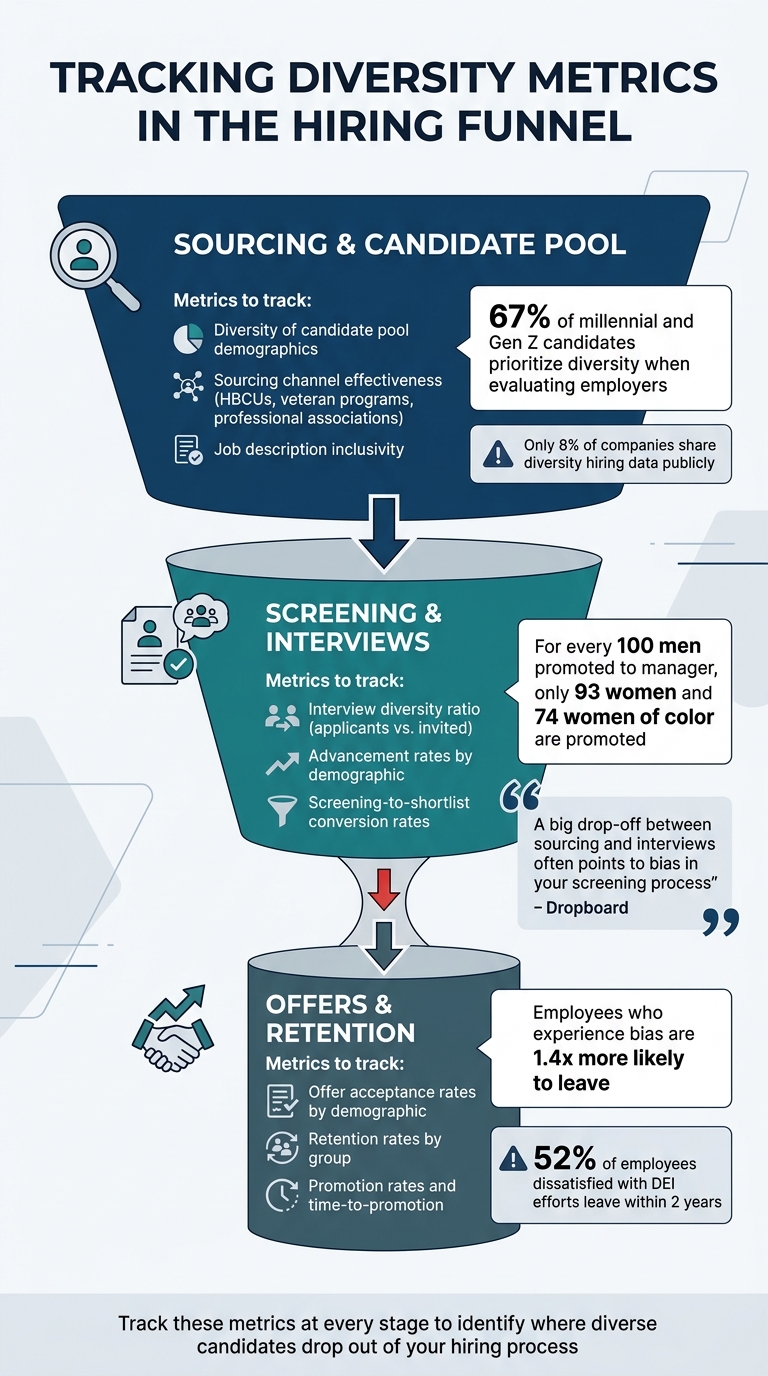
Complete Guide to Tracking Diversity Metrics Across the Hiring Funnel
To tackle diversity challenges in recruitment, it’s essential to measure the right metrics at every stage of the hiring process. This approach helps pinpoint where diverse candidates may drop off and highlights areas where your process is working well.
Sourcing and Candidate Pool Numbers
Start by assessing the diversity of your candidate pool. This baseline will show whether your outreach efforts are effectively engaging underrepresented groups. Pay attention to which sourcing channels – like partnerships with Historically Black Colleges and Universities (HBCUs), veteran programs, or professional associations – are bringing in diverse applicants. Additionally, review your job descriptions for inclusive language and ensure your commitment to diversity is clear.
Why does this matter? Research shows that 67% of millennial and Gen Z candidates prioritize diversity when evaluating employers, yet only 8% of companies share their diversity hiring data publicly [1][10]. By tracking these metrics, you can identify where your sourcing efforts might need improvement and prepare to address potential biases as candidates move through the process.
Screening and Interview Advancement Rates
Next, compare the demographics of applicants against those who are invited to interviews. This "interview diversity ratio" can help uncover whether bias creeps in during the screening stage. As Dropboard explains:
"A big drop-off between sourcing and interviews often points to bias in your screening process that needs fixing" [7].
For example, studies show that for every 100 men promoted to manager, only 93 women and 74 women of color are promoted [1][7]. Tracking who advances from initial screenings to shortlists or final interviews can reveal where representation falters. Tools like standardized scorecards and structured interviews can help ensure all candidates are assessed fairly and consistently.
Offer Acceptance and Retention Rates
Finally, focus on offer acceptance and retention rates by demographic group. These metrics can uncover whether certain groups are declining offers due to issues like compensation, benefits, or workplace concerns. Retention data also provides insight into whether your company fosters an inclusive environment. As Rod Danan, Founder of Prentus, puts it:
"Hiring diverse talent without retaining them is a red flag that points to deeper cultural or systemic issues" [1].
Retention challenges often tie back to workplace bias or barriers to advancement. For instance, employees who experience bias are 1.4 times more likely to leave, and 52% of employees dissatisfied with their company’s DEI efforts are more likely to leave within two years [1][7][11]. Tracking promotion rates and time-to-promotion by demographic can also shed light on "broken rungs" that hinder career growth for underrepresented groups.
How to Improve Your Diversity Metrics
Once you’ve identified your key metrics, the next step is refining your hiring process to close gaps in measurement and reduce bias.
Create Consistent Screening and Assessment Methods
Using structured interviews, blind resume screening, and diverse interview panels ensures candidates are evaluated objectively. These methods require every candidate to answer the same set of questions and be measured against standard criteria, reducing reliance on subjective judgments [7]. Blind resume screening, for example, removes identifying details like names, photos, or addresses, so hiring managers focus strictly on qualifications [3].
Sharing interview questions in advance can be particularly helpful for neurodiverse candidates who may need extra preparation time [3]. Additionally, rethink rigid screening criteria – such as specific GPA thresholds or overly narrow keyword searches – which can unintentionally exclude qualified candidates from diverse backgrounds [7]. As Dropboard aptly puts it:
"A quick hire isn’t necessarily a good hire if your practices are unintentionally screening out qualified candidates from diverse backgrounds" [7].
Incorporating technology into these processes can further standardize assessments and reduce bias.
Use Technology to Track Data and Reduce Bias
Technology plays a crucial role in both tracking diversity metrics and minimizing unconscious bias. Platforms like Lever, Greenhouse, and AI-driven tools such as SeekOut and Gem provide real-time dashboards to monitor diversity metrics at every stage of the hiring funnel, ensuring you can identify and address potential drop-offs immediately [12][13].
Bias reduction tools like Textio help craft inclusive job descriptions, while platforms such as HireVue monitor for bias during video interviews [13]. Tools like PMaps and HireHunch anonymize candidate data during blind screening, focusing evaluations purely on skills and behaviors [12].
Additionally, diversity-focused job boards can help connect you directly with underrepresented talent pools. For example, Jopwell links employers with Black, Latinx, and Native American professionals, PowerToFly emphasizes gender diversity, and PDN Recruits targets BIPOC talent [12][13]. Starting with a more diverse pipeline makes it easier to build representation throughout the hiring process.
By automating data tracking and using these tools, your recruitment team can shift their focus to embedding these insights into everyday practices.
Make Diversity Part of Your Recruitment Team’s Work
Tracking metrics is only effective if your recruitment team actively uses the data in their day-to-day activities. Incorporate tracking tools into their workflows to ensure accountability and reduce manual errors. Pay close attention to pass-through rates – for instance, how many underrepresented candidates move from screening to the first interview – to pinpoint where candidates may be dropping out.
Share diversity metrics regularly within your organization to highlight its importance alongside other business objectives. As Project Include notes:
"Measuring D&I will elevate it to the same status as other business priorities" [14].
Set clear, measurable goals, such as increasing leadership representation by 15% within 24 months, rather than vague aspirations [14].
Retention is just as critical as hiring. Conduct stay and exit interviews to understand why diverse employees stay or leave, and use these insights to refine your recruitment strategy. Regular pay equity audits can also reveal and address hidden disparities within specific roles or departments [6]. These actions create a sustainable system for measuring and improving diversity over time.
Building a Long-Term Diversity Measurement System
Once you’ve made strides in improving your processes, the next step is creating a system that ensures diversity efforts are maintained as your company grows. A one-time review won’t cut it. You need a system that embeds diversity tracking into your everyday operations.
Set Starting Points and Monitor Progress
Start by documenting your current metrics. This baseline will help you measure progress over time. Record data such as your Diversity Sourcing Ratio and Diversity Interview Ratio as they stand today [3]. Break this data down by department, job level, and function to uncover any hidden gaps [3][6].
Compare your internal metrics with benchmarks from the EEOC, industry standards, and local demographics to see how you stack up [1][3]. Regularly update your diversity dashboard – quarterly is a good starting point – to identify trends and adjust your hiring strategies accordingly [3]. Use visual tools like line graphs to track changes over time and bar charts to highlight differences across teams [3].
Let Data Shape Your Hiring Strategies
Use the insights from your diversity data to refine your recruitment approach. Examine conversion rates at every hiring stage – from resume screenings to final interviews – to pinpoint where diverse candidates are dropping out [3]. Set clear, measurable goals. For example, instead of vaguely aiming to "improve diversity", target specific outcomes, like increasing the percentage of women in leadership roles by 15% within two years [3]. As Project Include highlights:
“Measuring D&I will elevate it to the same status as other business priorities. This prioritization will make sure it’s approached with the same sort of rigor” [14].
Regular pay equity audits are another essential tool. These audits can expose pay gaps across gender and racial lines, even within specific roles or departments [6]. For instance, in 2022, women earned about 82 cents for every dollar earned by men, with American Indian and Native Alaskan women earning $0.71 and Hispanic women earning $0.78 [6]. Addressing these disparities ensures your compensation practices are fair and transparent.
As your recruitment strategies evolve, your measurement system should adapt alongside them.
Align Metrics with Your Company’s Growth
As your company scales, your diversity tracking needs to keep pace. For fast-growing organizations, consider publishing diversity reports twice a year. Break down data into detailed demographic groups, such as specific ethnicities, disability status, or veteran status, while ensuring that no group falls below five individuals to maintain anonymity [14][6].
Set long-term diversity goals that align with local demographics, your customer base, and industry trends [14]. Share these metrics internally to build trust and externally to demonstrate accountability [14]. Avoid misleading metrics, like including administrative staff in engineering diversity counts, as this can erode trust and obscure real challenges [14].
Finally, tie your diversity metrics to broader business goals, such as revenue growth, customer satisfaction, and innovation. Companies that prioritise diversity see 2.5 times higher cash flow per employee, and inclusive teams are over 35% more productive than those that aren’t [2]. This approach reinforces the business value of diversity and ensures it remains a key focus as your company evolves. By integrating these strategies, you’ll create a system that not only tracks progress but also drives long-term, scalable impact.
Conclusion
Improving diversity metrics requires continuous measurement, analysis, and adjustment. As Dropboard wisely states:
"Think of diversity metrics as your compass and data analysis as your map – together they show where you are and help plot the best path forward" [3].
Tracking diversity at every stage of the hiring process is non-negotiable.
Start by establishing your baseline metrics. Document your current Diversity Sourcing Ratio and Diversity Interview Ratio, then set measurable goals – like increasing women in leadership roles by 15% within the next 24 months [3]. Use structured interviews, perform regular pay equity audits, and update your diversity dashboard quarterly to ensure accountability [3][6].
The numbers speak for themselves: inclusive teams are over 35% more productive, and companies prioritizing diversity see 2.5 times higher cash flow per employee [2]. Achieving these outcomes means treating diversity metrics with the same precision as revenue or customer acquisition data.
If you’re looking to embed these practices into your hiring strategy, consider working with Rent a Recruiter. Their embedded recruiters integrate directly with your team, bringing structure and transparency to your hiring process – whether you’re scaling quickly or building a sustainable recruitment function.
The data is in your hands. Use it to create meaningful change and avoid letting valuable insights go to waste.
FAQs
How can we legally and ethically collect demographic data in the U.S.?
In the United States, gathering demographic data must align with federal laws, particularly Title VII of the Civil Rights Act. To remain compliant, ensure all data collection is voluntary, based on informed consent, and treated with strict confidentiality. The information should only be used for lawful purposes, such as supporting compliance with anti-discrimination regulations. Adhering to these legal standards is essential to uphold ethical practices and protect individuals’ rights.
Which diversity metrics should we track first if we’re starting from scratch?
When building your hiring process from the ground up, prioritize metrics that provide clear, actionable insights. Start by examining the demographic breakdown of applicants, interviewees, and hires across categories like race, ethnicity, gender, and age. Monitoring representation at each stage of your hiring funnel can help pinpoint where biases might exist. Additionally, tracking retention rates for employees from diverse backgrounds can shed light on how inclusive your workplace truly is. These data points form a strong starting point for enhancing diversity in your organization.
How can we spot where underrepresented candidates drop out of our hiring funnel?
To understand where underrepresented candidates may be exiting your hiring process, take a close look at recruitment metrics at every stage – from application through to onboarding. Use dashboards to track candidate progress and identify any points where drop-offs are higher than expected. If you notice sudden declines among particular groups, it could signal biases or obstacles in the process.
Feedback from candidates who leave the process is another valuable tool. Their insights can reveal hidden issues, helping you adjust your approach to maintain a diverse talent pool throughout the hiring journey.