
When roles remain unfilled, it’s not just about attracting more applicants; it’s about moving candidates efficiently through your hiring funnel. Candidate pipeline conversion rates measure how effectively candidates progress from one stage to the next. Improving these rates can reduce hiring costs, speed up hiring timelines, and help scaling companies hit their growth targets.
Key takeaways:
- Conversion rates highlight where candidates drop off in your hiring process.
- Benchmarks for 2026 show where your funnel should perform (e.g., 70–90% offer acceptance rate).
- Early-stage issues often stem from filtering challenges, while mid-funnel leaks point to misalignment between recruiters and hiring managers.
- Speed matters: delays in reviewing applications or extending offers can cost you top candidates.
Actionable steps:
- Map your hiring funnel and define clear criteria for each stage.
- Measure conversion rates at every stage, using a recruitment health check to identify gaps.
- Address bottlenecks, such as slow application reviews or misaligned expectations.
- Simplify processes, like reducing application form fields or enabling self-scheduled interviews.
- Track progress quarterly, focusing on pipeline velocity and structured rejection reasons.
If managing this feels overwhelming, Rent a Recruiter offers embedded recruitment support to streamline your hiring process, saving you time and cutting costs by up to 70%.
How to Analyze Your Recruiting Pipeline Quality with AI | Course Module
sbb-itb-a23bd6a
Step 1: Map Your Hiring Funnel
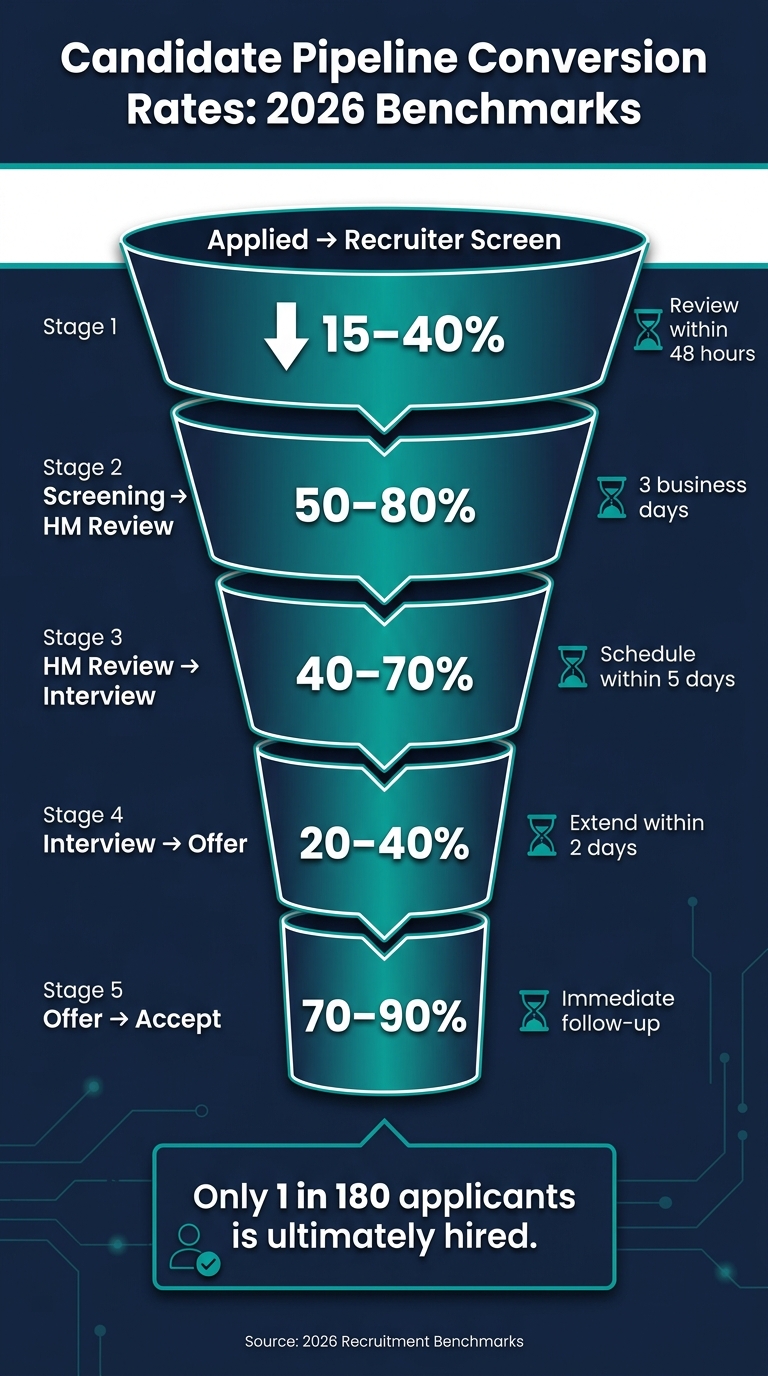
Hiring Funnel Conversion Rates: 2026 Benchmarks & Bottlenecks
Before you can improve conversion rates, you need to map out your hiring funnel. This step helps uncover inefficiencies and ensures your process is aligned for better outcomes. Start by defining each stage, setting clear criteria, and centralizing your data in your Applicant Tracking System (ATS).
Define Funnel Stages and Metrics
A typical hiring funnel has key stages: Application, Screening, Hiring Manager (HM) Review, Interview, Offer, and Hire. Each stage should have clear entry and exit triggers. For instance, a candidate progresses to the "Screen Completed" stage only after the recruiter logs their notes in the ATS – not simply after a phone call.
One of the most common issues in hiring funnels is leaks at handoff points between teams. By setting clear criteria, you can reduce disagreements about candidate quality. As Eric Guidice from Metaview points out:
"Hiring funnels do not leak randomly. They leak at the joints where two functions hand off to each other and quietly disagree about what good looks like." [3]
The table below highlights each stage, its 2026 benchmark conversion rate, and the recommended time limits to keep candidates moving forward:
| Funnel Stage | 2026 Benchmark Conversion | Time Limit |
|---|---|---|
| Applied → Screening | 15–40% | Review within 48 hours |
| Screening → HM Review | 50–80% | 3 business days |
| HM Review → Interview | 40–70% | Schedule within 5 days |
| Interview → Offer | 20–40% | Extend within 2 days |
| Offer → Accept | 70–90% | Immediate follow-up |
To better understand your pipeline, track pipeline velocity – the median number of days candidates spend in each stage. This is more actionable than focusing solely on time-to-hire. As the Treegarden team explains, "time-to-hire is a useful aggregate metric, but it hides everything important. It tells you the total time elapsed, not where the time was lost." [6]
With clear stages and metrics, you’re ready to pinpoint where improvements can boost your conversion rates or rate your recruitment process to identify specific gaps.
Collect Accurate Data
Once your funnel is mapped, the next step is ensuring your data reflects reality. All candidate progress should be logged in your ATS. Relying on external tools or informal methods can lead to gaps, compromising the accuracy of your metrics.
Improve data quality by standardizing rejection reasons and tracking how long candidates stay in each stage. Use coded categories like "compensation misfit" or "technical skill gap" instead of free-text notes. This practice turns drop-off data into actionable insights. Combined with pipeline velocity tracking, it provides a clearer view of where delays occur.
Also, distinguish between rejections and withdrawals. A candidate who is rejected is very different from one who withdraws voluntarily. If withdrawal rates rise – especially in later stages – it could indicate issues like a poor candidate experience or uncompetitive offers, rather than problems with sourcing.
Step 2: Measure Conversion Rates Across the Funnel
Once your funnel is mapped and your data centralized, the next step is to quantify each stage. Measuring conversion rates helps pinpoint where candidates are dropping off and how significant the drop-offs are.
Calculate Stage-to-Stage Conversion Rates
Here’s the formula to use:
Stage Conversion Rate (%) = (Candidates advancing to the next stage ÷ Candidates who entered the current stage) × 100 [2]
For instance, if 200 candidates enter the screening stage and only 60 move on to the hiring manager review, your Screen → HM Review conversion rate is 30%. This is well below the 2026 benchmark of 50–80%, suggesting that your process might need some fine-tuning.
To ensure your data is accurate, follow these best practices:
- Use ATS timestamps to track when candidates enter and exit stages.
- Eliminate duplicate candidate records across job postings.
- Standardize stage names across teams to avoid inconsistencies.
- Ensure every candidate has one clear outcome per role (e.g., accepted, declined, withdrawn, or rejected).
Additionally, use a fixed cohort window, such as grouping candidates by the month their requisition was approved or their offer extended. This prevents conversion rates from being skewed by incomplete data [2].
Below is a table outlining the 2026 benchmarks for key funnel transitions, along with common reasons for low conversion rates:
| Funnel Stage Transition | 2026 Benchmark | Diagnostic Signal |
|---|---|---|
| Applied → Recruiter Screen | 1%–3% (post-filter) [3] | Misaligned job descriptions or noise from AI-generated applications [3] |
| Screen → HM Review | 50%–80% [2] | Disconnect between recruiters and hiring managers |
| HM Review → Interview | 40%–70% [2] | Overly strict hiring manager criteria |
| Interview → Offer | 20%–40% [2] | Screening or interviews failing to predict success effectively |
| Offer → Accept | 70%–90% [2] | Delayed offers or uncompetitive compensation packages |
By comparing your data to these benchmarks, you can identify where your process diverges from the ideal. For example, the Applied → Recruiter Screen conversion rate has dropped to just 1–3% in 2026, largely due to an influx of AI-generated applications. Low performance at this stage often highlights filtering challenges rather than recruiter inefficiency [3].
Once you’ve identified gaps, dive deeper by examining supporting metrics.
Track Supporting Metrics
While conversion rates give you a snapshot, supporting metrics provide the context behind those numbers. Key metrics to monitor include:
- Time-in-Stage (Pipeline Velocity): Focus on the median time candidates spend in each stage, as averages can be skewed by outliers. For example, aim to review applications within 48 hours, complete screenings within 3 business days, and extend offers within 2 business days of a final decision [7].
- Offer Acceptance Rate (OAR) and Funnel Yield: These metrics show how efficiently your funnel converts applicants into hires. A low OAR might point to issues with compensation or the speed of your offer process.
- Application Completion Rate: A low completion rate often signals friction in your application process. Multi-page forms, for example, have a 44% abandonment rate [4].
- Segmentation by Source Channel: Breaking down conversion rates by channel can reveal patterns. Referrals and proactively sourced candidates typically convert at rates 4–8 times higher than cold, inbound applications [9].
"Knowing your hiring-manager-screen-to-onsite ratio is 38% tells you a leak exists. It does not tell you whether the leak is the recruiter sourcing the wrong profile, the hiring manager evaluating against a different rubric, or the role itself being underspecified." – Eric Guidice, Metaview [3]
Step 3: Find Where Candidates Are Dropping Off
Once you’ve measured your conversion rates, the next step is to figure out where candidates are exiting your hiring process – and why.
Pinpoint High Drop-Off Stages
Start by identifying the stages with the highest drop-off rates. A sudden 20-point swing in a stage’s performance over a quarter signals a potential process issue, while consistent underperformance might point to deeper structural challenges.
After spotting these "leaky" stages, dig into the data. Review rejection and withdrawal reasons using structured rejection tags, as discussed earlier. Rank these reasons by frequency with a Pareto analysis to pinpoint the key drivers of candidate loss at each stage.
Here are two patterns to watch for:
- Early-stage drop-offs (Application → Screen) often indicate a filtering issue rather than a recruiter problem. With the rise of AI-powered application tools, the number of applications per hire has tripled since 2021, often inflating the pool with unqualified candidates [9].
- Mid-funnel leaks (Screen → Hiring Manager Review, Hiring Manager Review → Interview) are frequently linked to "intake debt". This happens when the hiring manager’s expectations for the ideal candidate shift away from the original job description [3].
If you suspect over-aggressive filtering, try a blind re-screen of 20 recent rejections. If you find qualified candidates among them, it could mean your criteria are too restrictive [10].
From there, segment your data to uncover additional trends.
Segment Data for Deeper Insights
Breaking your data into segments can help reveal patterns you might miss at a high level. Look at source channels, roles, locations, recruiters, and hiring managers. For instance, referrals and proactive sourcing tend to deliver conversion rates 4–8 times higher than cold applications [9].
Role-specific differences also matter. For example, tech positions average 191 applicants per hire, while healthcare roles average just 47 [9]. Applying the same benchmarks across all roles can skew your analysis. Instead, set baselines tailored to each role to ensure fair comparisons.
Don’t forget to track time-in-stage alongside conversion rates. A 30% Screen → Interview conversion rate might seem fine until you notice it takes three weeks to schedule those interviews. As one recruiter observed:
"A 30% screen-to-interview rate means nothing if it takes three weeks to schedule. Time between stages is where candidates actually ghost you." – Prepzo [8]
Timing is critical. Candidates who wait more than two weeks between their final interview and receiving an offer are 45% more likely to accept a competing offer [8]. Slow processes don’t just delay hiring – they actively cause candidates to drop out.
Step 4: Make Targeted Improvements to Each Stage
To address where candidates drop off, use the insights from your data to make precise adjustments at each stage of the hiring process.
Simplify the Application Process
Only 6% of people who view job postings actually complete an application [9]. Why? Long forms, unnecessary fields, and slow-loading pages are major culprits. Research shows that every extra form field can reduce completion rates by 5–10% [9].
Simplify things. Remove nonessential fields and optimize your application for mobile users – this alone led to a 35% increase in completion rates in 2024 [9]. Collect only the basics upfront and gather additional details later in the process. Speed also matters. Candidates who wait more than 7 days for a response are 25% less likely to stay engaged [7]. Setting a 48-hour SLA (service-level agreement) for application reviews can significantly reduce early-stage drop-offs [7].
Once the application process is streamlined, focus on keeping the momentum going through screening and interviews.
Tighten Screening and Interview Processes
Screening and interviews are often where the process slows down. Misalignment between recruiters and hiring managers – what Eric Guidice from Metaview calls "intake debt" – can lead to qualified candidates being overlooked or unsuitable ones moving forward.
"Funnels do not leak randomly. Every conversion drop traces upstream to a misalignment between two functions… that shows up as a number one stage later." – Eric Guidice, Metaview [3]
To avoid this, start with calibration screens – 3 to 5 rounds where recruiters and hiring managers refine the job criteria together [3]. On the screening side, simple yes/no knockout questions can filter out 60% of unqualified applicants [11], allowing your team to focus on stronger candidates. For interviews, use structured scorecards to ensure every interviewer evaluates candidates against the same criteria. This reduces panel disagreements and keeps decisions consistent [3].
Another way to improve candidate experience? Let them book their own interview slots. This small change has been shown to reduce withdrawal rates, which currently sit at 42% [9]. Combine this with same-day debriefs after panel interviews to prevent delays in decision-making [7].
Once you’ve tightened up screening and interviews, focus on sealing the deal with competitive, timely offers.
Make Offers More Competitive and Timely
Currently, only 65–70% of offers are accepted [7]. But you can improve this by being faster and clearer. Candidates who wait more than two weeks after their final interview are far more likely to accept another offer. High-performing teams aim to extend offers within 24–48 hours of the final interview [2][7].
"Speed and transparency. Extend offers within 2 business days of making a decision. And don’t leave salary negotiation ambiguous. A clear, competitive offer with defined benefits closes faster than a vague ‘we’ll work something out.’" – HrPanda [7]
Approval delays are a common bottleneck. Pre-approving standard salary bands for frequently hired roles can eliminate last-minute sign-offs [2]. Use e-signature tools like DocuSign or Dropbox Sign to let candidates accept offers instantly from any device [5]. After an offer is accepted, maintain consistent communication to reduce the risk of counter-offers derailing your hire [5].
Step 5: Track Progress and Refine Over Time
Improving your hiring process is only part of the equation. To see real results, you need to track performance consistently and adjust as needed. Without this, even the best-laid plans can fall short.
Benchmark Performance and Set Goals
When evaluating your funnel, rely on your own historical data rather than generic industry averages, which can vary wildly depending on the role or sector. For instance, a tech company hiring senior engineers will have a very different funnel compared to a healthcare organization recruiting for entry-level positions. Consider this: technology roles see an average of 191 applicants per hire, while healthcare averages just 47 [9].
Focus on quarter-over-quarter trends within your own data. Dive into your ATS quarterly to pinpoint the stage with the most fluctuation – this is often where issues lie [3].
Set clear, measurable SLAs for each stage and hold your team accountable. For example, require hiring managers to provide feedback within 48 hours of a screening or ensure offers are extended within 48 hours of the final interview. These small but impactful targets can significantly improve your funnel’s efficiency [2][8]. Also, use structured rejection reasons, like "minimum qualification fail" or "compensation misfit." This way, you’ll know why candidates drop off, not just that they did [2][3].
If tracking these metrics feels overwhelming, embedded recruitment support can help bridge the gap.
Use Embedded Recruitment Support
For many scaling companies, capacity issues make it hard to keep tabs on the hiring funnel. When hiring ramps up, tracking often falls to the wayside because most teams lack dedicated internal resources to monitor data in real time.
"The gap between a mediocre funnel and a good one is not brilliance. It is visibility." – Abhishek Singla, Founder, Prepzo [8]
Embedded recruiters can fill this gap by handling real-time data oversight. With Rent a Recruiter, experienced recruiters integrate directly into your team, ensuring accurate data collection, running weekly pipeline reviews, and holding stakeholders accountable for bottlenecks. This eliminates the need for a separate internal data team. For high-growth companies in sectors like technology, SaaS, fintech, and engineering, this approach ensures conversion data is acted on immediately – before it becomes a problem.
The payoff? Clients save over 80 hours per month, freeing leadership to focus on strategy while maintaining a well-oiled hiring machine.
Conclusion: Building a More Efficient Hiring Process
A slow and inefficient hiring funnel doesn’t just waste time – it drains resources. On average, only 1 in 180 applicants ends up being hired [9]. High candidate drop-off rates amplify the cost and time it takes to fill roles, creating a cycle that can hinder growth.
Key Takeaways
To fix this, start with a clearly defined hiring funnel. Then, track conversion rates at every stage to get a clear view of where issues lie. Once you identify drop-off points – whether it’s a cumbersome application process, miscommunication between recruiters and hiring managers, or delays in offer approvals – make specific, actionable changes. Finally, monitor your progress using stage-level SLAs and rejection tags, ensuring every improvement is backed by data.
Conversion rates are your diagnostic tool. They highlight exactly where the breakdown occurs, enabling you to address problems at their source [1][3].
"Stop looking only at outcomes and start looking at the process." – Helen Dwyer, General Manager, Scout Talent Group [1]
Companies that adopt structured pipeline management typically reduce time-to-hire by 30% [7]. That’s not just a small win – it’s a real opportunity to scale your team faster and more effectively.
These strategies provide a roadmap for making measurable improvements, and you can find more insights on our recruitment blog.
Next Steps
If you’re ready to put these strategies into action, Rent a Recruiter can help. By embedding experienced recruiters directly into your team, Rent a Recruiter brings the structure and accountability that growing companies need. Clients often reduce hiring costs by up to 70% compared to traditional agency fees. Book a consultation to see how streamlining your hiring process can drive real results for your business.
FAQs
Which pipeline stage should I fix first?
When addressing conversion rate challenges, zero in on the stages with the biggest negative gaps compared to industry standards. Trying to fix every stage at once will dilute your efforts. Instead, focus on the top two problem areas that are holding you back.
For instance, if a large number of candidates drop off between application and screening, it might signal that your job descriptions aren’t accurately reflecting the role or expectations. On the other hand, if the bottleneck is between screening and interviews, the issue could lie in process inefficiencies – like delayed responses or clunky scheduling systems. Identifying these pain points and addressing them directly will have the most impact.
How do I track pipeline velocity in my ATS?
To monitor pipeline velocity in your ATS effectively, focus on capturing accurate timestamps for when candidates enter and exit each stage. These timestamps allow you to calculate the time-in-stage by measuring the difference between them.
Configure your ATS to include the following features:
- Stage-aging alerts: Automatically flag candidates who stay in a stage longer than your service level agreements (SLAs).
- Velocity views: Provide a clear overview of stage-aging and the speed of offers being made.
- Median time-in-stage calculations: Pinpoint bottlenecks by identifying stages where candidates are delayed.
For reliable data, ensure all status changes are logged directly in the ATS.
What causes candidates to drop off after interviews?
Candidates frequently lose interest when faced with slow communication, drawn-out feedback cycles, or delays in receiving offers. Prolonged interview processes, vague evaluation methods, and long pauses between stages can further discourage them. To maintain engagement, prioritize prompt updates and strive to finalize hiring decisions within 48 hours after the final interview.