
If hiring starts late, your workforce plan is already off track.
I’d put it simply: workforce planning only works when recruitment can keep pace with growth. If you bring hiring into the planning cycle early, you get better control over headcount timing, more predictable spend, and fewer delivery delays. For scaling companies, that can mean up to 70% lower hiring costs versus agency fees, 25% to 40% shorter time-to-fill, and 80+ hours saved each month in hiring admin.
Here’s the short version:
- Workforce planning fails when hiring is reactive
- Empty roles can cost about $25,000 per month on average, and more than $42,000 for computer and maths roles
- Median time-to-fill sits near 48 days, which puts product, sales, and delivery plans at risk
- Embedded recruitment services gives you recruiter capacity inside your team, tied to business milestones
- That means clearer hiring roadmaps, better pipeline visibility, and steadier budgeting
- For finance and leadership teams, fixed monthly pricing is easier to plan around than per-hire agency fees
If you lead hiring, finance, or growth, the point is clear: you do not just need roles filled, you need hiring built into how the business plans and executes.
A embedded recruiter helps turn headcount plans into dated hiring steps, spots timing risks early, identifies process gaps, and gives you data you can use in the next planning cycle. If you want to talk through what that looks like, Rent a Recruiter is one option to review, and if cost is the main question, you can see your potential savings.
How To Do Workforce Planning: An Overview
sbb-itb-a23bd6a
The Problem: Workforce Plans Fail When Recruitment Is Not Built for Scale
A workforce plan breaks down when the recruitment function behind it cannot keep up.
Many growing SMEs have the roles mapped out and hiring dates pencilled in. But on the ground, they lack the capacity to hire at speed, clear visibility on time-to-fill, and any stable way to predict cost. When that happens, the plan starts to slip.
You usually see the damage in three areas: forecasting, process control, and cost.
Why Forecasting Skill Needs Is Hard in Fast-Moving Teams
In fast-moving SMEs, workforce planning rarely stays still for long.
Product roadmaps change. Customer demand moves. Funding timelines slip. A new client win, a product shift, a regulatory issue, or an integration problem can create hiring demand halfway through the cycle. Roles that were nowhere on the plan six months earlier suddenly need to be filled in a matter of weeks.
That creates a gap between planned headcount and what the business now needs.
If you do not have current workforce data, hiring plans often fall back on manager estimates. That sounds harmless, but it can lead to a costly miss: the wrong skills hired at the wrong time. And when the skill mix changes, the hiring process has to change with it.
How Ad Hoc Recruitment Weakens Process Control and Data Visibility
Once hiring turns reactive, consistency tends to disappear.
Interview stages vary by role and by hiring manager. Ownership gets split between HR and line managers. No one has clear accountability from start to finish. At the same time, candidate data ends up spread across email chains, spreadsheets, and separate systems. That makes reporting on time-to-fill and conversion rates hard to trust.
“Many ‘talent shortages’ stem from unclear roles, weak sequencing and process bottlenecks.” – Rent a Recruiter [1]
This hits workforce planning directly.
If your team underestimates the usual time-to-fill for a senior engineer because there is no data to test that assumption, product delivery dates get built on a timeline that is not real. Leaders cannot see where candidates are dropping out, which sourcing channels are pulling their weight, or how long each stage is taking.
Without that visibility, budget planning turns into guesswork.
How Variable Hiring Costs Disrupt Budget Planning
Unpredictable recruitment spend is a major risk for SMEs trying to grow in a controlled way.
Commission-based agency fees usually sit between 15% and 30% of annual salary per hire. On a $260,000 engineering hire, that works out at $39,000 to $78,000 for a single placement [2]. If internal hiring capacity falls short, those costs can hit your budget with little warning.
For growth-stage companies, that kind of volatility affects burn and makes cost-per-hire much harder to forecast. Budget set aside for product development or marketing can end up being pulled into recruitment at short notice. That makes it hard to build a dependable cost-per-hire number into the next planning cycle.
That is where embedded recruitment service changes the model.
The Solution: How Embedded Recruitment Supports Workforce Planning
When forecasting, process control, and hiring as you scale start to slip, embedded recruitment turns a workforce plan into an actual hiring sequence.
An embedded recruiter works inside your business and inside your planning cycle from day one.
The model is simple. Experienced recruiters are integrated into your team, join planning decisions early, and move on those decisions straight away. Rent a Recruiter, for example, places recruiters into scaling SMEs within 5 days on fixed monthly pricing, cutting hiring costs by up to 70% compared with commission-based agency fees from traditional recruitment agencies [1].
How Embedded Recruiters Turn Workforce Plans Into Hiring Roadmaps
A workforce plan only matters if someone can turn it into action with real dates attached. That’s the job.
Embedded recruiters join the planning rhythm with leadership and finance, then turn top-level goals into a staged hiring roadmap. That means setting out when requisitions open, when shortlists should be ready, when interviews happen, and when offers need to land.
So instead of a broad target like “add 5 account executives and 3 customer success managers by Q2”, you get a dated, role-by-role plan. That gives you something the business can track, manage, and budget for.
Just as important, embedded recruiters pressure-test the assumptions behind the plan. If a team expects a senior engineer search to close faster than the usual 6 to 8 weeks the market often needs, the embedded recruiter flags it early, before it turns into a delivery issue [1].
That matters because bad hiring assumptions don’t stay in recruitment. They spill into revenue plans, delivery timelines, and team workload.
How Closer Team Integration Improves Role Quality and Ready Talent Pipelines
One of the clearest gains in the embedded recruitment model comes from proximity.
When a recruiter spends real time with the teams they hire for, role quality improves. They get a sharper view of what success looks like in the job, not just what sits in a job spec. Instead of working from a generic description, they help shape competency matrices based on how the role works day to day.
That leads to better-defined roles and more realistic hiring timelines.
It also changes how pipelines are built. Rather than waiting for a role to be approved and then starting from zero, embedded recruiters use the hiring roadmap to spot repeat and business-critical roles 60 to 120 days ahead [1].
They can then:
- build segmented talent pools
- keep strong candidates warm
- move faster when approval comes through
The commercial impact is simple. Less delay, less scrambling, and less wasted time from hiring managers.
Embedded Recruitment vs. Transactional Hiring
The difference is operational, not just structural.
| Feature | Transactional (Agency) Recruitment | Embedded Recruitment |
|---|---|---|
| Cost Predictability | Variable; high per-hire fees | Fixed monthly pricing; more predictable budgeting |
| Pipeline Building | Focused on current openings | Builds pipelines ahead of demand |
| Data Visibility | Low; data sits in the agency’s systems | High; works within the company’s own ATS and tools |
| Alignment with Workforce Plan | Incidental; lacks commercial context | Directly aligned with business milestones and headcount goals |
For a scaling SME, this shows up in three places: timing, cost, and control.
A transactional model fills one opening. Embedded recruitment plans the next three.
The Business Impact: Lower Cost, Faster Hiring, and Better Planning Accuracy
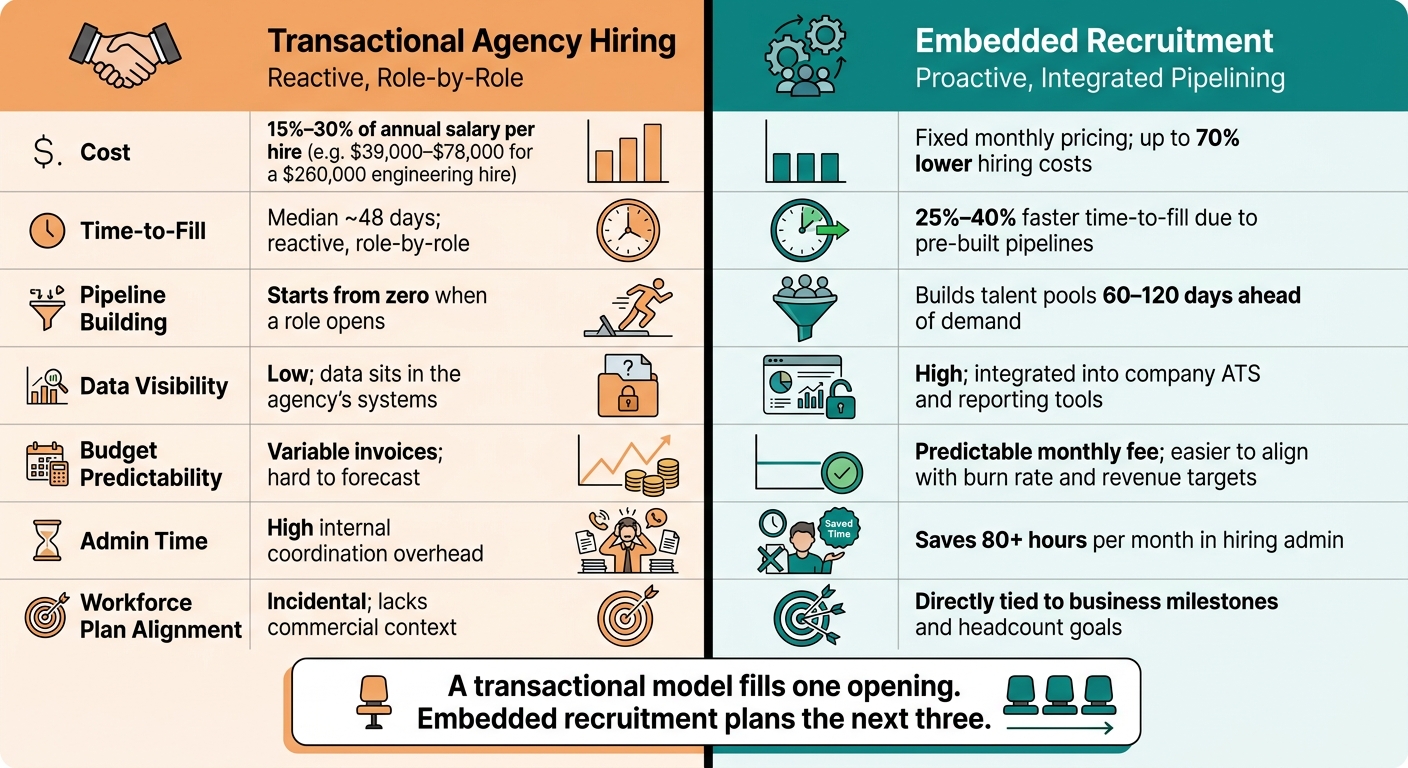
Embedded Recruitment vs. Agency Hiring: Cost, Speed & Control
Planned hiring gives leadership forecasts it can trust.
What Changes When Hiring Becomes Planned Rather Than Reactive
When hiring sits inside your planning cycle and you apply talent acquisition strategies designed for scale, you see the impact in speed, cost, and forecast accuracy.
Companies using embedded recruitment often cut time-to-fill by 25% to 40% compared with ad hoc hiring [3][4]. That happens because roles are defined earlier and talent pipelines are built before vacancies open. The result is not just faster fills. It means better milestone timing and stronger capacity planning.
Quality of hire improves too. When a team is not under pressure to fill a seat at the last minute, it can run structured interviews and assess long-term fit with more care. Better fit reduces rework, supports team output, and gives leaders a hiring process that backs the workforce plan instead of scrambling to catch up.
HR teams and hiring managers also get time back. With structured workflows, standard interview guides, and one clear owner for the end-to-end process, companies can save over 80 hours per month in internal hiring and admin time [1].
How Embedded Recruitment Helps Finance and Leadership Teams Plan with Confidence
These gains matter most when finance needs headcount and budget forecasts it can rely on.
For finance teams, one of the biggest shifts is moving away from variable agency invoices to a predictable monthly fee. That makes it much easier to build a recruiting budget in U.S. dollars and compare it directly with revenue targets or burn rate. Rent a Recruiter reports that clients can reduce hiring costs by up to 70% compared with commission-based models [1].
Leadership teams get something just as useful, clear headcount visibility. Instead of learning that a key hire is delayed only when delivery starts to slip, embedded recruiters flag risks early through regular reporting. Over time, that hiring data, such as time-to-fill by role type, offer acceptance rates, and which channels produce hires, helps make each planning cycle more accurate than the last [1].
The next step is to build those gains into the planning cycle itself.
Next Steps: Building Embedded Recruitment Into Your Workforce Planning Cycle
Start with Business Milestones and Hiring Demand
Once the model is in place, the next move is to tie it into your planning cycle. Start with business milestones, not open roles.
Look at the next 12 to 18 months and pinpoint the three to five milestones most likely to drive hiring, such as funding, product launches, market expansion, or delivery spikes [5][6]. For each one, set out the role families, headcount needed, and target start date.
Then work backward from that milestone date. That’s what turns a workforce plan from a rough forecast into something your team can actually execute [5][6].
Define Scope, Metrics, and Planning Cadence
Once demand is mapped, define the embedded recruiter’s scope with clarity. Be specific about the functions covered, hiring volume, time frame, and which parts of the process they own end to end [1].
One SME may need engineering and product hiring support for six months. Another may need full-cycle coverage across sales, customer success, and operations [1].
You’ll also want a simple planning rhythm. Track:
- Pipeline coverage
- Time-to-fill
- Offer acceptance rate
- Hiring manager response times
Review these on a quarterly cadence so the plan stays aligned as conditions shift [1]. For more insights on optimizing your talent strategy, explore our recruitment blog. When hiring demand climbs, scale support up. When it levels off, scale it back [1].
Conclusion and Call to Action
That kind of structure turns workforce planning into a working process, not just a spreadsheet exercise. Embedded recruitment gives you clearer visibility, better timing, and tighter budget control, so you can hire in line with business demand and stay on schedule.
Book a Call to talk through your hiring needs, or See Your Potential Savings to see what embedded recruitment could mean for your budget.
FAQs
When should embedded recruitment start?
Consider embedded recruitment when hiring demand shifts, leadership is stretched thin, or slow, uneven hiring starts hitting revenue.
It works well when you’re scaling after funding, launching new products, or dealing with seasonal peaks without enough internal sourcing capacity. The big advantage is speed. Embedded recruiters can join your team in as little as 48 hours to 5 days, so you can step in before hiring pressure turns into missed targets or stalled growth.
A 3 to 6 month pilot gives you room to test the model, track results, and see what it does for hiring speed, team bandwidth, and output.
How do I know if my workforce plan is too reactive?
Your workforce plan is probably reactive if roles only open when pressure is at its highest. That usually shows up in a few familiar ways: hiring feels fragmented, decisions vary from team to team, and leaders end up screening resumes instead of working on the business.
You may also see last-minute hiring, slow processes that lead to candidate drop-off, unclear ownership, and no forward-looking headcount plan. That kind of setup costs you time, slows delivery, and pulls senior people into work they shouldn’t be doing.
Rent a Recruiter helps you put a more structured, proactive hiring process in place, one that lines up with business goals and gives you more control over hiring outcomes.
What metrics should we track to improve hiring forecasts?
Track the metrics that tie hiring work back to business results.
That means keeping a close eye on time-to-fill, cost-per-hire, and Headcount Forecast Error (MAPE), so you can compare planned hiring against what actually happened.
It also helps to watch what happens after the hire. Monitor new-hire retention at 90 days and 12 months, along with attrition trends, offer acceptance rates, and pipeline velocity.
Why does that matter? Because better data leads to better hiring calls. You spot gaps sooner, improve forecast accuracy, and see hiring needs earlier, before they turn into delivery risk or missed growth targets.