Before you commit to a UK hire, confirm where the person will work, whether sponsorship is needed, and what it will cost. We recommend checking the role, salary, and visa route before agreeing to a start date, so you can budget for fees and avoid preventable delays.
Most sponsor licence applications are decided in less than 8 weeks, but visa processing and relocation add time. Your hiring plan should cover:
- Route and eligibility: Check that the job and worker meet the requirements.
- Total cost: Budget in GBP (£) for licensing, sponsorship, visa costs, and internal admin.
- Start-date checks: Arrange the Certificate of Sponsorship and confirm work permission before work begins.
- Clear ownership: Assign responsibility for records, work locations, reporting, and renewals.
We also explain where recruitment support fits, while keeping immigration decisions with your sponsor team and qualified advisers. The aim is simple: <u>a hiring budget and start date you can plan around</u>.
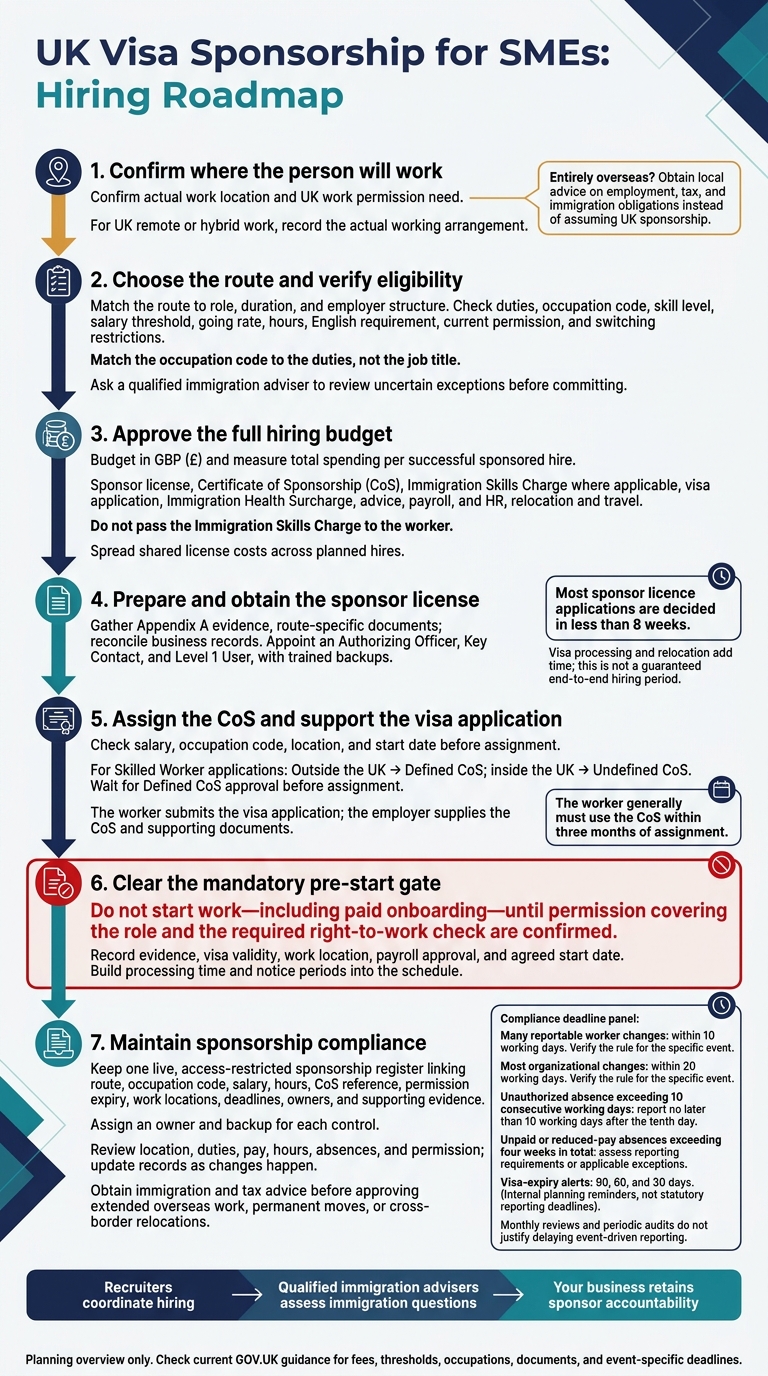
UK Visa Sponsorship for SMEs: Hiring Roadmap
Choose a Visa Route and Plan Your Budget
Compare Employer-Sponsored Visa Routes
Choose your visa route based on the role, duration, and employer structure, not the fee alone. For remote and hybrid hires, the route must fit where the employee will actually work, not just where your business is based.
Check the GOV.UK sponsorship guidance before approving recruitment. Your choice affects the hire’s timing, costs, and compliance requirements. Use this table for planning, then confirm the current rules before deciding.
| Route | Purpose and eligibility | Sponsor duties and stay limits | Settlement |
|---|---|---|---|
| Skilled Worker | Recruiting an overseas worker into a continuing UK role; job, salary, skill, and worker requirements apply | Assign a Certificate of Sponsorship (CoS) and maintain monitoring and reporting throughout sponsorship | May lead to settlement if the worker meets the rules |
| GBM: Senior or Specialist Worker | Temporary transfer from a linked overseas business; overseas employment, occupation, salary, and experience conditions apply | Maintain sponsorship throughout the assignment; route-specific stay limits apply | No direct settlement route |
| Other Global Business Mobility routes | Graduate Trainee, UK Expansion Worker, Service Supplier, and Secondment Worker; each requires business, training, or contractual evidence | Duties and maximum duration depend on the route | No direct settlement route |
| Scale-up Worker | Eligible high-growth businesses hiring a highly skilled worker | Sponsorship applies only during the initial sponsored period | May lead to settlement if the worker meets the rules |
| Temporary Worker | Defined short-term purposes, including creative, charity, religious, or government-authorized exchange work | Monitor the approved activity within route-specific time limits | No direct settlement route |
Once you select a route, check that both the role and the candidate meet its core requirements.
Check Job, Salary, and Worker Eligibility
Match the occupation code to the duties, not the job title. The July 22, 2025 reforms increased the Skilled Worker skill threshold to RQF level 6. The role itself must meet that threshold, not just the candidate’s qualifications.[10][12][13]
Before relying on an exception, check the current occupation tables, Immigration Salary List, applicable shortage provisions, and transitional rules.
Keep one dated eligibility file covering the vacancy, duties, occupation code, skill level, salary threshold, going rate, hours, discounts, and any transitional rule. Include evidence of the English requirement, current immigration permission, and switching restrictions. A shortage-list role does not automatically qualify for the lowest salary option.[12]
Retain interview notes and recruitment records even when no formal resident labor market test is required. Ask a regulated immigration adviser to review uncertain exceptions before you commit to the hire.[5][9]
Calculate Employer and Worker Costs
Once you confirm the route, budget in GBP (£). Before proceeding with the hire, account for the sponsor license application, each Certificate of Sponsorship (CoS) fee, and any applicable Immigration Skills Charge.[5][6][11]
Measure total spending per successful sponsored hire, including unsuccessful applications, internal administration, and relocation. Spread shared license costs across planned hires rather than charging the full amount to the first employee.
| Budget item | Payer and recovery rules | What to check |
|---|---|---|
| Sponsor license | Employer; check any recovery arrangement against the rules | Current fee by sponsor size and license type |
| Certificate of Sponsorship | Employer; check any recovery arrangement against the rules | Current fee for each CoS |
| Immigration Skills Charge | Employer where applicable; do not pass this cost to the worker | Whether the charge applies to Skilled Worker and Senior or Specialist Worker sponsorship, including exemptions |
| Visa application | Worker, or employer by agreement | Current fee, application location, visa length, and any discounted category |
| Immigration Health Surcharge | Usually the applicant, unless the employer reimburses it | Total for the worker and eligible dependents over the visa period |
| Advice, payroll, and HR | Employer compliance costs belong in your budget; keep personal immigration advice separate | Written advice quote, onboarding, reporting, recordkeeping, and payroll time |
| Relocation and travel | As set out in a written agreement; review repayment clauses first | Flights, temporary housing, moving costs, and dependents’ travel or relocation costs |
sbb-itb-a23bd6a
Can small businesses sponsor visas in the UK? Learn the truth. #ukvisa #sponsorvisauk
Get a Sponsor License and Sponsor Your Hire
Once you’ve chosen the route and set the budget, secure the sponsor license and assign the CoS before onboarding starts.
Prepare Your Application and Name Key Personnel
Apply for a Worker sponsor license to sponsor Skilled Worker or Senior or Specialist Worker hires. HR should gather the evidence, the hiring manager should confirm the business need, finance should approve fees, and a director should approve submission.
Check that business details match across Companies House, payroll, accounts, and application documents. Mismatched records can hold up your hiring plans.
Readiness checklist
- Required evidence: Gather the applicable Appendix A documents, proof of lawful UK operations, business details, key-personnel details, and fee-payment records.
- Route-specific documents: Prepare proposed job details, salary, work location, organizational structure, and overseas-business links where required.
- Recommended records: Keep recruitment approvals, right-to-work procedures, absence procedures, a compliance reporting calendar, and a named owner for each record.
Appoint an Authorizing Officer, Key Contact, and Level 1 User, with trained backups for each. Check their suitability, immigration status, applicable UK presence requirements, and eligibility for each role.
New sponsors generally receive an A-rating. A B-rating restricts new sponsorship and requires corrective action, so get advice before committing to further hires.[7][8]
Assign the CoS and Support the Visa Application
For Skilled Worker hires, request a Defined CoS for entry clearance from outside the UK. Use an Undefined CoS from your allocation for applications made inside the UK. Wait for Defined CoS approval before assigning it.
Before assignment, the manager should approve duties, HR should check employment terms, finance should authorize charges, and the immigration lead should approve eligibility. Check that the CoS matches the salary, occupation code, location, and start date.[4][5]
The Level 1 User should confirm CoS availability and arrange payment of the applicable assignment fee and Immigration Skills Charge for Skilled Worker or Senior or Specialist Worker sponsorship, unless exempt.
Give the worker the CoS reference and matching employment documents. They generally must use the CoS within three months of assignment. The worker submits the visa application; you supply the CoS and supporting documents. Escalate any discrepancies before submission so conflicting details don’t remain in the records.[5][15]
Confirm Work Permission and Start Dates
For remote hires, the actual UK work location determines the onboarding and compliance records you need. HR should own a shared tracker covering application and decision dates, visa validity dates, CoS details, work location, right-to-work evidence, payroll approval, and start dates. Build processing time and notice periods into your hiring schedule.
Do not let the worker start work, including paid onboarding, until permission covering the role and the required right-to-work check are confirmed.
Have the immigration lead review delayed starts, nonattendance, and changes before onboarding proceeds. Many changes must be reported within 10 working days. Retain the decision, supporting evidence, and any advice received.[5][7][8][14]
Manage Remote Work and Sponsor Compliance
Once your hire starts, the main compliance risk shifts to where they actually work. Track location changes so your records and reporting reflect the role being performed.
Track Work Locations and Review Overseas Work
Sponsorship covers the sponsored role, not unrestricted work anywhere. Record each worker’s normal location, expected working pattern, and any changes.
Require workers to notify HR or your sponsor-management team before changing their regular location, moving abroad, becoming fully remote, or working for a different client. A move to another branch, client site, or permanent full-time home working may need reporting through the Sponsor Management System (SMS).[8][18]
Base reporting decisions on the worker’s actual day-to-day pattern, not the contract label.
| Arrangement | Internal records | Report to Home Office | Review before approval |
|---|---|---|---|
| UK full-time remote | Home-working address, start date, contractual status, and attendance expectations | Report contractual full-time home working or a material change in normal location | Payroll address, health and safety, and data security |
| UK hybrid | Office days, home-working pattern, main office, and client sites | Hybrid work usually does not need reporting unless the main office or regular client site changes | Travel, expenses, payroll records, and consistency with the sponsored role |
| Short overseas assignment | Destination, dates, purpose, approval, and expected return | Do not assume a short trip needs reporting; assess whether extended work abroad changes the sponsored job | Destination-country work permission, tax, social security, payroll, insurance, and data transfers |
| Permanent overseas move | End date of UK work and new employing or reporting arrangement | Assess whether sponsorship should end and report relevant changes | Continued eligibility for the sponsored UK role, local employment, payroll, tax, and permanent-establishment exposure |
| Cross-border move | Former and new residence, dates, entity, manager, location, and role | Report changes affecting the sponsored job, location, salary, or sponsor obligations where required | Coordinated immigration, tax, payroll, and employment-law advice in both countries |
Send extended overseas work, permanent moves, and cross-border relocations to immigration and tax advisers before approval. A UK visa does not authorize work in the destination country.[8][16][18]
Assign Compliance Tasks and Reporting Deadlines
Give each control an owner and backup so reporting does not fall between teams. Most organizational changes have a 20-working-day deadline, but verify the rule for each event. Monthly reviews and periodic audits are internal checks, not reasons to delay reporting.[5][17]
| Control | Owner | Evidence and review schedule | Escalation trigger |
|---|---|---|---|
| Right-to-work checks | HR or authorized checker | Dated check evidence; before employment and at required follow-up | Missing evidence or unclear permission |
| Attendance and absences | Manager and HR | Start confirmation, leave approvals, and absence log; monitor as events occur | Failure to start; absence without permission exceeding 10 consecutive working days |
| Duties, pay, hours, and location | Manager, payroll, and HR | Approved changes and payroll records; before changes and at monthly review | Salary reduction, role transfer, new regular site, or overseas work |
| Reportable changes and termination | Level 1 User | SMS confirmation and supporting records; on each event | Uncertain reportability, early termination, or missed deadline |
| Visa expiry | HR | Permission evidence and calendar alerts at 90, 60, and 30 days | No extension plan or missing application evidence |
| Business or license changes | Authorizing Officer | Change documents, Home Office correspondence, and SMS records; on occurrence | Restructuring, legal-entity changes, suspension, or revocation |
Report absence without permission exceeding 10 consecutive working days no later than 10 working days after the tenth day. Unpaid or reduced-pay absences exceeding four weeks in total may also require reporting or an exception assessment. Escalate missed deadlines immediately to the Level 1 User and an immigration adviser.[8][15][18]
Keep a Central Sponsorship Register
Use one live, access-restricted register to connect each worker’s location, permission, deadlines, and responsible owners.
Poor controls can lead to downgrading, suspension, or revocation. During suspension, you cannot assign new Certificates of Sponsorship (CoS), but your sponsor duties continue.[4][8][18]
For each worker, link their visa route, occupation code, salary, hours, CoS reference, permission expiry, work locations, reporting deadlines, owners, and supporting documents. Store only the data you need and follow a documented retention schedule. Update the register as changes happen to prevent missed deadlines and unrecorded location changes.[8][18]
Coordinate Recruitment and Immigration Advice
Once sponsor duties are assigned, keep hiring delivery separate from immigration decisions. Recruiters manage hiring; authorized immigration advisers assess visa eligibility and handle applications; your business owns sponsorship decisions. Before engaging an adviser, verify them through the official “Find an immigration adviser” service.[20]
Use Embedded Recruiters to Coordinate Hiring
Rent a Recruiter embeds recruiters into your team to manage job intake, sourcing, screening, interviews, stakeholder coordination, and pipeline reporting.[19]
For sponsored vacancies, your recruiter should confirm the approved duties, salary, location, and reporting line with the hiring manager, then coordinate questions with HR and the immigration adviser. Collecting evidence is not an eligibility review. Recruiters can request documents using an approved checklist, but eligibility questions belong with the adviser.
Keep recruitment records in your company’s systems. Use one hiring record for interview decisions, outstanding documents, recruiter updates, approval dates and status, adviser questions, and the person responsible for the next action. Review stalled decisions weekly so delays have a clear owner.
Measure performance against your baseline using time to shortlist, hiring-manager response time, internal hours spent per hire, and recruitment cost per hire. These measures help you track hiring speed, internal workload, and spending.
Plan Recruitment Support Before Hiring
Before opening vacancies, map expected hiring demand, recruiter workload, interview capacity, budget, and target start dates. Add support when specialist vacancies, delayed interviews, or repeated approval errors slow hiring.
Name the hiring decision-maker, recruitment lead, HR contact, sponsor-duty owner, and immigration adviser. Agree who approves the role and offer, who resolves immigration questions, and what must be confirmed before you commit to a start date.
Put the recruitment scope in writing: vacancies covered, sourcing and screening tasks, document handoffs, reporting frequency, fees, and success measures. Schedule adviser reviews before approving offers and start dates. HR should record the advice and the sponsor lead’s decision in the sponsorship file.
Conclusion: Your Sponsored-Hiring Checklist
Confirm work location before sponsorship. For remote hires, where the person physically works determines the immigration route. Check whether they need UK work permission. If they will work entirely overseas, get advice on local employment, tax, and immigration obligations instead.
Match the visa route to the role, occupation code, salary, and worker’s status. Verify eligibility before approving the budget. Include the sponsor license, Certificate of Sponsorship (CoS), Immigration Skills Charge where applicable, and visa costs.
Prepare the license file, assign responsible staff, and confirm access to the Sponsorship Management System. Once the license is in place, check the job and worker details before assigning the CoS. The worker must normally apply within three months of assignment.[3]
Complete and retain the right-to-work check before work starts. Record permission expiration dates and restrictions in your sponsorship register, then review the records monthly. Changes to remote working arrangements can trigger reporting duties. Report reportable worker changes within 10 working days and organizational changes within 20 working days.[7][8] Give named owners responsibility for reporting and renewals so deadlines do not slip.
Recruitment support does not transfer sponsor accountability. Keep immigration decisions with your sponsor team and qualified immigration advisers. Check fees, thresholds, occupations, documents, and deadlines against current GOV.UK guidance.
FAQs
Can my startup qualify for a UK sponsor license?
Your startup may qualify if it meets the regulatory, legal, and administrative requirements. Confirm eligibility with qualified local advisers before starting, taking your business structure into account [1].
Budget time and resources for sponsorship duties, including reporting, record-keeping, and salary or labor-market requirements [1][2]. Do not advertise roles or let work begin until legal feasibility is confirmed and all registrations and immigration permits are fully cleared and confirmed [1].
What happens if my sponsored worker’s visa is refused?
If your sponsored worker’s visa is refused, they are not legally authorized to work for your company. Delay their start date until all required permits and authorizations are approved. Starting work before approval, including remotely, puts your company at serious compliance risk.
Submitting an application does not grant work rights, and immigration timelines vary. Work with qualified local specialists to review the refusal and determine next steps before proceeding.
Can a sponsored employee work remotely from abroad?
Approval depends on immigration laws, local employment regulations, and tax requirements in both countries. A visa or residence permit does not automatically grant permission to work remotely for a foreign company.
An employee working abroad may create a permanent establishment for your business, potentially triggering corporate tax and payroll obligations. Require formal HR or finance approval before any relocation. Consult local legal advisors to confirm compliance before approving remote work.