
Flexible recruitment is reshaping how scaling companies hire. Instead of relying on costly, commission-based agencies or inflexible in-house teams, you can use embedded recruitment to integrate experienced recruiters directly into your business. This approach cuts hiring costs by up to 70%, reduces time-to-fill by 50%, and gives you full control over the process.
Here’s what you need to know:
- Traditional Agencies: Charge 15–30% of a hire’s first-year salary, operate externally, and often lack alignment with your business goals.
- In-House Teams: Offer control but come with fixed costs of $175,000–$190,000 annually per recruiter, regardless of hiring demand.
- Flexible Recruitment: Provides embedded recruiters on a flat monthly fee ($10,000–$20,000), allowing you to scale hiring support up or down as needed.
Why it matters: Every unfilled role costs your business $98 per day in lost productivity. Flexible recruitment gives you the agility to meet hiring surges without overspending or overloading internal teams.
Quick Comparison:
| Factor | Traditional Agency | Flexible Recruitment | In-House Recruitment |
|---|---|---|---|
| Cost | 15–30% of salary | $10,000–$20,000/month | $175,000–$190,000/year |
| Scalability | Limited | High | Low |
| Time-to-Hire | ~42 days | ~12–20 days | ~63 days |
| Integration | External | Fully embedded | Internal |
If you’re hiring 10–24 roles annually, flexible recruitment could save you time, money, and resources while improving hiring outcomes, as seen in our embedded recruitment case study. To learn how Rent a Recruiter’s embedded model works, click here.
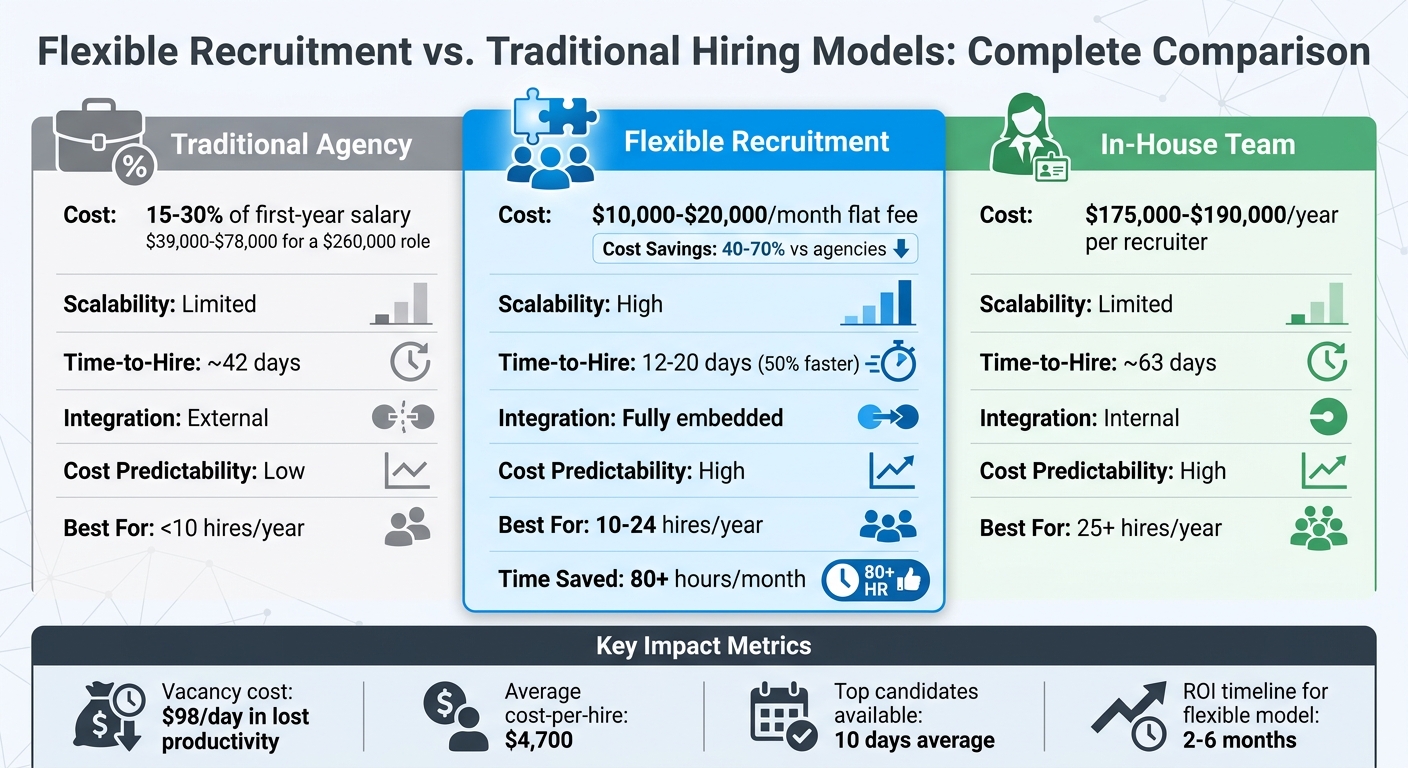
Flexible vs Traditional Recruitment Models Cost and Performance Comparison
Core Versus Flexible Staffing
sbb-itb-a23bd6a
Main Differences Between Flexible and Traditional Recruitment
How you engage recruiters can make or break your hiring strategy. Traditional recruitment often relies on external agencies or permanent in-house staff, while flexible recruitment embeds experienced recruiters directly into your team. These approaches differ significantly in cost, collaboration, and control.
Cost Structures and Pricing Models
Traditional recruitment agencies typically charge a commission for each placement – ranging from 15% to 30% of the first-year salary [2]. For example, hiring a $260,000 engineer could cost you between $39,000 and $78,000. Multiply that by several hires, and fees can quickly surpass $200,000 for just five roles.
Flexible recruitment, on the other hand, works on a flat monthly retainer, usually between $10,000 and $20,000 [2]. This predictable cost covers multiple hires within the same timeframe, significantly reducing expenses. Businesses using this model often cut hiring costs by 40% to 70% compared to traditional agency fees [1].
In-house recruitment teams come with the highest fixed costs. A single recruiter’s total annual expense – including salary, benefits, and tools – ranges from $175,000 to $190,000 [2]. These costs remain constant, whether you’re hiring two people or twenty, making this model less efficient during periods of low hiring demand.
"The visible cost of hiring is the smallest line item. The invisible cost is what kills your budget." – Paraform [2]
Here’s a quick comparison of the models:
| Factor | Traditional Agency | Flexible (Embedded) | In-House |
|---|---|---|---|
| Pricing Model | Commission (% of salary) | Flat monthly retainer | Fixed salary & benefits |
| Cost Predictability | Low (varies by salary/volume) | High (fixed monthly fee) | High (fixed overhead) |
| Best For | Fewer than 10 hires per year | 10–24 hires annually | Steady, high-volume (25+) |
These cost differences also influence how each model integrates with your team.
How Recruiters Work with Your Team
Traditional agencies operate externally, using their own tools and processes. You provide a job description, wait for candidates, and hope they understand your company’s needs. Since agencies often juggle multiple clients, your roles may not get the dedicated attention they require. This can make the relationship feel more transactional than collaborative.
Flexible recruitment flips the script. Embedded recruiters join your team, working directly within your systems and workflows. They align with your processes, goals, and culture – not just the job description. This approach ensures a deeper connection to your hiring needs.
A great example of this is Glan Agua, a water infrastructure company that partnered with Rent a Recruiter from 2023 to 2024. Over 17 months, embedded recruiters engaged with over 8,000 passive candidates and delivered 180 qualified applicants, helping address talent shortages in Ireland and the UK [1].
In-house teams offer similar integration benefits but lack adaptability. You’re locked into paying salaries and benefits even during hiring slowdowns, and when hiring surges, your team may struggle to handle the increased demand.
Visibility and Control Over the Hiring Process
Traditional agencies often operate as a "black box", providing little insight into their sourcing methods or pipeline progress. Once the 90-day guarantee period expires, their accountability tends to end. Agencies also typically retain control over candidate data, limiting your ability to build a long-term talent pool.
With flexible recruitment, embedded recruiters work directly within your systems, giving you full visibility into every stage of the hiring process. You own the candidate data, the talent pool, and the relationships built along the way. This creates ongoing accountability and allows you to build a sustainable hiring strategy.
This level of control is crucial in competitive markets, where top candidates are available for just 10 days on average [2]. Flexible recruitment models can cut time-to-fill by up to 50% compared to traditional agencies [1], giving you a critical edge in securing top talent.
While in-house teams also provide transparency, they lack the scalability of embedded recruitment. An embedded model combines the visibility of an internal team with the ability to flex and adapt to your hiring needs as they evolve.
Cost, Scalability, and Efficiency Compared
When weighing flexible recruitment against traditional models in terms of cost, scalability, and efficiency, the contrast is striking – particularly for high-growth SMEs dealing with unpredictable hiring needs.
Cost Breakdown by Model
The average cost-per-hire in the U.S. is around $4,700 [2], with vacancy drag costing $98 per day [2]. These numbers can add up quickly.
Here’s how the costs compare for hiring a $90,000 role:
| Cost Component | Traditional Agency (20% Fee) | Internal Recruitment |
|---|---|---|
| Direct Fee/Ads | $18,000 | $2,200 |
| Internal Time | $1,500 (15 hrs) | $4,000 (40 hrs) |
| Vacancy Cost | $10,350 (42 days) | $15,500 (63 days) |
| Tools/Checks | Included | $850 |
| Total Cost | $29,850 | $22,550 |
For businesses hiring at scale, flexible recruitment models using flat monthly retainers – typically ranging from $10,000 to $20,000 [2] – can slash hiring costs by up to 70% compared to traditional agency fees. Additionally, these models save over 80 hours per month in hiring-related admin.
"If a seat sits empty for three months while your in-house team runs a thorough search, you’ve ‘saved’ 15% on fees and lost $250,000 in unrealized value." – Paraform [2]
This cost efficiency strengthens the case for flexible recruitment as a more scalable option.
Scaling Up or Down with Hiring Demand
In-house recruiters come with fixed annual costs, typically between $175,000 and $190,000 [2]. Whether you’re hiring two people or twenty, that expense doesn’t change. During slow periods, this creates inefficiencies, while hiring surges – like those after funding rounds or product launches – can overwhelm internal teams.
Flexible recruitment solves this problem by matching recruitment capacity to actual demand. With the embedded recruitment model, you gain dedicated recruiters on a month-to-month basis. This allows you to scale up during peak hiring periods and scale down when things quiet down. For SMEs facing fluctuating hiring needs, this flexibility is a game changer.
If you’re hiring 10 to 24 people annually, flexible recruitment offers a better return on investment than traditional agencies or in-house teams [2]. For fewer than 10 hires, contingency agencies might suffice, while hiring over 25 people annually could make permanent staff more cost-effective.
But cost and scalability are only part of the equation. Speed and efficiency are equally critical.
Time-to-Hire and Productivity Metrics
Speed is vital when top candidates are available for just 10 days on average [2]. On average, in-house recruitment takes 63 days to fill a role, compared to 42 days for agency models [3]. Flexible recruitment can shorten this timeline significantly, with some platforms reducing the time to meet candidates to just 12 days [2].
This difference in time-to-hire has real business impact. For a $90,000 role, every 60-day vacancy costs nearly $6,000 in lost productivity – before you even factor in recruitment fees [2]. Faster hiring translates directly into improved productivity, which is exactly what high-growth SMEs need.
Flexible recruitment also reduces the administrative workload. Filling a standard role typically requires 30–40 hours of effort, while specialised roles can demand up to 80 hours [3]. By embedding recruiters directly into your team, you retain full control and visibility while freeing up internal resources to focus on strategic priorities.
How Flexible Recruitment Supports SME Growth
For SMEs experiencing rapid growth, recruitment on demand provides a hiring infrastructure that can scale with their needs. Choosing the right approach to recruitment can be the difference between achieving growth goals and wasting resources on inefficient processes.
Reducing Overhead and Optimizing Resources
Flexible recruitment isn’t just about cutting costs – it’s about freeing up leadership to focus on what matters most. One of the biggest challenges SMEs face is leaders spending too much time on hiring tasks. Traditional recruitment models often pull leadership away from critical areas like product innovation, securing funding, or expanding into new markets.
With flexible recruitment, hiring responsibilities shift to specialists. Leaders can concentrate on building their core team while recruiters handle junior or niche positions. This approach transforms recruitment from a reactive, time-consuming task into a structured process with clear metrics for success.
The financial advantages go beyond saving time. Using temp-to-hire models, for example, allows SMEs to evaluate candidates on the job before making a long-term commitment. This reduces the risk of costly hiring mistakes. Additionally, during trial periods, employers may not need to offer full benefits, which provides immediate savings while minimising risks.
"Temp-to-hire allows employers to evaluate a candidate’s performance on the job before making a long-term commitment. This reduces the risk of hiring the wrong person and saves the company money in onboarding, training, and other new-hire processes." – The Reserves Network [4]
By delegating recruitment to experts, SMEs can lower overhead costs and position themselves for faster talent acquisition.
Accessing Specialized Talent Quickly
In competitive industries like SaaS, fintech, and engineering, speed is critical when sourcing skilled professionals. Flexible recruitment models excel at quickly finding niche talent, whether for short-term projects or to cover temporary gaps like parental leave. Traditional hiring processes often can’t keep up with these demands.
Working with embedded recruiters provides SMEs access to established networks and efficient hiring workflows. This becomes especially important during growth milestones such as funding rounds, launching new products, or entering new markets. Any delay in hiring during these periods can directly impact revenue and market position.
By relying on recruitment specialists, SMEs can build high-performing teams without pulling internal resources away from growth-focused activities. This agility ensures they stay competitive, even in rapidly changing markets.
Adapting Your Workforce to Market Changes
Flexible recruitment enables SMEs to respond quickly to market changes, making it easier to manage fluctuating workloads or seasonal spikes in demand. Companies can scale up their workforce during busy periods or major projects and then scale down during quieter times, avoiding the ongoing costs of permanent salaries.
Temp-to-hire models also provide a way to confirm a mutual fit before committing to permanent hires, reducing the likelihood of mismatched expectations. This flexibility turns recruitment into a dynamic tool for growth, rather than a static expense.
How Rent a Recruiter‘s Embedded Model Works
The Embedded Recruiter Approach
Rent a Recruiter places seasoned recruiters directly into your team within just five days [1]. Unlike traditional recruitment agencies that operate externally, these recruiters fully integrate into your systems, processes, and day-to-day operations. They manage the entire hiring process under your company’s brand, ensuring a seamless experience for both your team and candidates.
This setup offers SMEs the flexibility and alignment of an in-house recruitment team without the long-term overhead. Your embedded recruiter becomes a trusted partner who understands your company’s values, hiring goals, and growth plans. Whether you’re ramping up after securing funding, launching a new product, or navigating seasonal hiring peaks, the model adjusts to your needs.
For example, Glan Agua has already demonstrated how embedded recruitment can achieve targeted results where traditional methods often fall short [1].
This tailored approach not only improves the quality of hires but also delivers notable cost savings, which we’ll explore next.
Results and Cost Savings
The embedded model can cut recruitment costs by 40% to 70% compared to traditional agency fees [1]. To put this into perspective, agencies typically charge 15% to 30% of a candidate’s first-year salary. For a $260,000 role, that’s between $39,000 and $78,000 in fees [2]. In contrast, Rent a Recruiter offers a consistent monthly retainer of $10,000 to $20,000, which covers multiple hires and additional recruitment support [2].
The savings go beyond direct costs. Companies reclaim over 80 hours per month previously spent on administrative and coordination tasks [1]. Time-to-fill is reduced by up to 50% [1], which is crucial when you consider that a 60-day vacancy can cost approximately $6,000 in lost productivity [2]. Most businesses see a clear return on investment within two to six months [1].
These combined financial and operational benefits make embedded recruitment a compelling choice for scaling companies.
Getting Started with Rent a Recruiter
Rent a Recruiter partners with high-growth SMEs in sectors such as technology, SaaS, fintech, engineering, and professional services. Whether you need short-term hiring support or a scalable long-term solution, the embedded model is designed to adapt.
To see how this approach can transform your hiring outcomes, visit Rent a Recruiter to schedule a consultation or request a free Recruitment Health Check. This tailored assessment evaluates your current hiring performance, employer branding, and cost efficiency, helping you identify areas for improvement.
FAQs
How do I know if flexible recruitment is right for my hiring volume?
Flexible recruitment works well when your hiring demands vary or include a high volume of roles. It gives you the ability to adjust hiring efforts quickly, responding to market trends and internal changes. This method can save both time and money, making it a strong option for high-growth SMEs. That said, if your recruitment needs are consistent and predictable, sticking with traditional models might be more effective.
What does an embedded recruiter actually do day to day inside my team?
An embedded recruiter works directly within your team, fully integrating with your systems, culture, and hiring objectives. They handle the entire recruitment process: sourcing candidates, reviewing resumes, conducting interviews, and working closely with hiring managers. By leveraging your applicant tracking system and employer branding, they streamline the process, shorten time-to-fill, and introduce structure and clarity to your hiring strategy.
What results should I expect in the first 30–60 days of an embedded recruiting engagement?
In the first 30 to 60 days, an embedded recruiter becomes a part of your team, often starting within just five days. They quickly get to grips with your hiring needs, fine-tuning processes, clarifying role requirements, and setting up workflows that work for your business. By actively sourcing and screening candidates, they can cut time-to-fill by up to 50% and slash hiring costs by as much as 70%. Beyond immediate results, they also lay the groundwork for long-term improvements in efficiency and candidate quality.