If your compliance hiring still takes 10+ weeks, growth can outrun your controls before you fill the gap.
I’d sum this up simply: fintech compliance does not fail because companies grow. It fails because hiring capacity, ownership, systems, and governance do not grow at the same pace. For CEOs, CFOs, HR leaders, and Talent leaders, that turns into delays, higher hiring spend, more admin, and more exam risk.
Here’s the short version of what matters:
- Add hiring capacity early, before alert backlogs and open roles start slowing the business
- Set clear control ownership, so product, compliance, and audit teams are not guessing
- Hiring by growth stage, rather than loading senior cost into the business too soon
- Use structured scorecards, so regulated hires are judged against the same bar
- Automate high-volume checks, especially KYC, sanctions screening, transaction monitoring, and SAR workflows
- Build controls into workflows, instead of fixing gaps after launch
- Track the right KPIs, including time to productivity, filing timeliness, case ageing, and issue closure
- Keep governance and audit readiness tight, so exams do not turn into fire drills
A few numbers make the business case clear. U.S. financial institutions filed 4.7 million SARs in fiscal year 2024. A chief compliance officer can cost $200,000+ in base salary alone. Internal compliance hiring can take 10 weeks or more, while embedded recruitment can add recruiter support within days. For scaling firms, that can mean lower hiring cost, less leadership drag, and more control over hiring delivery.
If I were leading this inside a scaling fintech, I would treat compliance team growth as a business capacity issue first, not just a risk issue. That is the lens the rest of this article takes.
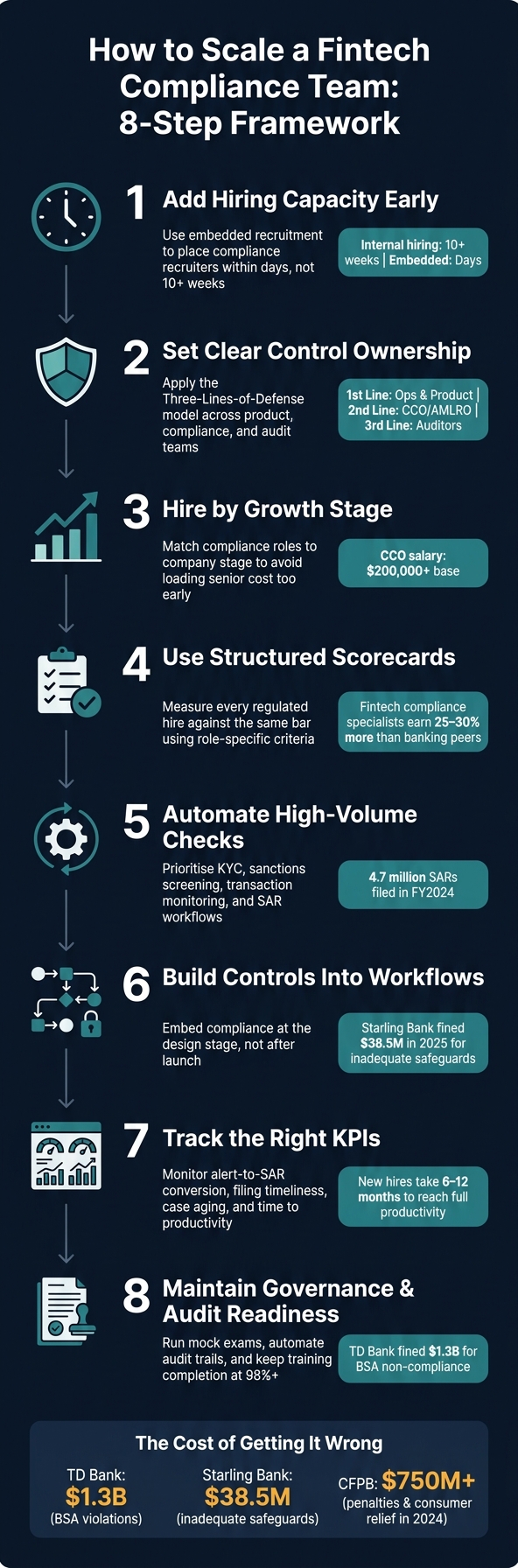
How to Scale a Fintech Compliance Team: 8-Step Framework
Why Fractional Compliance is a No-Brainer for Scaling Businesses
sbb-itb-a23bd6a
Why Compliance Teams Fail During Fast Growth
Most fintech compliance issues start the same way. Workload climbs faster than team capacity. That leads to alert backlogs, slower reviews, and weaker controls.
Timing makes the problem worse. It takes at least 10 weeks to source, interview, and onboard a productive compliance officer [3]. Exams often arrive with only 6 to 8 weeks’ notice [3]. So if monthly alerts jump from 150 to 400, an understaffed team can fall behind almost overnight [3].
And once that happens, manual work becomes a drag on the whole function. Manual checks do not scale. Fragmented tools and siloed data across compliance, product, engineering, and operations turn audit requests into spreadsheet hunts [1][4]. That costs you time, pulls senior people into admin, and makes it harder to show control when scrutiny lands.
The commercial risk is hard to ignore. TD Bank was fined $1.3 billion for BSA non-compliance, showing how weak controls crack under growth pressure [4].
Structure matters too. Compliance fails when the BSA officer lacks executive authority.
"BSA officers deserve a stronger voice at the executive level. Their position can make or break the bank. If you have BSA issues, you can’t grow, you can’t add products or services, and you can’t expand." [5]
That point hits at the core issue. If compliance leadership cannot influence decisions early, problems build in the background until hiring, controls, and oversight all start to slip.
The first fix is to add compliance hiring capacity before the backlog grows.
1. Use Embedded Recruitment to Add Compliance Hiring Capacity Fast
When compliance demand jumps and your internal team can’t keep pace, embedded recruitment helps you close the gap fast. Internal compliance hiring can take 10+ weeks from sourcing to onboarding [3]. By contrast, embedded recruitment can place experienced compliance recruiters into your team within days [1][3].
That matters when you need to hire for business-critical roles like an AMLRO, BSA officer, or DPO. Delays here don’t just slow hiring. They can slow growth, add risk, and pull leadership time into urgent hiring work.
Cost matters too, especially if you’re a pre-Series B fintech watching runway closely. A chief compliance officer in New York can cost about $200,000 in base salary alone, before equity and benefits [1]. A six-month contract can cost about $96,000, or $16,000 per month [3]. For scaling firms, that gap can change how long your cash lasts and how much hiring pressure the business can absorb.
There’s another upside. Experienced compliance specialists spot control gaps faster because they’ve seen the same failure modes before [3]. That means you can identify weak controls sooner, right when growth makes them harder to manage and more expensive to fix.
For fintech SMEs, Rent a Recruiter embeds experienced recruiters within days to manage compliance hiring end to end. You get structure, visibility, and consistency, while cutting hiring costs by up to 70% and saving 80+ hours per month.
2. Set Clear Compliance Ownership Using a Three-Lines-of-Defense Model
Once hiring capacity is in place, assign control ownership before gaps show up.
Fast-growing fintechs often run into trouble when compliance duties are blurred. One team thinks another team owns a control, nobody checks it, and the gap surfaces right before a regulatory exam. The three-lines-of-defense model solves that by giving each layer of the business a clear owner.
| Defense Line | Primary Owners | Key Responsibilities |
|---|---|---|
| 1st Line | Product Managers, Engineers, Ops | Embedding KYC/AML checks, data encryption, and fraud detection triggers directly into workflows |
| 2nd Line | CCO, AMLRO, DPO, Risk Managers | Policy drafting, SAR filing, regulatory monitoring, and staff training |
| 3rd Line | Internal/External Auditors | Independent control testing, mock regulatory exams, and gap analysis |
Here’s how it works in practice. The first line owns risk inside day-to-day workflows. Product, engineering, and operations build controls into the work itself. The second line sets policy, checks adherence, and keeps the business aligned with regulatory duties. The third line tests whether the first two lines are doing what they should.
That split matters because unclear ownership gets expensive fast. Exam findings lead to delays, rework, and leadership distraction. If you’re scaling in fintech, that can slow launches, stretch internal teams, and add cost at the worst time.
Keep the DPO independent and reporting to the board, not product [1]. Early-stage fintechs can use fractional CCOs or AMLROs to fill required officer roles without a $200,000+ salary [1].
Clear ownership helps you avoid control gaps before they turn into exam findings.
With ownership defined, sequence the next hires by growth stage.
3. Sequence Compliance Hires by Growth Stage
Once ownership is clear, the next step is timing. Hire in the order your regulators and your ops team will feel risk first. That keeps spend tied to need, and it helps you avoid loading senior compliance cost into the business too early.
Pre-launch, licensing comes first. You may need to appoint a named AMLRO and DPO at this stage [1]. For many firms, a fractional AMLRO or outsourced compliance lead is the fastest route. It can fill the required regulatory seat in days, while hiring and vetting a full-time executive can take months and slow product launch plans [1].
From seed to Series A, the job changes. Now you need internal structure, not just a named owner on paper. This is usually the point to hire a full-time Compliance Officer to put risk frameworks in place, along with a Bank Secrecy Act (BSA) Officer to run day-to-day AML activity [1].
Post-Series A, your footprint gets bigger, and the work gets more specialised. That’s when a full-time Chief Compliance Officer (CCO) often starts to make financial and operating sense. In major markets like New York, a CCO can command a base salary of $200,000+, before equity and benefits are added [1]. At this point, broad coverage is no longer enough. As the team matures, bring in AML technology specialists to manage alert rules and system testing, and add model-risk validators when AI is used for credit or fraud decisions [2][5].
| Growth Stage | Priority Hires |
|---|---|
| Pre-Launch | AMLRO, DPO |
| Seed to Series A | Compliance Officer, BSA Officer |
| Post-Series A | CCO, AML Technology Specialists |
| Advanced Scaling | Model-Risk Validators |
4. Build Standardized Hiring Scorecards for Regulated Roles
Stage-based hiring only works when every regulated role is measured against the same bar. In fintech compliance, a poor hire leads to rework, slower delivery, and exam risk. Hiring decisions have a direct business cost.
A standardized scorecard cuts out guesswork. Each role carries its own regulatory duties, so the scorecard should match that reality. Build each one around the controls the role will own day to day: BSA/FinCEN for AML, OFAC for sanctions, GDPR/CCPA for privacy. That keeps your hiring process tied to the work that matters, not vague job descriptions.
For model-risk roles, score both technical delivery and examiner defensibility. Someone may be able to build a fraud detection model. That does not mean they can explain it clearly under scrutiny or defend the logic to an examiner. Those are two different skills, and both need testing.
Technical knowledge matters, but pattern recognition often matters more than credentials alone. A certification can signal training. It does not prove judgment under pressure. Use behavioural prompts such as "Tell me about a time you found a BSA gap that nobody else caught" to surface how someone thinks, spots risk, and acts when the stakes are high. Senior compliance specialists in fintech often command a 25% to 30% salary premium over traditional banking peers [6], so you need to know you’re paying for proven skill, not just a polished CV.
| Role | Key Scorecard Criteria | Regulatory Focus |
|---|---|---|
| BSA/AML Officer | SAR/STR filing, programme development, examiner defense | BSA, FinCEN |
| KYC/Sanctions Analyst | Identity verification, escalation logic, sanctions monitoring | AML, OFAC |
| Model-Risk Validator | Algorithmic fairness, model-risk standards, technical defense | CFPB, Federal Reserve |
| Data Protection Officer | Impact assessments, breach notification, data subject requests | GDPR, CCPA |
| RegTech Developer | API standards, technical architecture, data-sharing protocols | Open banking |
Once the rubric is set, assign ownership so each interviewer tests against the same standards. Have the CCO own the scorecard, with legal and product input so the rubric stays tied to how controls work in practice. For AI or ML roles, add a model-risk validator to the process.
5. Invest Early in RegTech and Workflow Automation
Once ownership is clear and the right hires are in place, the next bottleneck is automation. Even a strong compliance team hits capacity limits fast if the work stays manual. At a certain point, manual processes put a ceiling on throughput.
The scale of the risk is hard to ignore. Financial institutions filed 4.7 million SARs in fiscal year 2024 [3]. TD Bank faced a $1.3 billion penalty for BSA non-compliance, which shows what an under-equipped compliance program can cost when volume grows [4].
The first controls to automate should be the ones carrying the most volume:
- Onboarding and KYC/KYB
- Sanctions screening
- Transaction monitoring
- Fraud scoring
- SAR filing
Start there, and you cut manual review, move escalations faster, and lower filing risk. That gives your compliance team more time for judgment-heavy work, where human review still makes the difference.
Tool choice matters most in areas where compliance depends on clean records and fast escalation. Audit trails should be non-negotiable. It also pays to pre-vet critical vendors, such as payment gateways and credit-scoring tools, before integration. If you get that decision wrong, fixing a poor vendor integration later will cost more than checking it properly upfront [4].
6. Embed Compliance Controls Into Product and Operations Workflows
Automation gives you more capacity. But workflow design decides whether your controls hold up when volume climbs. The key move is simple: build controls in at the design stage, not after launch.
Push compliance checks into product design early. Bring in your Data Protection Officer (DPO) or compliance lead to run privacy impact assessments while new features are still being built. That timing matters. Fixing risk before release is cheaper, faster, and far less painful than patching it later. Starling Bank was fined $38.5 million in 2025 due to inadequate safeguards for preventing financial crime [4]. That’s the cost of leaving controls too late. The next step is to place those controls inside the product and operations flow.
Build controls straight into onboarding, payments, fraud, and support workflows. These are the pressure points where compliance risk grows as transaction volume, customer numbers, and team activity increase. Automated screening can deal with volume at scale, while your investigators spend time on the cases that need judgment. In customer support, automated phone support can take routine queries like balance checks and password resets, while human agents handle disputes and more complex cases that need empathy and nuance.
Use this as the design rule for every high-risk workflow: if a process can create compliance exposure, the control should sit inside the workflow itself.
| Workflow Area | Embedded Control | Scaling Benefit |
|---|---|---|
| Onboarding | Embedded KYC checkpoint in the flow | Prevents end-stage manual review |
| Payments | AML detection & encryption | Real-time fraud prevention at mass-market scale |
| Fraud Reviews | Risk-based monitoring & automated screening | Reduction in false positives; investigators focus on high-risk cases |
| Customer Support | Automated phone support | Handles routine volume; keeps headcount flat during growth |
| Product Development | Pre-launch Privacy Impact Assessments | Avoids regulatory fines and costly post-launch reworks |
7. Track the Right Compliance Team KPIs and SLAs
Once controls sit inside day-to-day workflows, you need proof they’re doing the job. That means tracking metrics that show lower risk, faster filing, and team readiness.
Don’t get distracted by raw alert volume. A big number can look busy on paper, but it tells you very little if most of those alerts go nowhere. Alert quality matters more than alert count.
The same applies to team capacity. Headcount on its own is a weak measure. In regulated roles, new hires often take 6 to 12 months to reach full productivity [2]. If you only track team size, you miss the gap between hiring someone and getting full output from them. For CEOs, CFOs, and HR leaders, that gap affects planning, cost, and delivery.
SLAs should tie back to filing deadlines that carry actual risk, especially for SARs and DSARs. Miss those deadlines, and the cost can be more than admin pain. It can turn into direct regulatory exposure. N26 was fined $10 million by German authorities after delays in submitting suspected money laundering reports [8].
Use metrics that show whether your controls are working, how fast your team can file, and whether the function is ready for scrutiny.
| Category | Vanity Metric (Avoid) | Value Metric (Track) |
|---|---|---|
| Operations | Alert volume | Alert-to-SAR conversion rate |
| Risk | KYC/KYB pass rate | KYC/KYB catch rate for sanctioned entities |
| Capacity | Total headcount | Time to full productivity |
| Reporting | On-time SAR filing rate | Filing accuracy and on-time submission rate |
| Privacy | DSARs closed within deadline | DSAR resolution time vs. statutory deadline |
It also helps to review open examiner findings and unresolved issues every month. A growing backlog is often an early sign that audit readiness is slipping.
Recurring findings and missed SLAs shouldn’t just sit in a dashboard. Use them to shape remediation plans, training priorities, and audit prep. That’s where KPI tracking starts to pay off, not as reporting for reporting’s sake, but as a way to tighten control and cut avoidable risk.
8. Build Continuous Governance, Training, and Audit Readiness
Once KPIs show where the gaps are, governance and training are what fix them, and keep them fixed.
Give the CCO or BSA Officer direct executive authority. Without that, compliance cannot stop risky decisions when it needs to. Reporting lines shape who can block risk, not just who can write it down. The DPO should report straight to the board to protect the independence regulators expect. These roles need decision-making power, not just an advisory label.
Training has to sit across the whole business. Annual generic modules don’t work. Role-specific programmes do. AML specialists need hands-on SAR filing drills. Engineers need secure coding and data residency training. Product teams need KYC/KYB workflow walkthroughs. The point is simple: application beats attendance. Training only counts when teams can show they know how to use it in practice.
Keep a clear paper trail for every training cycle, remediation step, and control update. That makes it easier for internal teams to handle requirements in-house, and it cuts the scramble when regulators or auditors ask for proof.
Audit readiness protects scale because it shows your controls hold up under pressure. Run mock exams based on OCC or Federal Reserve methodology before a formal exam [3]. Back that up with automated audit trails, so every transaction and decision is documented by default. When that record-keeping is built in, you save time, cut manual admin, and lower the risk of gaps during review.
The cost of weak controls is not small. Starling Bank was fined $38.5 million in 2025 [4], and TD Bank was fined $1.3 billion for BSA violations [4]. That is why smart teams also plan extra contract staffing solutions for compliance capacity into known peak periods, such as Q2 pre-exam work and November AML alert spikes [3].
With governance in place, the next step is matching compliance roles to company stage.
Compliance Roles by Company Growth Stage
Once ownership is clear, the next step is role design. That sounds simple, but this is where a lot of scaling companies get stuck.
The issue is not only which title to hire next. It is deciding which jobs can sit with one person for now, and which jobs need to split once risk, volume, or regulatory pressure goes up.
That matters because hiring too early can load extra cost into the business. Hiring too late can leave gaps in AML, privacy, vendor risk, or reporting. The goal is to match compliance headcount to business complexity, not guesswork.
Use the map below to decide what to combine, what to split, and when to add specialist coverage.
| Growth Stage | Core Compliance Hires | Roles Often Combined | Typical U.S. Salary Range (USD) |
|---|---|---|---|
| Seed | Fractional CCO, Named AMLRO | CCO, AMLRO, and DPO often one fractional consultant or firm [1] | Hourly/fractional rate |
| Series A | Full-time Head of Compliance/CCO, Compliance Analyst | CCO may also cover DPO and vendor risk; Analyst covers policy, monitoring, and reporting [1] | $200,000+ (CCO) [1]; ~$85,000 (Analyst) [3] |
| Series B to C | AML Officer, KYC/CDD Analyst, Data Privacy Officer (DPO), Vendor Risk Manager | KYC and Sanctions may share a single Financial Crime team until volume forces separation [1][2] | ~$85,000+ per specialist [3] |
| Expansion | Sanctions Specialist, Compliance Tech Specialist, Model-Risk Validator | Specialist coverage required for multi-state licensing, AI-driven decisioning, and third-party risk [2] | Varies by specialization [2] |
A few patterns stand out.
At Seed, combining roles is often the only sensible move. A fractional CCO with named AMLRO cover can give you the oversight you need without locking in a full-time executive salary too early. In many cases, DPO duties sit in that same fractional setup [1]. For founders and CFOs, this keeps cost tight while still putting formal ownership in place.
At Series A, the picture changes. Once hiring volume, partner diligence, board reporting, and policy maintenance start stacking up, one senior person usually cannot carry everything alone. That is why companies often move to a full-time Head of Compliance or CCO, with a Compliance Analyst handling policy admin, monitoring, and reporting [1]. At this point, the cost starts to look more like a function than an adviser line item, with CCO pay at $200,000+ [1] and analyst pay around $85,000 [3].
From Series B to C, compliance starts to fragment into distinct workstreams. AML oversight, KYC/CDD checks, privacy, and vendor risk all begin to pull in different directions. Some teams still keep KYC and sanctions together inside one Financial Crime team, but only until case volume or risk exposure makes that too heavy to manage cleanly [1][2]. This is usually where leaders start seeing the cost of role overlap, weak controls, or slow reviews show up in day-to-day operations.
By Expansion, specialist coverage becomes harder to avoid. Multi-state licensing, AI-driven decisioning, and third-party risk all bring their own demands [2]. That is when roles like Sanctions Specialist, Compliance Tech Specialist, and Model-Risk Validator start making business sense, even if salary levels vary by niche [2].
This role map also shapes which hiring model makes sense at each stage.
Hiring Models for Scaling Compliance Teams
As compliance roles split by stage, the next call is how to staff them without slowing growth. The role map above shows what to hire. This section shows how to fill those roles fast, while keeping control.
Use this comparison to match each hiring method to urgency, control, and complexity.
| Feature | In-House Recruiting | Embedded Recruitment | Single-Role Agency Placements |
|---|---|---|---|
| Speed to Start | Slow | Fast | Fast |
| Process Control | High | High (collaborative, integrated) | Low |
| Budget Certainty | Medium | High | Low |
| Fit for Regulated Hiring | Best for building a permanent in-house TA function | Best for structured, scalable compliance hiring | Best for a single senior or specialized role |
In-house recruiting gives you the most control and the closest tie to company culture. The trade-off is time. It takes longer to build, and it needs a lot of internal bandwidth from leadership, HR, and hiring managers.
Single-role agency placements can work well when you need one senior or highly specialised hire. But costs are less predictable because fees change by search. They are also harder to scale when you need to hire across several compliance roles at once.
Embedded recruitment sits in the middle. You keep a high level of control, but you don’t have to build the whole hiring function from scratch. For fintech SMEs scaling after funding, launching a new product, or dealing with a spike in compliance hiring demand, an embedded recruitment model gives you speed, process control, and clearer monthly cost.
If you want that model with direct support, Rent a Recruiter is built for exactly that kind of regulated hiring pressure.
Once your hiring model is in place, monthly KPIs show whether it’s giving you enough compliance capacity.
Compliance Metrics to Review Every Month
Once hiring is in place, review a small set of monthly metrics to make sure compliance capacity is keeping up with growth.
This matters because headcount on its own tells you very little. What you need is a monthly view of team capacity, control performance, and exam readiness. If those start to drift, the cost shows up fast, in slower reviews, missed deadlines, audit pressure, and avoidable hiring gaps.
A simple way to read this is to group metrics across operations, regulatory, governance, privacy, and hiring pressure.
| Category | KPI | Monthly Target |
|---|---|---|
| Operations | KYC Onboarding Review Time | < 24-hour SLA (95% of cases) |
| Operations | Alert Backlog | < 500 alerts pending review |
| Operations | False Positive Rate | 1.5% of total alerts flagged |
| Operations | Case Aging | 90% of cases closed within 15 days |
| Regulatory | SAR Filing Timeliness | 100% filed within 30-day SLA [1] |
| Governance | Audit Issue Closure Rate | 95% of issues closed within 60 days |
| Governance | Training Completion | 98% staff completion rate |
| Data Privacy | DSAR Response Timeliness | 100% within statutory deadlines [1] |
| Hiring | Time-to-Fill (Standard Role) | 70-day average (10 weeks) [3] |
| Hiring | Time-to-Fill (Specialized Role) | 180-day average (6 months) [7] |
A few of these need close attention every month.
- Alert volume per analyst helps you spot capacity strain before it turns into a backlog.
- SAR filing timeliness helps you catch filing risk early. U.S. financial institutions filed 4.7 million Suspicious Activity Reports in fiscal year 2024 [3].
- Time-to-fill is not just a hiring metric. In regulated teams, open roles create direct control gaps.
Review the dashboard monthly, then link any spikes back to staffing, training, or remediation actions.
If case aging starts to climb, or training completion slips, treat that as an early warning. Fixing pressure early is far cheaper than cleaning up failures later.
Conclusion
Scaling a fintech compliance team comes down to structure and timing.
The companies that handle it well don’t treat compliance like a box to tick after something goes wrong. They build it into hiring, product, and operations from the start. In practice, that means lining up four pieces in the right order: hiring capacity, ownership, controls, and governance.
That order matters. Get it wrong, and the cost can climb fast.
The CFPB ordered over $750 million in penalties and consumer relief in 2024 [3]. That figure makes the point on its own. Weak structure is not a minor admin issue. It turns into financial risk, delay, and pressure on the whole business.
The practices covered here all lead back to the same idea: put structure in place before growth gets ahead of your controls. That includes clear ownership through a three-lines-of-defense model, stage-based hiring, standardized scorecards, early RegTech investment, embedded controls, and monthly governance reviews.
If compliance hiring still takes 10+ weeks, act now. Rent a Recruiter places recruiters inside your team within days, helping fintech SMEs hire faster, cut admin, and reduce costs by up to 70%.
FAQs
When should a fintech scale its compliance team?
A fintech should scale its compliance team as it grows. Compliance is a permanent part of the business, not a short-term cost line, so it needs to be part of your growth plan from day one.
As your user base grows, your product gets more complex, or you enter new markets, your regulatory load grows too. Scaling compliance in step with that growth helps you stay safe, cut friction with regulators, and protect customer trust.
Which compliance roles should be hired first?
Start with leadership and the core roles that keep you legally operating and ready for audit.
You need a Chief Compliance Officer, or the local equivalent, as the person ultimately accountable for the compliance function. Then add an AMLRO, a role many jurisdictions require and one that sits at the centre of anti-money laundering oversight.
Alongside those leadership hires, bring in a Compliance Officer to run the day-to-day work. That usually means policies, risk frameworks, SOPs, and contact with auditors and partners. If your business handles personal data, you should also appoint a Data Protection Officer.
For scaling firms in SaaS, Fintech, Insurance, and other regulated sectors, these roles are not just about box-ticking. They protect your ability to operate, reduce audit friction, and cut the risk of costly compliance gaps.
What KPIs best show compliance team capacity?
In fintech, the best KPIs tell you if your team can scale, not just stay busy.
Focus on:
- Time to productivity for new hires
- Retention at 12 and 24 months
- Cross-functional collaboration effectiveness
- Fewer regulatory incidents
Taken together, these metrics show whether compliance oversight is keeping pace with business growth.