Hiring the right talent isn’t just about job ads anymore. It’s about showing candidates what it’s like to work with you. Employee stories deliver this insight, helping companies reduce early turnover and improve hiring outcomes.
Scaling businesses especially benefit, as these stories give potential hires a clear, realistic picture of the workplace, saving time and reducing cost per hire on mismatched hires.
Key Takeaways:
- Why it matters: Replacing an employee can cost 50%-200% of their annual salary. Employee stories help set realistic expectations, reducing turnover.
- How it works: Structured Q&As highlight personal growth, challenges, and achievements, giving candidates a real sense of the role.
- For scaling companies: Employee stories ensure consistent messaging during rapid hiring, helping candidates connect with your mission and values.
Want to improve hiring efficiency and attract the right people? Rent a Recruiter can embed recruiters into your team to streamline this process.
Bring Your Employer Brand to Life with Employee Stories
See how these stories translate into results in our embedded recruitment case studies.
sbb-itb-a23bd6a
How to Structure Employee Q&A Stories
A well-structured Q&A can bring out the personal details that resonate with potential candidates. The difference between a forgettable testimonial and one that truly connects often lies in how the questions are framed. Here’s how to craft questions that draw out meaningful, relatable answers.
Choosing the Right Questions
The most common mistake? Asking questions that are too vague. A question like "Do you enjoy working here?" will likely get a simple yes or no. Instead, aim for prompts that invite storytelling. For example:
"Can you share a moment when you felt proud to work here?" or "How has this role helped you grow?"
Direct your questions toward role impact, memorable experiences, and personal growth. As Bruce Carey of Recruitics explains:
"’Our organization values career growth’ is generic and broad. Instead, say, ‘John started as an entry-level analyst five years ago and is now leading a team of 20.’" [5]
For senior-level candidates, don’t be afraid to ask tougher questions. For instance, how the company navigated a challenging product issue or a difficult period can lead to answers that feel more real and credible.
Keeping Responses Genuine
Once you’ve collected responses, resist the urge to over-edit them. Over-polishing testimonials strips away their authenticity. Candidates can easily spot overly corporate phrasing, and it often backfires.
Real, unpolished language builds trust. Keep the employee’s original tone and phrasing intact, even if it feels a little informal. A sentence that sounds like it came straight from the person will always resonate more than something that feels scripted. Encourage employees to share their challenges and how they overcame them – these moments make testimonials relatable and trustworthy.
Building a Repeatable Question Framework
When gathering stories across different teams, consistency is key. A repeatable framework not only saves time but also ensures that stories from various departments align and can be compared. Courtney Casey, Director of Marketing Operations at VC3, highlights the benefits of this approach:
"Having the bank of employee stories has been incredible. We’ve been able to reuse them to develop our employer brand – what are people saying about us, why do they like working here, what is our employer value proposition." [2]
Create a role-specific question bank tailored to individual contributors and managers. Pair this with a simple one-page guide for employees, encouraging them to focus on specific experiences rather than generic company slogans. Always include their name and title; anonymous testimonials lack credibility. A consistent framework ensures every story reinforces your company’s values and culture, making it easier to scale recruitment efforts effectively.
Connecting Individual Stories to a Single Culture Message
Aligning Stories with Your Employer Value Proposition
Once you’ve crafted structured Q&A stories, the next step is ensuring they consistently reflect your company’s values. This is where your Employer Value Proposition (EVP) plays a key role. Before publishing any story, ask yourself: Does this align with one of our core values? For example, Terri Cohen of Hueman tied employee stories to five core values – Excellence, Change, Teamwork, Trust, and Service – through a "Core Value Awards" program. Winners were celebrated on a "Wall of Fame", and the results spoke volumes: more than 200 hires in two years and a "Great Place to Work" certification maintained for an impressive 16 years straight. [7]
What makes a story resonate isn’t just its alignment with values but its specificity. Real names, measurable outcomes, and clear timelines add authenticity, making the narrative feel genuine rather than like a marketing pitch. Vague or overly polished anecdotes, on the other hand, can feel insincere and fail to connect with the audience.
This approach ensures you can authentically showcase a wide range of experiences within your company.
Representing Diversity Across the Company
No single story can encapsulate an entire workplace culture. To provide a more complete picture, actively seek out stories from across your organization – different roles, teams, locations, and career stages. This is especially significant for underrepresented candidates. Greg Russell, Head of Talent at Snapdocs, puts it succinctly:
"Underrepresented candidates evaluate culture more carefully than the average applicant. Generic recruiting decks do not give them the signal they need." [4]
Sharing stories that include moments of challenge – such as a failed product launch, navigating rapid change, or enduring tough quarters – can highlight psychological safety and a culture of honesty. Building a diverse story bank ensures that each narrative connects with its intended audience, offering a more authentic glimpse into your workplace.
Sharing Remote and Hybrid Work Experiences
Diversity in storytelling isn’t just about roles and teams. It also includes capturing experiences from varied work environments, like remote or hybrid setups. For candidates exploring these roles, culture can be harder to perceive. Without the chance to physically visit the office or experience the energy of shared spaces, employee stories become the primary lens into daily life.
In March 2025, Frontify’s Senior Talent Partner, Kiren Raisinghani, shared how the company revamped its values using Peakon scoring and Glassdoor feedback. They distilled their values into four core beliefs – "we are constructive, we thrive, we are united, and we are real" – tailored for a distributed workforce. These values came to life through initiatives like "Donut Chats", which paired employees for informal conversations, and an annual in-person event called "Hive." [3] These initiatives created moments employees could reference in their own stories, making the company’s culture tangible even in a remote setting. For more insights, explore our recruitment resources.
When gathering stories from remote employees, ask about their collaboration habits, onboarding experiences, and how they stay connected to the broader team. These details help potential hires understand what flexibility and a sense of community look like in practice.
Building a Process for Collecting Employee Stories at Scale
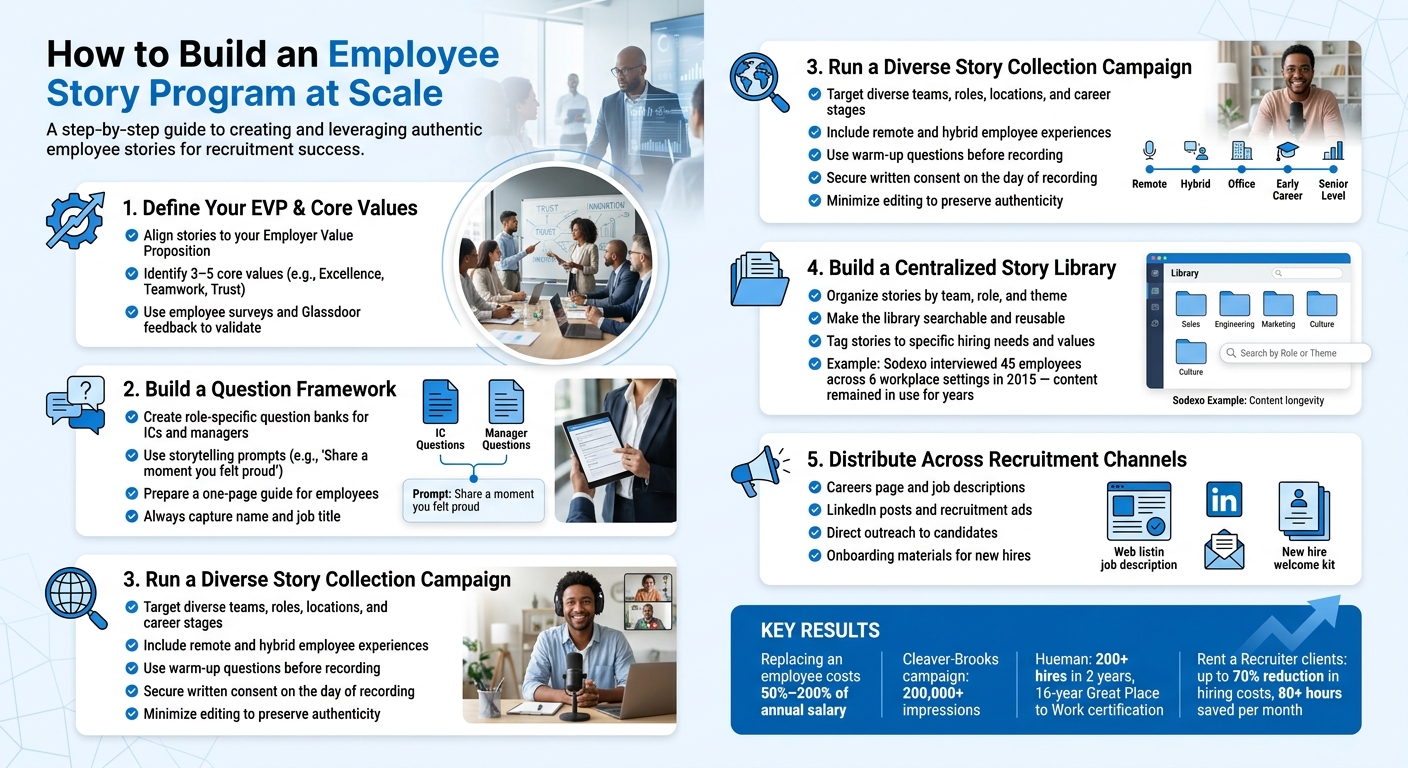
How to Build an Employee Story Program That Attracts Top Talent
A structured approach to collecting employee stories ensures your employer branding efforts are grounded in real, relatable narratives while supporting your broader recruitment goals.
Setting Up a Story Collection Process
Gathering one employee story is straightforward, but scaling this effort takes a clear, repeatable process. Think of it as a form of brand journalism – actively interviewing employees to capture their genuine insights and experiences. [9]
Start with a focused campaign that includes diverse teams and locations. For example, Sodexo launched such an initiative in 2015, interviewing 45 employees across six workplace settings. They began with focus groups and surveys to define their core brand promises before any filming took place. The resulting content library proved so effective that it remained in use for years, enriching their careers site and marketing materials. [10]
To scale effectively, follow a few key principles:
- Secure written consent on the day of recording to avoid delays. [10]
- Use warm-up questions to help employees feel comfortable before diving into discussions about company culture. Avoid overly scripted responses to maintain authenticity. [8]
- Keep editing minimal. Instead of polishing responses, focus on preserving the natural tone of the stories.
"Resist the urge to correct their language or how they’re describing things. It’s more important to show authenticity than hitting on the right buzz words." – Abby Cheesman, Co-founder, Skill Scout [10]
Store these stories in a centralized, searchable library organized by team, role, and theme. This makes it simple to find and repurpose stories for different recruitment channels without having to start from scratch every time.
Once you’ve built a robust library, the next step is weaving these stories into your recruitment strategy.
Using Stories Across Recruitment Channels
To make the most of employee stories, distribute them strategically across candidate touchpoints. Start with your careers page, but don’t stop there. Incorporate testimonials into job descriptions to give candidates immediate insight into your company culture. [1] Share these narratives on LinkedIn, in recruitment ads, and even in direct messages to candidates who are still considering applying. [9]
Employee stories can also enhance onboarding materials. New hires who see authentic accounts from their colleagues before their first day arrive with a clearer understanding of the team and culture they’re joining.
The trend among high-growth companies is clear: recruitment messaging is shifting from simple "We’re hiring" posts to experience-driven narratives. These stories answer candidates’ deeper questions and build trust long before they hit "Apply." [2] They do what job postings alone cannot – convincing candidates of the value of joining your team.
How Embedded Recruitment Partners Can Help
Even with a clear process in place, maintaining a steady flow of employee stories can strain internal resources. HR teams are busy filling roles, and marketing teams are focused on lead generation, leaving little room for ongoing storytelling efforts.
"HR and people operations teams aren’t marketers… having a bank of ready-made assets we can use to help HR with their main goal takes it off our plate." – Courtney Casey, Director of Marketing Operations, VC3 [2]
This is where Rent a Recruiter can make a difference. By using embedded recruitment to integrate experienced recruiters into your team, they take on the role of internal brand journalists, keeping your story library updated and aligned with your hiring needs. [9] Employer branding becomes a seamless part of your recruitment process, ensuring the stories you share highlight the roles you’re hiring for, the teams that are expanding, and the culture you’re building every day.
Conclusion: Turning Employee Stories Into a Talent Magnet
Key Takeaways
Employee stories bring your company culture to life. When candidates read about a team member’s personal experiences, a challenge they’ve overcome, or a moment of pride in their work, they start to imagine themselves in that environment. That emotional connection can turn a casual observer into an engaged applicant.
Including details like names, job titles, and specific situations adds credibility. As Recruitics points out:
"People are naturally skeptical of vague, nameless testimonials. A testimonial that includes a person’s name and role shows there’s a real person behind the words, lending credibility." [1]
These stories do more than build trust – they set clear expectations. When candidates understand both the rewards and challenges of a role upfront, they’re more likely to stay long-term. By organizing these stories into a searchable library and sharing them across your careers page, job ads, LinkedIn, and onboarding materials, a single authentic story can resonate with hundreds of candidates.
The results speak for themselves. Cleaver-Brooks‘ employee spotlight campaign generated over 200,000 impressions and earned second place for Best Launch of Recruitment Marketing Strategy at the 2024 Rally Awards – showing how a strong storytelling strategy delivers real impact. [6]
Use these insights to turn recruitment into a competitive advantage.
Call to Action
If you’re scaling quickly and struggling to build or maintain an employee story library, Rent a Recruiter can help. By embedding experienced recruiters into your team, you can streamline employer branding efforts and ensure your recruitment content stays fresh and aligned with your hiring goals. This approach not only keeps your storytelling effective but also integrates seamlessly into a scalable recruitment process.
Companies partnering with Rent a Recruiter often reduce hiring costs by up to 70% compared to traditional commission-based models, while saving over 80 hours per month on internal hiring tasks.
Want to showcase your culture and attract the right talent? Book a call with Rent a Recruiter to see how embedded recruitment can help you share your story and connect with candidates who align with your vision.
FAQs
How do we pick employees for stories?
Employees are chosen based on their real-world experiences and how well they embody the company’s culture. This involves asking thoughtful questions, paying close attention to their insights, and emphasizing achievements or viewpoints that align with the organization’s core values. The aim is to share relatable stories that bring the workplace to life, helping to build trust with potential candidates by showing what truly sets the company apart.
What questions get real, unscripted answers?
Questions that spark genuine, unscripted answers tend to be open-ended and personal. They invite reflection and honest sharing, whether in employee interviews or leader Q&A sessions. These kinds of prompts help people share their real experiences and viewpoints, offering a window into their authentic perspectives.
Where should we publish employee stories?
Employee stories resonate most when shared on platforms that showcase your workplace culture and connect with your target audience. The best places to do this include your company’s career page, social media channels like LinkedIn, Facebook, and Instagram, and even internal platforms. These outlets offer broad reach and the chance to use multimedia – like videos and photos – to build genuine, emotional connections with potential candidates while giving them a glimpse into your work environment.