
Want to increase hiring success by 35% while reducing costs? Diversity talent mapping uses data to identify and engage underrepresented talent pools, helping businesses achieve better hiring outcomes. For scaling companies, it’s a smarter way to build teams that drive results.
Here’s what you need to know:
- Job seekers care about diversity: 67% of candidates in 2026 consider diversity a deciding factor in job offers.
- Data improves hiring outcomes: Companies using recruitment reports and analytics see a 35% boost in diversity hiring rates and faster time-to-hire.
- Bias reduction matters: Tools like blind screening and inclusive job descriptions increase applications from underrepresented groups by 30–40%.
- SMEs benefit most: Predictive analytics reduce mis-hires, cut costs, and improve workforce planning accuracy.
If your hiring process isn’t delivering diverse talent, it’s time to rethink your approach. Use data to pinpoint gaps, refine job postings, and expand recruitment channels. Need help? Rent a Recruiter provides embedded recruitment solutions that streamline hiring while cutting costs by up to 70%.
Diversity in Data | AI & Analytics for improving Equality, Diversity & Inclusion (EDI) interventions
sbb-itb-a23bd6a
What Recent Studies Show
Recent studies highlight the tangible impact of proactive diversity strategies, particularly when they are data-driven. Using analytics to guide diversity talent mapping has proven to enhance key hiring metrics. Organizations that adopt structured approaches to building diverse teams see measurable benefits.
35% Increase in Diversity Hiring Rates
Data-driven diversity talent mapping has led to a 35% increase in diversity hiring rates compared to traditional recruitment methods. This success comes from moving away from reactive job postings to actively identifying and engaging underrepresented talent. Instead of waiting for applications, companies use data to pinpoint where diverse candidates are located – targeting specific talent pools across industries and regions.
For small and medium-sized enterprises (SMEs), this approach is especially impactful. By minimizing unconscious bias, it improves hiring outcomes and creates a more inclusive process. As the Armstrong Craven Team explains:
"Talent mapping prioritises candidates’ skills, qualifications, and potential cultural fit rather than making decisions based on surface-level characteristics"[5].
Younger workers also value these efforts. A staggering 83% of Gen-Z candidates consider a company’s diversity initiatives when choosing where to work, while 75% would rethink applying if they felt the organization lacked commitment to diversity[5]. Beyond just improving hiring rates, this data-driven approach also strengthens workforce planning.
Better Workforce Planning Accuracy
Analytics don’t just boost hiring – they also refine workforce planning. Diversity talent mapping provides a clear visual of current and future talent needs, giving companies real-time insights into their recruitment pipelines[3]. For SMEs, this precision reduces the risk of costly mis-hires and speeds up onboarding. Vanessa Kahkesh, Content Marketing Manager at Rippling, notes:
"Talent mapping enables hiring managers and HR teams to identify essential skills, evaluate employee strengths, and prepare for the future"[4].
This method allows businesses to spot high-potential candidates early, build relationships, and address skill gaps well before they become urgent hiring challenges. It’s a forward-thinking approach that ensures companies are prepared for what’s next.
Data-Driven Methods for Diversity Talent Mapping
Diversity talent mapping goes beyond traditional recruitment methods, offering a more effective way to engage underrepresented talent. By leveraging data and analytics, SMEs can reduce bias, improve hiring efficiency, and build more inclusive teams.
Analyzing Job Posting Data
The first step is to examine job postings for hidden biases. Inclusive language tools can help identify and replace biased terms with gender-neutral alternatives, ensuring your job descriptions appeal to a wider audience[6]. For instance, tools like Enlighten Jobs suggest alternatives and synonyms to broaden your reach. A good example? Searching only for "software engineer" might exclude candidates who identify as "software developer" or "application programmer."
Beyond language, tracking where diverse candidates drop out in the hiring process can reveal critical bottlenecks. Ian Cook, Vice President of People Analytics at Visier, highlights the importance of this approach:
"Data-driven recruitment is the difference between making these decisions on gut feeling and making them based on facts"[9].
Instead of viewing diversity as a single metric, measure success rates for different groups at every stage – from application to interview to offer. With this data, predictive analytics can uncover hidden patterns and refine your hiring strategy.
Using Predictive Analytics
Predictive analytics uses historical hiring data to identify trends and gaps. For example, it can highlight underrepresentation of certain races or genders in specific departments and suggest actionable steps to address these gaps[8]. AI tools focus on competencies, removing bias and ensuring objective matches based on skills.
The results speak for themselves. Studies show that diverse teams make better decisions 87% of the time, and companies hiring from non-traditional talent pools – like caregivers, veterans, or candidates without formal qualifications – are 36% less likely to experience skills shortages[8]. Predictive tools also help SMEs track long-term outcomes, such as promotion and retention rates, ensuring inclusivity remains a priority beyond initial hiring.
But effective diversity recruitment isn’t just about data; it’s also about knowing where to look.
Finding the Right Talent Channels
The choice of recruitment channels can greatly impact your ability to reach diverse candidates. Talent mapping helps pinpoint the platforms that align with your goals. While LinkedIn is a popular choice, SMEs should also explore niche platforms. For technical roles, GitHub and Stack Overflow are excellent options, while AngelList caters to startup-focused candidates[7]. Additionally, diversity-specific job boards like Jopwell (Black, Latinx, and Native American professionals), PowerToFly (gender diversity), and PDN Recruits (BIPOC talent) offer targeted access to underrepresented groups[6].
AI-powered tools like SeekOut and Gem simplify the process by searching multiple platforms simultaneously. These tools allow recruiters to filter candidates by demographics, skills, and backgrounds, expanding reach significantly. This is especially important given that 73% of job seekers consider workplace diversity a key factor when applying for jobs[6].
| Tool Category | Specific Tools | Key Advantage |
|---|---|---|
| Sourcing Intelligence | SeekOut, Gem, TurboHire | AI-driven filters for demographics and skills |
| Niche Job Boards | Jopwell, PowerToFly, PDN Recruits | Direct access to BIPOC and gender-diverse communities |
| Bias Reduction | PMaps, HireHunch, AssessHub | Blind screening and anonymized candidate matching |
| Cross-Platform | GitHub, Stack Overflow, AngelList | Specialized tech and startup talent identification |
How SMEs Benefit from Diversity Talent Mapping
For small and medium-sized enterprises (SMEs), diversity talent mapping offers more than just a compliance checkbox. It transforms hiring into a strategic advantage, improving retention, reducing costs, and supporting sustainable growth.
Lower Employee Turnover
Talent mapping tools equipped with predictive analytics can highlight employees at risk of leaving, allowing SMEs to address concerns before they escalate[10]. By spotting patterns of dissatisfaction early, businesses can retain key team members and avoid the disruption of unexpected departures. Internally, mapping also identifies high-potential employees for leadership roles, creating clear pathways for growth. This approach aligns with Gen Z’s preference for workplaces that prioritize diversity and development opportunities.
Lower Costs and Faster Hiring
On the financial side, diversity talent mapping slashes the average U.S. cost-per-hire of $4,700 and speeds up hiring by 33% compared to traditional methods[10][12]. This efficiency is critical when you consider that vacancies can cost mid-sized companies millions in lost productivity annually, according to McKinsey[10].
Diversity-focused tools also anonymize candidate information, uncovering talent often overlooked in traditional resume reviews – up to 60% of cases[11]. By building proactive talent pipelines, SMEs reduce their reliance on costly external recruiters and cut down on vacancy-related expenses. Additionally, 84% of employers have noted that skills-based hiring, a core feature of diversity mapping, improves workforce diversity[11].
These operational gains not only save money but also position SMEs for scalable and efficient growth.
Supporting Business Growth
Integrating diversity goals into talent acquisition isn’t just ethical – it’s a smart business move. In 2025, 50% of SMBs reported struggling to fill roles due to a lack of qualified candidates[13]. Diversity mapping addresses this challenge by broadening the pool of potential hires.
As Ann Schumann, a Content Writer and Former Recruiter at Manatal, puts it:
"Traditional hiring tends to be reactive, waiting for openings and then scrambling to fill them. Talent mapping offers a proactive alternative"[10].
With 66% of businesses planning to increase headcount in Q1 2026[13], SMEs that embrace diversity talent mapping will be better equipped to grow efficiently, avoiding the inefficiencies of rushed or unfocused hiring efforts.
How to Implement Diversity Talent Mapping
Using data-driven insights, here’s how you can implement diversity talent mapping effectively. With targeted actions, SMEs can see measurable progress within 30 days.
Start with a Talent Audit
Review hiring data from the past 12 months to uncover gaps in your recruitment process. Focus on the breakdown of demographics at each stage – from application to hire – and calculate interview-to-offer ratios for different groups. Pay close attention to 12-month retention rates. If diversity improves at the hiring stage but declines within a year, the issue may be tied to workplace inclusion rather than recruitment practices. As Talentprise highlights:
"Auditing your hiring funnel data and comparing the demographic composition at the application, interview, and offer stages tells you exactly where the gap opens up and which intervention is actually needed." [14]
Use voluntary self-identification data to monitor progress and set aspirational representation goals. Research shows companies in the top quartile for ethnic and cultural diversity outperform their peers by 36% in profitability [14].
Use Analytics to Detect Bias
Once you identify where candidates are dropping off, use analytics to address potential biases. Start by auditing job descriptions for exclusionary language – phrases like "ninja" or "aggressive" can discourage diverse applicants [14]. Introduce blind screening by removing names, addresses, and graduation years from resumes before review. Structured interviews with consistent questions and competency-based evaluations can also help minimize bias [14]. Track the progression of diverse candidates through the hiring funnel to ensure they are advancing at rates comparable to others.
After addressing bias, focus on expanding your reach to build a more diverse candidate pool.
Expand Your Recruitment Channels
Collaborate with organizations such as the National Society of Black Engineers (NSBE), Society of Women Engineers (SWE), and Out in Tech to tap into specialized networks [14]. Broaden your search beyond traditional sources by partnering with Historically Black Colleges and Universities (HBCUs), coding bootcamps for first-generation learners, and vocational training programs [14]. Shifting from job title requirements to skills-based criteria can increase the proportion of women in AI talent pools by up to 24% [14]. Additionally, diversify employee referral programs by encouraging referrals from underrepresented groups, breaking the cycle of homogeneous networks [14].
If implementing these steps feels overwhelming, external support can simplify the process.
Get Expert Support from Rent a Recruiter
Rent a Recruiter offers a free Recruitment Health Check, providing a tailored PDF report with insights into your employer branding, hiring practices, and diversity benchmarks. This helps pinpoint whether issues lie in sourcing, screening, or interviewing. For SMEs dealing with growth surges or scaling after funding, Rent a Recruiter embeds experienced recruiters into your team within days. These recruiters bring the structure, data-driven methods, and visibility needed to implement diversity talent mapping effectively. Businesses can cut hiring costs by up to 70% compared to traditional commission-based models, while reducing administrative burdens and creating a scalable, predictable recruitment process.
Traditional vs. Data-Driven Diversity Talent Mapping
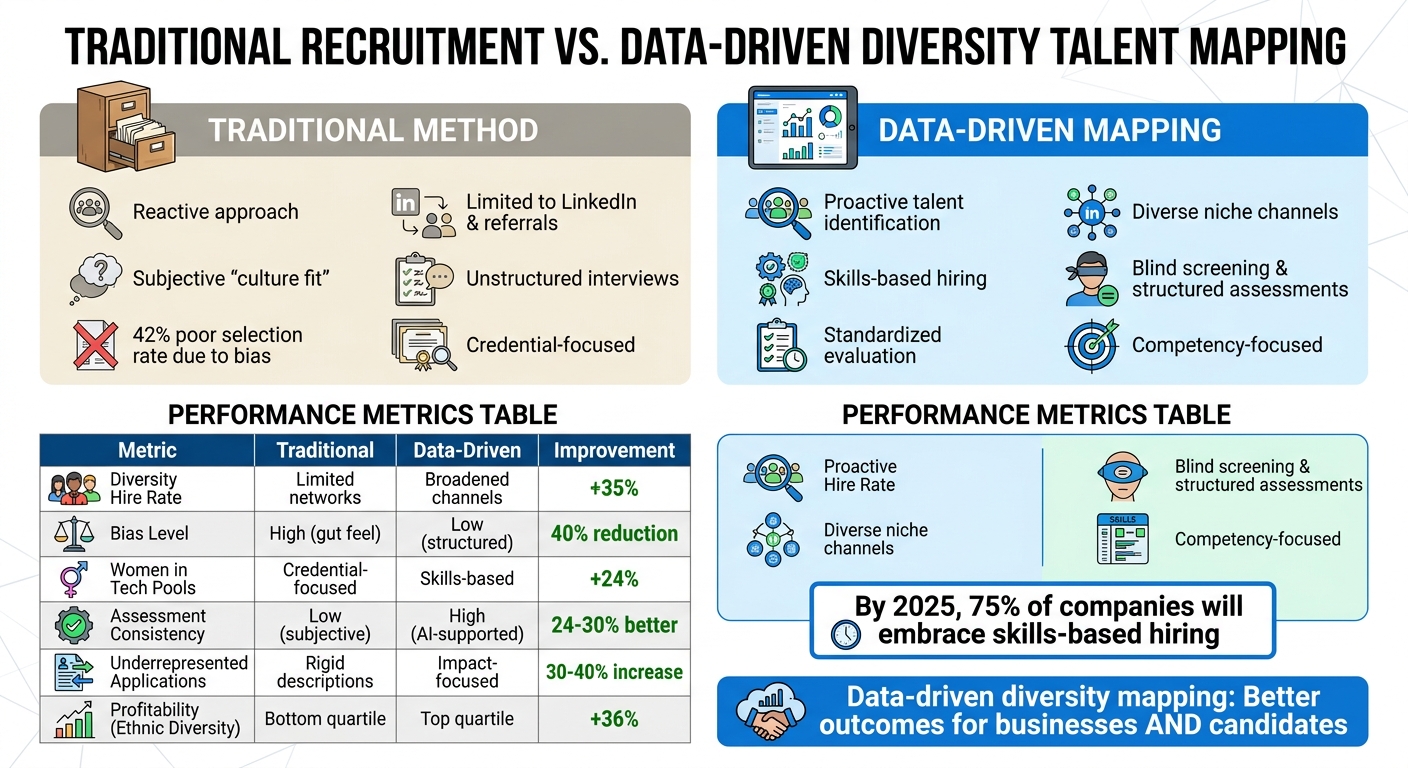
Traditional vs Data-Driven Diversity Recruitment: Performance Metrics Comparison
Let’s take a closer look at how traditional recruitment methods stack up against modern, data-driven diversity talent mapping.
Traditional recruitment often works reactively, leaning heavily on familiar channels like LinkedIn and employee referrals. This approach limits hiring teams to the same candidate pools they’ve always tapped into [1][14]. Decisions in these processes frequently hinge on subjective "culture fit" evaluations and unstructured interviews, leading to a 42% chance of poor candidate selection due to unconscious bias [14].
In contrast, data-driven diversity talent mapping takes a proactive approach. It identifies both internal and external talent pools that align with long-term objectives [1]. Instead of fixating on rigid credentials, it emphasizes skills-based hiring, blind screening, and structured assessments [2][14]. As Augtal puts it:
"When every candidate gets different questions and there’s no standardized evaluation rubric, hiring decisions default to ‘gut feel’ – which is just unconscious bias wearing a business suit." [2]
This structured methodology not only reduces bias but also offers measurable financial benefits. Companies in the top quartile for diversity see a 36% boost in profitability, while gender diversity in leadership increases the likelihood of above-average profitability by 25% [14]. Moving from credential-based requirements to skills-focused hiring has been shown to increase the representation of women in AI talent pools by as much as 24% globally [14].
Performance Comparison Table
Here’s how traditional methods compare to data-driven diversity talent mapping across key metrics:
| Metric | Traditional Method | Data-Driven Mapping | Improvement % | Source |
|---|---|---|---|---|
| Diversity Hire Rate | Limited by existing networks | Broadened through niche channels | +35% | [2][14] |
| Bias Reduction | High (Unstructured/Gut feel) | Low (Structured/Blind) | 40% | [14] |
| Women in Tech Pools | Credential-focused filtering | Skills-based evaluation | +24% | LinkedIn 2025 [14] |
| Assessment Consistency | Low (Subjective) | High (AI-supported/Structured) | 24–30% | [14] |
| Underrepresented Applications | Rigid job descriptions | Impact-focused job descriptions | 30–40% | [2] |
| Profitability (Ethnic Diversity) | Bottom Quartile | Top Quartile | +36% | McKinsey [2][14] |
Teams that adopt structured, AI-supported interviews see a 24–30% improvement in assessment consistency [14]. Additionally, rethinking job descriptions to focus on impact rather than rigid requirements can increase applications from underrepresented groups by 30–40% [2]. By 2025, 75% of companies are expected to embrace skills-based hiring [14], eliminating unnecessary barriers that previously excluded diverse talent.
The results are clear: data-driven diversity talent mapping isn’t just about fairness – it’s about delivering better outcomes for businesses and candidates alike.
Next Steps
Data-driven diversity mapping isn’t just a buzzword; it’s a game-changer. Taking a skills-first hiring approach can reduce vacancy fill time by 33% [12]. Plus, with 83% of Gen Z candidates prioritizing diversity when choosing a workplace [5], having an inclusive hiring strategy isn’t just ethical – it’s a competitive edge.
Here’s how to move forward: start by auditing the last 12 months of your hiring data. Pinpoint where diverse candidates are dropping out – whether it’s during applications, interviews, or at the offer stage [14]. This will reveal whether your challenge lies in attracting diverse talent (a pipeline issue) or advancing them through the process (a selection issue). Once you have clarity, take action. Introduce blind screening, refine job descriptions to be more inclusive, and standardize interviews to cut down on bias [11][14].
For tailored insights, try Rent a Recruiter’s free Recruitment Health Check. This tool delivers a detailed PDF report highlighting your employer branding strengths, process gaps, and diversity opportunities [15]. It even helps you assess your current diversity efforts, whether you’re just getting started ("Diversity Talent Aware") or aiming to become a "Diversity Talent Ally."
If you’re ready to operationalize these insights, embedding an experienced recruiter into your team could be the next step. Rent a Recruiter’s embedded recruitment services streamline your hiring process, offering structure, transparency, and consistency – all while cutting costs by up to 70% compared to traditional models. Their recruiters work as part of your team, managing everything from sourcing to onboarding, and saving you over 80 hours a month in admin time.
Don’t wait. Build an inclusive and efficient hiring strategy today. Book a call with Rent a Recruiter or explore the Recruitment Health Check to get started.
FAQs
What data do I need to start diversity talent mapping?
To kick off diversity talent mapping, start by gathering data on the total available talent pool for the roles you’re hiring. Pay close attention to factors like skills, experience, and demographics. Keep an eye on the diversity of your candidate sources, the makeup of your overall talent pool, and even your recruiting team itself.
Dive deeper by analyzing data from key hiring stages, such as interviews and shortlists, to pinpoint where biases might be creeping in. This approach allows you to set clear diversity targets, tackle sourcing gaps, and weave diversity into your overall hiring strategy.
How do I measure bias at each hiring stage?
Tracking bias in recruitment requires a data-driven approach. By analyzing diversity and representation at each stage of the hiring process, you can uncover where disparities may exist.
Here’s how:
- Examine candidate sources: Are you attracting applicants from a broad range of backgrounds, or are certain groups underrepresented from the start?
- Review applicant demographics: Analyze the diversity of your applicant pool to ensure it reflects your outreach efforts.
- Track interview invitations: Compare which demographics are advancing to interviews and identify any patterns of exclusion.
- Monitor shortlisted candidates: Look for disparities in who makes it to the final stages of consideration.
- Assess final hires: Evaluate whether your hiring decisions align with your diversity goals.
By comparing these metrics across demographic groups, you can identify potential drop-off points where certain groups may be disproportionately excluded. This insight allows you to implement targeted actions to address bias and create a more inclusive hiring process.
What are the best channels to reach underrepresented talent?
The best ways to connect with underrepresented talent involve targeted recruitment tools, setting clear diversity-focused metrics, and writing inclusive job descriptions. Research consistently shows that tailored outreach strategies not only engage a more diverse pool of candidates but also lead to better hiring results.