
Hiring isn’t cheap, but understanding your true cost-per-hire (CPH) can save you thousands per role. Whether you’re scaling fast or tightening budgets, tracking this metric gives you control over recruitment expenses and helps you make better decisions.
Key takeaways:
- The average CPH in the U.S. is $4,700, but roles like engineering or executive hires can cost significantly more – up to $10,625 per hire.
- Internal costs (recruiter salaries, hiring manager time) are often overlooked, leading to underestimations of true CPH by 30–50%.
- Poor hiring choices can cost up to 30% of a bad hire’s annual salary.
Cost Per Hire Metric – HR Metrics
sbb-itb-a23bd6a
What Is Cost-Per-Hire?
Cost-per-hire (CPH) measures the total expense of recruitment – from the moment a job is posted until the new hire’s first day. It’s defined by the ANSI/SHRM 06001.2012 standard [1][5]. Importantly, CPH focuses solely on the cost of finding a candidate, excluding salaries, benefits, and ongoing training.
"Cost per hire is not the cost of employing someone. It is the cost of finding them." – Wisemonk [1]
While CPH is a useful indicator of recruitment efficiency, it doesn’t tell the whole story. A lower CPH doesn’t always equal better hires. To get a clearer picture of recruitment success, many experts suggest pairing CPH with metrics like Quality of Hire and 90-day retention rates.
CPH is broken into two main categories: internal and external costs.
Components of Cost-Per-Hire
Many companies only track external costs, which can lead to underestimating the true CPH by as much as 30–50% [1].
| Cost Category | Examples |
|---|---|
| Internal | Recruiter salaries (prorated), hiring manager interview time, applicant tracking systems, employee referral bonuses, HR administrative overhead |
| External | Job board fees, agency or headhunter commissions, background checks, drug testing, sponsored ads, candidate travel, relocation packages |
Agency or headhunter fees often dominate external costs, typically ranging between 15% and 25% of the candidate’s first-year salary [1][7]. Additionally, tools like a LinkedIn Recruiter license can cost upwards of $10,000 annually [6], making software another significant expense.
Why Cost-Per-Hire Matters
Tracking CPH provides HR and finance teams with a shared financial framework for evaluating hiring investments. This metric helps organizations forecast headcount costs, identify high-expense roles or departments, and make better decisions about sourcing strategies.
It also highlights inefficiencies. For example, if engineering roles have a much higher CPH than sales, it could point to sourcing challenges or process inefficiencies that need attention. Breaking down CPH by department, role level, or sourcing channel can uncover opportunities to save money and improve processes.
The cost of a bad hire is another critical factor, often reaching up to 30% of the employee’s first-year salary due to lost productivity and replacement expenses [1][5]. Regularly monitoring CPH – ideally on a quarterly basis – can help companies spot rising costs early and address problems before they grow.
Next, we’ll outline how to calculate CPH accurately to make the most of these insights.
How to Calculate Cost-Per-Hire
Understanding how to calculate cost-per-hire (CPH) is essential for making informed decisions about your recruitment strategy. This is particularly important when navigating the biggest challenges in recruitment currently facing HR teams. Once you’ve identified the components that go into CPH, the calculation itself is straightforward – but accuracy is key. Every data point matters, so ensure your inputs are complete and precise.
The Standard Cost-Per-Hire Formula
The ANSI/SHRM 06001.2012 standard provides the following formula:
Cost-Per-Hire = (Total Internal Recruiting Costs + Total External Recruiting Costs) / Total Number of Hires [1]
In this formula, the numerator includes all expenses related to filling roles over a set period. This covers everything from recruiter salaries (prorated for the period) and hiring manager time (converted into dollar value) to ATS subscriptions, job board fees, agency commissions, background checks, and even candidate travel. The denominator is simply the total number of hires made during that same timeframe.
To calculate, pick a consistent time period (e.g., a quarter), sum up your internal and external costs using data from HR, payroll, and invoices, and divide by the number of hires.
Below are practical steps to ensure your calculation is as accurate as possible.
Tips for Accurate Calculation
Getting an accurate CPH depends on how well you gather and organise your data. Here are three key practices to follow:
- Put a dollar value on hiring manager time. Multiply their hourly rate by the hours spent on recruitment tasks like writing job descriptions, reviewing applications, and conducting interviews. Many companies skip this, leading to underestimations of their true CPH by as much as 30–50% [1].
- Match costs and hire counts to the same period. For example, don’t use a year’s worth of recruitment expenses while only counting hires from one quarter. Mismatched data will produce unreliable results.
- Define when a hire is counted – and stay consistent. Decide whether to count hires at the point of offer acceptance or on their start date, and stick to that definition across all calculations.
For deeper insights, avoid relying solely on a company-wide average. Break down your CPH by department, job level, and sourcing channel. This segmentation helps you identify where your recruitment spend is concentrated and highlights areas for improvement. With precise data, you can make better decisions and manage recruitment costs more effectively.
Key Drivers of Cost-Per-Hire
Understanding what influences your cost-per-hire (CPH) is essential to managing recruitment expenses effectively. Two major factors stand out: the type of role you’re hiring for and the recruitment channels you rely on. Let’s break these down.
Role Type and Hiring Volume
Hiring for specialized roles often comes with a higher price tag. Positions like software engineers, data scientists, and senior fintech professionals typically demand longer search processes, multiple evaluations, and, if you’re using an agency, higher fees. For example, the average CPH for executive roles has risen to $10,625, a 113% increase since 2017 [1]. Similarly, technology and engineering roles often fall in the range of $6,200 to $9,700 per hire [1].
Hiring volume also plays a critical role. If you’re scaling quickly, fixed costs – like recruiter salaries or applicant tracking system (ATS) subscriptions – are spread across more hires, lowering your average CPH. On the flip side, smaller hiring volumes mean those same fixed costs are divided among fewer hires, driving up the per-hire cost. Vacancies further compound these expenses. For revenue-generating roles, such as sales or account management, a vacant position can cost between $98 and $500 per day in lost productivity [1]. In industries like SaaS or professional services, the impact of an unfilled sales role on your pipeline can easily outweigh any recruitment savings.
Recruitment Channels and Tools
The channels you use to source candidates significantly affect your CPH. External recruitment agencies are typically the most expensive option, charging 15% to 25% of a candidate’s first-year salary [1]. For a mid-level engineer earning $120,000, this means an agency fee of $18,000 to $30,000, not including the internal time spent managing the process, which can be compared using an embedded recruitment savings calculator.
Employee referrals, by contrast, are much more cost-effective. On average, referred candidates cost $3,000 to $3,500 less per hire than those sourced through other methods, and they are hired 55% faster [1]. Job boards sit somewhere in the middle; while they’re useful for high-volume hiring, they come with ongoing subscription fees and don’t always yield strong results for specialized roles. Regularly auditing your channel mix can help. Eliminating underperforming job boards and reallocating that budget to referrals or direct sourcing can lower your CPH while maintaining a strong candidate pipeline. For high-growth companies, exploring the benefits of embedded recruitment can further optimize these costs.
Another often-overlooked expense is recruitment tools. Background checks, skills assessments, and ATS platforms all contribute to your external costs. While these tools are essential, tracking their impact on your budget can help you identify areas for savings. By addressing these cost drivers strategically, you can reduce overall recruitment spend without compromising on quality.
Cost-Per-Hire Benchmarks
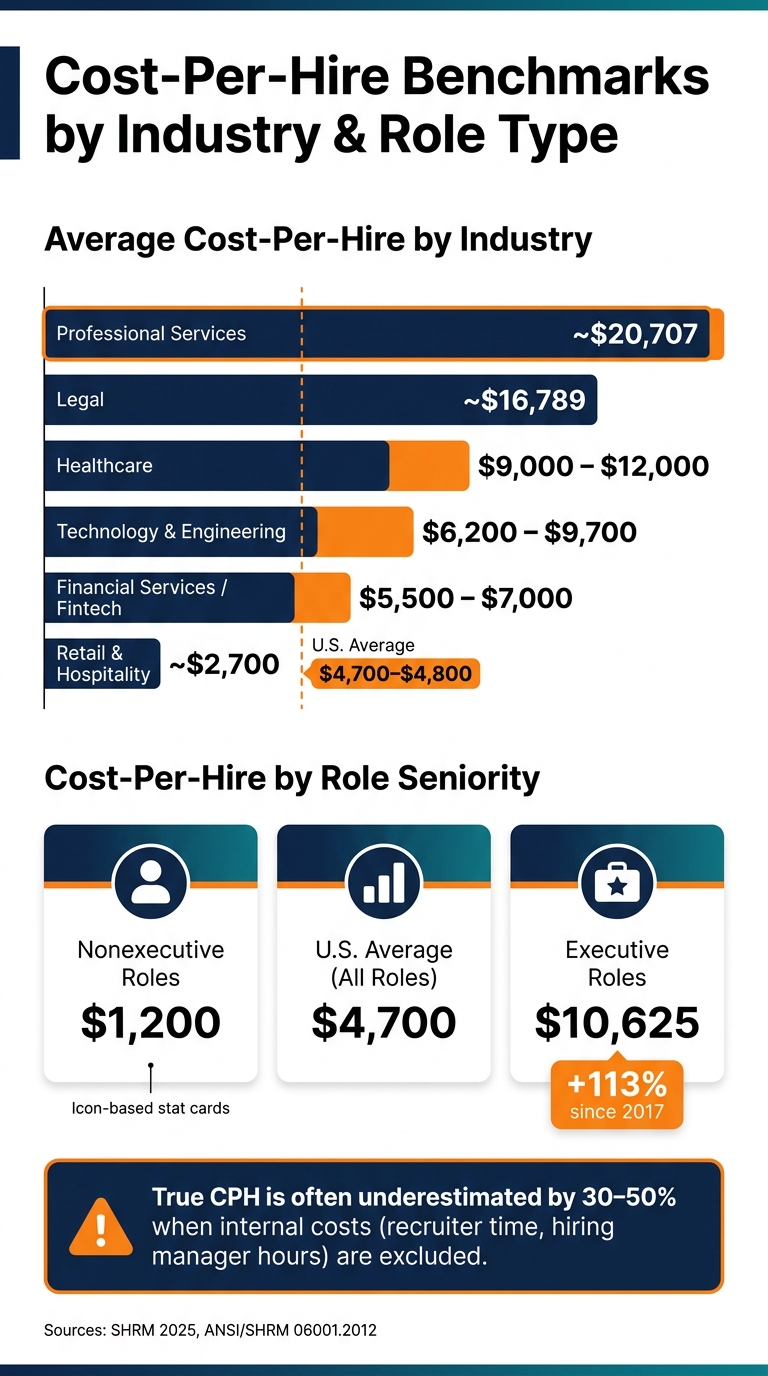
Cost-Per-Hire Benchmarks by Industry & Role Type
Knowing how to calculate cost-per-hire (CPH) is just the start. To truly understand if your recruitment spending is on track, you need to compare your numbers against industry benchmarks. While understanding your CPH is helpful, these benchmarks provide context to see how your costs stack up against others in your field. However, keep in mind that U.S. benchmarks can vary significantly depending on factors like industry, role seniority, and company size, so a single national average won’t always tell the full story.
The average CPH in the U.S. typically falls between $4,700 [9][8] and $4,800 [6]. But this broad figure hides a lot of nuance. For example, SHRM’s 2025 report shows that median CPH varies widely by role type. Nonexecutive hires average about $1,200, while executive roles climb to $10,625 [1]. This highlights a key point: the type of role you’re hiring for has a much bigger impact on costs than any company-wide averages. By combining these benchmarks with accurate CPH calculations, HR leaders can better identify inefficiencies and focus on areas to reduce costs without sacrificing quality.
Cost-Per-Hire Benchmarks by Industry
Industry-specific factors also play a big role in determining hiring costs. Fields that demand specialised skills, like technology or financial services, typically face higher CPH compared to industries with broader talent pools.
| Industry | CPH Range |
|---|---|
| Technology & Engineering | $6,200 – $9,700 [1] |
| Healthcare | $9,000 – $12,000 [1] |
| Financial Services / Fintech | $5,500 – $7,000 [1] |
| Professional Services | ~$20,707 [10] |
| Legal | ~$16,789 [10] |
| Retail & Hospitality | ~$2,700 [1] |
Professional services stand out with an average CPH of $20,707, reflecting the premium placed on specialised expertise and the extended timelines often required to fill these roles. On the other hand, industries like retail and hospitality benefit from larger candidate pools and higher hiring volumes, keeping their CPH closer to $2,700.
Variables Influencing These Benchmarks
Several factors can push your company’s actual CPH above or below these benchmarks.
Company size is one of the biggest variables. Smaller businesses (1–100 employees) generally see CPH ranging from $3,200 to $7,500, while mid-sized companies (101–1,000 employees) often fall between $2,500 and $5,500 [6][1]. Larger organisations may achieve lower CPH due to economies of scale, but the cost of enterprise-level tools and administrative overhead can sometimes offset those savings.
Location also plays a significant role. Hiring in high-cost areas like San Francisco or New York often drives up expenses – both in terms of salary expectations and sourcing costs. Shifting to remote-friendly roles can help reduce CPH significantly, especially by eliminating relocation packages, which average between $5,000 and $15,000 per hire [1], and cutting out travel expenses entirely.
Internal costs, such as time spent by hiring managers and productivity losses from unfilled roles, are often overlooked. Vacancy costs, for example, are estimated at around $500 per day for professional roles. These hidden factors can make the true CPH 30% to 50% higher than what companies initially calculate [1].
How to Reduce Cost-Per-Hire
Lowering your cost-per-hire (CPH) requires a mix of proactive planning, strategic hiring practices, and smarter use of resources. Let’s explore some practical ways to achieve this.
Building Talent Pools
A talent pool is essentially a ready-to-go pipeline of candidates you’ve already engaged with. These could be previous applicants, employee referrals, or individuals you’ve sourced proactively. The advantage? When a role opens up, you’re not starting from scratch.
Referral hires, for instance, are a game-changer. They typically cost $3,000 to $3,500 less per hire, fill roles 55% faster, and about 47% of these employees stay for more than three years [2]. This not only saves on upfront costs but also reduces expenses tied to turnover.
Having a talent pool also helps you stay ahead of unexpected setbacks. In Q1 2025, 35% of candidates withdrew after accepting job offers [1]. A well-maintained pipeline acts as a safety net, ensuring a single dropped offer doesn’t derail the process or extend costly vacancies, which can run up to $500 per day [1].
"The goal is to hire better people faster and more affordably – not to hire cheaper people." – Klipfolio [2]
By keeping your talent pool warm and engaged, you’re not just saving money – you’re building a long-term hiring advantage.
Using Embedded Recruitment Solutions
Embedded recruitment offers a smarter alternative to traditional agency fees. While agencies typically charge 15%–25% of a candidate’s salary, embedded recruitment operates on a fixed monthly fee. This model brings an experienced recruiter directly into your team, managing the entire hiring process with better speed, consistency, and cost transparency.
For example, Rent a Recruiter partners with high-growth companies in industries like SaaS, fintech, and engineering. Their embedded recruitment approach can cut hiring costs by up to 70% and save more than 80 hours of admin time per month. For scaling teams, especially those dealing with funding rounds or sudden hiring spikes, this predictable and efficient setup can make a huge impact.
Streamlining the Hiring Process
Even with efficient sourcing strategies, fine-tuning your hiring process is crucial to avoiding unnecessary costs. Delays and extra interviews don’t just waste time – they drive up labor costs and extend vacancy periods.
One effective solution is implementing structured interviews with standardized scorecards. Limiting interview panels to three or four people and using consistent evaluation criteria helps reduce the number of rounds without compromising decision quality [3].
Another key step is regularly auditing your sourcing channels. Many companies waste money on job boards that generate high application volumes but result in few hires. Redirecting that budget toward higher-return options like referrals, talent pools, or embedded sourcing can lower external costs while maintaining – or even improving – candidate quality [1].
How to Track Cost-Per-Hire Over Time
Tracking cost-per-hire (CPH) over time offers insights that a one-off figure simply can’t provide. For example, noticing an 18% increase in CPH over six quarters while quality of hire stays flat is far more actionable than focusing on a single snapshot. Using a rolling four- to eight-quarter view allows leadership to see the bigger picture, helping them respond to trends rather than isolated data points.
"A single data point is easy to dismiss. A trend line that shows CPH rising 18% over six quarters while quality of hire is flat is a conversation starter." – Wisemonk [1]
To avoid underestimating true CPH by 30% to 50%, it’s crucial to regularly include internal recruiter and manager time when tracking trends [1]. Additionally, breaking these trends down by department and role type can help pinpoint inefficiencies more effectively.
Tracking by Department and Role Type
A company-wide average can hide critical variations. For instance, technology and engineering roles often fall within benchmark ranges of $6,200 to $9,700, highlighting how departmental breakdowns reveal inefficiencies that might otherwise go unnoticed [1]. Examining costs by job type also uncovers role-specific expenses like technical assessments or signing bonuses, which can skew overall figures.
It’s also important to track CPH alongside metrics like quality-of-hire scores and 90-day retention rates. A low CPH might seem like a win, but if it leads to early turnover, the cost of a failed hire – up to 30% of their first-year salary – can quickly wipe out any savings [1].
Using Recruitment Metrics Dashboards
Once segmented, automated dashboards can provide real-time visibility into hiring costs, making them far more efficient than manual spreadsheets. By integrating tools like your Applicant Tracking System (ATS) and accounting software, you can automate data retrieval and monitor trends with ease.
Take Brex, a financial technology company, as an example. In 2025, they implemented Metaview‘s AI-powered reporting across their 1,200+ employees. Led by Brandon Miles, Head of Executive Recruiting, this dashboard helped reduce recruiter admin tasks, saving over 1,000 hours annually and doubling per-recruiter efficiency [4]. Similarly, Trainline’s Talent Acquisition Lead, Aaron Walker, reported saving 50 to 80 hours of business time each month by tracking and optimizing interview processes [4].
"We probably save around 10 minutes per interview… That works out to 50 to maybe 80 hours saved for the business per month. That’s a significant time and cost saving." – Aaron Walker, Talent Acquisition Lead, Trainline [4]
Tools like Klipfolio or iCIMS make it simple to create dashboards that segment CPH by department, role level, and sourcing channel. These insights empower finance, HR, and department leaders to make data-driven decisions that improve hiring outcomes.
Conclusion: Getting Control of Your Cost-Per-Hire
Cost-per-hire (CPH) isn’t just about recruiter fees. It also includes internal labor, vacancy costs, tool subscriptions, and the hidden expense of a bad hire – often underestimated by 30% to 50% [1].
The key takeaway? Cheaper isn’t always better. A $7,000 hire who stays for three years delivers far greater value than a $2,500 hire who leaves after five months [1]. That’s why it’s essential to evaluate CPH alongside quality-of-hire metrics.
Once you understand your spending, take steps to gain full visibility. Break down CPH by department, role type, and sourcing channel to identify inefficiencies that a single company-wide average might obscure. From there, focus on actionable improvements: enhance referral programs, review underperforming job boards quarterly, automate early-stage screening, and standardize interview processes.
By combining these insights with streamlined systems, an embedded recruitment model offers predictable hiring costs. For growing companies that need to scale quickly without losing control of budgets, Rent a Recruiter places experienced recruiters directly into your team. With a fixed-cost recruitment model, they handle the entire hiring process. Most clients cut hiring costs by up to 70% and save over 80 hours a month.
Tracking CPH is just the start. The real goal is building a recruitment function that’s measurable, scalable, and efficient. Now is the time to review your metrics and create a hiring process that supports long-term growth.
FAQs
What costs count toward cost-per-hire (and what doesn’t)?
Cost-per-hire takes into account internal costs such as salaries for your talent acquisition team, the time spent by hiring managers, expenses for recruitment tools, referral bonuses, and costs tied to internal events.
On the external side, it includes job board fees, agency commissions, background checks, candidate travel expenses, and advertising efforts.
What’s not included? Post-hire expenses like onboarding, training, equipment setup, and the salaries of new hires. This keeps the metric focused purely on recruitment-related spending.
How do I estimate hiring manager time in my cost-per-hire?
To get a clear picture of hiring manager time, calculate the total hours spent on tasks like reviewing job descriptions, screening resumes, conducting interviews, and holding debriefs. Multiply these hours by the manager’s fully loaded hourly rate. If you don’t have precise time logs, a simple way is to multiply the number of interviews by the average session length and the manager’s hourly pay. Ignoring this step can lead to underestimating hiring costs by 30%-60%. Rent a Recruiter provides businesses with better visibility into these internal costs, helping you stay on top of your hiring budget.
How can I reduce cost-per-hire without lowering quality-of-hire?
To reduce your cost-per-hire while maintaining high-quality hires, the key is to boost efficiency. One effective approach is adopting an embedded recruitment model. By integrating experienced recruiters directly into your team, you can save up to 70% compared to traditional recruitment agencies. These recruiters handle the entire hiring process, ensuring both quality and cost savings.
You can also explore these strategies:
- Employee referrals: A cost-effective option that often leads to hires with higher retention rates.
- Promoting internal talent: This taps into existing team members who already understand your company’s culture and values.
- Streamlining workflows: Automate tasks like interview scheduling and create standardized interview processes to save time and minimize mistakes.
By focusing on these methods, you can achieve a more efficient and cost-effective hiring process without compromising on the quality of your new hires.