Scaling recruitment without compliance risks can save your business thousands in penalties and protect your brand. For startups and scaling businesses, legal missteps in hiring can cost up to $160,000 per lawsuit, with additional fines for worker misclassification or I-9 errors. Beyond financial impact, non-compliance can harm your reputation, making it harder to attract talent and investors.
Here’s what you need to know to keep your hiring process compliant and scalable:
- Understand legal thresholds: Federal laws like Title VII apply once you have 15 employees, while the ADA and ADEA kick in at 20. Expanding into new states adds complexities like pay transparency and wage laws.
- Standardize hiring processes: Use consistent interview questions and documented screening criteria to avoid discrimination claims.
- Review job postings: Include clear salary ranges, essential job functions, and avoid biased language to meet state-specific requirements.
- Train hiring teams: Ensure managers know what’s legally off-limits during interviews and how to handle requests for accommodations.
- Document everything: Retain job postings, interview notes, and I-9 forms for required periods to stay audit-ready.
The bottom line? Prioritizing compliance from day one reduces legal risks, saves time, and supports sustainable growth. For businesses scaling quickly, embedded recruitment provides the expertise and systems needed to manage compliance while cutting hiring costs by up to 70%.
Let’s dive into the details of building a compliant and scalable recruitment framework.
Employment Essentials: Recruitment & Onboarding Compliance
sbb-itb-a23bd6a
Pre-Recruitment Compliance Essentials
Before you even think about posting a job, it’s crucial to get your policies, training, and approvals in order. Overlooking these steps can lead to expensive mistakes – misclassifying just 10 workers could cost between $430,000 and $680,000 in back wages, taxes, and penalties [2].
Legal Review of Recruitment Policies
Start by reviewing worker classifications. Use the Department of Labor’s "economic reality" test or the IRS common law test to correctly identify whether roles should be classified as employees or contractors [2]. Missteps here can result in back taxes and penalties that could slow your growth.
Next, check each role’s FLSA (Fair Labor Standards Act) status. This involves salary basis and duties tests. While the federal exempt salary threshold is $684 per week, states like California and Washington require much higher amounts – $1,320 and $1,380.80 per week, respectively, starting in 2025 [2].
Anti-discrimination policies are another must. They should explicitly cover protections against bias based on race, color, religion, sex (including pregnancy and sexual orientation), national origin, age (40+), disability, and genetic information [2][9]. Be mindful of state-specific rules too. For example, "Ban the Box" laws limit when you can ask about criminal history, and pay transparency laws in states like California, Colorado, and Washington require salary ranges in job postings [2][6][9]. If you’re hiring in Alaska, remember that a paid sick leave law takes effect in July 2025, so update your policies accordingly [2].
Data protection is equally critical. Ensure compliance with GDPR, HIPAA, and other regional laws when managing sensitive candidate information like Social Security numbers or health data [6]. For background checks, follow the Fair Credit Reporting Act (FCRA) guidelines, which require a standalone written disclosure and candidate consent before any screening [2][9].
Training Your Team on Compliance and Bias Prevention
Your hiring managers need to understand what’s off-limits during interviews. Train them to avoid questions about age, marital status, religion, family status, disability, and national origin [10][11]. In fiscal year 2023, the EEOC received 81,055 workplace discrimination charges, many stemming from illegal interview questions [11].
Provide your team with pre-approved question guides to ensure consistent evaluations across all candidates [10][9]. This not only promotes fairness but also creates a reliable audit trail. Encourage your team to document every decision with specific reason codes [5].
If you’re using AI-driven hiring tools, ensure there’s meaningful human oversight to maintain ethical standards. Laws like NYC Local Law 144, the Illinois Artificial Intelligence Video Interview Act, and the EU AI Act classify recruiting AI as "high-risk" and require bias audits, candidate notifications, and detailed documentation [11][5]. As Ameya Deshmukh, Director of Recruiting, explains:
"Compliance isn’t a tax on innovation – it’s how you make AI recruiting scalable, fair, and trusted." [5]
Additionally, train your team on ADA (Americans with Disabilities Act) requirements. They should know how to identify and handle requests for reasonable accommodations during the hiring process [5]. Remember, EEOC regulations require you to retain all personnel records – applications, interview notes, and more – for at least one year from the hiring date [11].
Budget and Headcount Approvals
Proper role classification under the FLSA is essential for managing overtime obligations and keeping compensation costs in check [2]. Your budget must also meet or exceed the higher of the federal or state minimum wage – startups can’t legally pay employees with equity alone [2].
Make sure your salary ranges align with pay transparency laws. States like California, Colorado, New York, and Washington require salary disclosures in job postings [11]. Failing to include this information can lead to fines and harm your employer brand.
Keep formal records of all budget and headcount approvals. These records act as a safeguard during audits or discrimination claims [9][6]. Using an Applicant Tracking System (ATS) can streamline approval workflows and maintain a consistent audit trail. For example, in 2024, Zenith Robotics, a robotics startup, implemented an ATS to standardize hiring reviews. This move improved hiring efficiency by 20% and reduced legal risks [8].
For roles tied to your core business, classify them as employees rather than contractors to meet DOL and IRS requirements [2]. If your company is scaling across states, consider working with a Professional Employer Organization (PEO) to manage varying state wage and hour laws. GreenLeaf Foods, a food tech startup, successfully used a PEO during rapid growth to navigate multi-state compliance and avoid financial and legal pitfalls [8].
With these pre-recruitment measures in place, you’ll be ready to post job openings that meet all compliance standards.
Job Posting and Description Compliance
State Pay Transparency Requirements 2026: Employer Compliance Guide
Once you’ve established your policies and approvals, the next step is creating job postings that not only attract diverse talent but also comply with legal requirements. A poorly crafted job description can lead to discrimination claims or violations of transparency laws, both of which can result in unnecessary costs.
Writing Inclusive, Legally Compliant Job Descriptions
To meet ADA requirements, U.S. employers with 15 or more employees must clearly distinguish between essential and marginal job functions [12]. Rachel Richardson, Head of Growth & Marketing at Grove HR, highlights the importance of this step:
"Courts give ‘considerable weight’ to a written job description prepared before advertising or interviewing." [12]
Language matters. Replace gendered terms like "salesman" with "salesperson", and avoid age-biased phrases such as "recent graduate", "digital native", or "young and energetic." Similarly, steer clear of experience caps like "maximum 5 years of experience", as these may violate the Age Discrimination in Employment Act, which protects applicants 40 and older [15].
Focus on outcomes rather than methods. For example, instead of saying "must be able to speak clearly on the phone", use "communicates effectively with clients." When listing physical requirements, ensure they are genuinely necessary for the role.
Use clear, measurable qualifications. Specify requirements like "proficient in Excel" or "bachelor’s degree required" rather than vague terms. Including an Equal Employment Opportunity (EEO) statement also reinforces your commitment to non-discrimination.
Once your descriptions are inclusive and legally precise, ensure they meet all required disclosure and accessibility standards.
Required Disclosures and Transparency
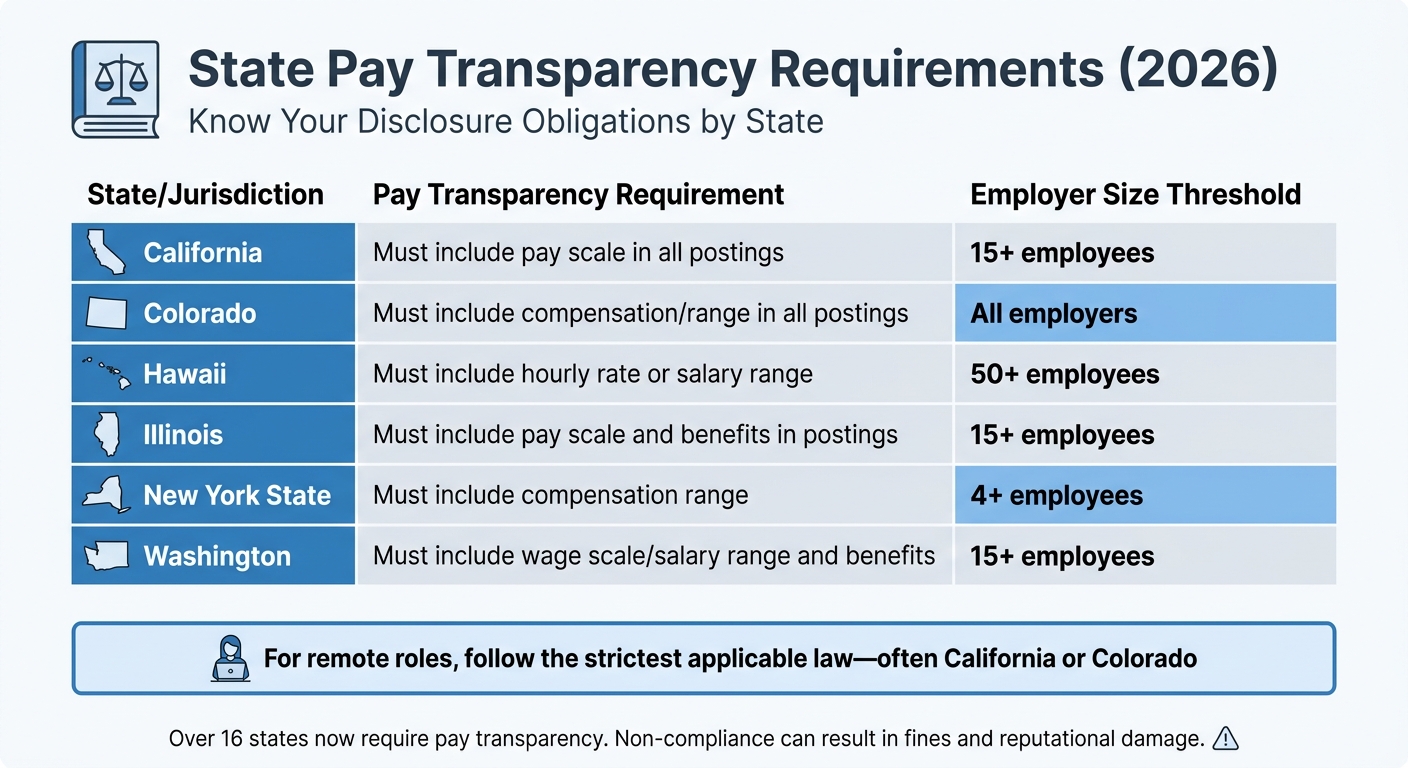
Pay transparency laws are expanding rapidly. By 2026, states such as California, Colorado, Hawaii, Illinois, New York, and Washington will require salary ranges in job postings. For example, California’s SB 642, effective January 1, 2026, mandates a "good faith estimate" of expected pay. To comply, avoid overly broad pay ranges [14].
Here’s a summary of state-level pay transparency requirements as of 2026:
| State/Jurisdiction | Pay Transparency Requirement | Employer Size Threshold |
|---|---|---|
| California | Must include pay scale in all postings | 15+ employees |
| Colorado | Must include compensation/range in all postings | All employers |
| Hawaii | Must include hourly rate or salary range | 50+ employees |
| Illinois | Must include pay scale and benefits in postings | 15+ employees |
| New York State | Must include compensation range | 4+ employees |
| Washington | Must include wage scale/salary range and benefits | 15+ employees |
For remote roles, follow the strictest applicable law – often California or Colorado. This also applies to job ads on platforms like LinkedIn, Instagram, or Facebook.
Avoid asking about criminal history on initial applications. Over 35 states and 150 cities have "ban-the-box" laws that limit when you can inquire about prior convictions [12]. Including a disclaimer that the job posting is not an employment offer helps protect your at-will employment status.
Finally, confirm that your postings are accessible and compliant with record-keeping requirements.
Accessibility and Record-Keeping for Job Postings
Accessibility is key. Ensure your postings are available to all candidates, including those needing accommodations or scheduling flexibility for religious observances. For states like California, salary ranges must be included directly in the job posting text – linking to external pages or using QR codes is not sufficient [14].
Proper record-keeping is equally important. Retain job postings, wage histories, and interview notes for the periods required by the EEOC and state laws [14][15]. Federal law also requires reporting new hires to state agencies within 20 days [12].
If you use staffing agencies or job boards, audit their postings to confirm they include the required pay scales. Remember, the legal responsibility ultimately falls on you as the employer. Additionally, retain Form I-9 for three years after hire or one year after termination, as non-compliance penalties range from $252 to $2,507 per form [12].
With job postings aligned to legal standards, you’re ready to move into the screening and interview phase while maintaining compliance.
Candidate Screening and Interview Compliance
Once you’ve nailed compliant job postings, the next step is ensuring your screening and interview processes meet the same high standards. These phases carry significant compliance risks, with the average cost of settling an employment-related lawsuit hitting $160,000 [8]. Inconsistent screening or asking prohibited questions often lead to costly discrimination claims.
Using Standardized Screening Criteria
Before you even glance at a resume, start with a job analysis. This defines the essential duties and skills for the role, creating a documented foundation for all screening decisions [3][16]. Every candidate should be evaluated against the same pre-defined criteria.
To keep things objective, use tools like Behaviorally Anchored Rating Scales (BARS) or numerical scoring rubrics. Require interviewers to finalize individual scores before group discussions – this avoids groupthink and ensures independent evaluations.
All criteria and questions must directly relate to the job. If any selection method shows an adverse impact on protected groups, you’ll need to validate it against actual job performance, following the EEOC’s Uniform Guidelines on Employee Selection Procedures [16]. For remote interviews, standardize technical requirements like audio and video quality to ensure fair assessments [16].
Once your criteria are locked in, the focus shifts to crafting interview questions that comply with the law.
Asking Legally Compliant Interview Questions
Federal laws, including Title VII, the ADA, and the ADEA, protect candidates from discrimination based on race, color, religion, sex, national origin, age (40+), disability, and genetic information [17][18][13]. The safest approach? Avoid gathering protected information entirely during the hiring process. The EEOC advises:
"If you do not have this information when you decide who to hire, it may be easier for you to defend your business against a hiring discrimination complaint." [17]
Keep questions focused on whether the candidate can perform the job’s essential functions. For example:
- Instead of, "Do you have any disabilities?" ask, "Can you perform the essential functions of this role with or without accommodation?" [18][19].
- Replace, "Are you married?" with, "Can you meet the specified work schedule and travel requirements?" [18][19].
- For salary discussions, avoid asking about past pay – 22 states now restrict or ban salary history inquiries [16]. Instead, ask, "What are your salary expectations for this position?" [19].
Here’s a quick guide to rephrasing tricky questions:
| Prohibited Question Topic | Acceptable Alternative |
|---|---|
| Age: "When did you graduate?" | "Are you at least 18 years old?" (if legally required) |
| Religion: "Do you observe any religious holidays?" | "This role requires Saturday availability. Can you meet that?" |
| Disability: "Do you have any disabilities?" | "Can you perform the essential functions of this role with or without accommodation?" |
| National Origin: "Where are you from originally?" | "Are you authorized to work in the U.S.?" |
| Salary History: "What was your salary at your last job?" | "What are your salary expectations for this role?" |
When your questions are compliant and your assessments are fair, the next step is documenting everything properly.
Documenting Interview Processes
Keep detailed records of notes, scores, and the reasons behind hiring or rejecting each candidate. This creates a clear audit trail [16][6][12]. Store interviewer notes separately from the candidate’s resume or application, and never use shorthand or codes that could imply protected characteristics [13].
Follow EEOC regulations for record retention [3][16]. Federal contractors, for instance, must keep interview records for two years [16]. If you’re using AI tools for scoring, document the outputs and oversight procedures to stay ahead of emerging compliance rules [16].
With a well-documented, legally sound process in place, you’re ready to tackle background checks and offer letters while keeping compliance front and center.
Background Checks and Offer Letter Compliance
Finalizing background checks and preparing compliant offer letters are critical steps in the hiring process. These tasks aren’t just about ticking boxes – they carry real financial risks. For instance, violations of the Fair Credit Reporting Act (FCRA) can result in penalties ranging from $100 to $1,000 per infraction[20]. Similarly, errors in I-9 paperwork can lead to fines between $252 and $2,507 per form[2].
Background Screening and FCRA Compliance
Before starting any background check, make sure you have a valid business reason for doing so. You’ll also need to obtain a standalone disclosure and written consent from the candidate[20]. If the background report reveals something that might lead to a rejection, you’re legally required to follow the pre-adverse action process. This means providing the candidate with a copy of the report, along with the "Summary of Your Rights Under the FCRA", and giving them five business days to address or dispute the findings[20]. If you decide not to move forward, a final adverse action notice must be sent, including the name and contact details of the reporting agency, along with a statement clarifying that the agency was not involved in the hiring decision[20].
"FCRA compliance, at its best, is proof that fairness and empathy can live at the heart of recruitment."
- Charm Paz, CHRP, Recruiter & Editor[20]
Using talent acquisition services or a third-party Consumer Reporting Agency (CRA) for checks like criminal records or social media reviews can help ensure legal compliance[21]. Consistency is key – apply the same background check criteria to all candidates for the same role. Keep FCRA documentation for at least five years[20]. If you’re hiring in multiple states, be aware of "ban-the-box" laws. These regulations, active in over 35 states and 150 cities, limit when you can ask about a candidate’s criminal history[12].
Once you’ve completed the background checks and met all FCRA requirements, you’re ready to extend a clear and compliant offer to your chosen candidate.
Creating Clear, Compliant Offer Letters
A well-crafted offer letter should cover all the essentials: the job title, a summary of primary duties (noting that these may evolve), the start date, compensation details (such as salary or hourly rate and pay schedule), and a brief overview of benefits[2]. The letter must also include an at-will employment statement, making it clear that either the employer or the employee can end the relationship at any time without cause[2].
Be sure to outline any conditions of employment, such as passing background checks, reference verifications, or providing proof of work authorization (I-9 compliance). Additionally, specify whether the role is exempt or non-exempt under the Fair Labor Standards Act (FLSA)[2]. If the offer includes stock options or bonuses, note that these are subject to board approval and governed by separate agreements. Avoid using language like "permanent position" or "long-term career", as this could undermine the at-will status[12].
By 2026, more than 16 states and several major cities will require salary range disclosures in job postings or during the offer process, so be prepared to include this information as needed[12].
Onboarding Forms and Documentation
Once the offer is accepted, the onboarding process begins. The I-9 form is a top priority: Section 1 must be completed by the employee on or before their start date, and Section 2 – where you verify original documents – must be finished within three business days of the start date[12]. Hiring an unauthorized worker can lead to fines ranging from $563 to $5,632 per worker, so accuracy is critical[2].
While E-Verify is optional for many employers, it’s mandatory for federal contractors and in states like Arizona, Georgia, and Tennessee[12]. Beyond the I-9, you’ll need to collect tax forms (e.g., W-4), direct deposit information, and emergency contact details. Store all this data in secure systems with access controls to protect sensitive information[7].
Federal law also requires reporting new hires to the appropriate state agency within 20 days to assist with child support enforcement[12]. Lastly, retain I-9 forms for three years after the hire date or one year after termination, whichever comes later[12].
Maintaining Compliance as You Scale
Keeping compliance on track as your company grows is non-negotiable. HR compliance breaches cost businesses an average of $174,000 per incident[7], a financial setback that can disrupt even the best-laid growth strategies. As hiring increases and regulations evolve, having the right systems and expertise in place is essential.
Regular Compliance Audits and Updates
Schedule annual compliance audits, with quarterly reviews for high-risk areas like payroll, worker classification, and leave policies[7]. If your hiring process involves AI tools, be aware that annual bias audits are already mandatory in several states. In California, starting October 2025, companies with five or more employees will need to audit AI tools for bias, document oversight for AI decisions, and retain records for four years[7]. Regular adverse impact analyses – comparing selection rates and error patterns across protected groups – are also crucial to avoid unintentional discrimination[5].
Scaling into multiple states adds another layer of complexity. State-specific laws, such as pay transparency requirements, often override federal standards. Over 16 states now require pay transparency[7]. To stay ahead, set up automated alerts for changes in state-level regulations, including minimum wage updates and new compliance requirements[7]. Additionally, federal laws mandate keeping FLSA payroll records, FMLA documentation, and I-9 forms for at least three years[7].
Bringing in recruitment expertise can simplify these processes, ensuring nothing falls through the cracks.
Using Embedded Recruitment Expertise
Managing compliance across multiple states and navigating ever-changing regulations can be overwhelming. This is where embedded recruitment expertise proves invaluable. By embedding experienced recruiters into your team, you gain structured oversight and compliance precision from day one. Rent a Recruiter offers embedded recruitment services that streamline hiring while cutting costs by up to 70% compared to traditional agency fees (calculate your hiring cost savings)[22].
Embedded recruiters help create audit-ready documentation for every stage of the hiring process, from standardizing interview questions to recording rejection reasons[5][6]. They also ensure proper worker classification, a common area of non-compliance that can result in costly penalties and back taxes[8]. With 68% of startups now operating remotely, managing state-specific laws on minimum wage, overtime, and leave becomes even more complex[8]. Dedicated recruitment experts provide the clarity and structure needed to navigate these challenges.
Tracking and Reporting for Compliance
Once audits are in place, documenting every compliance step is critical. Using an ATS or HRIS system, you can create a standardized trail of documentation, including action logs, rejection reasons, and data sources for hiring decisions[5][7]. For legally required records like I-9 forms, store them separately from general personnel files – either in a dedicated binder or digital folder. Missing or expired I-9s can result in fines ranging from $288 to $2,861 per form[7].
If your company has 100 or more employees (or is a federal contractor with contracts exceeding $50,000), you’ll also need to file an EEO-1 report annually, breaking down workforce demographics by gender and race[1]. Building a robust record-keeping system early is far easier than implementing one after your workforce has grown beyond 100 employees[10]. Regular legal check-ins, ideally on a quarterly basis, can help ensure your recruitment policies remain aligned with multi-jurisdictional requirements – especially for remote teams[10].
"A quarterly legal check-in can help prevent small issues from becoming big problems."
Conclusion
Compliance Checklist Summary
Creating a recruitment process that is both compliant and scalable starts with the basics. Focus on inclusive job descriptions with neutral language, clearly defined essential functions, and pay transparency where required. Use standardized interview questions to ensure fair and defensible evaluations, and back these up with essential documentation such as FCRA-compliant background checks, timely Form I-9 completion, and proper handling of candidate data[12][6].
As your company grows, regular audits, accurate worker classification, and record retention for up to 7 years become critical[12][23]. With 82% of startups encountering employment law issues within their first three years[4], putting these practices in place early on can save you from expensive fixes down the road. Once these fundamentals are set, it’s time to assess and refine your recruitment practices further. For more insights, explore our recruitment blog.
Next Steps
Kick off your Recruitment Health Check today. Rent a Recruiter provides a free assessment to benchmark your hiring performance, identify compliance gaps, and deliver a tailored report covering employer branding, hiring practices, and diversity. These steps are key to building structured, compliant recruitment processes, supported by the embedded recruitment expertise at Rent a Recruiter.
For companies scaling quickly, embedding skilled recruiters directly into your team ensures every hire is supported by audit-ready documentation and structured oversight. This approach not only reduces hiring costs by up to 70%, but also saves over 80 hours per month in internal admin work. Whether you need short-term assistance to meet hiring goals or a long-term partner to create a scalable recruitment function, having the right expertise turns compliance into a strategic advantage.
FAQs
What’s the fastest way to make hiring compliant as we scale?
To ensure hiring stays compliant as you scale, it’s crucial to develop a recruitment process that aligns with current legal standards. Begin by creating a detailed checklist that covers essential regulations, including fair hiring practices, privacy protections, and non-discrimination policies. Leverage recruitment tools that offer built-in compliance features, such as bias audits and audit trails, to reduce risks.
Stay informed about key laws like Title VII of the Civil Rights Act, the Americans with Disabilities Act (ADA), and GDPR. Embedding these legal requirements into your hiring workflows not only keeps you compliant but also streamlines the process, making it both efficient and legally secure.
Which state laws matter most when we hire remote employees?
State regulations on wages, overtime, paid leave, payroll taxes, unemployment insurance, and non-compete agreements play a key role when hiring remote employees. These laws differ significantly from one state to another, directly impacting compliance requirements. Staying informed and following these rules is critical to avoid legal complications and maintain seamless business operations.
How can we prove our hiring decisions were fair during an audit?
Maintaining detailed records of your recruitment process is essential for demonstrating transparency and compliance. This includes keeping comprehensive documentation such as job descriptions, interview notes, assessment results, and the reasoning behind each hiring decision. Ensuring these records align with relevant laws and your company’s internal policies helps protect your business while fostering a fair and consistent hiring process.