
I recommend fixing your longest hiring delay before adding more candidates to the pipeline. Start with 3 to 6 months of hiring data, identify the blocked stage, and give one person ownership of the fix. Measure success through time saved, cost per hire, and offer acceptance, not speed alone.
Five bottlenecks deserve your attention:
- Unclear priorities: Agree on role requirements and budget before sourcing to avoid wasted work.
- Recruiter overload: Match hiring demand to available hours, adding embedded recruitment support when capacity falls short.
- Limited interviewer availability: Reserve interview slots and remove duplicate rounds to reduce delays.
- Late feedback: Use shared scorecards and a 24-hour feedback target to keep decisions moving.
- Slow offer approvals: Confirm pay ranges and approval owners before final interviews to prevent last-minute rework.
My starting point: <u>fix one handoff, track it weekly, then tackle the next</u>. That keeps your focus on lower hiring costs, fewer internal hours, and hires that support delivery.
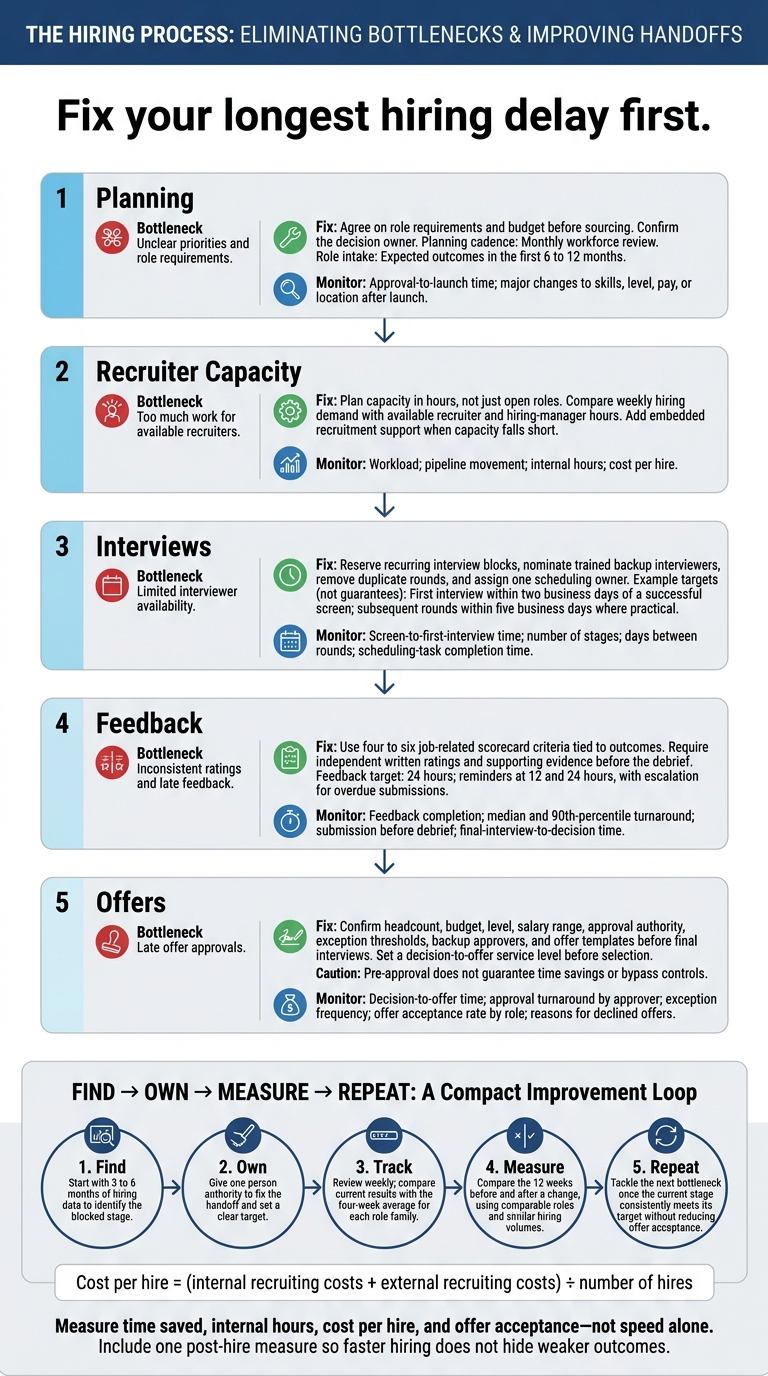
5 Hiring Bottlenecks and How to Fix Them
Hiring Plans and Recruiter Capacity
Once you know where hiring time is lost, address the planning and workload issues behind the delays.
Bottleneck 1: Unclear Priorities and Role Requirements
Agree on the hiring plan before searches start. Hold a monthly workforce review with business leaders, hiring managers, finance, and recruiting. Rank roles by business impact, urgency, skill scarcity, and the risk of leaving them vacant.
Each role needs an intake covering the business need, expected outcomes in the first 6 to 12 months, required skills, level, pay range, location, target start date, and decision owner.
Start sourcing only when the hiring manager, finance partner, and decision owner agree on those terms. Otherwise, recruiters spend time on roles that may later be paused, downgraded, or canceled.
Log major changes to skills, level, pay, or location after launch, alongside approval-to-launch time. Repeated revisions signal a planning problem, not a sourcing problem.
Even with clear priorities, hiring stalls when recruiters have more work than time.
Bottleneck 2: Too Much Work for Available Recruiters
Plan capacity in hours, not just open roles. Estimate the weekly time needed for sourcing, screening, scheduling, candidate updates, offers, and reporting. Compare that demand with recruiter and hiring-manager availability after meetings, leave, and other work.
Use your own workload history rather than a generic recruiter-to-role ratio. Prioritize business-critical and scarce-skill searches, and give lower-priority work a dated place in the queue.
For recurring roles, keep approved job descriptions, screening questions, scorecards, and candidate pipelines ready. Before reusing a pipeline, check that candidates are still available and fit the role. Standardize intake, scheduling, updates, and reminders to protect sourcing time.
Track workload, pipeline movement, internal hours, and cost per hire to check whether these changes free up capacity.
If demand still exceeds internal capacity, external recruiting support can fill the gap. For capacity spikes, Rent a Recruiter embeds experienced recruiters into your team within days and manages hiring end-to-end on a fixed monthly model.[5]
Before committing, confirm recruiter availability, supported role types and locations, expected volume, sourcing responsibilities, and reporting cadence. Measure results against your baseline: qualified candidates should move forward while internal recruiter and hiring-manager hours per hire and cost per hire fall.
sbb-itb-a23bd6a
Interview, Feedback, and Offer Delays
Once recruiter capacity matches hiring demand, delays tend to shift to interviews, feedback, and offers. Each stage needs clear ownership to keep hiring moving.
Bottleneck 3: Limited Interviewer Availability
Give every interview stage a purpose, owner, and deadline before interviews begin. Crowded calendars, repeated rounds, and time-zone mismatches slow the process and increase candidate drop-off.
Assign one person, usually the recruiter or coordinator, to manage scheduling, rescheduling, and escalation. The hiring manager owns stage decisions. Let candidates self-schedule within approved, time-zone-aware windows. Run assessments in parallel when they do not depend on interview outcomes.
Example service levels are a first interview within two business days of a successful screen and subsequent rounds within five business days where practical.
Treat these as targets. Document exceptions rather than skipping required steps.
| Bottleneck | Process symptom | Process fix | Metric to monitor |
|---|---|---|---|
| Calendar conflicts | Several days pass before a shared interview slot is available | Reserve recurring interview blocks; nominate trained backup interviewers | Screen-to-first-interview time |
| Excessive rounds | Candidates repeat similar conversations with multiple stakeholders | Define the decision each round informs and remove duplicate stages | Number of stages; days between rounds |
| Unclear scheduling ownership | Candidates receive conflicting messages or wait for someone to coordinate | Give one named owner responsibility for scheduling and escalation | Scheduling-task completion time |
Bottleneck 4: Inconsistent Ratings and Late Feedback
Use four to six job-related scorecard criteria tied to outcomes. Define the evidence interviewers should look for, explain the scoring scale, and assign each criterion to an interviewer. Keep missing evidence separate from evidence that someone falls below the required standard.
Without shared scoring guidance, personal preferences shape ratings. Disagreements then lead to repeat interviews and delayed decisions. U.S. Office of Personnel Management guidance supports structured interviews to improve validity, rater reliability, and agreement.[7]
Require independent written ratings, supporting evidence, unresolved questions, and recommendations before the debrief. Set a 24-hour feedback target, with reminders at 12 and 24 hours and escalation for overdue submissions.
Discuss evidence against the scorecard, not the first opinion voiced. Record the reasons for the final decision in your applicant tracking system. Track feedback completion, median and 90th-percentile turnaround, submission before debrief, and final-interview-to-decision time.
After the panel reaches a decision, offer approval becomes the final gate.
Bottleneck 5: Late Offer Approvals
Resolve offer parameters before final interviews. Confirm headcount, budget, level, salary range, variable pay, equity rules, approval authority, exception thresholds, backup approvers, and offer templates.
Check that candidate expectations fit the approved package. Otherwise, selecting someone can trigger rework, delays, and candidate drop-off. Have HR or counsel verify applicable U.S. pay-transparency requirements, including remote-work locations. Disclosure may be required in the posting, not just at the offer stage.[8][9]
| Dimension | Serial approvals | Pre-approved workflow |
|---|---|---|
| Timing | Compensation and level are reviewed sequentially after candidate selection | Budget, level, range, approvers, templates, and exception rules are confirmed before interviews or before final selection |
| Delay point | Each reviewer waits for the previous approval; exceptions may restart the process | Delays occur only if the proposed hire falls outside approved parameters |
| Ownership | Recruiter coordinates; successive leaders approve | Hiring manager owns the request; recruiter prepares the offer; designated approver handles exceptions |
| Control mechanism | Approval chain, documented exception review, and offer audit trail | Predefined authority matrix, range controls, backup approver, and standardized template |
Set a decision-to-offer service level with the offer owner and approvers before selection. Pre-approval removes routine questions from the final stage. It does not guarantee time savings or bypass controls.
Monitor decision-to-offer time, approval turnaround by approver, exception frequency, offer acceptance rate by role, and reasons for declined offers. Record decline reasons so you can distinguish approval delays from compensation mismatches.
Track Hiring Delays, Costs, and Results
Once you’ve identified the main bottleneck, track it weekly to see where hiring still stalls, or perform a recruitment health check to identify systemic issues.
Use a weekly hiring dashboard to follow each priority requisition from approval to acceptance. Track stage age, interviewer availability, feedback turnaround, offer approval time, accepted offers, and withdrawals.
Break results down by role family and department. Add recruiter and hiring-manager views when volumes are high enough for reliable comparisons. Use this dashboard to confirm which of the five bottlenecks still slows hiring, and keep metric definitions consistent every week.[13]
Assign an Owner to the Longest Delay
Compare this week’s results with the four-week average for each role family. Flag stages that repeatedly miss targets, build up a backlog, or block the next step.
Map each delay to intake, sourcing, scheduling, evaluation, or approvals. Give one owner the authority to fix the handoff and change the process. Record the affected requisitions, corrective action, target, median actual time, and percentage within target.
Take these findings into monthly workforce planning. Compare forecast hiring volume with recruiter, interviewer, and administrative capacity. Adjust requisition timing, interviewer rotations, or recruiter coverage before demand exceeds capacity again. Requisitions per recruiter can show workload pressure that total headcount misses.[6]
If the same delay keeps returning, calculate its labor cost.
Measure Internal Hours and Cost per Hire
After fixing the delay, measure the hours it consumed and any time saved to show the impact.
Track weekly time spent on intake meetings, sourcing, screening, scheduling, interviews, feedback, offers, and reporting. Separate hours for recruiters, hiring managers, interviewers, coordinators, and HR or finance staff.
Calculate cost per hire = (internal recruiting costs + external recruiting costs) ÷ number of hires. Use the same labor valuation and expense categories each period. Include software, advertising, assessments, referral bonuses, and background checks, and report results by role group.[10][11]
Compare the 12 weeks before and after a change, using comparable roles and similar hiring volumes. Review median time-to-fill, time in the affected stage, internal administrative hours, accepted offers, offer-acceptance rate, withdrawal rate, and cost per hire.
If recruiter capacity is the constraint, Rent a Recruiter reports that clients may save more than 80 internal hiring and administrative hours per month. That is a provider-reported figure, not a guarantee.
Add one post-hire measure so faster hiring does not hide weaker outcomes.[12]
Conclusion: Fix the Longest Hiring Delay First
Hiring moves only as fast as its slowest handoff. More candidates won’t help if interviews or approvals are blocked.
Fix the slowest handoff first. Give it one owner and a clear target, then manage it as an operating priority.
Track that stage each week until it consistently meets the target without reducing offer acceptance. Then tackle the next bottleneck.
If recruiter workload is holding you back, use embedded hiring support from Rent a Recruiter. Start by reviewing your open roles, recruiter capacity, hiring volume, and how long you need support.
FAQs
How do we spot hiring bottlenecks with limited data?
Map your hiring workflow from requisition approval to start date. Track dwell time, how long candidates spend at each stage. More than five business days flags a delay that needs attention.
Review your funnel weekly for stalled candidates, drop-offs, resume backlogs, scheduling delays, and offers awaiting approval for over one week. Compare metrics by hiring manager or department to pinpoint whether delays sit within one team or affect hiring across the business.
Which interview rounds can we safely remove?
You can safely remove interview rounds that repeat discussions or add no new, actionable information to your hiring decision [1]. Check for duplicate questions and overlapping assessments to see where your team is spending time without improving the decision [2].
Use structured interview kits with clear, role-specific competencies and shared scorecards. This gives each stage a distinct purpose [3][4]. Cut rounds that add nothing to your decision criteria to simplify hiring and reduce time-to-hire [1][3].
How do we measure quality after speeding up hiring?
Track 90-day retention, hiring manager satisfaction, and the interview-to-offer ratio weekly to catch early signs that hiring quality is slipping. A rising interview-to-offer ratio may point to weak screening. Falling 90-day retention often suggests rushed hiring decisions.
Monitor offer acceptance rates and time to full productivity too. These measures help you check whether faster hiring is delivering people who accept your offers, stay, and get up to speed.