
Collaborative recruitment is transforming how scaling companies hire. By involving HR, hiring managers, and team members at every stage, businesses make better hiring decisions, reduce costs, and save time. For SMEs, this approach ensures roles are filled faster while avoiding the risks of bad hires, which can disrupt operations and increase expenses.
Key benefits of collaborative recruitment:
- Improved hiring accuracy: Diverse perspectives lead to better candidate evaluations.
- Faster time-to-hire: Streamlined feedback and decision-making processes.
- Cost savings: Employee referrals and structured processes reduce recruitment spend.
What’s covered in this guide:
- Defining key roles in a recruitment team.
- Mapping workflows to eliminate bottlenecks.
- Designing a clear hiring process with defined responsibilities.
- Tools and metrics to track and improve performance.
- How embedded recruitment can support your SME.
If your internal team is stretched thin, Rent a Recruiter can embed experienced recruiters into your team. This service reduces hiring costs by up to 70% and saves over 80 hours per month on admin tasks. Whether you’re hiring your first team or scaling quickly, collaborative recruitment is the smarter way to grow.
How to Build an Unstoppable Team: Be the Collaborator Everyone Wants
sbb-itb-a23bd6a
Building the Foundations of a Collaborative Recruitment Team
Getting collaborative hiring right starts long before you post the job. It begins with having the right people in the right roles, ensuring clear ownership at every stage, and taking an honest look at how your current process operates.
Key Roles in a Collaborative Recruitment Team
A successful hiring process relies on several key players. At the core is the hiring manager, who defines what "good" looks like for the role and makes the final decision. The recruiter or talent acquisition (TA) specialist acts as the strategic coordinator, managing the process end-to-end, offering market insights, and keeping everyone aligned. A talent sourcer focuses on building a steady pipeline by identifying and engaging passive candidates well before the role becomes urgent.
Supporting these roles, a recruitment coordinator ensures smooth logistics by handling scheduling, job postings, and candidate communications. Interviewers, whether peers or technical experts, provide insights that go beyond the hiring manager’s perspective. As Steve Jobs famously said:
"When we hire someone, even if they are going to be in marketing, I will have them talk to the design folks and the engineers." [7]
As your SME grows, adding a recruitment operations role becomes critical. This position handles your ATS (applicant tracking system), reporting, and process documentation, ensuring your hiring engine runs smoothly over time.
With these roles in place, the next step is establishing clear ownership to avoid bottlenecks.
Defining Responsibilities and Ownership
Unclear responsibilities can delay follow-ups and stall decision-making. A RACI chart (Responsible, Accountable, Consulted, Informed) helps map out who owns each part of the hiring process, from initial intake to final offer approval. This framework makes handoffs explicit, reducing the risk of tasks falling through the cracks.
| Role | Primary Responsibility | Key Ownership |
|---|---|---|
| Hiring Manager | Defining success criteria | Final hiring decision; role fit validation |
| Recruiter | Strategic advising | Candidate relationship and offer management |
| Sourcer | Pipeline building | Finding passive talent and market mapping |
| Coordinator | Keeping the process moving | Scheduling, logistics, and feedback follow-up |
| Recruitment Ops | Infrastructure management | Overseeing the ATS, data integrity, and process design |
One key principle to enforce is that one person makes the final decision. While team input is valuable, decision-by-committee often leads to delays and missed opportunities. Empowering the hiring manager to act based on team feedback keeps the process moving forward.
With roles and ownership clarified, it’s time to evaluate and refine your current workflows.
Mapping Your Current Recruitment Workflows
After defining roles and responsibilities, take a close look at your existing process to identify bottlenecks and friction points by taking a recruitment health check.
Start with a process audit. How many roles are currently open? How long have they been open? Where are candidates dropping out? Research shows that 95% of hiring managers lack clear visibility into where candidates are falling through the cracks [6], often due to poor data capture.
Revisit your intake meetings to ensure roles are clearly defined and timelines are aligned. Then, dig into the bottlenecks – whether it’s slow feedback, mismatched expectations, or unclear handoffs. As Hiretruffle points out:
"A lot of TA problems that look like people problems are actually structure problems." [8]
Once you’ve identified the gaps, test your updated workflow with a single team or department. This pilot approach allows you to gather valuable data and refine the process before rolling it out across the entire company. Small-scale testing ensures minimal disruption while setting the stage for smoother hiring across the board.
Designing a Collaborative Hiring Process
Once you’ve defined roles and mapped workflows, the next step is creating a hiring process that’s easy to follow, even during unexpected absences or high-pressure hiring demands. This process should ensure consistency across every stage, with clear steps for all stakeholders.
Stages of a Collaborative Hiring Process
A well-designed collaborative process ensures that the right people are involved at the right time. It brings together insights from HR, hiring managers, and team members to make hiring more effective.
| Stage | Collaborators | Key Action |
|---|---|---|
| Intake | HR, Hiring Manager | Define success metrics and "must-have" skills before sourcing begins |
| Sourcing | Recruiter, Sourcer, Employees | Network outreach and referral generation |
| Screening | Hiring Team Committee | Collaborative resume review and shortlisting |
| Interviewing | Peers, Managers, Leadership | Competency-based assessments assigned by role |
| Decision | Hiring Team | Consensus meeting with the hiring manager as final decision owner |
| Onboarding | Peers, Hiring Manager | Buddy programs and team integration |
Employee referrals should be a top priority during sourcing. They provide a 45% quality-of-hire rate and significantly improve your candidate pipeline [6].
To streamline interviews, assign each interviewer a specific competency to assess. This avoids repetitive questions and reduces candidate fatigue. For most professional roles, keep the interview process to three structured stages or fewer [6].
Let’s break down how to formalize these stages and eliminate unnecessary delays.
How to Create a Hiring Team Charter
A hiring team charter acts as a one-page guide, outlining roles, time commitments, evaluation standards, and decision-making authority. By clarifying expectations upfront, you eliminate confusion and ensure everyone is aligned. Standardized interview questions and scorecards help reduce unconscious bias, ensuring all candidates are assessed using the same criteria [2][3].
As TalentAlly explains:
"Recruiting works best when it becomes a coordinated effort across leadership, hiring managers, marketing, employees, and even operations." [6]
Include a training template for new interviewers so they understand the process, standards, and compliance requirements from day one [2]. This step ensures that even those new to the process can contribute effectively.
A clear charter simplifies collaboration and helps prevent the bottlenecks that slow down hiring.
How to Reduce Friction in Team Collaboration
Hiring delays are often caused by unclear handoffs, slow feedback, or scheduling issues. These problems are structural, not motivational, and can be resolved with a few adjustments.
- Set a 24–48 hour feedback deadline to keep the process moving.
- Use automated scheduling tools so candidates can book interviews directly [2][9].
- Incorporate quick syncs, like "mini-gates", after first-round interviews. These brief check-ins catch any misalignment early, before too much time is invested in a candidate [1].
- Centralize all feedback, scores, and notes in your ATS. This ensures every team member has access to the same information when it’s time to make decisions [2][9].
Operating Models for Collaborative Recruitment
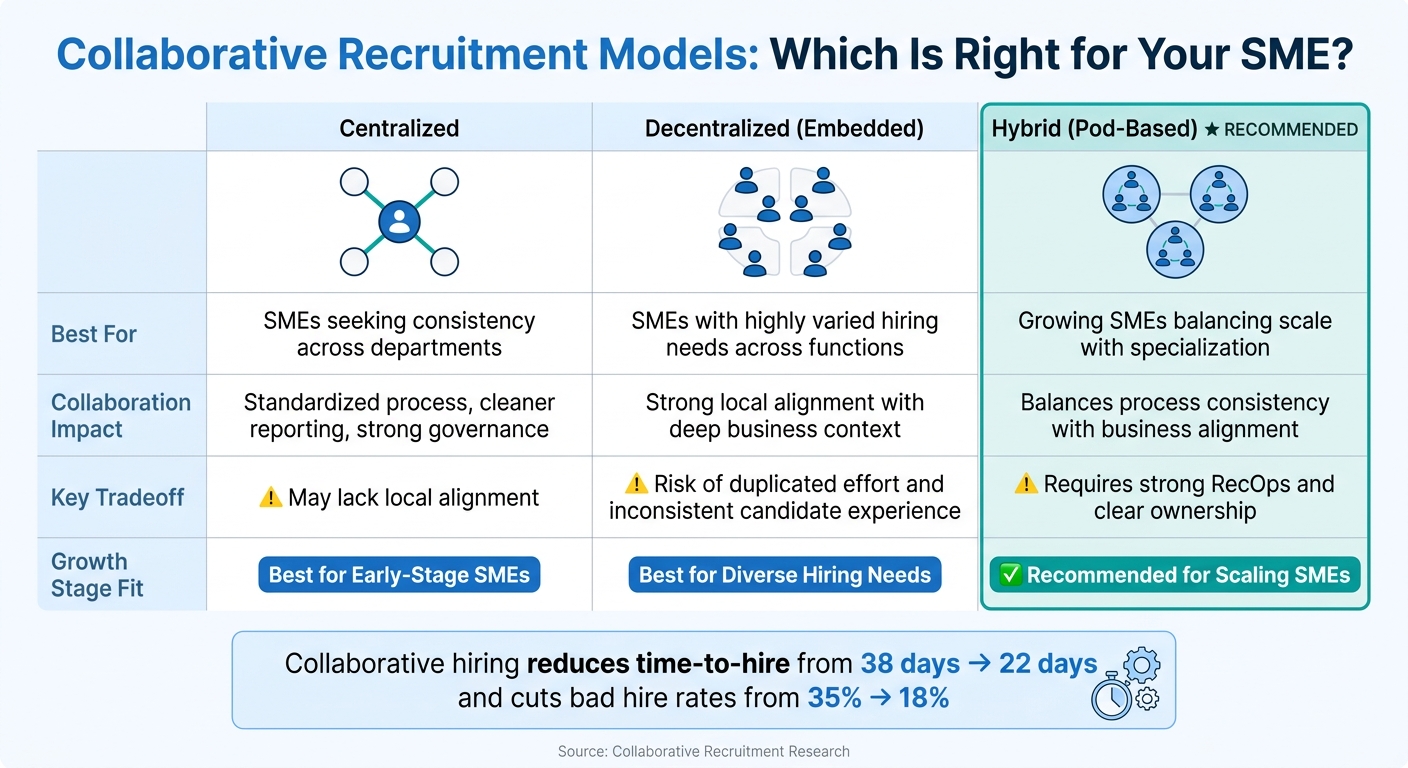
Collaborative Recruitment Models: Which Is Right for Your SME?
Recruitment Team Structures That Support Collaboration
A well-structured recruitment team is the backbone of collaborative hiring. The way you organize your team directly impacts how effectively they work together. Many SMEs begin with just one recruiter, but as hiring demands grow, this setup often becomes unsustainable.
To improve efficiency, it’s crucial to move beyond isolated hiring approaches. A "Quarterback" model works well here: the recruiter takes charge of strategy and process efficiency, while the hiring manager focuses on defining the role and making final decisions [2][4].
As you scale your hiring, dividing responsibilities across sourcing, coordination, and operations can prevent burnout and improve team output [8]. For businesses managing multiple vacancies, a pod-based structure – featuring a recruiter, sourcer, and coordinator dedicated to a specific business area – ensures alignment with company goals without adding unnecessary complexity [8].
"A strong talent acquisition team isn’t a collection of recruiters. It’s a system for planning hiring needs, creating clear ownership, standardizing evaluation, and making better decisions at scale." – HireTruffle [8]
By clearly defining roles within the team, you create a foundation for smooth collaboration, which is essential for maintaining quality in the hiring process.
How Recruitment Operations Supports the Team
Recruitment operations (RecOps) act as the glue that holds the hiring process together. This function reduces inefficiencies and keeps everything running smoothly. RecOps standardize workflows, manage data, and ensure communication is clear – avoiding duplicated efforts and missteps [8].
One key aspect of RecOps is enforcing structured processes. By managing timelines for feedback and using standardized scorecards, they ensure consistency across roles. As Tania Miranda of Recruitee puts it:
"The workload is simply too much – and moves too fast – for recruiters alone to manage these processes." [2]
Another major role of RecOps is data management. Metrics like time-to-fill, drop-off rates, and offer acceptance rates provide insights into potential bottlenecks. For instance, 95% of hiring managers say they need better visibility into why candidates drop out during recruitment [6]. This is exactly the kind of gap that RecOps can help address, ensuring the team makes informed decisions. To identify these gaps in your own organization, you can rate your recruitment process using our free analysis tool.
Comparing Recruitment Operating Models
Selecting the right recruitment operating model is crucial for aligning your hiring strategy with your company’s needs. The right approach depends on factors like company size, the complexity of hiring, and the consistency required across teams.
| Model | Best For | Collaboration Impact | Key Tradeoff |
|---|---|---|---|
| Centralized | SMEs seeking consistency across departments | Standardized process, cleaner reporting, strong governance | May lack local alignment |
| Decentralized (Embedded) | SMEs with highly varied hiring needs across functions | Strong local alignment with deep business context | Risk of duplicated effort and inconsistent candidate experience |
| Hybrid (Pod-Based) | Growing SMEs balancing scale with specialization | Balances process consistency with business alignment | Requires strong RecOps and clear ownership |
For most scaling SMEs, the hybrid pod-based model strikes the right balance. It keeps recruiters integrated with the teams they support, while RecOps ensures the overall process stays consistent. While a centralized model may work in the early stages, it can become less effective as hiring needs expand to cover diverse functions like engineering, sales, and operations.
Tools, Metrics, and Rituals for High-Performing Recruitment Teams
Recruitment Collaboration Tools Worth Using
Clear roles and efficient workflows are important, but the right tools can truly transform how your team collaborates. A strong Applicant Tracking System (ATS) should be at the heart of your setup. Modern ATS platforms act as shared hubs where recruiters, coordinators, and hiring managers can work together seamlessly. Features like notes, @mentions, and task assignments make it easy to track every candidate interaction in one place.
Scheduling tools also play a key role in saving time. Instead of juggling emails to align multiple interviewers’ calendars, candidates can simply pick from available time slots synced with the team’s schedules. By consolidating sourcing, candidate records, and communication into a unified ATS+CRM platform, teams can save up to 8–10 hours per week[5].
"Recruiters who spend half their day on admin are now structurally inefficient." – RecruitBPM[5]
Standardized collaborative scorecards are another must-have. When every interviewer evaluates candidates based on the same criteria – like technical skills, communication, and team fit – it reduces confusion and helps combat unconscious bias.
With these tools in place, your team is better equipped to track performance effectively.
Metrics to Track Collaborative Recruitment Performance
Metrics are the backbone of any high-performing recruitment process. They not only measure success but also clarify accountability for every role involved:
| Role | Primary Metrics |
|---|---|
| Sourcer | Sourcing conversion rate, pipeline health, response rate |
| Recruiter | Time-to-fill, quality of hire, offer acceptance rate |
| Coordinator | Scheduling efficiency, interview turnaround time, candidate CSAT |
| Recruitment Ops | Funnel analytics, drop-off rates, system accuracy |
| Hiring Manager | Time-to-submit, 90-day retention |
Two often-overlooked metrics are feedback turnaround time and interviewer participation rate. Delayed feedback can cost you top candidates, as they may accept other offers while waiting. Setting a 24–48-hour deadline for evaluations after interviews can significantly improve hiring outcomes[11]. Collaborative hiring models have shown to reduce time-to-hire from an average of 38 days to 22 days and decrease bad hire rates from 35% to 18%[11].
Tracking these numbers is crucial, but maintaining consistent practices is equally important.
Team Rituals That Keep Collaboration on Track
Even the best tools and metrics won’t work without consistent team habits. Regular rituals ensure everyone stays aligned without micromanagement.
Start with an intake meeting. Before sourcing begins, the recruiter and hiring manager should sit down to define the ideal candidate profile, clarify must-have versus nice-to-have skills, and set clear expectations for the process.
After final interviews, hold a consensus review meeting. This brings the hiring team together to discuss evaluations and make a decision. To avoid groupthink, require each interviewer to submit their scores individually before the meeting[7].
Finally, conduct weekly or biweekly pipeline reviews. These meetings help identify where candidates are dropping off and ensure no one falls through the cracks. Pairing these reviews with retrospectives on completed searches allows the team to refine and improve their approach for future hiring cycles[10].
How to Implement Collaborative Recruitment in Your SME
A Roadmap for Building Collaborative Recruitment
To introduce collaborative recruitment into your SME, you don’t need to overhaul everything at once. Instead, take a step-by-step approach. Many SMEs struggle with hiring because their processes are informal, inconsistent, and often depend on whoever is available at the moment. Moving to a collaborative model can address these inefficiencies and improve results.
Start by auditing your current hiring funnel. Look for recurring issues such as delayed feedback, inconsistent candidate experiences, or high turnover in specific departments. These problems often highlight structural flaws rather than individual mistakes.
Once you identify the gaps, secure leadership support by presenting the issue in business terms. Highlight the cost of delays in filling roles and the impact of unfilled positions on the company’s goals. Gaining C-level buy-in is essential to ensure the new approach has the authority it needs to succeed.
From there, take these practical steps:
- Assign clear responsibilities for strategic planning, execution, and evaluation tasks to avoid confusion and ensure accountability.
- Run structured intake meetings for every new role. Define success metrics, must-have skills, and timelines before sourcing begins.
- Train non-recruiters on structured interviewing, unconscious bias, and basic ATS usage to create consistency across evaluations.
- Establish guardrails to streamline the process. Limit interview rounds, require feedback within 24–48 hours, and designate a single decision-maker to prevent delays caused by group indecision.
Even implementing just one or two steps – like formalizing intake meetings or enforcing timely feedback – can significantly improve time-to-hire and the candidate experience. For SMEs with limited internal capacity, the next section explains how embedded recruitment can fill the gaps.
How Rent a Recruiter Supports Collaborative Hiring
When internal teams are stretched thin, partnering with an talent acquisition services can help you transition to a collaborative hiring model more effectively. For many SMEs, the biggest challenge is finding the time and resources to manage the process, create workflows, and train team members – all while keeping up with day-to-day hiring needs.
Rent a Recruiter solves this by embedding experienced recruiters directly into your team, often within days. These recruiters don’t just fill roles; they also design efficient hiring processes, train your staff, and ensure smooth collaboration among stakeholders. Acting as a “quarterback,” they oversee the entire talent acquisition process while keeping everyone aligned and informed.
The benefits are clear. Companies that work with Rent a Recruiter typically cut hiring costs by up to 70% compared to traditional commission-based agencies. They also save over 80 hours per month on internal hiring and admin tasks. Whether you need temporary support to meet a hiring goal or a long-term partner to build a scalable recruitment function, the embedded model provides the expertise and structure to strengthen your existing team.
Collaborative Hiring Approaches by Growth Stage
Your company’s growth stage plays a major role in determining the best collaborative hiring strategy. A small startup and a scaling SaaS company will have very different hiring needs and levels of process maturity. Below is a breakdown of typical approaches based on company size and stage:
| Growth Stage | Hiring Maturity Level | Collaborative Approach |
|---|---|---|
| Early Stage (Startup) | Ad-hoc / Reactive | One person handles most hiring. Focus on simple workflows and engage the whole team for sourcing and referrals. |
| Mid-Stage (Growing SME) | Structured / Emerging | Dedicated recruiters and coordinators emerge. Formalize interview panels, scorecards, and feedback processes. |
| Late / Scaling Stage | Strategic / Optimized | Specialized roles (e.g., sourcers, recruitment operations) develop. Use data-driven reviews and central analytics. |
At every stage, the core principle remains the same: collaboration thrives when roles are clearly defined, processes are documented, and all stakeholders understand their responsibilities.
Conclusion: Building a Recruitment Team That Works Together
Key Takeaways for Collaborative Recruitment
Recruitment doesn’t have to fall solely on HR’s shoulders. When small and medium-sized enterprises (SMEs) treat hiring as a team effort, the impact is undeniable: quicker decisions, better hires, and reduced turnover.
What drives this success? It starts with clear role ownership, so everyone knows their responsibilities from the outset. Structured intake meetings ensure alignment on what the ideal candidate looks like, while setting feedback deadlines of 24–48 hours keeps the process moving smoothly, reducing the risk of losing top candidates to competitors. Including future colleagues in the process is another game-changer. Candidates who meet their potential teammates are more likely to integrate seamlessly and stick around longer. These strategies, combined with a collaborative framework, can significantly cut both hiring costs and time.
Given that 76% of employers report talent shortages and 66% of recruiters find it harder to identify qualified candidates compared to a year ago [6], having a well-coordinated recruitment team is no longer optional – it’s a competitive edge. A strong hiring system ensures better planning, clearer accountability, consistent evaluations, and smarter decisions at scale.
Get Started with Collaborative Recruitment
Now is the time to turn these principles into action. You don’t need a massive HR team to hire effectively. What you do need is a solid structure, an engaged team, and a repeatable process.
If your team is juggling too much or you’re scaling rapidly, Rent a Recruiter can step in. By embedding a skilled recruiter directly into your team – often within days – they handle the recruitment process from start to finish. This includes bringing structure to your hiring while letting your internal team focus on evaluating candidates instead of managing logistics. Businesses partnering with Rent a Recruiter typically slash hiring costs by up to 70% compared to traditional agency fees and save over 80 hours a month on administrative tasks.
Whether you’re making your first structured hire or building a scalable recruitment function for the future, the essentials remain the same: defined roles, consistent systems, and a committed team.
FAQs
How do I know if collaborative recruiting will slow us down?
Collaborative recruiting has its risks – especially when roles, responsibilities, and communication points aren’t clearly established. Without a clear structure, involving multiple stakeholders can lead to confusion and delays, turning collaboration into a bottleneck.
To keep things moving smoothly, make sure everyone knows their role, shares accountability, and stays aligned through regular check-ins. With the right planning and tools, you can streamline the process, cut down on bias, and improve how well candidates match the role – all without sacrificing speed. The key? Managing the process effectively and keeping the team focused on shared goals and timelines.
What’s the simplest way to assign interview roles without confusion?
Clearly outlining each team member’s responsibilities is key to a smooth hiring process. From the start, assign specific tasks – such as initial screenings, technical evaluations, or final interviews – to the right individuals. Make sure everyone knows exactly what’s expected of them.
To keep things running smoothly, maintain open communication and document roles and schedules. This avoids confusion or duplicated efforts, ensuring the process stays efficient and teamwork-focused.
Which hiring metrics matter most for an SME team?
For small and medium-sized enterprise (SME) teams, hiring success hinges on tracking quality, efficiency, and effectiveness. Key metrics to monitor include:
- Time-to-fill: How quickly roles are filled.
- Candidate quality: Measured through performance in the role and retention rates.
- Hiring manager satisfaction: Feedback from managers on the hiring process and outcomes.
- Candidate experience: Scores reflecting how candidates perceive the hiring journey.
Collaboration-focused metrics also matter. For example, tracking the number of interviewers involved per candidate and ensuring diverse feedback can highlight areas for improvement. By keeping an eye on these metrics, SMEs can fine-tune their hiring processes, improve candidate fit, and cut down on recruitment costs and timelines.