
Bad candidate experience costs you hires, time, and money. If strong tech candidates wait too long, hit clunky applications, or face unclear interviews, they drop out or reject the offer. That pushes up hiring cost and leaves revenue-driving roles open for longer.
Here’s the short version: candidate experience is a hiring performance issue, not just an HR metric. The biggest gains usually come from fixing a few points in the funnel, speeding up recruiter follow-up, tightening interview structure, and making ownership clear. That means better offer acceptance, less wasted interview time, and fewer restarts on hard-to-fill roles.
A few numbers make the case:
- 82% of candidates say the hiring experience affects whether they accept an offer
- Candidates who get regular updates are 80% more likely to accept
- 60% of job seekers abandon applications before finishing them
- Average offer acceptance sits around 78% in current market data
- Interviews booked under 24 hours ahead can hit 28.0% no-shows
If you want better hiring outcomes, focus on four things:
- Map the full candidate journey and find where drop-off starts
- Cut friction in job ads, applications, assessments, and interview hand-offs
- Use structure and clear communication to keep strong candidates engaged
- Track the right metrics so you can link process changes to hiring results
For scaling SaaS, Technology, IT, Fintech, Engineering, Security, Insurance, and Professional Services teams, this is where process design matters. And if your internal team does not have the bandwidth to run that process well at volume, embedded recruitment can give you more control, lower spend, and a steadier hiring engine.
Below, I break down what to fix first, what to measure, and how to turn candidate experience into a growth lever.
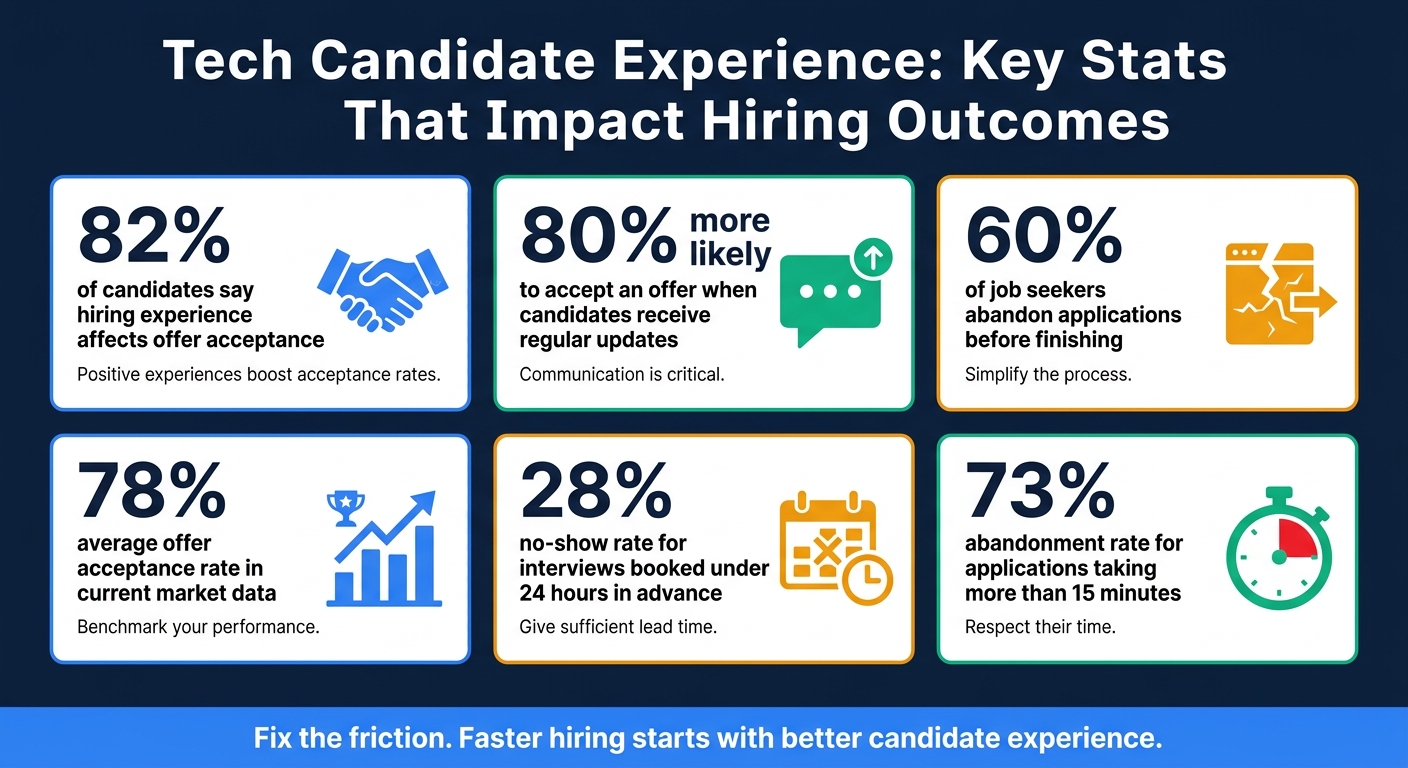
Tech Candidate Experience: Key Stats That Impact Hiring Outcomes
Map the Tech Candidate Journey and Find the Friction
The Hiring Stages That Shape How Candidates See Your Company
If you want to fix candidate experience, start by mapping where friction begins. A tech candidate journey has eight stages: awareness, consideration, application, screening, technical assessment, interviews, offer, and post-decision follow-up. Each stage either keeps people moving or gives them a reason to drop out.
It starts before anyone applies. In tech, candidates often check your engineering blog, review your public GitHub repos, and read Glassdoor feedback before they submit an application. Your tech stack, documentation, and engineering standards all send a signal about whether your company is worth the effort. Dice’s tech hiring data shows 90% of tech professionals say employer branding affects their job decisions.[5]
Once someone applies, the process becomes operational. Application forms, recruiter screens, coding assessments, system design interviews, and panel interviews all come with friction risk. For a senior backend engineer, that could mean a GitHub portfolio review during screening and a system design interview later on. The touchpoints change by role, but the pattern does not: every hand-off is a point where candidates decide whether to continue or step away.
Post-decision follow-up matters as well, even for people you do not hire. A prompt, respectful close, whether that is a clear rejection note or a timely update on next steps, shapes referrals, reapplications, and what people say about your company to peers. That has a direct effect on future hiring reach and brand perception.
How to Use Funnel Data to Find Where Candidates Drop Off
Most hiring teams know their time-to-fill. Far fewer know where they are losing candidates in the funnel, and why. That is where funnel metrics help. They show you where the process breaks down, so you can fix the right thing instead of guessing.
Application completion rate is often the first metric to check. Research shows 60% of job seekers abandon applications before finishing them, with long forms, duplicate data entry, and missing salary ranges among the main causes.[1] If drop-off is high here, the issue is usually not candidate quality. It is application friction. Applications that take more than 15 minutes can see abandonment rates as high as 73%.[2]
Further down the funnel, assessment completion rate and interview no-show rate show whether candidates are still engaged after they start the process. Talview‘s scheduling data found an 18.7% overall no-show rate, with interviews booked less than 24 hours in advance reaching 28.0% no-shows, compared with 8.1% for interviews booked 48 to 72 hours out.[3] That points to a scheduling and communication issue, not a sourcing issue.
Offer acceptance rate is the clearest sign of how the full experience landed. Ashby‘s Talent Trends data puts average offer acceptance at 78%, with SaaS and Cloud at 79% and Fintech at 77%.[4] Teams with weak communication, late-stage pay surprises, or slow written offer delivery often fall below that mark. And when that happens, you pay for it twice: more time lost, and more hiring spend to reopen the search.
| Funnel Metric | What It Signals | Business Impact |
|---|---|---|
| Application completion rate | Form friction, salary transparency, role clarity | Top-of-funnel volume without extra spend |
| Assessment completion rate | Fairness, time burden, logistics | Bottlenecks that extend time-to-hire |
| Interview no-show rate | Scheduling gaps, communication quality | Wasted engineering time, higher cost per hire |
| Stage-to-stage conversion | Where qualified candidates exit due to process | Targeted fixes that increase offer volume |
| Offer acceptance rate | Compensation competitiveness, overall experience | Fewer cycles needed to fill each role |
Start with the hand-off that has the most friction. Fix that first, then move to the next one. The biggest drop-off point should set your first priority, because that is where you are losing the most time, money, and qualified talent.
sbb-itb-a23bd6a
Decoding candidate experiences: A new era in tech hiring | Elif Schaefer | LeadDev Berlin 2024
Build a Candidate-Focused Tech Hiring Process
Once you know where people are dropping out, fix the parts of the process that create friction you don’t need.
Write Clearer Job Ads and Simplify the Application Flow
People scan job ads fast. LinkedIn found that the average candidate spends about 14 seconds scanning a job description before deciding whether to keep going.[6] If your post is dense, vague, or packed with jargon, strong applicants leave before you even get a shot at them.
Start with structure. Open with a short summary of what the role does and the problem this person will solve. Then list 5 to 7 concrete bullet points that reflect the actual work. Split required skills from preferred skills into separate lists, and keep hard requirements to 5 to 7 items. Vague or overloaded job descriptions can put off up to 60% of potential applicants, especially women and candidates from underrepresented groups.[7]
Pay and working setup should be in the ad, not saved for later. Show the base salary range in U.S. dollars, such as $140,000 to $170,000 base plus equity. State whether the role is remote, hybrid, or on-site. If there are location limits or core collaboration hours, spell them out.
The application itself should take 5 to 10 minutes on mobile. Use resume parsing to pre-fill fields instead of making people type out their work history again. Cut duplicate fields. Keep required inputs to contact details, work authorization, and one or two role-specific questions. A visible progress bar helps too.
When the ad is clear and the application is easy, you remove one of the first points where good people walk away.
Use Fair Technical Assessments and Structured Interviews
A fair assessment should look like the work the person would actually do. That means debugging or refactoring for engineers, incident review for DevOps, SQL analysis for data roles, and prioritization exercises for product roles. Keep assessments to 60 to 90 minutes. You want to test skill, not stamina.
Structured interviews also lead to better hiring decisions. Research shows structured technical interviews have a predictive validity of 0.51 versus 0.38 for unstructured interviews, about a 34% improvement in predicting developer performance.[8] That matters because better prediction means fewer hiring mistakes, less wasted team time, and stronger delivery after the hire joins.
Build scorecards around 3 to 5 must-have competencies for the role, such as system design, debugging, and communication. Use a 1 to 5 scale with clear behavioral anchors for each score. Every interviewer should use the same rubric, take evidence-based notes, and submit feedback on their own before the debrief. That reduces anchoring bias and makes decisions easier to defend.
Set expectations before the interview starts. Send the candidate the interviewer’s name and role, the format, the topics being covered, and any tools they should know in advance. Then stick to a decision or next-step update within 2 to 3 business days. That kind of follow-through builds trust and helps keep strong people engaged.
Balance Automation with Direct Human Communication
Automation is great for admin. Self-serve scheduling links, automatic application receipts, stage updates, and interview reminders all cut internal delays without eating up recruiter time. For U.S. candidates, show interview times in the candidate’s local time and label the time zone clearly, such as ET, CT, MT, or PT.
But automation has limits. After a final-round interview, a recruiter should follow up in person within the promised response window, even if the decision is still pending. If someone reached a serious stage in the process, a rejection should come with a personal email or a short call, not a generic template. Offers should be delivered by video or phone, with the hiring manager available to talk through team culture, roadmap, and where the role fits. That’s often the point where top candidates decide whether to accept.
As hiring volume grows, consistency starts to affect hiring outcomes. Many scaling teams don’t have the recruiter capacity to manage logistics and direct candidate communication at the same time. This is where embedded recruitment helps. An experienced recruiter works inside your team, standardises workflows, and runs hiring end to end. For scaling companies, that means lower hiring costs, fewer bottlenecks, and a more consistent candidate experience as volume grows. It also gives you a process that’s easier to repeat and measure.
Measure, Improve, and Scale Candidate Experience
Most teams track cost-per-hire and time-to-fill. Those numbers tell you how efficient hiring looks on paper. They do not show where candidates get stuck, lose interest, or walk away.
If you want to improve candidate experience, you need metrics that show friction inside the process. Then you need to check whether each change cuts delay by using a recruitment process analysis tool and helps you close the right people faster.
The Metrics That Show Hiring Quality and Efficiency
Track these metrics by role, recruiter, and hiring manager. That’s how you spot where candidate experience starts to slip.
| Metric | Definition | Business Value |
|---|---|---|
| Time to first human contact | Time between application and first recruiter or hiring manager reply | Slow contact loses candidates who have multiple offers; target is within 24 to 48 business hours |
| Time between stages | Average wait between completing one stage and beginning the next stage | Gaps longer than 3 to 5 days push candidates toward faster employers |
| Total candidate time-to-hire | Calendar days from application to accepted offer | Shorter timelines generally correlate with higher offer acceptance in competitive tech markets |
| Candidate Net Promoter Score (cNPS) | How likely candidates are to recommend your hiring process, regardless of outcome: % Promoters (9 to 10) minus % Detractors (0 to 6) [10] | A standard candidate-experience sentiment metric; tracks candidate sentiment over time |
| Post-stage survey results | Structured 3 to 5 question surveys sent after key stages using 1 to 5 Likert scales; average score per question per stage | Pinpoints specific issues like unclear assessment instructions or unprepared interviewers; % rated 4 or 5 |
| Stage-level pass-through rate | Percentage of candidates who advance from one stage to the next: (Candidates who start Stage B ÷ Candidates who completed Stage A) × 100 | Shows which stage is blocking qualified candidates |
These metrics do two jobs at once. They show where your process slows down, and they show where hiring quality may be leaking out of the funnel.
How Feedback Loops Lead to Better Hiring Decisions Over Time
Collecting feedback only matters if you do something with it. The goal is simple: send short surveys after key stages, review patterns every month or quarter, and make one clear change with one owner and one deadline.
After screening, send a 3 to 4 question mobile-friendly survey within 24 to 48 hours. Ask about role clarity, recruiter helpfulness, and whether the candidate understood the next steps.
After assessments, ask about instruction clarity, whether the task felt relevant to the role, and how much time it took.
After interviews, ask about interviewer preparation, scheduling flexibility, and whether the candidate had space to ask questions.
After a final decision, keep rejection surveys short and optional. Ask offer-accepted candidates for their overall cNPS rating.
There’s a response-rate gap worth planning for. Hired candidates respond to surveys at more than twice the rate of rejected candidates, 54% versus roughly 25%.[9] Send rejection surveys 2 days after the decision to get better response quality.
As hiring volume grows, monthly reviews work well for high-volume roles like engineering and product. Quarterly reviews are enough for lower-volume specialist positions.
Ownership also needs to be clear:
- Recruiting operations tracks time-to-contact and time-to-hire
- Hiring managers own interview quality
- People analytics owns cNPS analysis
Track every process change in a shared log. Then check the next cycle to see if the metric moved. That’s the part many teams miss. If you can’t tie a change to a result, you’re just collecting comments.
This is how candidate experience becomes something you can measure and fix. Use these metrics to guide tool choices and team setup, so you remove delay instead of just reporting on it.
Tools and Team Models That Support Better Candidate Experience
Once you know where candidates drop off, the next step is simple: remove friction. That comes down to two things, the right tools and clear ownership.
Choose Tools Based on Candidate Usability, Not Just Recruiter Convenience
Pick tools for candidate usability, not just recruiter convenience. If a platform saves your team 10 minutes but makes it harder for applicants to finish the process, you lose out.
A practical hiring stack should cover ATS, scheduling, communication, assessments, and video interviews. The test for each tool is the same: does this cut candidate effort?
Your ATS should manage job posting, resume collection, shortlisting, scheduling, communication, and offers in one place. Scheduling tools should let candidates self-schedule using live interviewer availability, so you avoid the usual email ping-pong. Assessment platforms should run cleanly on mobile, without forcing candidates to set up a new account or download software.
Before you commit to any tool, run a mobile audit across the full journey, from your careers page through application, assessment, and video interview, on both iPhone Safari and Android Chrome. Fix any step that asks for more than one tap or an extra download. The goal is straightforward: fewer logins, fewer taps, fewer drop-offs.
Tools only help when one person owns the process behind them.
How Embedded Recruitment Adds Structure and Scale to Tech Hiring
An embedded recruiter solves this by owning sourcing, screening, scheduling, and communication end to end across multiple open roles. That gives you one clear point of control.
They set service-level expectations, standardise scheduling and communication, and make sure no candidate goes silent after finishing an assessment. That’s how you turn a pile of tools into a process that works the same way every time.
Rent a Recruiter places experienced recruiters into your team within days, bringing structure, visibility, and steady execution while cutting hiring costs and admin time. For scaling companies that need predictable delivery without building a full internal recruiting function, a fixed monthly model also removes cost uncertainty.
Conclusion: Turn Candidate Experience into a Measurable Growth Advantage
Strong candidate experience turns hiring into a repeatable growth advantage. Companies that get this right do more than fill roles faster. They build a reputation that makes the next hire easier and cuts wasted time across the process.
If you’re ready to audit your current process or want to look at embedded recruitment support, learn more at Rent a Recruiter.
FAQs
What hurts candidate experience most?
The biggest damage to candidate experience usually comes from friction you didn’t need in the first place, weak communication, and a hiring process that changes from role to role.
Long or overcomplicated applications are a big part of the problem. The worst offender? Requiring people to create an account before they can apply. That step alone drives 41.2% of candidates away.
Speed matters too. Top talent is often off the market within 10 days. If your team is slow to follow up, struggles to schedule interviews, or leaves long gaps between stages, candidates start to feel ignored.
That has a direct business cost. You lose strong applicants, offer acceptance drops, and your employer brand takes a hit. In growth-focused sectors like SaaS, Technology, IT, Fintech, Engineering, Security, Insurance, and Professional Services, that kind of drag can slow hiring when you can least afford it.
How fast should we move candidates?
Move candidates through the process fast, but keep decision points clear and scheduled.
Send an automated acknowledgment right away. Follow up within 1 to 2 business days, then keep each follow-up window to 3 to 5 business days after every stage.
No stage should run past 5 business days. Set 48-hour feedback SLAs after interviews. Extend offers within 48 hours of the final interview, and send the digital offer within 24 hours of the decision.
This kind of pace cuts drop-off, saves hiring team time, and helps you close stronger candidates before they take another offer.
Which candidate experience metrics matter most?
The most important metrics are:
- Candidate NPS (cNPS) to track satisfaction
- Application Completion Rate to spot early friction
- Time-to-First-Contact to measure responsiveness
- Offer Acceptance Rate to show trust in your process and the strength of your offer
- 90-day retention to assess early fit after hire
Taken together, these metrics show where people drop out, where communication starts to lag, and whether your hiring process supports a strong early fit.
For hiring leaders, that matters because candidate experience is not just a brand issue. It affects speed, acceptance rates, and retention. If people leave during the application, wait too long for a reply, or decline at offer stage, you’re losing time and increasing hiring cost.