
If you only start hiring when a role opens, you are already late, and that delay can cost you $1,700 to $5,000 per day in lost output.
I see the fix as simple. Build talent pools around known hiring demand, keep them clean, and use them before you pay for new sourcing. Done well, this can cut hiring time from 42 to 60 days to roughly 10 to 15 days, while giving you more control over cost, workload, and hiring quality.
Here’s the short version:
- Start with demand, not tools
- Prioritise repeat, specialist, and leadership roles
- Reuse past finalists, referrals, and internal talent first
- Track salary expectations in $USD and work authorisation early
- Review pool data every quarter, because records decay by 20% to 30% a year
- Run a light nurture cadence so your best contacts stay warm
- Measure speed, cost per hire, and source performance after each hire
For CEOs, CFOs, HR leaders, and Talent Leaders, the point is not to build a big database. It is to build a hiring system that saves time, cuts agency spend, and reduces scramble when growth picks up.
If recruiter capacity is the blocker, Rent a Recruiter or an embedded recruiter can run the process inside your team without adding full-time headcount.
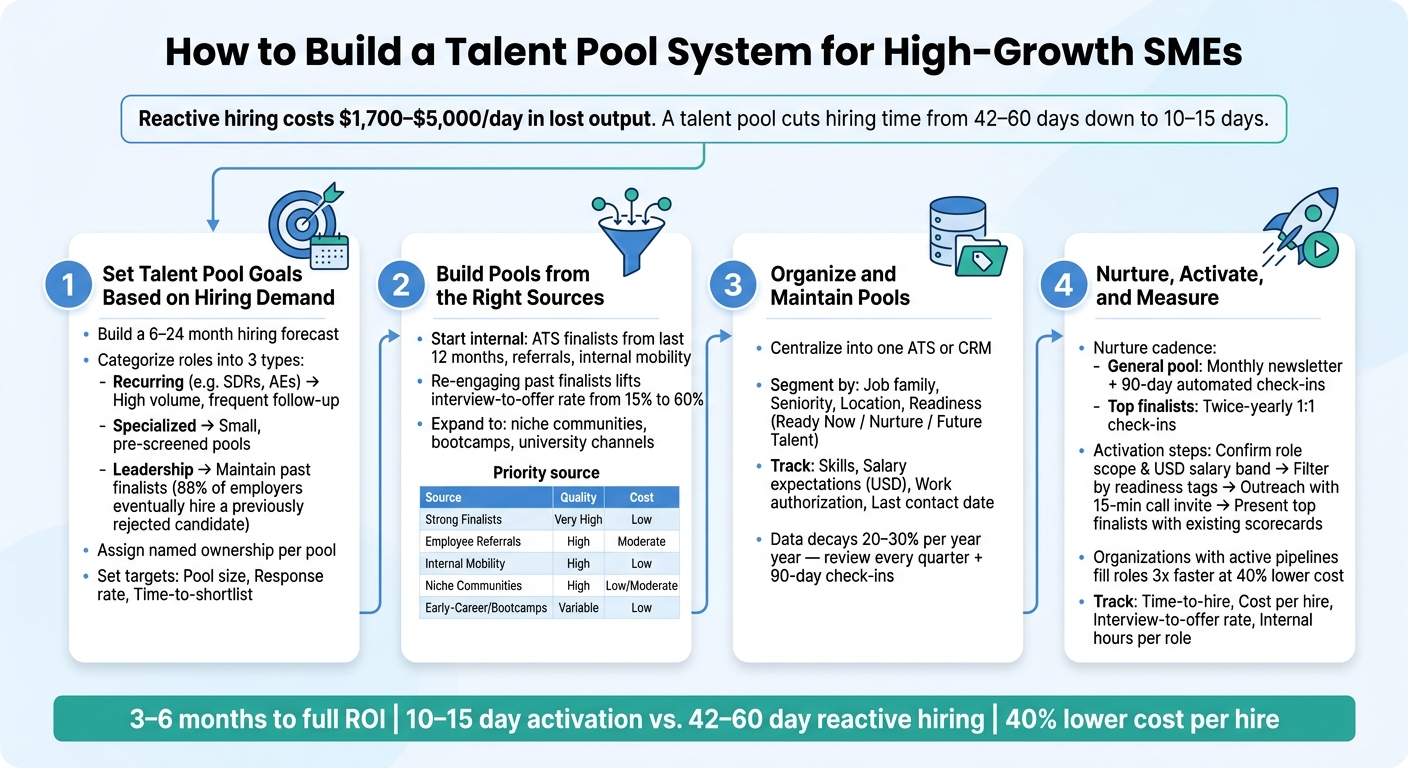
How to Build a Talent Pool System: 4-Step Process for High-Growth SMEs
Building Talent Pools and keeping them engaged
sbb-itb-a23bd6a
1. Set Talent Pool Goals Based on Hiring Demand
Start with a 6 to 24 month hiring forecast. That gives you a clear view of which talent pools you need, how big they should be, and who should own them.
Begin with the roles that put the most pressure on hiring.
Map recurring, specialized, and leadership roles
Not every role needs the same pool plan. The simplest way to prioritise is to split roles into three groups based on repeat hiring, hard-to-fill demand, and leadership succession needs.
Recurring hires are roles like Sales Development Representatives (SDRs) or Account Executives (AEs) that you hire again and again, often around quarterly spikes. These pools usually need more volume and more frequent follow-up.
Specialized hires are harder-to-fill roles that need smaller, pre-screened pools. In these cases, quality matters more than size.
Leadership roles need a different approach again. For senior hires, finalists from earlier searches can save you time and cut search costs later. Nearly 88% of employers have eventually hired a candidate they previously rejected, which makes this group worth maintaining carefully [1].
Use each role type to shape the right pool size, source mix, and follow-up cadence.
Once those role groups are clear, set targets for each pool.
Set pool targets and assign ownership
With the role mix mapped out, define what success looks like for each pool.
Set targets for:
- Pool size
- Response rate
- Time-to-shortlist
Targets on their own are not enough. Ownership is what keeps a pool usable. Without a named owner, pools go stale fast. Pool data decays by 20% to 30% each year as candidates change jobs or contact details [1].
Assign one owner for maintenance and re-engagement, usually the recruiter. Hiring managers should help flag strong finalists from earlier searches, while leadership sets the overall direction.
Pools linked to repeat demand need the most attention because they get used most often. If nobody owns them, they lose value fast.
2. Build Your Initial Talent Pools from the Right Sources
Use the role priorities and pool targets from Step 1 to pick the first sources worth your time.
Start with internal networks, referrals, and past applicants
Before you post a single job ad, check what you already own. Start in your ATS and review strong finalists from the last 12 months. These are people who got close but were not hired because timing, budget, or headcount changed. Going back to them can lift your interview-to-offer pass-through rate from 15% to 60% [1].
Instead of sending a standard rejection, send a short re-engagement note. Then move strong past applicants, referrals, and internal candidates into a future-role pool.
For recurring roles, referrals and strong finalists are usually the best place to begin. For specialist roles, niche communities tend to matter more. For entry-level hiring, early-career channels often give you the best return for the effort. The aim is simple: use sources you can come back to every quarter without piling more work onto your recruiters.
Add external communities, platforms, and early-career channels
Once you’ve worked through internal sources, expand outward, but stay focused. Industry communities, niche professional groups, and early-career channels can help you reach people who will not come through a job post alone. For entry-level tech and sales roles, university links, coding bootcamps, and local meetups can work well.
Set the target profile first. Decide on a small number of must-haves. Use a short form to collect opt-ins, and only add people who have given consent. Keep outreach consistent so screening and follow-up do not turn into a mess as volume grows.
Compare talent sources by quality, cost, and scalability using our hiring resources
Start with the sources that give you the best mix of quality, low cost, and low effort.
| Talent Source | Candidate Quality | Relative Cost | Recruiter Time | Scalability | Best-Fit Roles |
|---|---|---|---|---|---|
| Strong Finalists | Very High | Low (internal) | Low | Low/Medium | Tech, Engineering, SaaS, Leadership |
| Employee Referrals | High | Moderate (bonuses) | Low | Medium | All roles |
| Internal Mobility | High | Low | Medium | Low | Leadership, Specialized |
| Niche Communities | High | Low/Moderate | High | Low | Engineering, Fintech, DevOps |
| Early-Career/Bootcamps | Variable | Low | Medium | High | Entry-level Tech, Sales |
The next move is to place these contacts into one system, so you can segment them and keep the pool up to date in the next step.
3. Organize and Maintain Talent Pools So They Stay Useful
Once you’ve sourced candidates, the next job is keeping that pool usable.
That sounds simple. In practice, it’s where many teams fall down. Good sourcing only pays off if your pool stays current, searchable, and easy to activate when a role opens.
Set up a central system and segment by hiring need
Move everything into one system, whether that’s your ATS, recruiting CRM, or a structured database.
If data sits across spreadsheets, inboxes, and LinkedIn notes, your team loses time before the search even starts. A central system cuts that friction and gives you a cleaner path from open role to shortlist, a key benefit of recruitment on demand models.
From there, segment the pool around what helps hiring move faster:
- job family
- seniority
- location
- readiness
For U.S.-based SMEs, there are two more fields you should track from day one: salary expectations in USD and work authorization status. Miss either one, and you can hit delays late in the process, right when you’re trying to close.
Tag data consistently and review pools every quarter
Consistent tagging is what makes a talent pool useful under pressure.
When a role lands, recruiters need to find the right people fast, not dig through half-complete records. Each candidate profile should include skills, domain experience, salary expectations in USD, preferred contact channel, last contact date, and work authorization.
There’s a simple reason this matters. Candidate data goes stale. Records typically decay by 20% to 30% a year as people change jobs or update contact details, so review pools every quarter and run 90-day check-ins between reviews [1].
A pool that isn’t maintained becomes dead weight. A pool that is maintained saves time, cuts repeat sourcing work, and gives you more control over hiring timelines.
Compare segmentation models for speed and reporting
The right segmentation model depends on what you need the pool to do.
If you’re hiring for the same roles again and again, job family segmentation is easy to manage and simple to report on. If succession planning is on the agenda, seniority gives you a better view of leadership depth. If speed is the main goal, readiness-based segmentation, such as Ready Now, Nurture, or Future Talent, gives you the shortest path to a shortlist and a clearer view of pool health.
| Segmentation Model | Activation Speed | Recruiter Workload | Reporting Clarity | Best For |
|---|---|---|---|---|
| By Role / Job Family | Moderate | Low | High | High-volume recurring roles |
| By Seniority | Moderate | Low | High | Leadership pipeline planning |
| By Engagement / Readiness | Very High | High | High | Urgent or hard-to-fill roles |
| By Location / Remote | High | Low | High | U.S. tax and compliance planning |
For lean SME teams, start with role-based segmentation. Then add readiness tags for urgent roles.
That gives you a setup that’s easy to manage, while still letting you move fast when hiring pressure picks up.
With the structure in place, you can now build a simple cadence to keep candidates engaged and ready to activate.
4. Nurture, Activate, and Measure Your Talent Pools
Once your pool is organised, the job is simple: keep it warm so you can use it fast when hiring opens up.
Run a simple engagement cadence that fits SME capacity
For your general pool, send a short monthly newsletter and set automated check-ins every 90 days. Keep both brief and useful. No fluff, no long updates, just enough to stay on their radar.
For your highest-value group, especially final-round candidates who did not get an offer, a twice-yearly one-to-one check-in helps keep the relationship alive. It also keeps that group near the top of the list when a new role lands.
Across every tier, two things matter most: fast follow-up and clear opt-out options. In competitive U.S. markets, a slow reply makes your team look disorganised. An easy opt-out shows respect. Both help protect your employer brand.
How to activate your pool when a role opens
When a role opens, move from nurture mode to search mode using the same tags and readiness signals. Start with your ATS or CRM before you widen the search.
First, confirm the role scope and salary band in USD with the hiring manager. Once that is locked, filter by skills, location, and readiness tags such as "Ready Now", "Nurture Q3," and "Future Finalist." Put "Ready Now" candidates first, along with any final-round candidate from the past 12 months.
The process itself is straightforward:
- Search the pool for warm candidates who match the confirmed role criteria.
- Send personalised outreach and invite them to a 15-minute call, not a full interview.
- Show top finalists to the hiring manager first. You already have scorecards on file, so they can often skip the earliest interview rounds and move straight into the formal hiring process.
Organizations with active talent pipelines fill roles 3x faster and at a 40% lower cost than those starting from scratch [2].
Track results and refine the model over time
After each hire, review which sources, messages, and tags drove the fastest response. Track time-to-hire, cost per hire, internal hours per role, and interview-to-offer rate. That gives you a clear view of whether the pool is getting stronger or just getting bigger.
Use automated contact checks each quarter to confirm contact details and measure candidate interest. If response rates are falling, your content or timing likely needs to change. If interview-to-offer rates are low, your segmentation or activation process needs tightening.
Not every engagement tactic gives the same return. For SME teams, the trade-off usually comes down to time, response rate, and role type.
| Engagement Tactic | Time Cost | Response Rate | Pool Size Suitability | Best-Fit Role Types |
|---|---|---|---|---|
| Newsletters | Low (automated) | Low/medium | Large pools | General/all |
| Virtual Events | Medium | Medium | Specialized groups | Engineering, sales |
| 1:1 Check-ins | High | High | Final-round candidates | Leadership, specialized |
If your team does not have recruiter bandwidth, embedded support can keep the cadence and reporting running without adding headcount. This is a core benefit of embedded recruitment, which provides the expertise of an in-house team with the flexibility of an external partner.
Conclusion: Build a Repeatable Talent Pool System for Growth
Once your pool is in place and kept up to date, the next job is simple in theory and hard in practice: make it repeatable.
A talent pool only works when hiring demand, sourcing, segmentation, and nurture stay in sync. If one part slips, the whole system slows down. Building that kind of hiring engine takes discipline, consistency, and clear ownership. You can rate your recruitment process to identify specific gaps in your current system.
That speed has a direct business impact in the U.S., where hiring delays turn into cost fast. A well-run pool can activate candidates in 10 to 15 days, compared with the 42 to 60 days common in reactive hiring [1]. That means less time lost, less pressure on internal teams, and less revenue left on the table.
The payoff does not happen overnight. Most teams need around 3 to 6 months of steady effort before the model starts to show major ROI [1]. But once it starts working, you are not starting from scratch every time a role opens. You are hiring from a system, not from panic.
For teams that need to move faster, Rent a Recruiter can embed experienced recruiters within days to build and run the system end to end.
FAQs
How big should a talent pool be?
There’s no fixed number. A big talent pool means very little if people don’t convert.
The better way to size it is to work backward from your hiring plan.
If you need 30 hires, you may need 91 offers, 606 screens, and 3,030 ready-now candidates to get there. That’s the commercial reality of funnel maths.
So don’t chase volume for the sake of it. Focus on quality and engagement so your pool can deliver when hiring demand hits.
For hiring leaders, that matters because a smaller, active pool will often outperform a much larger database that’s gone cold. The goal isn’t to store names. It’s to build a pipeline that turns into hires.
Which roles need talent pools first?
Start with the three to five job families you’ve hired most often in the last 24 months. Don’t try to map every role in one go. That spreads effort too thin and weakens your data.
Keep the focus on high-volume roles such as sales, engineering, or customer support. Then align with leadership on the capabilities you’ll need over the next 12 to 24 months, especially for roles that are hard to fill.
This gives you a tighter scope, better data, and a clearer link to hiring outcomes that matter to the business.
What if we do not have recruiter capacity?
Without in-house recruiter capacity, hiring often turns reactive. Your team ends up stuck in manual sourcing, interview admin, and follow-up, with as much as 70% of their time going on work that slows the business down.
Working with Rent a Recruiter gives you experienced recruiters embedded into your team within days. They run hiring end-to-end, help you build talent pools, cut hiring costs by up to 70%, and save your team more than 80 hours per month.