Start building your niche talent pool before a vacancy puts delivery dates at risk, especially when facing challenges in recruitment. I recommend starting with one scarce skill segment, one owner, and a monthly data check. Track qualified candidates and time to shortlist, not database size, so you can see whether your work saves recruiter time and supports hiring targets.
Here’s the seven-step approach I use:
- Define the skills your business needs, separating required skills from those you can train.
- Source in specialist communities where you can review relevant work.
- Check skills, interest, and availability before counting someone as a fit.
- Organise candidates by skills and readiness so your team avoids repeat sourcing.
- Stay in touch with relevant updates, guided by each person’s contact preferences.
- Reconnect when matching roles open, confirming fit before the hiring-manager handoff.
- Measure results and update the pool, tracking conversion, sourcing costs, and hiring speed.
The aim is simple: <u>less repeated work and a shorter path to qualified candidates</u>. Start small, measure against your last 6 to 12 months of similar hires, and expand when the results support it.
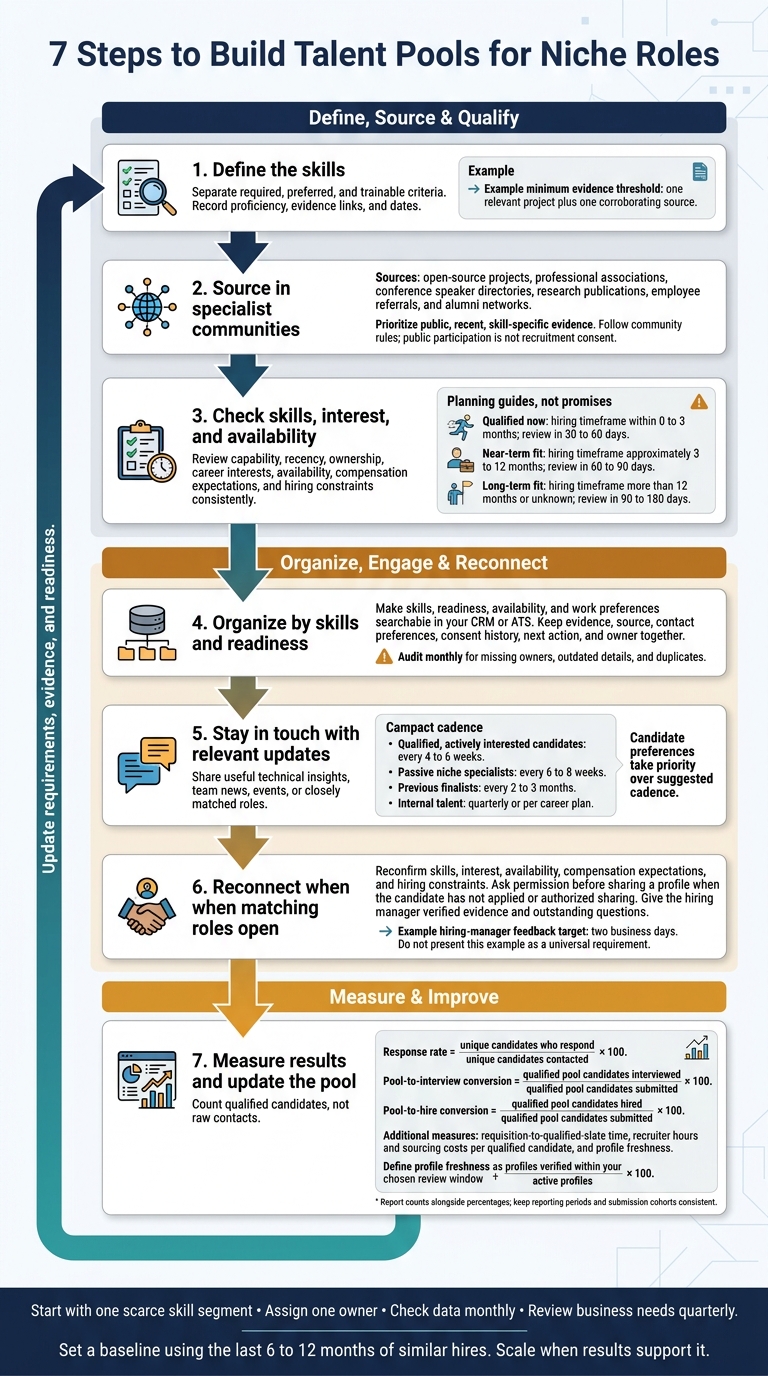
7 Steps to Build Talent Pools for Niche Roles
Steps 1–3: Define, Source, and Qualify Candidates
Step 1: Define Skills and Candidate Profiles
Turn your requirements into a skills-based profile covering technical skills, evidence of applied work, certifications, seniority, and work preferences. Separate required, preferred, and trainable criteria so your team knows where it can flex.
Define seniority through ownership and decision-making, not years alone. Use consistent tags such as IAM and incident-response, with proficiency levels, evidence links, and dates. Before adding someone to the active pool, set a minimum evidence threshold, such as one relevant project plus one corroborating source.[4][5]
Example: A DevSecOps engineer with documented cloud-control implementation, security automation, and incident-response evidence may be a stronger match than a title-only security engineer.
Use this profile to focus sourcing on places where you can see those skills in practice, often requiring specialist IT recruitment expertise.
Step 2: Source Candidates From Specialist Communities
Look for candidates through public work or verified credentials. Online communities can help you find relevant skills, but participation and outreach must follow community rules.
The comparisons below are directional, not performance benchmarks. Avoid prohibited scraping. Record the source, discovery date, relevant evidence, public profile or portfolio link, and preferred contact method.
Public participation does not mean consent to recruitment. Ask permission before adding someone to regular talent-pool communications.
For niche roles, prioritize channels with public, recent, skill-specific evidence to keep sourcing focused.
| Channel | Candidate relevance | Reach | Time investment | Data quality | Relationship-building potential |
|---|---|---|---|---|---|
| Open-source projects | High when contributions match the target stack | Variable | High | Strong work evidence, but identity and availability may be unclear | High when engagement follows community norms |
| Professional associations | Moderate to high when the association is role-specific | Moderate | Moderate | Often good for credentials and professional context | High through events, committees, and permission-based outreach |
| Conference speaker directories | High for visible subject-matter expertise | Narrow | Moderate to high | Strong for topics presented, but not proof of current availability | High if outreach references the person’s work |
| Research publications | High for specialized or emerging technical domains | Narrow | High | Strong for documented expertise, though commercial experience may vary | Moderate to high through considered, subject-specific contact |
| Employee referrals | Often high because the referrer adds context | Low to medium | Low to medium | Medium to high, subject to referral detail | High because of the warm introduction |
| Alumni networks | Variable; stronger when the network has a relevant program or employer base | Medium | Medium | Medium | High for long-term relationship development |
Step 3: Check Skills, Interest, and Availability
Apply the same job-related review sequence to every candidate: demonstrated capability, recency, level of ownership, career interests, availability, compensation expectations, and hiring constraints.
Label information as verified, candidate-stated, publicly observed, inferred, or unknown. If technical evidence is uncertain, ask a hiring manager or subject-matter expert to review it.
Use identical core questions and scoring criteria. OPM notes that structured interviews improve evaluation consistency by limiting interviewer discretion.[6] One review standard helps your team make consistent pool decisions.
| Status | Qualification level | Likely hiring timeframe | Next action | Review date |
|---|---|---|---|---|
| Qualified now | Meets required skills or has minor confirmed gaps; interest and constraints are compatible | Within 0 to 3 months | Obtain consent, confirm current interest and compensation alignment, and schedule a role-specific conversation when appropriate | 30 to 60 days |
| Near-term fit | Demonstrates several relevant skills but has a material gap that could be closed through experience, training, or a different opening | Approximately 3 to 12 months | Share relevant information, identify the missing evidence, and maintain a light-touch relationship | 60 to 90 days |
| Long-term fit | Shows adjacent capability, learning trajectory, or strong potential but is not yet aligned with current requirements | More than 12 months or unknown | Offer useful community or company updates and document a possible development path | 90 to 180 days |
Treat these windows as planning guides, not promises. Save a specific next-review date and the evidence behind each status.
Keep early qualification lightweight to limit unnecessary assessment time. Reserve formal work samples for active hiring when appropriate. Move candidates between groups when their evidence, interests, or availability changes, not simply because time has passed.
Use these statuses to group candidates by skills and readiness in Step 4.
sbb-itb-a23bd6a
Steps 4–6: Organize, Engage, and Contact Candidates
Step 4: Group Candidates by Skills and Readiness
Turn the ready-now, near-term, and long-term groups from Step 3 into a searchable talent pool so your team can find suitable people without repeating the groundwork.
In your recruiting CRM or ATS, make Step 3 statuses searchable alongside specialty, seniority, location, work authorization, work model, compensation expectations, availability, target start date, and hiring timeframe.
Label passive prospects, previous applicants, finalists, referrals, and internal talent. Keep assessment evidence, source, contact preferences, consent history, last contact, next action, and owner fields together, using standardized values. Remove duplicate records before import to prevent repeat outreach.
Set role-based access and audit changes monthly for missing owners, outdated details, and duplicates. Collect only the recruiting data you need, and keep sensitive information separate from general pool views.
Have legal counsel check your retention and deletion rules. EEOC guidance generally requires covered private employers to retain personnel and employment records for one year, with longer or case-specific preservation requirements for discrimination charges.[10][11][7][8][9]
Maintain do-not-contact records and preserve opt-out evidence under your retention policy.
Step 5: Stay in Touch With Relevant Updates
Match updates to candidates’ stated interests, not your publishing calendar. Use permission-based contact to share technical insights, product news, event invitations, or closely matched roles.
Candidate preferences take priority over the suggested cadence below. Automated reminders can help your team follow up, but keep conversations personal. Check that company, team, work model, role scope, and current hiring-status details are accurate. Honor opt-outs within required timeframes.[12]
Use short, relevant messages to maintain contact with your organized pool.
| Segment | Purpose | Suggested cadence | Message type | Owner | Success indicator |
|---|---|---|---|---|---|
| Qualified, actively interested candidates | Maintain a warm relationship | Every 4 to 6 weeks | Personal check-in, relevant role, or technical update | Recruiter | Reply rate, updated availability |
| Passive niche specialists | Give useful reasons to stay connected | Every 6 to 8 weeks | Technical insight, product news, or event invitation | Recruiter or subject-matter expert | Engagement rate, conversation rate |
| Previous finalists | Reopen a trusted relationship | Every 2 to 3 months | Team update, project news, or tailored check-in | Recruiter who managed the process | Re-engagement rate, interview acceptance |
| Internal talent | Identify future mobility or return opportunities | Quarterly or per career plan | Internal opening, team update, or career conversation | Talent partner or HR owner | Qualified internal applications, conversations |
Step 6: Reconnect When Matching Roles Open
When a matching role opens, use your searchable fields to move from talent pool to targeted outreach.
Start with qualified, recently engaged candidates, strong previous finalists, and people with newly confirmed availability. Match your message to each person’s stated priorities. Include project scope, required skills, seniority, location, work model, compensation range in U.S. dollars, schedule, and likely start date.
Before moving anyone forward, reconfirm role interest, availability, notice period, location and work authorization, work model, compensation expectations, relevant skills, and willingness to complete assessments. If someone has not applied or authorized profile sharing, ask permission before sending their profile to the hiring manager.
Give the hiring manager a concise handoff covering verified qualifications, evidence links, motivation, availability, compensation expectations, work preferences, consent or contact status, and any risks or unanswered questions. Keep recruiter ownership clear unless responsibility changes.
Set a hiring-manager feedback target, such as two business days, to keep decisions moving. Track contacted, interested, screened, review, assessment, interview, offer, and hired stages. Record withdrawals and declines separately from future-interest status to prevent duplicate outreach and unnecessary reassessment.
The Talent Pool in a Nutshell | AIHR Learning Bite
Step 7: Measure Results and Update the Pool
After Steps 4 through 6, focus on what the pool delivers. Build a monthly dashboard around qualified candidates, not raw contacts. Count additions by skill segment only once candidates meet your documented minimum requirements.
Use consistent formulas so you can compare results:
- Response rate: unique candidates who respond ÷ unique candidates contacted × 100.
- Pool-to-interview conversion: qualified pool candidates interviewed ÷ qualified pool candidates submitted × 100.
- Pool-to-hire conversion: qualified pool candidates hired ÷ qualified pool candidates submitted × 100.
Report counts alongside percentages, and keep reporting periods and submission cohorts consistent.[13][14]
Measure requisition-to-qualified-slate time in calendar days, from requisition approval to delivery of the first slate that meets the hiring manager’s requirements. Report the median and number of searches.
Track recruiter hours and sourcing costs per qualified candidate. Measure how current your profiles are: profiles verified within your chosen review window ÷ active profiles × 100. Together, these figures show whether the pool reduces hiring effort and improves results.
Compare performance by source, skill segment, outreach approach, and owner. Check where replies stop turning into qualified submissions, or submissions stop turning into interviews. Use multiple quarters when samples are small.
Where lawful and appropriate, review aggregate representation and barriers in requirements, scheduling, or assessments. Keep demographic analysis separate from selection scoring. Never rank candidates by protected characteristics.
Use the skill segments and readiness groups from earlier steps to check whether your pool matches the hiring plan as you scale.
Compare Pool Coverage With Hiring Plans
Review coverage quarterly, or monthly for fast-changing specialties. Compare planned openings and hiring dates with the current, qualified, interested candidates in each segment, using the labels established in Step 1.
Set coverage targets by scarcity and seniority, not total record count. Assign each gap an owner and a review date so shortages have a clear follow-up.
Update skill requirements and availability, and reclassify candidates when their readiness changes. Test outreach timing while keeping the audience and qualification criteria consistent.
Use post-hire feedback to check whether screening captured the skills and expectations that mattered on the job. Adjust qualification criteria or outreach details, then track interview conversion, offer acceptance, and early retention after the change.
Archive or delete outdated records only under your documented retention policy and any legal holds.[7][15][16]
Conclusion: Start With 1 Critical Skill Segment
Treat your talent pool as a working hiring system, not a static résumé archive. Track how current your data is, re-engagement rate, time to shortlist, pool-to-interview conversion, and hires from the pool as part of a recruitment process audit.[17][19][20] If maintenance exceeds your team’s capacity, add recruiter support before coverage slips.
Start with one scarce skill segment linked to a near-term business priority. Assign one owner, check data monthly, and review progress against business needs quarterly. Use results from similar niche roles over the past 6-12 months to set a hiring-speed baseline.[18][19] Scale only once the pool consistently produces qualified candidates.
Add Recruitment Support When Capacity Is Limited
When urgent vacancies keep pulling your team away from pool maintenance, Rent a Recruiter can place recruiters inside your team to manage sourcing, engagement, and handoffs.
Use talent maps and recruitment health checks to spot gaps. Agree on ownership upfront, including who handles records, follow-up, reporting, and maintenance when the engagement ends.
FAQs
How many candidates should my niche talent pool include?
For niche roles, candidate quality and engagement matter more than volume. There’s no fixed pool size, but 20 to 50 candidates is a workable range for most smaller U.S. businesses. Within an actively managed pipeline, aim for about 3 to 8 candidates per role. [1][2]
For hard-to-fill roles, fewer than roughly 3 pipeline candidates per expected hire likely won’t give you enough coverage for future openings. [1]
How can I engage specialists when I have no open roles?
Build long-term relationships by sharing useful information, not pushing aggressive pitches. Segment your talent pool by readiness and role so each message fits its audience. Share brief industry updates, company milestones, or compensation benchmarks in U.S. dollars.
For general talent pools, send a monthly newsletter or an automated check-in every 90 days. For priority prospects, including previous runners-up, schedule one-to-one check-ins twice a year. Keep messages short and make opting out easy.
How long should I test a talent pool before expanding it?
Start with a 30-day pilot for one priority role. Expand only when you can reliably generate qualified conversations and conversions, repeat the process, and have reviewed engagement and hiring outcomes [1].
For niche roles, building broader relationships takes longer. Plan for 3 to 6 months of steady work before you see strong, consistent results [2][3].