Losing candidates after they’ve signed an offer is more common than you think – and it’s costing you time, money, and productivity. Over half of candidates (52%) keep applying for jobs after accepting an offer, and 28% back out entirely. For scaling companies, every hire matters. Losing even one can disrupt your team and push back critical goals.
Here’s the problem: most companies treat the time between offer acceptance and Day 1 as dead space. It’s not. This period is one of the riskiest in the hiring journey. Silence or poor communication from your side can make candidates second-guess their decision. The solution? A structured post-offer engagement plan that keeps candidates connected, reduces dropouts, and ensures they’re ready to hit the ground running.
What should your plan include?
- Clear goals: Focus on reducing withdrawals, improving retention, and getting new hires productive faster.
- Candidate segmentation: Tailor your approach based on career stage, role type, and risk level.
- Engagement timeline: Map out key actions in the first 48 hours, preboarding, and the final week before Day 1.
- Consistent communication: Use templates and role-specific content to maintain engagement and avoid gaps.
- Metrics tracking: Monitor offer-to-start rates, email open rates, and early turnover to measure success.
Scaling companies can’t afford to lose talent at this stage. A strong engagement plan protects your hiring investment and sets the tone for long-term success. If managing this process feels overwhelming, consider partnering with an embedded recruiter to streamline and scale your efforts. By doing so, you’ll save time, cut costs, and secure the talent you need to grow.
How to Boost Your Post-Offer Candidate Engagement
sbb-itb-a23bd6a
Define the Goals and Structure of Your Post-Offer Engagement Plan
Before you send out a welcome email or schedule a check-in, take a moment to define the purpose and structure of your engagement plan. Without this foundation, post-offer engagement can quickly become a mix of well-meaning but inconsistent efforts instead of a dependable system.
Set Clear Business Goals
Your engagement plan should focus on measurable outcomes – like reducing offer withdrawals, improving first-year retention rates, and speeding up new hire productivity. These goals directly impact your bottom line. For instance, a structured engagement process can increase new hire retention by as much as 82% [7]. Considering that replacing an employee can cost anywhere from 50% to 200% of their annual salary [7][9], every accepted offer you protect translates to significant savings.
Two other critical objectives to include are safeguarding your employer brand and easing candidate anxiety. Disengaged candidates are 80% more likely to share negative experiences publicly [9]. Additionally, 80% of employees feel anxious between accepting an offer and their first day, and steady communication can make all the difference [7].
"Recruiting convinces someone to join. Preboarding makes them glad they said yes." – Tiny Team [7]
Aim for an offer acceptance rate (OAR) above 90% [4]. If you’re not already tracking this metric, now is the time to start – it’s one of the clearest indicators of how well your post-offer process is performing.
Once your goals are clear, refine your approach by segmenting candidates based on their unique needs.
Segment Your Candidate Groups
Segmenting candidates allows you to focus your efforts where they’ll have the most impact.
Key factors for segmentation include career stage, role type, work model, and risk level. Early-career hires, such as interns or recent graduates, often face long gaps – sometimes up to eight months – between accepting an offer and starting their role [2]. This makes them more likely to back out compared to seasoned professionals with a standard two-week notice period. Candidates in highly specialised roles, like data scientists or quantitative risk modelers, benefit from tailored engagement, such as project previews or technical resources, while general roles can follow a more standardised approach [8]. Remote hires also require unique considerations, such as shipping equipment well in advance (at least two weeks before their start date) and arranging virtual social activities [7].
Pay special attention to high-risk candidates. These include those with extended notice periods (60–90 days), individuals who negotiated heavily on compensation, passive candidates sourced through headhunting, and those relocating for the role [8]. Use your ATS to flag these candidates for priority outreach before they disengage.
| Segment | Primary Goal | Key Touchpoints |
|---|---|---|
| Early Career | Build community and belonging | Peer buddies, monthly newsletters, keep-warm events [2][3] |
| Niche/Specialized | Clarify role and impact | Hiring manager calls, project briefs, technical resources [8] |
| Remote Hires | Logistical readiness | Early hardware shipping, virtual coffee chats, digital welcome packets [7] |
| High-Risk | Reassurance & retention | Frequent check-ins, personal outreach from leadership [8][3] |
With segmentation complete, you can now lay out a detailed timeline for each phase of engagement.
Build a Post-Offer Timeline
Now that your goals are set and candidates grouped, treat the engagement period like a project – complete with milestones, assigned responsibilities, and deadlines.
Break the timeline into four key phases: Kick Off (first 48 hours), Engage (ongoing communication), Enable (final two weeks of logistics and preparation), and Perform (tracking engagement) [3]. Each phase should have a specific owner, whether that’s the recruiter, hiring manager, or a peer buddy, to ensure nothing gets overlooked. For larger teams, consider using a RACI matrix to assign roles and responsibilities.
"The organizations that will win the next generation of talent are the ones that treat the post-offer experience as the start of the employee journey." – Ahva Sadeghi, VP of Growth and Business Development, Yello [2]
Establish a consistent communication rhythm from the outset. Reaffirming your measurable goals throughout the process will keep candidates engaged and confident until their first day [3].
How to Structure a Post-Offer Engagement Timeline
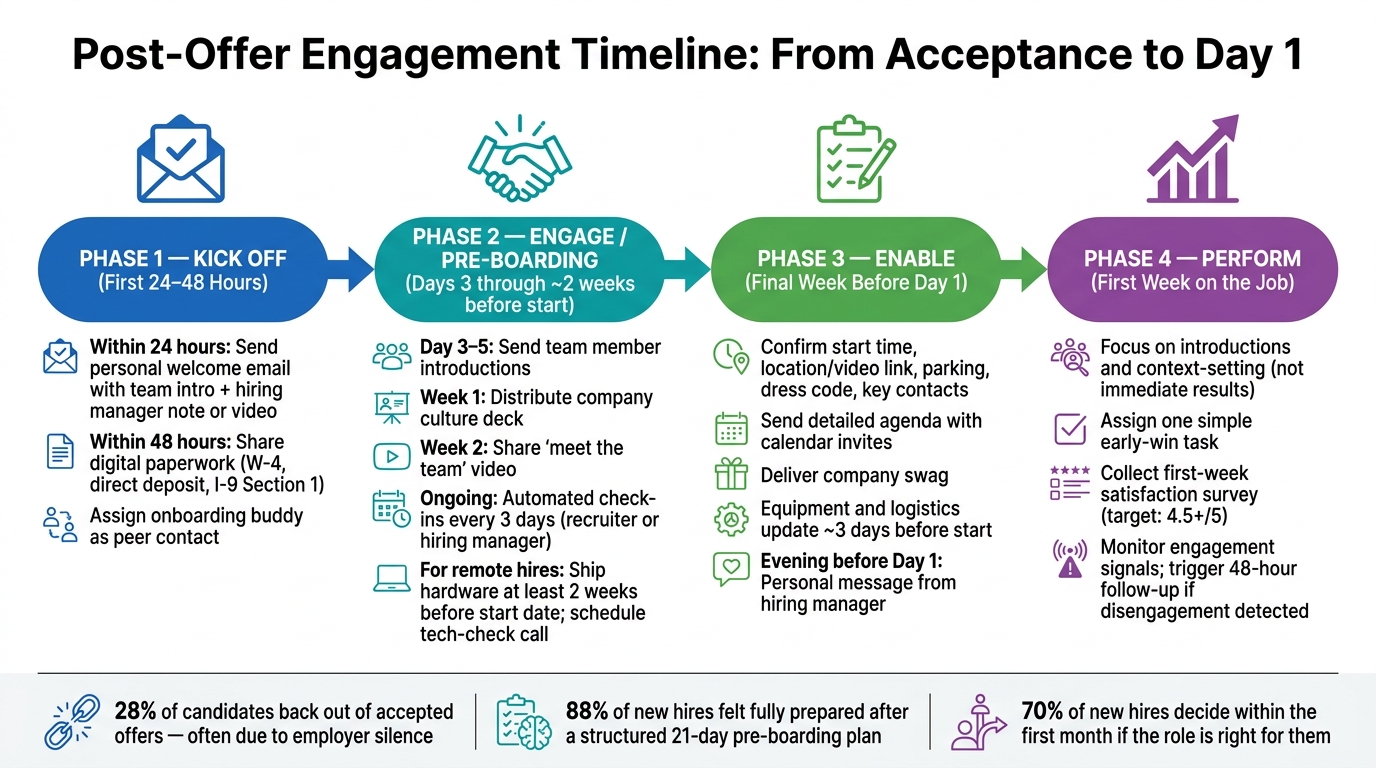
Post-Offer Engagement Timeline: From Acceptance to Day 1
Once you’ve set clear goals and segmented your candidates, perhaps with the help of an embedded recruitment service, it’s time to turn your post-offer engagement plan into action. A structured timeline ensures new hires are ready and excited for Day 1. Breaking this process into manageable phases helps secure their commitment from the start.
The First 24 to 48 Hours After Acceptance
The period immediately after a candidate accepts your offer is critical. Studies show that 28% of professionals have backed out of accepted offers, often because the employer went silent right after signing [1]. Avoid making this mistake.
Within 24 hours, send a personal welcome email. This should introduce the team, outline the next steps, and include a short note or video from the hiring manager to create an instant connection. Within the first 48 hours, share essential digital paperwork like the W-4, direct deposit forms, and I-9 Section 1, so administrative tasks don’t pile up on Day 1. Assign an onboarding buddy to act as a peer contact for any questions. Keep in mind that I-9 Section 2 must be completed on or after the start date, as required by federal law.
After this initial outreach, shift your focus to logistical and administrative preparations during the pre-boarding phase.
Pre-Boarding Admin and Preparation
Once you’ve established an emotional connection with your new hire, tackle the logistical side of things. Finalize compliance tasks and required paperwork promptly. For remote hires, ship any necessary hardware at least a week in advance, and schedule a brief tech-check call to ensure everything works properly [6].
Distribute role-specific materials in stages. For example, you might send a company culture deck one week and a "meet the team" video the next. Spacing out this information keeps new hires engaged without overwhelming them.
With the admin tasks under control, you can focus on strengthening the relationship.
Building the Relationship Before Day 1
While logistics are essential, relationship-building is what keeps new hires committed. Darren Gant, Cisco Meraki‘s Global Onboarding Manager, introduced a 21-day pre-boarding plan that included automated check-ins every three days, team introductions, and company insights. This approach led to 88% of new hires and managers feeling fully prepared for their first day [11].
Establish weekly touchpoints, such as recruiter check-ins, team introductions, or cultural insights, to maintain consistent communication and avoid any gaps [11].
The Final Week Before and First Week on the Job
The final week before Day 1 is your chance to eliminate any lingering uncertainties. Confirm all the details – start time, location or video link, parking, dress code, and key contact information. Send a detailed agenda with calendar invites, and have the hiring manager send a personal message the evening before Day 1 [10]. If you’re sending company swag, aim for it to arrive during this time to create a sense of belonging.
"The final day touchpoint is frequently skipped and it is one of the most valuable. A personal message from the hiring manager the evening before start… converts first-day anxiety into first-day energy." – FirstHR [1]
During the first week, avoid pushing for immediate results. Instead, focus on introductions, providing context, and assigning one simple task that offers an early win. This approach is crucial, as 70% of new hires decide within their first month if the role is right for them – and 29% make that decision within the first week [11]. Start small to build their confidence and set the stage for long-term success [6].
Standardize Your Communications for Consistency at Scale
Once your engagement timeline is in place, the next step is ensuring that every candidate receives the same high-quality experience. Standardizing communications is key to maintaining consistency across multiple roles. Without a clear system, communication can become uneven, and that inconsistency can quickly erode trust.
Build Modular Communication Templates
A practical solution is creating a library of reusable templates tailored to each hiring stage – application, screening, interview, offer, and pre-boarding. Use merge fields like {{candidate.firstName}}, {{requisition.title}}, and {{expected_timeline}} to personalize messages. This approach ensures candidates feel valued while saving time on drafting new messages for every interaction [13].
"Automation should remove friction (scheduling, FAQs), not replace the relationship." – Redirecruit [9]
Focus full personalization efforts on critical touchpoints such as interview scheduling, post-interview updates, and formal offers. For acknowledgments, status updates, and pre-boarding reminders, templates can handle the job effectively without losing the human touch [5].
Templates create the structure, but role-specific content bundles add the depth needed for a tailored experience.
Prepare Role-Specific Content Bundles
Content bundles provide candidates with essential details about their role and team. For each position or department, include materials such as team member profiles, a role preparation guide, an FAQ covering benefits and daily responsibilities, and a spotlight on company culture with stories from employees in similar roles [13][12].
Here’s how to space out these communications:
- Send team introductions 3–5 days after offer acceptance.
- Share the role-specific FAQ alongside the formal offer.
- Provide equipment and logistics updates about three days before the start date.
This staggered approach keeps candidates engaged without overwhelming them and addresses the pre-boarding gap that often leads to 10–15% of accepted offers falling through [5].
Assign Ownership and Keep Materials Current
Templates and content bundles are only effective if they stay up to date. Assign HR to oversee standardized templates and compliance documents, while hiring managers should be responsible for updating role-specific materials [5][12]. Use a shared document or an ATS library as the single "source of truth" to avoid outdated language, inconsistent branding, or compliance issues.
"Consistency is what turns a chaotic hiring process into a repeatable system." – FirstHR [5]
Regular audits of your templates are essential to ensure they align with current job postings and maintain a personal touch in follow-ups [14]. By combining standardized templates with tailored role-specific content, you’ll create a structured and engaging post-offer process that helps retain top talent.
Track, Measure, and Improve Your Engagement Plan
To ensure your engagement plan delivers results, you need to track the right metrics. By building on the structured timeline mentioned earlier, monitoring these key indicators will help you refine and improve your approach over time.
Metrics to Track
Start by measuring your offer-to-start conversion rate – the percentage of candidates who accept an offer and actually show up on their first day. In competitive industries like technology, renege rates can hit 10% to 20% [15]. Keeping this number low is critical.
Next, look at digital engagement metrics. For instance, email open rates above 70% suggest strong interest, while anything below 40% could indicate disengagement [15]. Combine this with task completion rates (e.g., timely submission of background checks and paperwork) and first-week satisfaction scores to get a comprehensive view of how well your engagement plan is working.
| Metric | What to Measure | Benchmark |
|---|---|---|
| Offer-to-Start Conversion | Percentage of accepted offers that reach Day 1 | Less than 10% renege rate |
| Email Open Rate | Engagement with pre-boarding communications | Over 70% (Healthy) |
| Task Completion Rate | Completion of paperwork, background checks, and portal activity | 100% before start date |
| First-Week Satisfaction | New hire survey scores | 4.5+ out of 5 |
| Early Turnover (90-day) | Attrition within the first 3 months | Trending downward |
These metrics not only measure performance but also highlight areas that need attention. Use them to validate whether your touchpoints and preboarding tasks are achieving their intended goals.
Gather Feedback to Close Gaps
Metrics tell you what’s happening, but feedback reveals the why. A simple way to gather this is through a Candidate Net Promoter Score (cNPS) survey after the first week. Ask new hires how likely they are to recommend your company based on their experience. This single question can uncover hidden issues that metrics alone might miss.
If a candidate starts showing signs of disengagement – such as ignoring emails or skipping preboarding tasks – act quickly. Implement a 48-hour follow-up policy: if engagement drops, a recruiter or hiring manager should reach out personally within 48 hours [15][3].
"The period between offer and start date is a fragile bridge. Investing in tools like the Engagement Health Scorecard isn’t just about preventing reneges; it’s about building a strong foundation for employee loyalty." [15]
By combining metrics with actionable feedback, you’ll have the insights needed to address issues before they escalate.
Review and Update the Plan Regularly
Make it a habit to review your core metrics on a monthly basis. If any key indicator trends downward for two consecutive months, treat it as a signal to investigate and make adjustments [5]. After each major hiring cycle, conduct a structured review to document successes, identify shortcomings, and pinpoint any communication gaps. For additional templates and guides, explore our recruitment resources.
Clear accountability is crucial here. Recruiters should oversee engagement health data, while hiring managers ensure that role-specific touchpoints remain effective. As Yello wisely puts it:
"If you’re not actively maintaining their commitment, you’re passively losing it." [3]
Conclusion and Next Steps
A strong post-offer engagement plan is critical to avoiding one of the most preventable risks in hiring: losing candidates between offer acceptance and their first day. This often-overlooked period deserves as much focus as the earlier stages of recruitment.
To recap, an effective engagement strategy includes key actions like sending a warm welcome within 48 hours, maintaining regular touchpoints, involving hiring managers early, and acting quickly if engagement starts to wane. As Megan C. Moore, Campus Talent Acquisition Advisor at Hyster-Yale, wisely notes:
"You can’t feel that your pre-onboarding plan is ever final." [2]
This mindset is crucial. The most effective plans adapt and improve with every hiring cycle, driven by honest feedback and measurable outcomes.
For scaling companies, managing this process at scale can be a challenge. Maintaining a personalized approach while hiring in volume requires resources and time. That’s where Rent a Recruiter can help. With embedded recruitment, you can streamline your process and save over 80 hours per month, ensuring no candidate slips through the cracks.
Start small – use a single communication template and assign clear responsibilities. From there, scale these practices to improve your offer-to-start conversion rates and create a more resilient hiring process. Every step you take strengthens your ability to secure top talent and keep your recruitment pipeline running smoothly.
FAQs
Who should own post-offer engagement tasks?
Post-offer engagement tasks need clear ownership to maintain accountability and keep candidates involved. In smaller teams, these responsibilities often fall to a recruiter or an embedded recruitment service. For larger organizations, the workload is typically split: recruiters focus on managing the overall process, hiring managers take care of team-specific introductions, and departments like HR or IT step in to handle pre-boarding tasks. Leveraging an applicant tracking system or automated workflows can help assign roles clearly and ensure deadlines are consistently met.
How often should we communicate before Day 1?
To ensure candidates remain engaged and less likely to explore other opportunities, set up a consistent communication plan. Keep touchpoints within five business days of each other. Examples include:
- A welcome message right after they accept the offer
- Updates during their first week to keep them informed
- Mid-period check-ins with updates like company news or team introductions
- A final confirmation message before their start date
Make sure to outline how often you’ll communicate and through which channels, such as email or text, so there’s no confusion.
What’s the fastest way to prevent offer reneges?
The fastest way to reduce offer reneges is by implementing a structured post-offer engagement plan. Within 48 hours of an offer being accepted, send a personalized welcome message that includes clear next steps. From there, keep communication flowing with scheduled touchpoints – introduce them to the team, share a pre-start checklist, and arrange check-ins with their future manager. These steps help strengthen their connection to your company and reaffirm their decision to join.