If bias shapes your shortlist, you pay for it later in missed hires, longer time-to-fill, and more recruiter hours.
I see blind CV screening as a simple way to cut noise at the first review stage. By removing names, ZIP codes, graduation years, and other identity cues, you push reviewers to look at skills, results, and role fit instead of signals that can distort judgement. That matters more when hiring volume climbs and managers are under pressure to move fast.
For scaling teams in SaaS, IT, Fintech, Engineering, Security, Insurance, and Professional Services, the business case is direct:
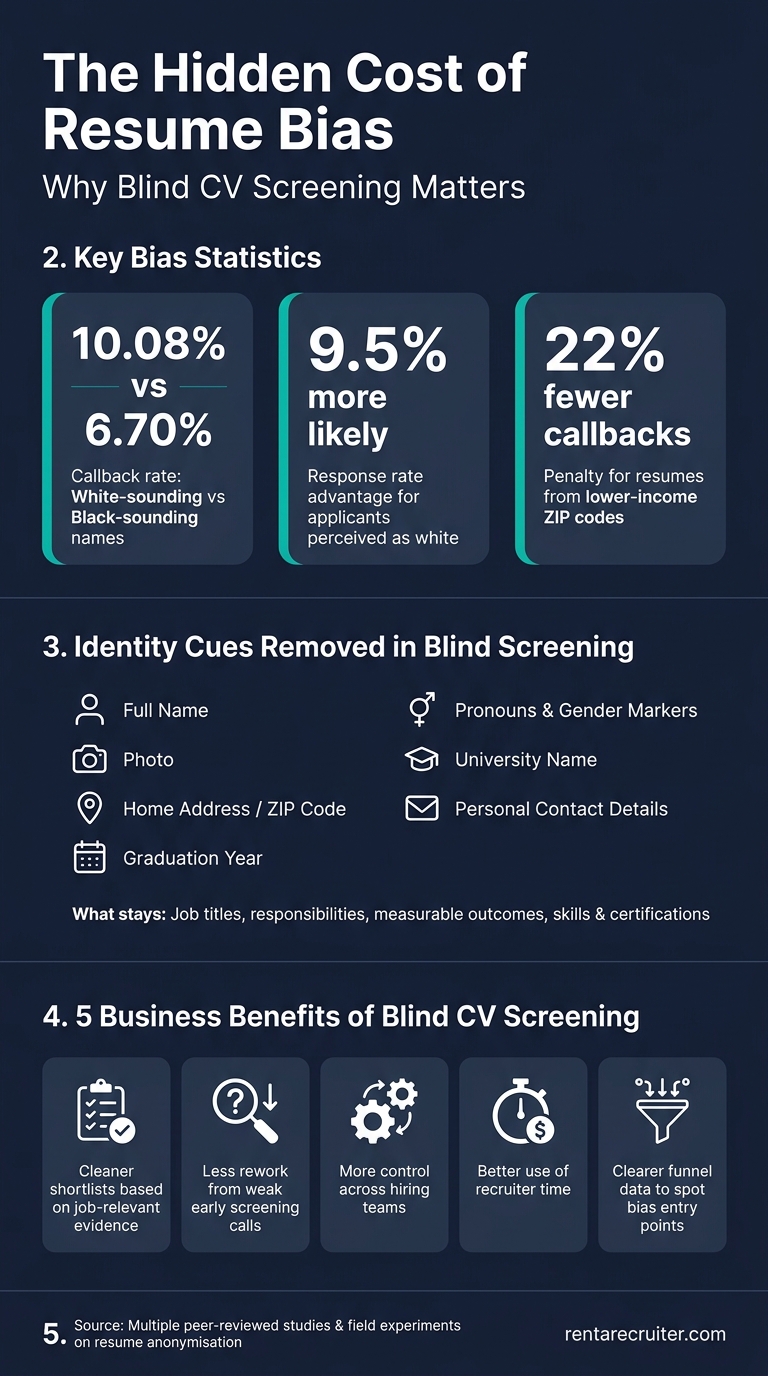
- Cleaner shortlists based on job-related evidence
- Less rework from weak early screening calls
- More control across hiring teams and business units
- better use of recruiter time when screening rules are fixed
- Clearer funnel data so you can spot where bias enters the process or rate your recruitment process to find other efficiency gaps
A few numbers show why this matters. Studies cited in the article found 10.08% callback rates for resumes with white-sounding names versus 6.70% for Black-sounding names. Another study found applicants seen as white were 9.5% more likely to get a response. Resumes from lower-income ZIP codes saw 22% fewer callbacks.
The point is simple: if the first screen is biased, the rest of your process starts from the wrong list. Below, I break down what blind CV screening changes, where it helps, where it falls short, and how you can put it into your hiring process without adding drag.
Blind CV Screening: Key Bias Statistics & Business Impact
Are Companies Underestimating Undercover Bias In Hiring?
sbb-itb-a23bd6a
How Blind CV Screening Reduces Bias at the Resume Stage
Blind CV screening removes identity cues before resume review. That pushes attention back to skills, experience, and proof of performance. Its biggest effect tends to show up at the resume stage, where one small cue can shape who gets shortlisted and who gets filtered out.
Take away those cues, and you stop snap judgments before they start.
What Gets Removed and What Stays Visible
The table below shows what is usually redacted, why it matters, and what U.S. SMEs should think about when setting a redaction policy.
| Information Removed | Risk Addressed | Notes for U.S. SMEs |
|---|---|---|
| Full name | Race, ethnicity, and gender assumptions | Particularly relevant because resumes with White-sounding names have received about 50% more callbacks than identical resumes with Black-sounding names.[13][14] |
| Photo | Gender, age, and appearance bias | Photos can trigger appearance-based judgments and are usually not needed for first-pass review. |
| Home address or ZIP code | Neighborhood and socioeconomic proxies | ZIP codes can signal location- and income-based assumptions. |
| Graduation year | Age discrimination | Removing this cuts the habit of labelling candidates as too senior or too junior based on time since graduation instead of actual experience. |
| Pronouns and gender markers | Gender bias | Helpful when gender stereotypes might shape screening decisions. |
| University name | Prestige and geographic bias | This can be swapped for a generic descriptor, such as degree level and field, when the school name may trigger assumptions about class or background. |
| Personal email, phone, LinkedIn URL | Identity disclosure before review | Contact details can be added back once a candidate moves forward. |
What stays visible is what a reviewer actually needs to assess fit: job titles, employers or employer descriptors, responsibilities, measurable outcomes, tenure in each role, core skills, certifications, and relevant credentials.
That matters for hiring teams under pressure. You are not stripping out job-relevant evidence. You are removing details that can distort judgment. The resume still shows whether someone can do the job, while lowering the odds that identity drives the first decision.
What the Evidence Says About Diversity Outcomes
This only matters if it changes outcomes. At the first screen, pilot results suggest it often does.
Summaries of multiple anonymisation pilots found that in most studies where anonymisation was introduced, minority and majority callback rates moved closer at the initial screen.[12] A Harvard-linked study found that blind review increased both the size and average quality of the applicant pool, partly because more qualified women applied when they expected fairer treatment.[2][5]
That has a direct business angle. Our recruitment case studies demonstrate how these strategies impact real-world hiring outcomes. If fairer screening helps you draw in stronger applicants, you are not just reducing bias. You may also improve shortlist quality and make better use of recruiter time.
Still, the picture is not simple. A French government-backed field experiment found that in some organisational settings, especially where firms were already pro-diversity, anonymised resumes widened the gap between minority and non-minority candidates at the interview stage.[9][10][11]
So blind screening is not a magic fix. It is a control point. It can reduce distortion early on, but it does not remove the need for discipline later in the process.
Once identity cues are removed, reviewers still need a fixed scoring rubric. Without that, anonymised review can turn into a different kind of guesswork. Blind screening works best when paired with structured scoring, which keeps resume review consistent and tied to the role.[6][7][1][8]
How to Put Blind CV Screening Into Practice
Once you’ve defined the identity cues to remove, the next step is simple in theory and harder in practice: build anonymization into the intake workflow from the start.
Map the Workflow and Choose Manual or ATS-Based Anonymization
Start by mapping every route candidates use to enter your hiring process: careers pages, job boards, referrals, and recruiter-sourced applicants. Then push every resume through a single anonymization step before any hiring manager or interviewer reviews it. Referred candidates should also apply through the ATS so they go through the same process as everyone else.[16][3]
The right setup depends on your hiring volume and how mature your process is.
| Factor | Manual Redaction | ATS-Based Anonymization |
|---|---|---|
| Speed | Slower; each resume requires hands-on editing | Fast; automated on submission |
| Scalability | Lower volume | High volume, multi-role hiring |
| Error risk | Higher; human oversight can miss subtle cues | Lower; consistent rule-based redaction |
| Required expertise | One trained coordinator with a checklist | ATS configuration or specialist tool setup |
| Best-fit use case | Early-stage SMEs and single-team rollouts | Growth-stage companies hiring across multiple teams |
AI-based tools can redact names, ages, locations, pronouns, and school names while keeping an original record for compliance.[18][17][19][20]
That matters because redaction tackles bias at the input stage. Scorecards stop it from creeping back in at the decision stage.
Pair Anonymized Resumes With Structured Evaluation
Blind screening on its own won’t fix weak hiring decisions. If reviewers don’t have a fixed scoring method, they can still fall back on gut feel, only now without the candidate’s name attached.
Blind screening works best when it feeds into role-specific scorecards that rate candidates against set criteria, such as technical skills, years of relevant experience, scope of impact, and domain knowledge.[4][15]
Unstructured review is a poor predictor of performance. Structured scorecards and anchored rating scales perform much better.[15] When you pair anonymized resumes with consistent scoring criteria, reviewers are pushed to look at job-relevant proof instead of prestige signals or identity cues. That cuts halo effects and makes decisions easier to defend.[4][15][3]
Skills-based assessments add another layer of signal quality. That could mean work samples, short technical tests, or job-relevant case studies. When blind resume screening, skills tests, and structured interviews are used together, hiring decisions become more accurate and much easier to audit.[4][15][3]
How Embedded Recruitment Support Fills the Gap
Putting a blind screening workflow in place takes more than good intent. You need alignment across redaction rules, ATS setup, scorecards, and interviewer training.
Rent a Recruiter embeds recruiters directly into your team to map the workflow, define redaction rules, configure anonymization, and build scorecards and interview templates. With fixed monthly pricing, you get more control over cost and hiring capacity during spikes, often cutting total hiring spend by up to 70% while saving more than 80 hours per month in internal hiring and admin time.[16][3][17]
Limitations, Safeguards, and Metrics to Track
Blind CV screening can cut bias at the top of the funnel. But it does not fix hiring on its own.
If the rest of your process is loose, bias can slip back in fast. That means any gains you make at resume review can disappear by the interview stage. For hiring leaders, that matters because better screening only pays off if it leads to better hiring outcomes, not just a cleaner first step.
Where Blind Screening Falls Short
Blind screening removes early identity signals, but it doesn’t make a candidate fully anonymous. Hiring teams can still make assumptions from writing style, graduation year, career timeline, or other resume details.
And here’s the issue: if interviews are unstructured, the process can drift right back to gut feel. Once that happens, the value of anonymous resume review starts to fade.
The takeaway is simple. You need to control interviews with the same discipline you apply to resume screening.
Safeguards That Make the Process More Reliable
Blind screening works best when the rest of the funnel is structured and consistent. Standardized interview questions, steady panel makeup, and separate demographic reporting help stop bias from creeping back in once candidates are visible.
That gives you a process that’s easier to audit and easier to trust. It also helps protect hiring speed and quality as volume grows.
| Benefit | Risk or Limitation | Mitigation Strategy |
|---|---|---|
| Evaluators focus on job-relevant skills | Managers may infer identity from writing style, graduation year, or other resume details | Use ATS tools to strip specific keywords and standardize formatting |
| More diverse candidates reach the interview stage | Bias can re-enter once the candidate is seen or heard in person | Pair blind screening with structured interviews and diverse panels |
Tracking diversity data separately from what evaluators see keeps reporting clean. It also supports auditing without shaping screening decisions.
Metrics That Show Whether the Change Is Working
You won’t know if blind screening is working unless you measure it. For most teams, that means tracking funnel movement, hiring speed, and downstream quality.
Pass-through rates by stage show whether candidates from underrepresented groups are moving past the resume screen at the same rate as others. If diversity looks strong at shortlist stage but drops after interviews, that’s a sign your interview process is where the problem sits. Interview-to-offer ratios by demographic group make that even clearer by showing exactly where the funnel is leaking.
Time to shortlist shows whether anonymization is slowing the process down. If the new workflow adds too much drag, it can become a bottleneck, and that has a direct cost in recruiter time and delayed hiring.
On the quality side, track performance review scores and retention trends for people hired through blind screening, then compare those results with cohorts hired before the change. That gives you a much clearer view of whether skill-based screening is leading to stronger hires over time.
De-identified review moves attention back to job-relevant evidence. Done well, that improves screening decisions over time and helps you make hiring choices with more consistency. For more tools and guides on optimizing your talent strategy, explore our hiring resources.
Conclusion: Build a Fairer, More Consistent Screening Process Without Slowing Hiring
Once redaction and structured scoring are in place, blind screening becomes a practical way to cut bias without slowing hiring down. Standard resume screening leaves room for unconscious bias to shape early decisions. Blind CV screening removes identity signals before they affect how a candidate’s experience is judged.
Dubois notes that blind scouting reduces bias and produces more robust assessments [21], giving hiring teams a clearer view of job fit. That matters most when the process is paired with clear scoring and simple measurement. In practice, blind screening works best when combined with structured evaluation rubrics and ongoing tracking of pass-through rates and hiring outcomes. For more insights on optimizing your talent strategy, explore our recruitment blog.
For growing teams, blind screening adds structure without creating delays. Rent a Recruiter places experienced recruiters into your team within days to manage hiring end-to-end and keep the process consistent. Book a call to see how that support could fit your hiring goals.
FAQs
What should stay visible on a blind CV?
Keep only the information tied to skills, qualifications, and relevant experience.
Hide personal details like names, photos, contact info, addresses, graduation dates, specific schools, gendered titles, and religious or faith-based references. Remove proxy signals too, such as ZIP Codes, so screening stays objective and helps cut unconscious bias.
Can blind screening hurt hiring speed?
Not necessarily. Blind screening can add work if resumes need to be redacted by hand, but it does not automatically slow hiring.
Used inside a structured recruitment process, it can help you move faster. Why? Because it cuts down on inconsistent reviews and helps hiring teams make quicker, more confident decisions based on objective, competency-based criteria.
How do we measure if blind screening works?
Track candidate pass-through rates by demographic at each stage of the hiring process. This gives you a clear view of where people are moving forward, and where they’re dropping out.
Use the EEOC’s four-fifths rule as a simple check for adverse impact. If the selection rate for a protected group is less than 80% of the highest group’s rate, that’s a warning sign worth looking into.
It also helps to review hiring data every quarter for drop-off patterns. Small issues at the top of the funnel can turn into bigger hiring gaps later on, especially when you’re scaling across teams or regions.
For an added check, run substitution tests with identical resumes and different names. If outcomes shift when the only change is the name, you may have a consistency problem in screening or shortlisting.