
Every unfilled SaaS role delays revenue, product launches, and growth. On average, hiring takes 95 days, and 70% of companies struggle to fill critical positions. Poor hiring decisions can cost 3-5x a senior hire’s annual salary, while efficient hiring directly impacts speed-to-market and revenue goals.
Recruitment metrics help you fix hiring bottlenecks, balance speed with quality, and align hiring with business targets. Here’s a quick look at the most impactful metrics for SaaS hiring:
- Time to Hire: Tracks speed from candidate pipeline entry to offer acceptance. Faster processes lower costs and attract top talent.
- Time to Fill: Measures internal efficiency from job approval to offer acceptance, highlighting delays that impact productivity.
- Cost per Hire: Captures total hiring expenses, helping SaaS companies control budgets while maintaining quality.
- Quality of Hire: Evaluates the long-term impact of hires on performance, retention, and business outcomes.
- Offer Acceptance Rate: Indicates how well you secure top candidates, with benchmarks of 85-95% for high-performing teams.
- Source of Hire: Identifies the most effective recruitment channels, optimizing spend and results.
- Candidate Satisfaction: Reflects your employer brand and impacts retention, with 52% of candidates rejecting offers after poor experiences.
The takeaway? Recruitment metrics turn hiring into a measurable, scalable process that drives growth. By tracking these data points, SaaS companies can reduce costs, improve hiring quality, and fill roles faster. Ready to rate your recruitment process and fix your hiring bottlenecks? Rent a Recruiter can help.
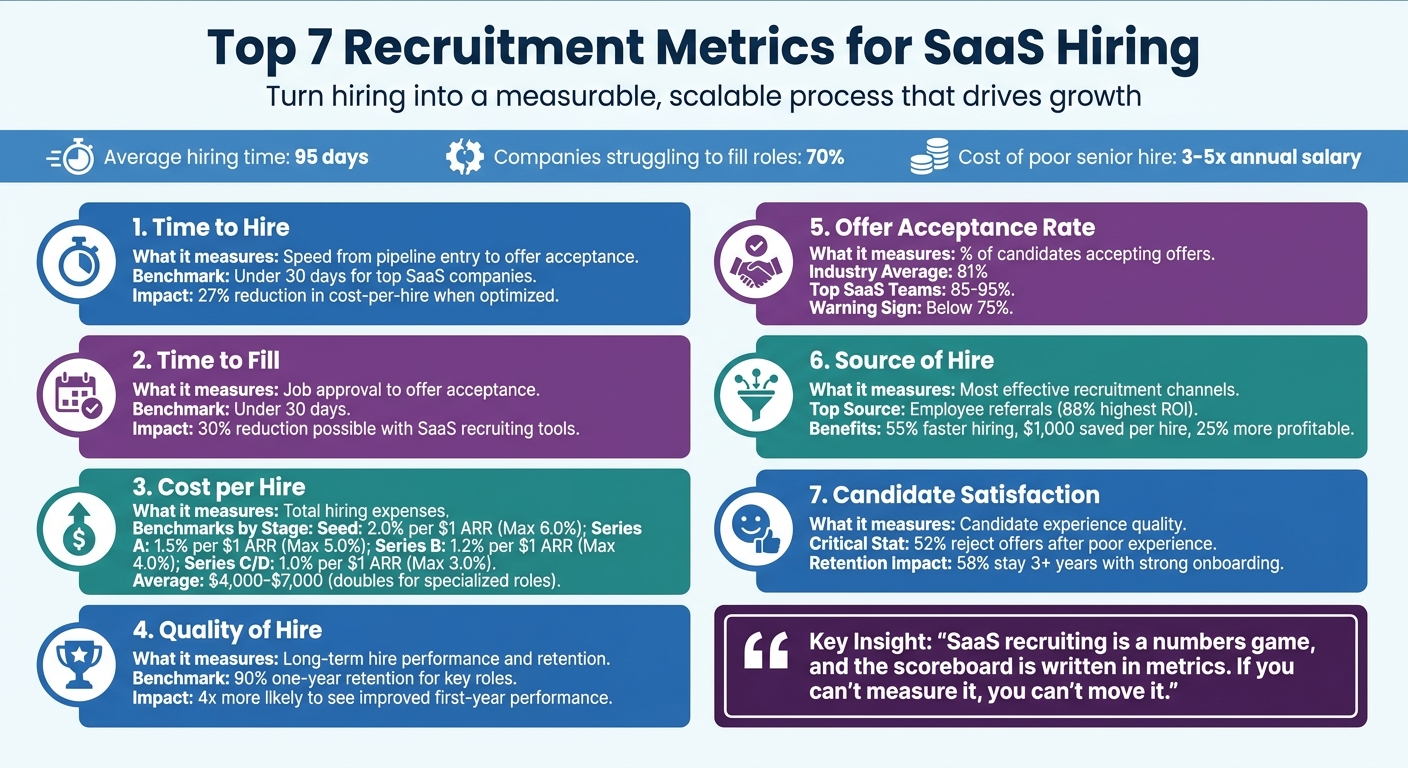
7 Essential SaaS Recruitment Metrics and Benchmarks
1. Time to Hire
How Fast Your Hiring Process Runs
Time to Hire tracks the period from when a candidate enters your pipeline to when they accept an offer. It’s a key indicator of how smoothly your interviews, feedback, and decisions flow. In a competitive market, where top talent often juggles multiple offers in mere hours, acting quickly is critical[7].
For U.S. companies, the average cost-per-hire ranges from $4,000 to $7,000, with costs doubling for specialized SaaS roles[8]. If your Time to Hire exceeds 30 days, you risk losing candidates to faster competitors. Take the example of a 200-person software firm in November 2025. By adopting a cloud-based recruitment platform, they centralized job postings and automated resume screening and interview scheduling. This reduced their average Time to Hire from 55 days to 32 days in just six months, slashing cost-per-hire by 27%[8]. Moving fast doesn’t just attract top talent – it also trims unnecessary expenses.
Cost Savings from Faster Recruitment
Every day a role stays vacant has a price tag. For instance, leaving a $180,000 position unfilled for two weeks could cost you $6,923 in lost productivity[2]. Beyond the financial hit, your team feels the strain, with existing employees taking on extra tasks, increasing the risk of burnout.
The best SaaS companies aim to fill roles in under 30 days[7][4]. They achieve this by cutting through delays: limiting decision-makers, issuing offers within 48 hours, and leveraging AI-powered recruitment tools for faster screening[7]. Jacob Wickett, Founder of Live Digital, puts it plainly:
"If we’re not hiring fast, we’re not hiring the best."[7]
Delays don’t just cost money – they also affect how candidates view your company and the quality of hires you make.
Effects on Candidate Experience and Hire Quality
A slow hiring process can damage your reputation as an employer. Over half of candidates (52%) say they would reject even a great offer if they had a poor recruitment experience[4]. Long waits for feedback or redundant interview rounds send a message of inefficiency.
The goal isn’t to rush decisions but to streamline them. Structured interviews with scorecards allow for quicker, data-driven choices without compromising on quality. Companies using cloud-based recruiting tools report hiring cycles that are 25–40% faster, along with a 20% drop in cost-per-hire[8]. With the right systems in place, you can achieve both speed and quality in your hiring process.
sbb-itb-a23bd6a
2. Time to Fill
How Fast Your Hiring Process Moves
Time to Fill measures the timeline from when a job is approved to when a candidate accepts the offer. It’s a window into how efficiently your embedded recruitment service operates [4]. While Time to Hire looks at the candidate’s experience, Time to Fill focuses on what’s happening inside your organization. It’s a key metric for spotting internal slowdowns. And in a competitive market where top candidates often juggle multiple offers in a matter of hours, these internal delays can cost you the talent you need.
As Jen Dewar from JobScore puts it:
"When critical positions remain unfilled, existing team members often shoulder additional responsibilities, potentially leading to burnout and decreased performance across your organization." [4]
Pinpointing these internal delays is the first step to understanding the financial and operational impact of leaving roles vacant too long.
The Cost of Slow Hiring
Every unfilled role comes with a price. Beyond lost productivity, it can drag down team morale, delay product launches, and push back revenue milestones. For example, companies that adopt SaaS-based recruiting tools often see a 30% reduction in Time to Fill by streamlining workflows and automating initial screenings [8]. Leading SaaS businesses aim to fill roles in under 30 days [7], relying on structured interviews and consistent scoring systems to make quick, informed hiring decisions without compromising on quality.
Driving SaaS Growth with Faster Hiring
When you integrate Time to Fill with other key recruitment metrics, you create a more effective hiring strategy. Faster hiring doesn’t just save money – it positions your company for long-term success. With the global SaaS market projected to hit $1,131.52 billion by 2032, growing at an annual rate of 20.0% [9], hiring speed directly influences your ability to capture market share. Right now, 70% of SaaS companies report struggling to fill essential roles [3], creating bottlenecks that slow product development and revenue growth.
3. Cost per Hire
Breaking Down the Costs of Hiring
Understanding the full financial scope of hiring is essential for scaling a SaaS business. Cost per hire (CPH) captures both direct and indirect expenses. Direct costs, like job board fees and recruiter salaries, typically make up 60–70% of the total hiring spend [2]. Indirect costs – such as time spent by managers in interviews, referral bonuses, and delays in project timelines – add another layer to the overall expense [2].
For example, consider a software engineer earning $180,000 a year. A two-week hiring delay costs the company $6,923 in lost productivity. On top of that, technical hires often require 90–120 days to reach their full productivity, creating a significant gap in output [2]. These numbers highlight why keeping hiring efficient is so critical for long-term growth.
Aligning Costs with SaaS Growth Goals
For early-stage startups, the average cost per hire is around $12,000, while later-stage companies reduce this to $6,000 [10]. The drop reflects the benefits of established hiring processes, a strong employer reputation, and scalable systems. Companies that implement structured interview processes see hiring outcomes improve by 70–81% [5], which helps avoid the costly mistake of a poor hire. A bad senior-level hire, for instance, can cost 3 to 5 times their annual salary [2].
| Funding Stage | Target CPH Benchmark | Max Budget |
|---|---|---|
| Seed | 2.0% per $1 of ARR | 6.0% per $1 of ARR |
| Series A | 1.5% per $1 of ARR | 5.0% per $1 of ARR |
| Series B | 1.2% per $1 of ARR | 4.0% per $1 of ARR |
| Series C/D | 1.0% per $1 of ARR | 3.0% per $1 of ARR |
Source: Betts Recruiting [10]
By keeping CPH within these benchmarks, SaaS companies can reinvest savings into growth initiatives while maintaining a high-quality hiring process.
Balancing Cost, Efficiency, and Candidate Experience
Reducing costs doesn’t mean neglecting the candidate experience. A poor recruitment process can hurt your reputation – 52% of candidates will turn down a role, no matter how attractive, if they’ve had a negative hiring experience [4]. On the flip side, companies that focus on employee referrals report 82% retention rates and hire 55% faster than other methods [5]. This proves that efficiency and quality can go hand in hand.
Leveraging fractional recruiters is another way to cut costs. They reduce CPH by 35% compared to full-time recruitment teams [5]. This approach also increases capacity, allowing companies to manage an average of 14 open roles, up from 9 just three years ago [5]. By combining expertise with flexibility, fractional recruiters help businesses scale their hiring while keeping costs in check.
MUST-KNOW RECRUITMENT METRICS and ACTIONABLE INSIGHTS – Time to Fill, Cost per Hire, Acceptance Rate
4. Quality of Hire
When building a SaaS company, quality of hire outweighs speed. A poor senior-level hire can cost your business 3 to 5 times their annual salary [2]. On the flip side, hiring exceptional talent can transform your team’s performance – elite developers accelerate feature delivery, while top engineering and sales teams deliver 40% faster results and 60% higher quota attainment, respectively [2].
Supporting Long-Term SaaS Growth
Hiring high-caliber talent strengthens your team’s overall capability. For instance, a standout engineer can reduce technical debt, enhance system reliability, and directly support scalability [2]. In customer success, skilled managers can significantly impact retention. Reducing churn from 5% to 3% on a $100M ARR base saves $2M in ARR, which translates to $20M in enterprise value [11].
Retention also plays a critical role. Leading SaaS companies maintain 90% one-year retention rates for key roles, compared to the industry average of 75–80% [2]. This stability allows teams to focus on growth initiatives instead of constantly backfilling positions. Companies that prioritize quality of hire are 4x more likely to see improved first-year performance [4].
Effects on Candidate Experience and Hire Quality
Candidate experience directly impacts the quality of your hires. Poor experiences can be costly – 52% of candidates reject offers, no matter how attractive, after a negative interview process [4]. Over half also drop out due to a lack of engagement during the hiring journey [6].
Structured assessments tailored to the role can improve results. Using real-world scenarios, such as refactoring legacy code or conducting simulated demo calls, helps evaluate candidates effectively. Tracking metrics like time-to-productivity (typically 90–120 days for technical roles) and offer acceptance rates provides insights into what’s working [2][3]. Combined with other recruitment metrics, these practices form the foundation of a hiring strategy that supports sustainable SaaS growth.
5. Offer Acceptance Rate
Offer acceptance rate measures the percentage of candidates who accept your job offers, essentially acting as your "close rate" for top talent. In 2022, the average across industries was 81% [12], but high-performing SaaS teams aim for 85% to 95% [14][16]. This metric ties directly to recruitment success, as it reflects how effectively you secure the candidates you want.
Effects on Candidate Experience and Hire Quality
If your offer acceptance rate falls below 75%, it’s a red flag. It could point to issues with compensation, your hiring process, or the overall candidate experience. Research shows that nearly half of candidates reject offers after a poor experience, and 32% withdraw if competitors move faster [15]. Timing is critical – while the average offer stage lasts 2.5 to 3 days for SaaS roles, this extends to about 4 days for technical positions [13]. For candidates juggling multiple offers, 70% cite the smoothness of the hiring process as a deciding factor [15]. Losing a candidate at this stage doesn’t just hurt your timeline; it effectively doubles your cost to hire for that role [12].
"A high job offer acceptance rate can help you improve both your quality of hire and time to fill, so you can build a more efficient and effective hiring process." – Jen Dewar, JobScore [15]
Supporting Long-Term SaaS Growth
This metric is about more than just filling roles – it ensures you’re hiring your first-choice candidates rather than settling for less [15][16]. In SaaS, the offer stage is where retention begins. Address salary expectations early to avoid surprises later [1]. Break down acceptance rates by department (e.g., Engineering vs. Sales) to pinpoint where your value proposition may be falling short [3]. Tie offer discussions to broader business goals, like the company’s 18-month product roadmap or equity potential, to attract candidates who align with your long-term vision [3].
6. Source of Hire
Once candidates accept offers, understanding where they come from is key to refining your recruitment approach.
Source of Hire pinpoints which channels – like employee referrals, LinkedIn, job boards, or niche communities – are delivering the best talent. This insight helps you allocate your recruitment budget more effectively. For example, in SaaS, 88% of employers rank employee referrals as the highest ROI for talent sourcing [18].
Cost Savings from Faster Recruitment
Employee referrals are a game-changer. They save an average of $1,000 per hire and reduce hiring time by 55% [18][5]. Beyond cost, referrals lead to candidates who are 25% more profitable and 70% more likely to stick around long-term [18]. Compare this to job boards, which only yield 8–12% qualified candidates, while specialized partners deliver 40–60%. Outbound applicants also outperform inbound ones, being five times more likely to get hired [5].
"SaaS recruiting is a numbers game, and the scoreboard is written in metrics. If you can’t measure it, you can’t move it." – Rent-A-Sourcer [3]
Supporting Long-Term SaaS Growth
Tracking your Interview-to-Hire ratio by source is crucial. If a channel requires 10 interviews to make one hire, it might be time to pause that channel and shift resources elsewhere [3]. Segment your sourcing data by role – for instance, top engineers might come through referrals, while marketing talent could emerge from niche communities. Tie this data to 6-month and 12-month retention rates to assess the quality of hires over time.
In SaaS, where 70% of companies face challenges in recruitment when trying to fill critical roles, knowing which channels consistently deliver candidates with the right experience – such as scaling products or managing specific go-to-market strategies – can give you a major advantage [3].
To sharpen your strategy, calculate your Sourcing Channel Cost (SCC) by dividing total spend per channel by the number of qualified hires. Businesses that reallocate budgets to their most effective sources can cut cost-per-hire by 50% [5]. When reaching out to candidates, be specific. For example, highlight something like, "We noticed you scaled demo conversions for a PLG motion," rather than using generic messaging [3]. Keep in mind, top developers are usually available for less than 10 days [17].
This data-driven clarity in sourcing, combined with earlier metrics, ensures your SaaS hiring strategy is both effective and scalable.
7. Candidate Satisfaction
Candidate satisfaction is more than just a feel-good metric; it’s a direct reflection of your brand and a cornerstone of your retention strategy. It measures whether applicants perceive your hiring process as professional, transparent, and respectful – factors that heavily influence offer acceptance and long-term retention.
The statistics are clear: 52% of candidates will turn down an otherwise appealing job offer if they’ve had a poor recruitment experience [4]. For SaaS companies, where the average hiring timeline stretches to 95 days and 70% struggle to fill critical roles, losing top talent to a flawed process is a risk no business can afford [3]. When candidates juggle multiple offers, the quality of your hiring process often becomes the deciding factor. This metric doesn’t just impact immediate hiring outcomes; it also lays the groundwork for future employee engagement and loyalty.
Effects on Candidate Experience and Hire Quality
A positive candidate experience doesn’t just end with a signed offer letter – it ripples into retention and overall hire quality. Companies with structured onboarding processes and strong early experiences report that 58% of new hires stay beyond three years, compared to just 33% for those with weaker processes [2]. The interview stage is pivotal. If the promises made during this phase don’t align with the reality of the role, attrition within the first six months is almost inevitable [3].
"Closing isn’t the end of recruiting. It’s the start of retention." – Rent a Recruiter [3]
To gauge satisfaction, use post-interview surveys and monitor proxy indicators like application completion rates. Keep in mind that 70% of candidates lose interest if they don’t receive feedback within a week [19]. Implementing measures like 30-60-90 day plans and pre-boarding initiatives can set clear expectations and boost new hire productivity early on [3].
Satisfied candidates don’t just fill your current roles – they also strengthen your employer brand. With 73% of job seekers citing employer brand as a key reason for applying, every positive experience adds value to your talent pipeline [3]. Just as metrics like Time to Hire and quality of hire reflect operational efficiency, a smooth and respectful hiring process sends a powerful message about your company culture – far more than any carefully crafted careers page ever could [3].
How Rent a Recruiter Improves Your Recruitment Metrics
Improving recruitment metrics takes more than just effort – outsourcing recruitment and talent acquisition provides a smart, focused approach. Rent a Recruiter places experienced recruiters directly into SaaS teams, targeting key areas like time to hire, cost per hire, and quality of hire – all without the high fees or delays of traditional agencies.
One standout strategy is proactive outbound sourcing. Instead of waiting for candidates to apply, Rent a Recruiter actively identifies and engages top talent who may not be actively job hunting but are a perfect fit for high-growth SaaS environments. By tapping into market insights and targeting talent from competitors or aligned teams, Rent a Recruiter helped one SaaS company source 600 global candidates in just six months [3]. This approach cuts recruitment cycles by 60%, a game-changer when the average SaaS hire takes 95 days [3]. And with top candidates often snapped up within days [7], speed can make or break your hiring success.
The financial impact is just as compelling. Rent a Recruiter’s flat-fee subscription model can slash hiring costs by up to 70%, while saving your team over 80 hours per month on admin-heavy tasks [3]. With predictable costs, you can focus your budget on scaling your business without compromising on hiring quality.
But speed and cost savings don’t come at the expense of quality. Rent a Recruiter incorporates structured assessments, such as coding challenges or churn-risk simulations, to evaluate candidates effectively. Additionally, every role comes with a 30-60-90 day success blueprint, ensuring new hires ramp up faster and stay longer. This combination boosts both time-to-productivity and retention, directly supporting your company’s growth and revenue goals.
To take it a step further, Rent a Recruiter offers a free Recruitment Health Check. This tool audits your hiring process, highlights bottlenecks, and shows how your metrics compare to industry standards. Whether you’re struggling with extended time-to-fill periods or losing candidates due to poor experiences, the Health Check gives you a clear roadmap to build a scalable, efficient recruitment function that aligns with your growth ambitions.
Conclusion
Recruitment metrics aren’t just numbers on a dashboard – they’re the foundation for turning hiring into a strategic advantage. For SaaS companies, every delay in filling a role can mean missed ARR, while a poor hire can cost up to five times their annual salary [2]. These metrics give you the clarity to make smarter decisions that directly impact your bottom line.
The seven metrics discussed here work best when viewed as a whole. For instance, a high offer acceptance rate combined with high first-year attrition might indicate that roles are being oversold during interviews [1]. Similarly, reducing time-to-hire is meaningless if it sacrifices quality. Companies that focus on improving quality of hire are four times more likely to see better first-year performance [4]. The takeaway? With the right data, you can achieve both speed and quality.
"SaaS recruiting is a numbers game, and the scoreboard is written in metrics. If you can’t measure it, you can’t move it." – Rent-A-Sourcer [3]
Start small. Review fast-moving metrics like pipeline conversion and offer acceptance weekly, and dive deeper into cost-per-hire and quality metrics monthly [1][5]. Always link these numbers to business goals – whether it’s hitting revenue targets, launching products on time, or reducing churn. This approach not only strengthens your case for recruitment budgets but also proves the ROI of hiring to your leadership team.
Whether you’re scaling after a funding round or navigating a hiring surge, tracking the right metrics gives you the roadmap to build a recruitment process that grows with your business. The real question isn’t whether you should track these metrics – it’s whether you can afford not to.
FAQs
What’s the difference between time to hire and time to fill?
The distinction lies in what part of the hiring process each metric evaluates. Time to fill captures the entire timeline – from when a job is posted to when a candidate accepts the offer. On the other hand, time to hire focuses specifically on the period starting when a candidate enters the pipeline (whether by applying or being sourced) until they accept the offer. Both are essential for assessing recruitment efficiency and optimizing hiring strategies, especially in SaaS companies.
How do I measure quality of hire in a SaaS team?
To assess the quality of hire within a SaaS team, track key metrics like job performance, retention rates, and ramp-up time. These figures provide insight into how effectively new hires contribute to your company’s objectives, fit within the team, and deliver value over time.
Which recruitment metrics should I review weekly vs. monthly?
For SaaS hiring, it’s crucial to track weekly metrics like the number of new applicants, candidate engagement levels, and the performance of your sourcing channels. These help you identify bottlenecks early and keep your pipeline moving smoothly.
On a monthly basis, focus on metrics like time-to-fill, quality of hire, and hiring velocity. These provide a bigger-picture view of how well your recruitment efforts align with your growth objectives.
Weekly reviews let you make quick corrections, while monthly evaluations help fine-tune your long-term hiring strategy.