We align new hires with company values by defining expected behaviors before Day 1, then coaching and reviewing them through Day 90. Start with three to five values, each tied to actions you can observe, not personality traits.
Only 12% of employees strongly agree their organization does a great job onboarding, according to Gallup.[1][2] Our approach connects hiring promises, manager support, and role expectations to help you reduce confusion, rework, and time to productivity.
- Before Day 1: Set shared hiring standards and confirm that embedded recruitment promises match the job.
- During onboarding: Give managers and buddies clear roles, with check-ins in Week 1, at Day 30, and at Day 90.
- Measure results: Review role readiness, manager time, rework, and retention, then fix recurring gaps.
The goal is <u>consistent working standards</u>, not personal conformity. Here’s how we turn those standards into daily practice.
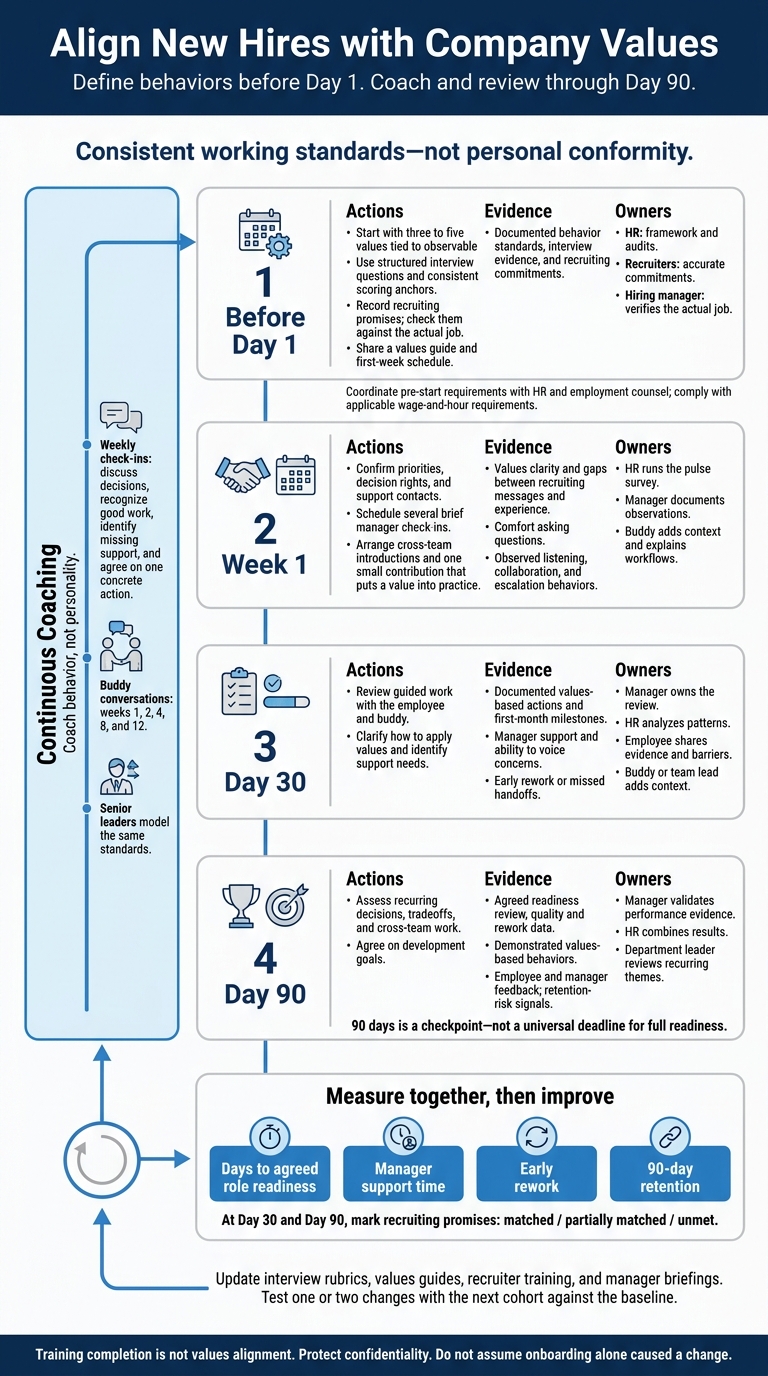
Align New Hires with Company Values: Before Day 1 to Day 90
Define Company Values Before Day 1
Turn Values Into Observable Behaviors
Give each core value a one-page standard: why it matters, what leaders and employees should do, and which behaviors are off-limits. Check that leadership’s definition matches how your business interviews, promotes, recognizes contributions, and handles mistakes. Leaders cannot promote respect while tolerating interruptions or abuse.[9]
Make those expectations specific to each role.
Abstract value Observable behavior Role-specific application Ownership Takes responsibility, documents next steps, and communicates status until resolution A SaaS support employee records a customer escalation, identifies the owner, coordinates engineering input, and updates the customer through resolution Collaboration Shares relevant information, invites dissent, and resolves disagreements directly A software engineer documents a design decision and requests input from product, security, and accessibility partners Customer focus Uses customer evidence to prioritize work and explains tradeoffs clearly A customer-success manager reviews usage data, sets realistic expectations, and escalates recurring defects High performance Meets role-specific standards, manages priorities, and requests support before deadlines are missed A project manager maintains a risk log and renegotiates deadlines when assumptions change
Use this same standard in job descriptions and interviews so hiring teams assess the behaviors the role requires.
Set Consistent Hiring Criteria
Turn these expectations into structured interview questions and scorecards. Assess job-related actions, not personality similarity. Score technical qualifications separately, and let candidates with different backgrounds and communication styles show how they meet the same standards. Keep selection job-related and nondiscriminatory.[5][6]
Give every candidate the same questions and use the same scoring anchors. For a question about correcting an error, agree on the scores before interviews:
1 = unclear actions or shared blame; 3 = clear corrective action and a reasonable outcome; 5 = timely communication, documented follow-through, and learning.
Have interviewers record evidence and score independently before discussing candidates. This keeps the hiring decision tied to evidence rather than whoever speaks first.[10][11]
Carry that standard into the handoff before the start date.
Plan the Recruiting-to-Onboarding Handoff
Every pre-start message should match the values standard presented during hiring. Share a short values guide with the mission, role expectations, reporting structure, policies, technology requirements, required paperwork, first-week schedule, and key contacts.
Recruiters should record commitments about role scope, compensation, location, flexibility, travel, and performance expectations. The hiring manager should check these commitments against the actual job before finalizing onboarding, reducing the risk of mismatched expectations.[3][7]
Put ownership in writing: HR owns the framework and audits; recruiters transfer accurate commitments; managers coach behaviors; senior leaders model standards; buddies explain workflows.
Coordinate paperwork, access, policy training, and other pre-start steps with HR and employment counsel. Do not require mandatory training, meetings, or work before employees are on the clock unless the arrangement complies with applicable federal, state, and local wage-and-hour requirements.[4][8]
Reinforce these expectations throughout the first 90 days. For more hiring guides and templates, explore our recruitment resources.
sbb-itb-a23bd6a
How to Instill Culture from Day 1 (AKA Onboarding) | Inside The Process
Put Values Into Practice During the First 90 Days
After the handoff, use onboarding to turn your values standard into repeatable working habits.
Link Orientation to Daily Decisions
Connect your mission and values to the decisions employees make each day. Explain who has authority, when to escalate, and what good performance looks like.
Ask a leader or experienced teammate to talk through competing priorities and how your organization handles legitimate tradeoffs. Give remote and hybrid employees the same context in writing, including value guides, decision examples, team contacts, communication norms, meeting expectations, and escalation paths.
For example, ask how they would handle a customer issue before the manager is available: what they would do, who they would tell, and how they would document it.
Focus on reasoning, authority limits, and next steps, not whether someone can repeat a value statement. Follow the discussion with a simple assignment that lets them practice the behavior.
Reinforce that practice through scheduled checkpoints.
Set Milestones for Week 1, Day 30, and Day 90
Week 1: Have the manager confirm priorities, decision rights, and support contacts. Schedule several brief check-ins that week. Give the buddy a written schedule, confidentiality boundaries, and escalation guidance. Arrange cross-team introductions and one small contribution that puts a value into practice. For remote employees, add virtual shadowing and document decisions they would otherwise learn about through office conversations.
Day 30: Review guided work with the employee and buddy. Clear up any remaining confusion about how to apply values.
Day 90: Assess how the employee applies values in recurring decisions, handles tradeoffs, and works across teams. Then agree on development goals. Keep buddy conversations scheduled for weeks 1, 2, 4, 8, and 12. Treat 90 days as a checkpoint, particularly for complex, senior, or highly technical roles.
Use these checkpoints to coach behavior, not just track completion.
Coach Behaviors Through Regular Feedback
Use weekly check-ins to discuss decisions, recognize good work, and coach where needed. Focus on the behavior, its impact, and a better action, not the employee’s personality.
Before correcting someone, ask what information, authority, training, or support was missing. Agree on one concrete action and revisit it at the next meeting. Welcome respectful disagreement, and link feedback to teamwork, decision quality, and the employee’s next development goal.
Measure Values Alignment and Improve Onboarding
Gather Evidence at Each Checkpoint
Training completion records attendance, not values alignment. Track employee feedback, manager observations, role milestones, and performance data. Combine time-to-productivity, retention, surveys, performance reviews, and informal feedback to assess progress.[12]
Use consistent checkpoints to check whether employees put those values into practice over time.
| Checkpoint | Evidence to collect | Responsible owner |
|---|---|---|
| Week 1 | Employee pulse survey covering values clarity, gaps between recruiting messages and experience, and comfort asking questions; manager observations of listening, collaboration, and escalation behaviors; employee explanation of how values shape daily decisions | HR or People Operations runs the survey and records responses; the manager documents observations; the assigned buddy adds context |
| Day 30 | Documented values-based actions; role clarity and support needs; employee assessment of manager support and ability to voice concerns; progress against first-month milestones; early rework or missed handoffs | The manager owns the review; HR analyzes patterns across teams; the employee shares evidence and identifies barriers; the buddy or team lead adds context |
| Day 90 | Agreed readiness review; quality and rework data; demonstrated values-based behaviors; employee and manager feedback; retention-risk signals; comparison of recruiting promises with actual experience | The manager validates performance evidence; HR or People Operations combines results; the department leader reviews recurring themes |
Apply the same standards to leaders. Check whether they explain trade-offs consistently, respond constructively to dissent, and act on concerns.[13]
Use anonymous feedback where practical, particularly for questions about retaliation, inconsistent leadership behavior, or policy violations. Before collecting responses in small groups, explain the limits of confidentiality. Small teams or combinations of demographic details can make individuals identifiable.
HR should report grouped themes, not comments that can be traced to individuals. Score documented actions, not personality or communication style.
Use Results to Update the Process
Compare onboarding promises with employees’ actual experience. Where gaps appear, trace them back to hiring messages, manager behavior, or changes to the role.
At Day 30 and Day 90, mark each recruiting promise as matched, partially matched, or unmet. Review job descriptions, recruiter notes, interview materials, employer-brand claims, manager statements, and employee feedback. Look for outdated messaging, unclear expectations, and inconsistent manager behavior.
Track days to agreed role readiness, manager support time, early rework, and 90-day retention together. This connects the employee experience to time spent, work quality, and retention outcomes.
Compare results by role, location, and hiring cohort. Account for workload, manager changes, team redesign, compensation, and role complexity. Report breakdowns only when sample sizes protect confidentiality, and do not assume onboarding alone caused a change.
Turn recurring gaps into specific updates to interview rubrics, the values guide, recruiter training, and manager briefing materials. For each change, record the supporting evidence, accountable owner, due date, expected outcome, and review date. Test one or two changes with the next cohort, then compare results with the baseline before rolling them out.
Conclusion: Assign Owners and Review Progress
Use your checkpoint data to assign owners and close the gaps you found.
Give values alignment clear ownership. Define the behaviors you expect, reinforce them through recruiting and onboarding, coach them during the first 90 days, and review the results.
Before you start:
- Choose one hiring group and the 2-3 values that matter most.
- Translate each value into interview signals, onboarding tasks, and observable behaviors.
- Assign an overall process owner, plus an owner for each area: recruiting, onboarding, coaching, and measurement.
- Record baseline metrics for values understanding, time to role readiness, and 90-day retention.
- Schedule reviews for Week 1, Day 30, and Day 90. Revise the pilot after 90 days before scaling.
When hiring volume exceeds your internal capacity, consistency breaks first at the handoff.
Get Recruitment Support When Capacity Is Limited
If recruiting capacity is tight, an embedded recruitment partner like Rent a Recruiter can help keep communication consistent from sourcing through onboarding.[14] That support does not shift ownership: HR owns onboarding, managers coach behavior, and leaders model values.
Book a call to discuss your recruiting capacity and process consistency.
FAQs
How do we distinguish values misalignment from a training gap?
Training gaps show up when a new hire struggles to learn role-specific tools, systems, or technical requirements. Even with clear instructions, they may need more time to get up to speed.
Values misalignment shows up in behavior that conflicts with your company’s values, such as avoiding accountability, blaming others, or failing to collaborate as expected.
To tell the difference, assess whether the person lacks technical knowledge or consistently acts against your organization’s core behavioral principles.
What if company values conflict in a decision?
When company values conflict, put core principles ahead of secondary preferences, even when that means making a compromise. Encourage employees to identify which core principle should guide the decision.
Leaders and team members should explain their choices openly so decisions stay transparent and aligned with the organization’s mission. Put values into practice every day, rather than leaving them as abstract ideas.
How do we address leaders who contradict our values?
Make transparency and objective feedback part of how you lead. Regularly check that business decisions reflect company values. Your choices shape the workplace as your company grows.
Give employees safe ways to flag concerns about leadership behavior, including anonymous questions during Executive Ask Me Anything (AMA) sessions or suggestion boxes. Hold regular skip-level meetings so senior leaders hear directly from employees and can check whether day-to-day experiences match the values you communicate.