We train hiring managers to make better decisions with fewer repeat interviews, not just better conversations. Start with shared questions, fact-based notes, and independent scoring, then set a 24-hour feedback target to keep decisions moving.
Our approach covers five steps:
- Check current skills and record time spent on interviews and recruiter rework.
- Build role-specific guides and scorecards so managers assess the same job requirements.
- Practise interviews and scoring before managers interview without coaching.
- Track feedback quality, decision time, and manager hours per hire against your starting point.
- Pilot one role before expanding, using results rather than attendance to judge progress.
The test is simple: does training save your team time and support better hiring decisions? We start with <u>how your managers interview today with Recruitment as a Service</u>.
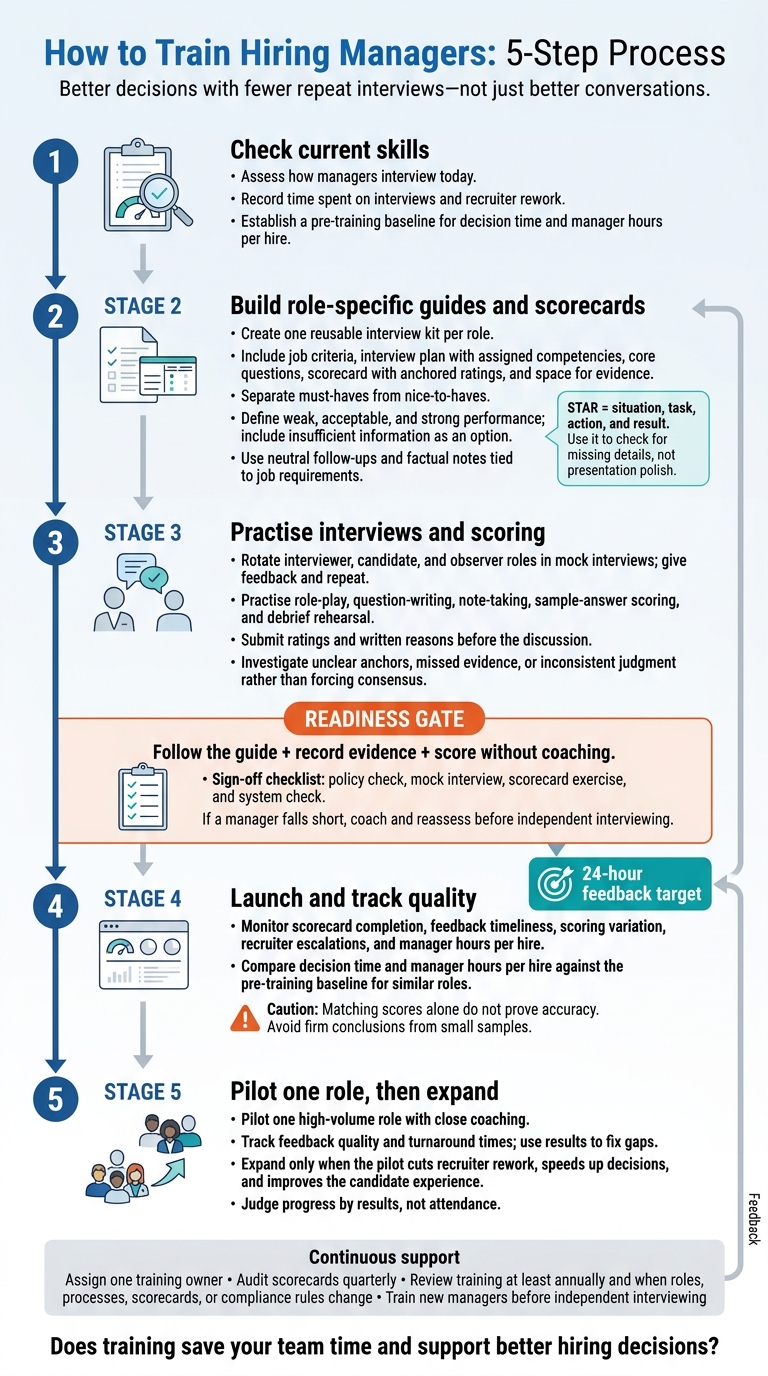
How to Train Hiring Managers: 5-Step Process
Practical Interviewing Techniques For HR & Managers With Jo Irwin
sbb-itb-a23bd6a
2. Build the Interview Guide and Scorecard
Create one reusable interview kit per role: job criteria, an interview plan with assigned competencies, core questions, a scorecard with anchored ratings, and space for evidence. Use the U.S. Office of Personnel Management’s structured interview guidance for support. This turns your training standards into a repeatable process, so managers assess applicants against the same requirements.
Define Job Criteria and Rating Scales
Separate must-haves from nice-to-haves and identify observable behaviors for each requirement. Define what weak, acceptable, and strong performance looks like before interviews begin. Include an insufficient information option so managers don’t turn missing evidence into a guessed rating.
Write Core Questions and Neutral Follow-Ups
Write behavioral questions about past actions and situational questions about job-related scenarios. Give interviewers a shared question set for each competency and role to reduce improvisation.
Teach STAR, situation, task, action, and result, as a check for missing details, not presentation polish. Use neutral follow-up questions to clarify the candidate’s specific role and results, without hinting at the answer you want.[1]
Ask Job-Related Questions and Take Factual Notes
Train managers to listen fully before asking follow-up questions, clarify missing details, and record what the candidate did and the result. Assess evidence against defined job requirements, rather than relying on subjective judgments about fit.
HR should set rules for restricted questions, sensitive disclosures, and how notes are stored, accessed, and retained under applicable federal, state, and local law. Managers should follow HR policy, not make legal judgments.
Test the guide and scorecard in mock interviews before using them in live hiring.
3. Practice Interviews and Align Scoring
Test your interview guide and scorecard before managers use them with real candidates. Mock interviews show whether managers can apply both consistently, helping you spot gaps before they affect hiring decisions.
Run Mock Interviews With Observer Feedback
Use the role’s interview guide and a labeled candidate brief. Include claims or results the interviewer must verify during the session.
Rotate interviewer, candidate, and observer roles, then repeat the exercise after feedback. The observer should name the specific behavior to change, rather than simply saying the interview went well or poorly.
Use the same rubric for every practice round.
| Practice activity | Capability tested | Observable passing behavior |
|---|---|---|
| Role-play | Listening and time control | Follows the guide, stays on script, manages time, and clearly explains the format and next steps. |
| Question-writing | Neutral probing | Writes follow-ups that clarify ownership and results without suggesting an answer. |
| Note-taking | Factual documentation | Records candidate actions and results, keeping evidence separate from impressions. |
| Sample-answer scoring | Applying rating anchors | Chooses a rating independently and supports it with facts. |
| Debrief rehearsal | Evidence-based discussion | Explains ratings against job criteria and asks what evidence supports others’ scores. |
Use this table as your practice rubric. If a manager needs prompting, coach the missed skill and repeat that part of the simulation. Readiness means following the guide, recording evidence, and scoring without coaching.[1]
Score Answers Independently Before Debriefing
Give managers identical sample answers. Ask them to submit ratings and written reasons before the discussion, so you can assess their judgment independently.
During the debrief, compare the facts each manager recorded against the rating anchors. Keep evidence separate from opinion.
Investigate disagreements rather than forcing consensus. Check for unclear anchors, missed evidence, or inconsistent judgment. Clarify the rubric where needed, then repeat the exercise to improve consistency in hiring decisions.
Track rating variation alongside the supporting evidence. Matching scores alone do not prove accuracy.
4. Launch Training and Track Interview Quality
Once managers pass mock practice, move them into live interviews with monitoring in place.
Set Requirements for Interview Panel Members
Require sign-off before managers interview independently: a policy check, mock interview, scorecard exercise, and system check. Set passing criteria upfront. If a manager falls short, provide coaching and reassess. Attendance alone does not mean they’re ready. Apply the same standards for neutral questioning, factual notes, and independent scoring in live hiring as in practice.[1]
Give panel members one launch pack containing the current interview plan, scorecard, debrief template, and submission steps. Use self-paced e-learning for repeatable policy content, backed by brief email or Slack reminders before interviews. Keep the 24-hour feedback standard for live hiring.[1]
Measure Interview Quality, Decision Time, and Manager Hours
Build a simple dashboard from existing scorecards and feedback notes. Track scorecard completion, feedback timeliness, scoring variation, recruiter escalations, and manager hours per hire. Use an embedded recruitment savings calculator to quantify these efficiency gains.[1]
Compare decision time and manager hours per hire against the pre-training baseline for similar roles. This helps you assess whether training saves time and supports hiring decisions. Review patterns with HR to identify barriers, but avoid firm conclusions from small samples.[1]
Update Training and Assign Support
Give one person ownership of training standards and completion records. During active hiring, recruiters should flag late feedback, ratings without evidence, and unapproved criteria. Embedded recruiters should also coach managers on live interviews and flag recurring issues.[1]
Audit scorecards quarterly to spot repeated gaps. Review training at least annually, and whenever roles, interview processes, scorecards, or compliance rules change. Train new managers before they interview independently, and direct follow-up coaching toward observed problems.[1]
5. Conclusion: Pilot the Program, Then Expand
Once managers pass practice and begin live interviews, pilot the process on one high-volume role before expanding. Track feedback quality and turnaround times. Keep the pilot small enough to coach managers closely.[1]
Use the results to fix gaps before rollout. Identify local champions who can model the process and help peers by using modern interview techniques. Expand only when the pilot cuts recruiter rework, speeds up decisions, and improves the candidate experience.[1]
Assign a training owner and schedule the pilot. If you need extra recruiting capacity, contact Rent a Recruiter.
FAQs
How long should hiring manager training take?
Hiring manager training needs regular follow-through, not just a one-off session. Start with 60 to 120 minutes on structured interviewing, scoring, and bias awareness. Then use a structured 30-day onboarding plan to cover role-specific tools, mock interviews, and calibration exercises.
Schedule quarterly calibration sessions lasting 45 to 60 minutes to keep ratings consistent across hiring managers. Add annual refresher training, with extra sessions whenever your hiring process or legal requirements change.
How can we reduce interviewer bias?
Replace gut feelings with structured, evidence-based interviews. Ask every candidate the same competency-based questions. Train hiring managers to use standardized scoring rubrics with clear criteria so decisions reflect job requirements, not personal impressions.
Have managers score independently before group discussions to limit anchoring and peer influence. Tie feedback to observable, job-related evidence rather than vague impressions like “culture fit.” Require feedback and scorecards within 24 to 48 hours to preserve accuracy and reduce reliance on fading memories or personal bias.
How do we measure training ROI?
Measure hiring manager training ROI by comparing time saved, hiring quality, and reduced risk with program costs. Track recruiter rework and manager time saved to see whether training reduces the work needed to make each hire.
Monitor new-hire performance, early attrition, scorecard completion, feedback turnaround, offer acceptance, and candidate feedback. Together, these measures show where training is changing hiring decisions and results.
Use certification completion and interview kit adoption as early signs of behavior change. Then track time-to-fill and 6- to 12-month retention to confirm business impact. Audit scorecards and calibration sessions to check that managers make consistent, evidence-based decisions.