Hiring across borders can add payroll costs and tax duties, even without a local office. We recommend checking the employee’s work location, tax residence, duties, and travel dates before you approve the arrangement, so you can budget for the full cost of the hire.
Staying below 183 days is not a guaranteed tax exemption. Employee tax, employer withholding, social security, and corporate-tax exposure each need a separate check.
Before work starts, we recommend you:
- Confirm the costs: Check registrations, withholding, and social security contributions in each country.
- Review the role: Assess whether the employee’s workspace or contract activity could create a taxable business presence.
- Keep control: Require written approval, track actual workdays and travel, and review changes before thresholds are reached.
<u>Confirm work authorization separately.</u> With country-specific advice and clear records, you can make hiring decisions with fewer unexpected costs and less payroll rework.
Remote cross-border working: the tax and legal challenges
sbb-itb-a23bd6a
What Payroll and Social Security Duties Apply?
Use the travel and workday records above to check payroll, withholding, and social security requirements. Employee income tax and employer payroll duties are separate issues. For every country where the employee lives or works, document who handles withholding, registration, wage reporting, social security contributions, and employee notices.
When Must Employers Register for Foreign Payroll?
You may need to register for payroll or withhold tax even without a local subsidiary. Employee treaty relief does not automatically remove your reporting duties as an employer.
Check registration triggers, deadlines, employer identifiers, filing frequency, and payment currency. Assign clear responsibility for registration, withholding calculations, returns, and payment funding, including employer social contributions. Local registration does not remove the need to assess U.S. withholding.
Do U.S. Withholding and Social Security Taxes Continue?
For U.S. persons paying U.S. citizens or resident aliens for work abroad, federal income-tax withholding generally continues.[3][1]
Reduce withholding only when foreign law requires withholding on the same compensation, or when you reasonably expect the employee to qualify for the foreign earned income exclusion and have received the required statement. For eligible U.S. citizens, that statement may be Form 673.[3][1] Recheck withholding when circumstances change. Reduced withholding does not remove filing obligations.[3][6][1]
Assess Social Security and Medicare separately from income tax. U.S. Social Security and Medicare withholding generally stops when a worker is employed abroad by a foreign employer. However, arrangements involving an American employer or certain foreign affiliates can lead to different results.[5]
SSA totalization agreements generally assign coverage to one country to prevent duplicate contributions. Request and retain the applicable certificate of coverage, check its dates, and provide it when foreign authorities require proof.[4][7] A social security exemption does not remove income-tax payroll duties.
How Do Worker Status and Assignments Affect Tax Duties?
The working relationship, not the contract label, determines status. Review control, integration, economic dependence, and who directs the work as part of your talent acquisition strategies before deciding which payroll rules apply.
| Worker or assignment status | Physical work country | Withholding risk | Registration trigger | Social security coordination issue | Required documentation |
|---|---|---|---|---|---|
| U.S. employee on temporary foreign assignment | Agreement country | Foreign wage withholding may apply; assess U.S. withholding separately | Check whether the employer needs local registration or a payroll agent | Determine which country covers the employee under the applicable totalization agreement | Assignment letter, travel calendar, treaty analysis, certificate of coverage |
| U.S. employee working remotely abroad without formal assignment | Non-agreement country | Local withholding may apply; review U.S. withholding separately | Check whether physical work or employer presence requires registration | Contributions may be due in both countries if no coordinating agreement applies | Remote-work approval, workday records, local tax advice, payroll decision memo |
| Seconded employee to a foreign affiliate | Host country | Host-country withholding may apply even if the home entity keeps paying the salary | Determine whether the host or home entity must run payroll and report compensation | Assess host coverage, home coverage, and any totalization certificate; do not assume the payroll entity determines coverage | Secondment agreement, recharge arrangement, host payroll records, certificate of coverage, contribution calculations |
| U.S. contractor working abroad | Foreign work country | Payer withholding and reporting depend on local law and worker classification | Determine whether the company must register as a payer | Assess self-employed contributions and any agreement rules | Contractor agreement, status assessment, invoices, tax forms |
This table is a screening aid, not country-specific legal or tax advice.
Can Remote Work Create Corporate-Tax Duties?
Yes. Remote work abroad can create a permanent establishment (PE) or another taxable business presence under local law. That can mean corporate-tax registration, filings, and profit allocation. [14][10]
Payroll duties and corporate-tax risk need separate reviews. The same remote worker can trigger both, one, or neither. Before approving a request, assess corporate tax separately from hiring as you scale, payroll, social security, and immigration. [14][10]
Can a Home or Coworking Space Be a Permanent Establishment?
Neither automatically creates a PE. Check whether the space is permanent, regularly used for company business, and at the employer’s disposal. Your company does not need to own or lease it. [2][9][11]
Record who requires or pays for the space, any dedicated facilities, how often it is used, and what work happens there. Regular, employer-directed use carries more risk than incidental personal use. [2][9][11]
What Does the OECD‘s 50% Benchmark Mean?
For approval screening, the OECD commentary treats homes and similar locations, including second homes and holiday rentals, as less likely to be an enterprise’s place of business if they account for under 50% of total working time for the enterprise over the relevant 12-month period. This remains subject to the commentary’s qualifications. Measure actual work, not the agreed schedule. [8][13][15]
Reaching 50% does not automatically create a PE. Permanence, business purpose, and local law still matter. Use the workday log to check the benchmark and support your PE assessment. [8][10][16]
Which Employee Activities Increase Corporate-Tax Risk?
The fixed-place test looks at the business location. The dependent-agent test looks at what the employee does. Depending on the treaty wording, agent risk can arise when someone habitually concludes contracts or plays the principal role in contracts routinely approved without material changes. [9][12]
Review actual negotiations and approvals, not just signing authority. Customer contact or sales alone does not establish a PE. A low home-office percentage does not settle agent risk either. [9][12]
Use these patterns for initial screening, not as a final decision.
Preliminary indicators, not legal conclusions. Percentages refer to total working time over the relevant 12-month period. [10][13]
| Work pattern | Time in country | Activities | Business reason for location | PE risk: fixed-place or agent | Employer response |
|---|---|---|---|---|---|
| Occasional remote work | Less than 50% | Internal, preparatory, or auxiliary work | Personal convenience | Lower fixed-place concern; assess agent risk separately | Set a day limit, prohibit contract authority, and retain records |
| Regular home-office work | Regular | Core business functions | Supporting local operations | Further fixed-place review needed | Confirm the calculation and reassess activities |
| Local sales role | Any duration; regularity matters | Negotiating and securing contracts | Developing the local market | Possible dependent-agent concern | Examine negotiations and whether approvals involve material review |
| Recurring coworking use | Extended or recurring | Local management and supplier decisions | Managing local operations | Possible fixed-place concern | Review workspace access, permanence, and employer control |
How Should Employers Approve and Track Cross-Border Work?
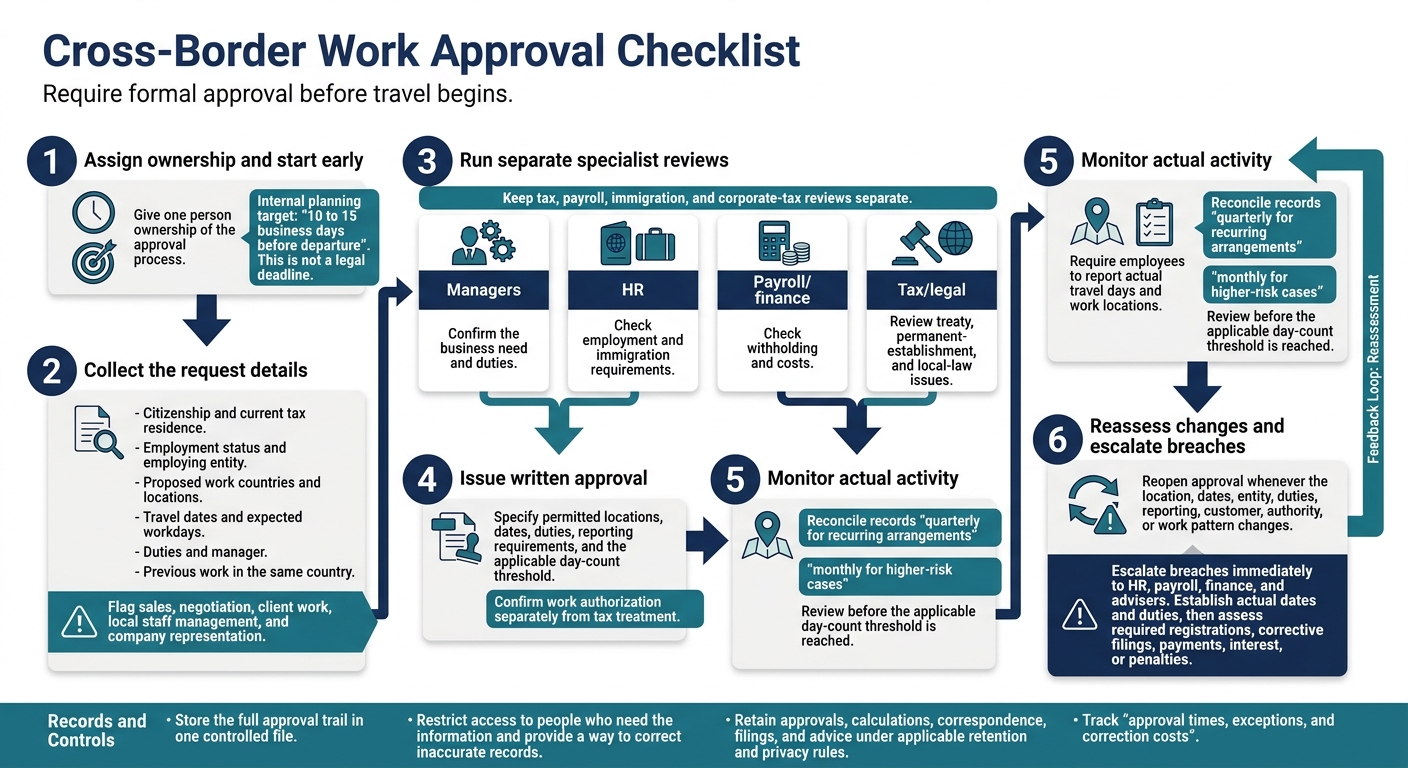
Cross-Border Work Approval Checklist
Once you’ve identified payroll and permanent-establishment risk, require formal approval before travel begins. Set an internal planning target of 10 to 15 business days before departure. This is not a legal deadline.
Give one person ownership of the approval process, with clear responsibilities:
- Managers confirm the business need and duties.
- HR checks employment and immigration requirements.
- Payroll/finance checks withholding and costs.
- Tax/legal reviews treaty, permanent-establishment, and local-law issues.
Keep tax, payroll, immigration, and corporate-tax reviews separate. Store the full approval trail in one controlled file so decisions and responsibilities are easy to trace.
What Information Is Needed Before Approval?
Collect only what you need to approve or deny the request: citizenship, current tax residence, employment status, employing entity, proposed work countries and locations, travel dates, expected workdays, duties, and manager.
Identify sales, negotiation, client work, local staff management, or company representation. Record any previous work in the same country, as this can change the risk assessment.
Restrict access to people who need the information, and give employees a clear way to correct inaccurate records.
Written approval should specify permitted locations, dates, duties, reporting requirements, and the applicable day-count threshold. Confirm work authorization separately from tax treatment.
When Should Employers Review an Approval Again?
Approval needs to reflect what happens, not just what was planned. Require employees to report actual travel days and work locations. Reconcile records quarterly for recurring arrangements, or monthly for higher-risk cases.
Reopen approval whenever the location, dates, entity, duties, reporting, customer, authority, or work pattern changes. Review it before the applicable day-count threshold is reached, too.
Escalate breaches immediately to HR, payroll, finance, and advisers. Establish the actual dates and duties, then assess any required registrations, corrective filings, payments, interest, or penalties.
Retain approvals, calculations, correspondence, filings, and advice under the applicable retention and privacy rules. Track approval times, exceptions, and correction costs to spot missing data and unclear ownership.
Conclusion: What Must Employers Do Before Work Begins?
Before work starts, confirm tax, payroll, social security, corporate-tax, and immigration risks. Then issue written approval and begin monitoring.
Get country-specific professional advice when the outcome is uncertain because of treaty conditions, local registration, sales, negotiation, client work, recurring work, or potential permanent-establishment exposure.