AI video interviews can cut screening admin, but faster screening does not guarantee better tech hires. We recommend starting with one role family and one bottleneck, then measuring recruiter hours, review time, completion rates and total costs in U.S. dollars.
For your hiring team, the priorities are simple:
- Save time: Use recorded responses to reduce scheduling work, or live AI support for transcripts and notes.
- Protect hiring quality: Use consistent, job-related questions and technical work samples. Keep people responsible for decisions.
- Check the full cost: Count setup, training, human review, corrections and audits before claiming savings.
- Keep the process accessible: Explain recording and data use, offer alternatives and assign a human contact for errors.
- Expand only after testing: Compare pilot results with your baseline, including hiring outcomes at 6 and 12 months.
Our approach: treat AI as screening support, not a replacement for judgement. <u>Scale only when your results show less work without weaker hiring outcomes.</u>
Interviewing with AI: 7 examples of what to expect and how to interact
sbb-itb-a23bd6a
Benefits and Limits of AI Video Interviews
Faster screening increases throughput, not hiring quality. AI video interviews can ease time-zone scheduling, repetitive screening, uneven notes, and pressure on recruiter capacity. They can also give you clearer visibility into screening progress.[6][8]
Those gains depend on people owning reviews, exceptions, and final decisions. Consistent questions can help you compare applicants at scale, but controlling bias still requires job-related questions and human review. A faster, standardized process only pays off if that review holds up.
| Potential benefit | Hiring problem | Required conditions | Limits |
|---|---|---|---|
| Lower screening burden | Repetitive screening and high application volume across time zones | Asynchronous recording, clear questions, reliable transcription, reasonable completion windows, and enough reviewer capacity | Candidate abandonment, transcript corrections, and review backlogs can reduce gains |
| Consistent comparisons | Need to compare responses using the same job-related questions and rubric | Standardized prompts and scoring | Consistency does not validate weak criteria |
| Better visibility | Unclear delays and decision ownership | Timestamps, review records, and tracked handoffs | Records require access controls and retention rules |
These limits make job-related scoring criteria the next step.
Before trusting the numbers, keep three types of evidence separate. Independent research tests interview methods or assessment validity. Provider claims report selected customer outcomes. Employer-measured results show what happened in your own hiring process.[7][8][9]
Your internal results need a baseline, measurement window, owner, and comparison group. These evidence types are not interchangeable.
Reduce Screening and Scheduling Work
Use transcription and structured response records to prepare evidence for review, not to replace technical judgment. Track application-to-review turnaround, recruiter hours per role, and invitation-to-completion rates.
Include transcript corrections, summary checks, and audits in the workload. They are work, not hidden overhead.
Net time saved = baseline recruiter hours – review, correction, and audit time.
If responses arrive sooner but sit longer waiting for review, you have moved the bottleneck rather than removed it.
Use Consistent Questions and Hiring Records
Equivalent questions and behaviorally anchored scorecards help you compare responses on job-related evidence.
Schmidt and Hunter’s meta-analysis estimated predictive validity of approximately r = .51 for structured interviews, compared with r = .38 for unstructured interviews. These figures are correlations with job performance, not accuracy percentages. They do not validate AI-generated scores.[10]
Use hiring records to flag review gaps and uneven scoring, and to audit bottlenecks, score drift, and reviewer consistency.
Design Job-Related Assessments
Tie every assessment to a documented job analysis before you scale screening. Embedded IT recruitment saves time, but measuring the wrong skills can lead to poor hiring decisions. Identify the core tasks, skills, and observable behaviors needed to perform the job well.
Define Skills and Scoring Criteria
Ask your embedded recruitment service or hiring manager to map each competency to an assessment and scoring rubric. Each competency should have a scored work sample or interview prompt.
Use video to assess job-related reasoning and communication, not as proof of coding skill. Pair it with a debugging, code review, or system design work sample.
Use the same core questions and scoring definitions for comparable candidates, with approved accommodations.
Control Bias and Protect Candidate Access and Data
Transcript errors can make a correct technical answer look wrong. Keep appearance, facial expressions, eye contact, and accent out of technical scoring. When communication matters, score accuracy and clarity, not charisma or confidence. Disability-related speech differences must not lower scores.[5]
| Control area | Required action | Owner |
|---|---|---|
| Bias | Test representative responses. Check data, labels, features, and thresholds for bias or irrelevant proxies. | Assessment owner and vendor |
| Accessibility | Provide captions, keyboard-compatible access, accessible instructions, appropriate extra time, scheduling flexibility, and equivalent response formats without reducing candidates’ opportunities. Do not require medical details for accommodations. | Recruiting and accessibility lead |
| Privacy | Collect only needed data. Document its purpose and retention, explain sharing and deletion, and obtain consent where required. Prohibit unrelated reuse unless separately disclosed and permitted. | Privacy or legal lead |
| Security | Restrict and log access, encrypt recordings and transcripts, manage vendor access, and establish breach procedures. | Security lead |
| Validity | Link scored components to core job tasks. Compare results with work samples or later performance to check that the assessment measures the claimed skill. | Talent assessment lead |
| Adverse impact | Compare selection rates and job outcomes across relevant groups where lawful and feasible. Investigate material disparities. | HR analytics and legal |
| Transparency | Explain what AI evaluates, who reviews results, what data you collect, and how candidates can request accommodations or contest errors. | Recruiting and legal |
Have counsel review applicable U.S. federal, state, and local requirements.
Once the rubric is set, keep AI output separate from the final hiring judgment.
Check AI Scores and Require Human Review
Have trained reviewers score responses without seeing AI recommendations. Then resolve disagreements using documented evidence.
Compare group completion and pass rates where lawful. Use the four-fifths rule as a screening flag, not a legal test.[11] Test prediction separately against work samples or predefined performance outcomes after 6 or 12 months.
| Criterion | AI-assisted score | Trained human rating | Disagreement check and limit |
|---|---|---|---|
| Evidence accuracy | Retrieves rubric-linked statements. | Checks meaning and context. | Correct missing, fabricated, or mistranscribed evidence. |
| Consistency | Applies configured scoring rules. | Applies behavioral anchors. | Investigate rubric ambiguity. Agreement does not prove validity. |
| Fairness | May reproduce data or label bias. | May reflect stereotypes or preferences. | Audit both, including group differences. |
| Performance prediction | Requires outcome testing. | Offers expert judgment, not ground truth. | Compare with job-related outcomes. Interpret small samples cautiously. |
| Decision authority | Recommends or flags. | Can correct errors and overturn recommendations. | Never reject solely on an AI score. Document the evidence behind decisions. |
Run a Pilot and Measure Results
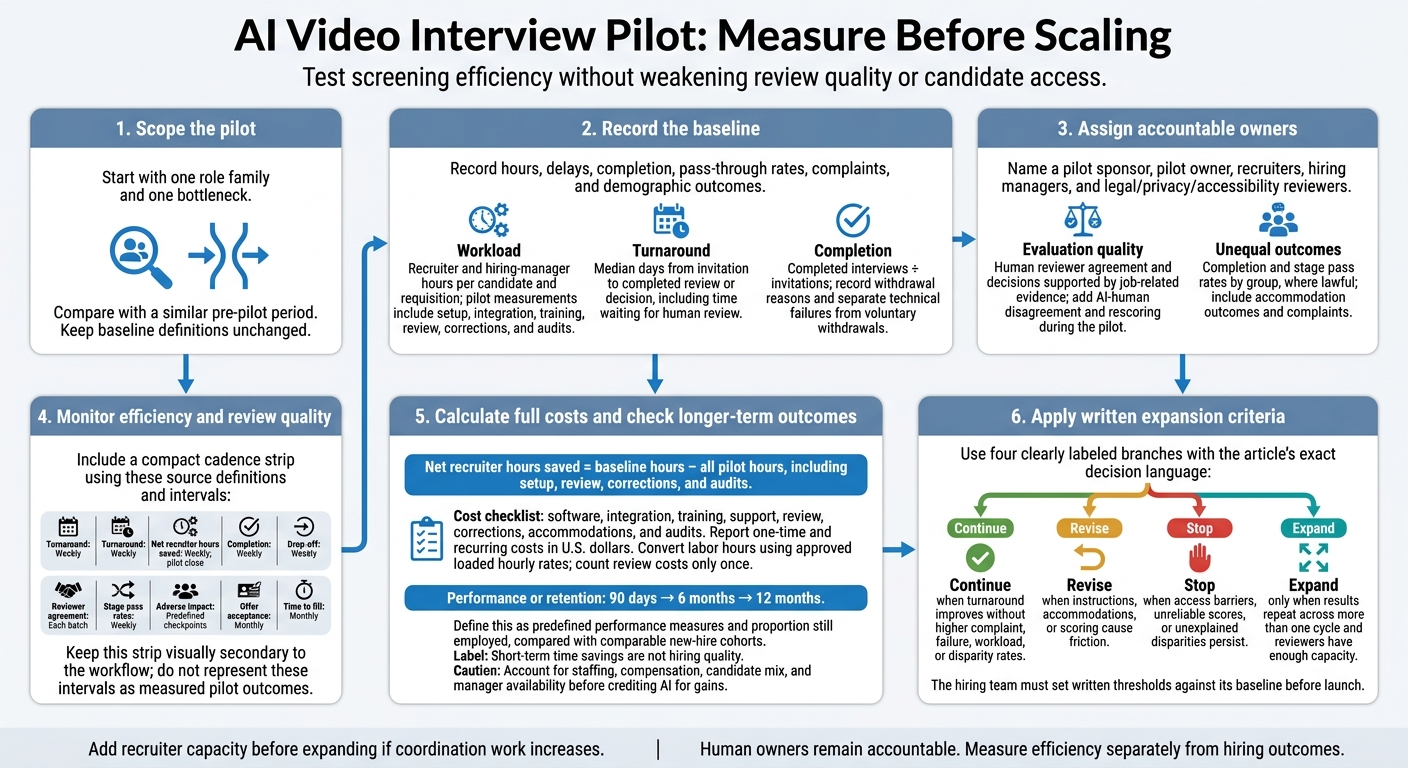
AI Video Interview Pilot: Measure Before Scaling
Test whether AI speeds up screening without reducing review quality or candidate access. Before launch, record baseline hours, delays, completion, pass-through rates, complaints, and demographic outcomes.
The EEOC advises that AI assessment content and scoring should relate clearly to the job, produce consistent results, and be documented for validation and auditing.[12]
Start with one role family and one bottleneck. Compare results with a similar pre-pilot period to check whether AI cuts screening work without weakening access or review quality. Keep baseline definitions unchanged so you can compare results accurately.
| Measure | Baseline process | Pilot workflow |
|---|---|---|
| Workload | Recruiter and hiring-manager hours per candidate and requisition | Same measures, including setup, integration, training, review, corrections, and audits |
| Turnaround | Median days from invitation to completed review or decision | Same interval, including time waiting for human review |
| Completion | Completed interviews ÷ invitations; recorded withdrawal reasons | Same calculation; separate technical failures from voluntary withdrawals |
| Evaluation quality | Human reviewer agreement and decisions supported by job-related evidence | Same measures, plus AI-human disagreement and rescoring |
| Unequal outcomes | Completion and stage pass rates by group, where lawful | Same measures, plus accommodation outcomes and complaints |
Assign Owners and Set Expansion Criteria
Name a pilot sponsor, pilot owner, recruiters, hiring managers, and legal/privacy/accessibility reviewers. Give each person clear approval and escalation authority.
Before launch, define required human checks, who can override decisions, how appeals will be handled, and how candidates can give feedback. Document who can pause the pilot and who owns each decision.
Set written thresholds against the baseline:
- Continue when turnaround improves without higher complaint, failure, workload, or disparity rates.
- Revise when instructions, accommodations, or scoring cause friction.
- Stop when access barriers, unreliable scores, or unexplained disparities persist.
- Expand only when results repeat across more than one cycle and reviewers have enough capacity.
Track Time, Cost, and Hiring Quality
Use one definition for each metric. Report weekly efficiency separately from longer-term hiring outcomes so short-term time savings do not stand in for hiring quality.
Track one-time and recurring costs in U.S. dollars, including software, integration, training, support, review, corrections, accommodations, and audits. Convert labor hours to costs using approved loaded hourly rates. When calculating net savings, count review costs only once.
Account for staffing, compensation, candidate mix, and manager availability before crediting AI for gains.
Net recruiter hours saved = baseline hours − all pilot hours, including setup, review, corrections, and audits.
| Metric | Definition | Baseline | Data source | Owner | Review cadence |
|---|---|---|---|---|---|
| Turnaround | Median days from invitation to completed review or decision | Comparable requisitions | ATS timestamps and interview logs | Recruiter | Weekly |
| Net recruiter hours saved | Baseline hours − all pilot hours | Prelaunch time study | Time and workflow logs | Recruiting operations | Weekly; pilot close |
| Completion | Completed interviews ÷ invitations | Prior comparable rate | ATS and interview records | Recruiter | Weekly |
| Drop-off | Starters who do not finish ÷ starters | Prior abandonment rate | Event logs and support records | Recruiter | Weekly |
| Reviewer agreement | Human-human and AI-human agreement, measured separately | Blinded double-scored sample | Review records | Hiring manager | Each batch |
| Stage pass rates | Candidates advancing ÷ candidates entering each stage | Comparable stage rates | ATS stage history | Recruiting operations | Weekly |
| Adverse impact | Group differences in selection and completion, where lawful | Comparable group outcomes | ATS and protected demographic records | HR/legal | Predefined checkpoints |
| Offer acceptance | Accepted offers ÷ offers issued | Comparable offer rate | ATS | Recruiter | Monthly |
| Time to fill | Requisition approval to accepted offer | Comparable requisitions | ATS | Recruiting operations | Monthly |
| Performance or retention | Predefined performance measures and proportion still employed | Comparable new-hire cohorts | Performance records and HRIS | HR business partner | 90 days, 6 months, 12 months |
Add Recruiter Capacity When Needed
If the pilot adds coordination work, add recruiter capacity before expanding. Rent a Recruiter can embed recruiters to coordinate assessments, manage candidate communication, maintain ATS records, and monitor results.
Conclusion: Scale Screening With Human Oversight
In remote tech hiring, use AI to support screening, not make hiring decisions. Automate invitations and transcription, keep questions job-related, and require human reviewers to check scores against job-related evidence before approving decisions.
Build applicant safeguards into your workflow. Disclose AI use, offer accessible alternatives, and provide a named human contact. Limit access to recordings and set clear retention and deletion rules. Speech analysis can disadvantage applicants with speech-related disabilities.[5]
Start with one bottleneck in engineering recruitment. Expand only when pilot results show accuracy, accessibility, reviewability, and hiring quality. Faster screening only helps when named human owners, not AI scores, remain accountable.
FAQs
Which tech roles suit AI video interviews best?
AI-powered video interviews work best for high-volume technical hiring and specialized roles that need objective skill checks [1][2]. For developer roles, AI can assess React, JavaScript, and CSS skills to check whether candidates’ claims match their abilities [2]. These tools also help you assess communication skills and personality fit early in the hiring process [1].
Rent a Recruiter helps scaling companies build these tools into structured, bias-resistant hiring workflows, supporting consistent, high-quality technical hiring [3][4].
How many candidates should our pilot include?
Aim for at least approximately 30 candidates per group to collect statistically meaningful data for bias auditing [1]. Keep the pilot focused on one department or one to two job families over a 6-week period [2][3][4].
This scope gives you enough evidence to show results and gain internal support before rolling the process out across your organization [2][4].
How can we separate AI gains from other hiring changes?
Build a structured, skills-first hiring baseline before adding AI. Use standardized questions, scoring rubrics with clear criteria, and independent evaluations. Track pass-through rates and differences in interviewer scores at each stage.
Then compare time-to-hire and quality-of-hire against that non-AI baseline. This helps you separate AI’s impact from gains made by improving your hiring process.