AI can help you hire faster and with more control, but only if you set rules first. For scaling firms in SaaS, fintech, engineering, IT, security, insurance, and professional services, the commercial case is simple: cut manual screening time, improve shortlist quality, and keep a close view on hiring risk.
I’d boil it down to this:
- Use AI for sourcing, screening support, and ATS rediscovery
- Set clear hiring rules before any tool goes live
- Score people on skills, not pedigree or background signals
- Keep human review in every high-stakes decision
- Track funnel data by stage so you can spot issues early
The article shows that AI can support both speed and hiring outcomes when the process is structured. It also makes the point many teams miss: if your data, scorecards, and workflows are loose, AI just scales bad hiring habits.
If you want the short version, here it is: good AI hiring is not about automation alone. It is about better process design. That means tighter screening criteria, cleaner data, clear recruiter ownership, and regular funnel reviews tied to cost, time-to-hire, and shortlist quality, or rate your recruitment process to find gaps.
For decision-makers, the message is clear. Do not start with tools. Start with control. That is what turns AI from extra noise into a hiring system your team can use at scale.
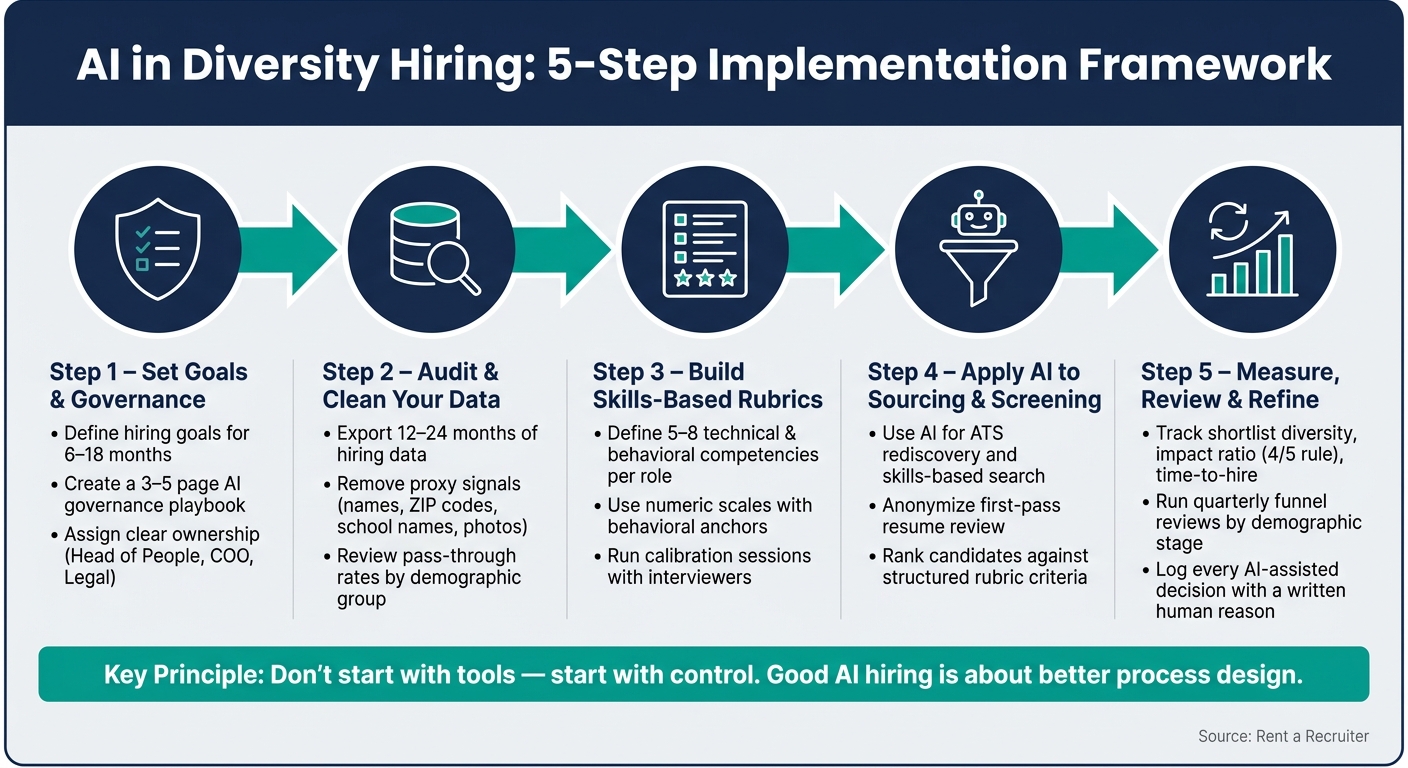
AI in Diversity Hiring: 5-Step Implementation Framework
How Employers Can Escape the AI Hiring Loop and Build More Inclusive Hiring Practices
sbb-itb-a23bd6a
Set Clear Diversity Goals and Governance Before Using AI
Strategy on its own is not enough. Before you use AI in screening, you need clear rules, clear ownership, and clear limits.
Define hiring goals tied to business growth
Start with your hiring plan for the next 6 to 18 months. If you’re scaling an engineering team after a funding round, or building a sales function for a new market, that is where your diversity goals should sit, not in a vague policy document.
Make those goals specific to each hiring stage and easy to measure. For example: "Ensure at least 40% of engineering shortlists include candidates from underrepresented racial or ethnic groups within six months." That gives your team a concrete target. It also gives any AI tool a clear job to support, instead of letting it operate against loose or unclear standards.
Link each goal to a business result, such as product fit, market reach, or retention. That matters for two reasons. First, it keeps the work tied to hiring outcomes that affect growth. Second, if your process is reviewed under Title VII, you can show the criteria were connected to business need, not guesswork.
Create a short AI governance policy
For most U.S.-based SMEs, you do not need a huge policy pack to get started. A short internal policy that covers four points is usually enough:
- Which AI tools are approved, and for which tasks
- Which job criteria those tools are allowed to use
- When a human must review AI output before any decision
- How often you’ll check for adverse impact
This is the part many teams skip, and it is often where risk shows up. If your AI setup is loose, hiring managers improvise, recruiters fill gaps on the fly, and no one can explain how decisions were made.
Use job-related criteria, human review, and adverse impact checks to stay in line with EEOC expectations. The four-fifths rule is the standard starting point for adverse impact testing: if any protected group’s selection rate falls below 80% of the highest-selected group’s rate, that’s a signal worth investigating.[1][2][3] Bias auditors typically recommend a minimum sample size of around 30 candidates per group before running these calculations to make the results meaningful.[4][5]
Ownership also needs to be explicit. A Head of People or Talent can manage day-to-day tool setup and recruiter training. A COO or CEO should hold final accountability, with the authority to pause any tool if an issue appears. A legal or compliance adviser, even an external one, should review the policy every quarter, especially if you hire in places with their own AI hiring rules.
The table below sums up the core governance controls, what each one does, and why it matters for U.S.-based SMEs.
| Governance Practice | Purpose | Relevance for U.S.-Based SMEs |
|---|---|---|
| Documented job criteria | Ensures AI scores candidates against objective, role-specific skills and qualifications | Supports EEOC focus on job-related selection; reduces risk of arbitrary or indefensible decisions |
| Approved AI use cases | Limits AI to defined tasks such as sourcing, resume de-identification, or structured screening support | Prevents opaque decision-making and keeps AI use aligned with Title VII expectations |
| Human review of AI outputs | Requires a recruiter or hiring manager to review AI recommendations before any advance or reject decision | Critical for accountability and final decision-making |
| Adverse impact monitoring | Tracks selection rates by group to detect disproportionate screening-out of protected classes | Directly tied to the four-fifths rule and helps surface potential adverse impact early |
| Remove proxy data | Removes or limits fields that proxy for protected characteristics, such as names, ZIP codes, or photos | Reduces the risk of AI amplifying existing bias in historical hiring data |
| Candidate notice | Informs applicants when AI is used in their evaluation | Builds trust and aligns with emerging disclosure expectations |
Put these controls into a concise 3 to 5 page playbook that hiring managers will use. If the document is too long, it will sit in a folder and do nothing. Pair it with a brief quarterly review where your governance group checks the metrics, flags adverse impact patterns, and decides whether any AI settings need to change.
Once governance is set, audit your data and screening criteria before you deploy AI.
Build Fair Data, Screening Criteria, and AI Workflows
Audit your data and remove signals that distort hiring decisions
AI will mirror the data you give it. If past hiring patterns leaned toward one group over another, the system can repeat that bias at scale. That is not just a people risk. It is a hiring quality, compliance, and cost risk.
In one large randomized experiment using roughly 361,000 synthetic resumes, GPT-3.5 Turbo penalized Black male candidates by 0.30 points relative to otherwise identical White male candidates.[6]
Before you automate screening, export 12 to 24 months of hiring data and review pass-through rates by group at each stage. If one group drops out at the resume screen more often than others, you need to know why before AI starts making that pattern faster and harder to spot.
Watch for proxy signals. These fields may not name race, gender, or age, but they can still point to them. Common examples include school names, ZIP codes, and exact work dates. In early-stage screening, strip these out. Use years-of-experience ranges instead of exact dates, standardize location as remote-eligible or commute-based, and set your ATS to hide names, photos, pronouns, and addresses from first-pass resume review.
There is one catch. Anonymous resume review worsened the interview gap between majority and minority candidates by about 10 percentage points in some contexts.[7][8] So anonymization is not a fix on its own. Use it alongside structured rubrics, not instead of them.
Once your data is cleaner, lock scoring to job-related criteria, not proxy signals. That gives you a process your team can defend, and one that is less likely to waste time on poor-fit profiles.
Use skills-based scoring and structured rubrics
Use the same criteria from your governance policy in every scorecard. Build a success profile for each role with 5 to 8 technical and behavioral competencies, each with clear definitions of what good performance looks like.
Then turn that into a structured scorecard with a numeric scale and short behavioral anchors at each level. For example, a customer success manager rubric might score problem-solving with an anchor such as: provides at least two specific examples of de-escalating a challenging customer situation. That level of detail cuts down gut-feel scoring and gives your team a shared standard.
Your AI tools should score against those same competencies. Map skills, project history, and assessment results to the rubric criteria. For high-volume hiring, standardized online assessments or structured application questions often give cleaner signals than resume text alone. For specialist roles, work-sample reviews or portfolio checks give the system job-task evidence that is closer to the actual role.
This matters commercially. Better inputs lead to better shortlists. Better shortlists mean less recruiter rework, fewer wasted interviews, and a lower chance of expensive mis-hires.
Rubrics also help your hiring team stay aligned. Run calibration sessions so interviewers score the same sample profile and compare results. When people agree on what good looks like before interviews begin, the scores mean more and are easier to defend if your process is reviewed.
After you standardize scoring, the workflow itself needs to be clear enough for recruiters to explain.
Choose workflows that recruiters can explain
Recruiters should be able to explain every ranking. If they cannot, you have a black-box process that is hard to trust and even harder to defend.
Explainability gives your team a way to catch errors, answer candidate questions, and show compliance if someone audits the process. It also helps hiring managers buy into the system, because they can see why a profile ranked where it did.
For SMEs without deep technical resources, use AI tools that show ranking logic in plain terms. That could include feature importance views, score breakdowns, or short written explanations tied to job-related factors. A recruiter should be able to say, "This candidate ranked higher because they scored stronger on the technical assessment and had more direct experience with the core skill we defined", not just "the AI said so."
Use the table to choose the lightest control that fits your process.
| Technique | Bias Reduction Potential | Transparency for Recruiters | Implementation Effort for SMEs |
|---|---|---|---|
| Anonymization | High for early-stage bias from names, photos, and obvious demographic cues; especially useful in resume screening. | Medium: recruiters see less identifying info but still need clarity on what’s hidden and why | Medium: requires ATS configuration and process changes, but can often be piloted on a subset of roles |
| Feature suppression | High when removing strong proxies like school, ZIP code, or graduation year from AI models and ranking logic. | Medium-High: once documented, it’s clear which features are excluded, though model internals may remain opaque | Medium-High: needs data analysis and coordination with vendors or internal teams to adjust models |
| Explainability (XAI) | Medium-High: improves ongoing bias detection and accountability by making drivers of decisions visible. | High: recruiters can understand and articulate why candidates are ranked or flagged | Medium: requires selecting tools with explainable outputs and training recruiters to interpret them |
| Standardized rubrics | High: reduces subjective, unstructured judgments and ensures AI and humans use the same job-related criteria. | High: criteria and scoring are explicit and easy to share with stakeholders | Low-Medium: main effort is designing rubrics and training interviewers; technology changes can be incremental |
A practical rollout usually starts with rubrics first. Then add anonymization, feature suppression, and explainability in that order. That keeps the process simple at the start, gives recruiters more control, and sets you up to expand sourcing and screening without losing visibility.
Apply AI to Diversity-Focused Sourcing While Keeping Human Control
Expand your talent pool with broader sourcing workflows
With fair data and scoring in place, AI can help you widen sourcing without widening bias.
Most SMEs keep going back to the same small set of channels. That limits reach, and it often limits hiring outcomes too. Skills-based search helps you find nontraditional candidates based on what they can do, not just their job title or credentials.
Your ATS is also an underused asset. Many SMEs are sitting on years of candidate data that never gets touched again. AI-assisted rediscovery tools can match those past profiles to new roles, which can cut sourcing spend and save recruiter time.
On the job description side, AI can spot exclusionary language before a role goes live. That keeps the copy tied to what the job actually needs, instead of loaded wording that narrows the pool too early.
Standardize early-stage screening to cut inconsistency
Once your pool is broader, the next step is simple: use the same rubric to rank first-pass applicants.
This is where inconsistency often creeps back in. Even with clean data and clear scorecards, early screening can drift when different reviewers apply different standards. AI-assisted shortlist ranking, paired with anonymized first-pass review, helps reduce that variation.
Set your ATS to remove names, photos, and graduation dates before AI scoring starts. Then rank profiles against structured rubric criteria, skills, assessment data, and relevant experience, instead of CV layout or polish. Vodafone deployed AI screening globally and saw a 16% increase in female hires by removing recruiter bias from the initial screening stage, resulting in a more diverse shortlist at the first pass.[9]
Have a recruiter check borderline and rejected profiles on a regular basis. That gives you a way to spot bias or data issues early, before they affect hiring decisions at scale. AI is useful for surfacing candidates across a large pool, but people should still own final decisions, final interviews, and offer negotiations.
Use embedded recruiters to run AI-assisted hiring at scale
If internal capacity is thin, an embedded recruiter can own these workflows end to end.
When your team is stretched, an embedded recruiter can run AI-assisted sourcing, screening, scheduling, and stakeholder follow-up while keeping human review in place. Rent a Recruiter embeds experienced recruiters directly into SME teams within days, managing hiring end to end while bringing structure, visibility, and consistency to how you hire.
The table below maps the key AI-enabled sourcing workflows to their diversity goals, data requirements, recruiter effort, and expected impact.
| Workflow Component | Diversity Objective | Data Needs | Recruiter Effort | Expected Impact |
|---|---|---|---|---|
| Anonymized First-Pass Review | Reduce unconscious bias | Anonymized resumes | Low (Automated) | More diverse shortlists |
| Skills-Based Scoring | Broaden talent pool | Skills/Assessment data | Medium (Setting rubrics) | Higher quality-of-hire |
| ATS Rediscovery | Access overlooked talent | Historical candidate data | Low (AI-surfaced) | Reduced sourcing costs |
| Job Description Optimization | Reduce exclusionary language | Role requirements | Low (Generative AI) | Increased applicant diversity |
Use shortlist diversity and pass-through rates to check whether the process is improving access.
Measure Results, Refine the Process, and Take the Next Step
Once sourcing and screening are live, you need to check whether they improve access without creating adverse impact.
Track the metrics that show whether AI is working
Track the full funnel, not just shortlists and pass-through rates. Those only show the top of the funnel.
The table below shows the key metrics SMEs should track, what to measure, and what to do when something looks off.
| Metric | How to Measure It | What It Shows | Corrective Action |
|---|---|---|---|
| Shortlist Diversity | Anonymized candidate-mix dashboard | Sourcing channels are failing to reach diverse talent | Expand sourcing workflows to new platforms and communities |
| Impact Ratio (4/5 Rule) | Automated calculation of selection rates by group | Potential adverse impact against a protected group | Audit screening rules and proxy variables |
| Selection Rate by Stage | Funnel drop-off reports by demographic | Bias in specific interview stages or scorecards | Standardize rubrics and train hiring managers on bias |
| Recruiter Hours Saved | Tracking time spent on manual screening vs. AI-assisted review | AI is not clearing enough noise | Refine scoring rules |
| Time-to-Hire | Timestamp tracking from application to offer | Bottlenecks in human-in-the-loop review stages | Adjust recruiter workflows or use embedded recruitment support |
Review each role on its own. Aggregate results can hide adverse impact.
Every AI-assisted advance or rejection should also be logged as a human action, with a written reason behind it, not as an autonomous model output [10]. Keep those records for at least three years to meet current notice and recordkeeping rules [10].
Run quarterly reviews and adjust based on evidence
Use the dashboard to pinpoint which stage needs attention. A quarterly review does not need to be heavy.
Pull your funnel data. Check where drop-off happens by demographic. Then look at whether your sourcing channels are still bringing in diverse applicants.
Review screening rules and scorecards for proxy signals such as ZIP code, school, or hobby data. If a screening criterion is not directly tied to job performance, it deserves a second look.
Hiring manager behaviour matters too. If shortlists are diverse but final selections are not, the issue is likely in the interview stage, not sourcing.
Conclusion: Build an AI hiring process that scales
AI can support diversity hiring, but only when measurement, governance, and recruiter judgment stay connected.
Start with defined diversity targets linked to business growth. Govern AI use so each decision is explainable and logged. Build screening criteria around skills, not credentials or background signals that can introduce bias. Apply AI to sourcing and early screening, with human review at every meaningful stage. Then measure what is happening in your funnel and adjust based on evidence.
If you need hands-on support, Rent a Recruiter can place experienced recruiters inside your team to run AI-assisted hiring with structure and accountability. Book a call to see how embedded recruitment support can help you build a more scalable, cost-effective hiring process.
FAQs
How do we audit our hiring data before using AI?
Before you use AI in hiring, audit your data first.
If your data is messy, old, or biased, AI will only scale the problem. That’s the bit many teams miss.
Start with your ATS. Remove duplicate records and standardise the fields that affect screening and reporting, such as:
- Job titles
- Skills
- Seniority levels
- Location data
This matters for more than admin. Clean, structured data gives you better hiring decisions, cleaner reporting, and less time lost fixing issues later.
You should also review funnel conversion rates across protected demographic groups at each stage of the hiring process. That gives you a clearer view of where drop-off happens and whether one group is being filtered out at a higher rate than another.
Apply the EEOC four-fifths rule. If a group’s selection rate falls below 80% of the highest group, investigate before moving forward.
In plain terms, if one group is being selected at a much lower rate, don’t ignore it and don’t automate on top of it. Fix the data and review the process first.
What hiring decisions should always stay human-led?
AI can summarise information and surface context, but it should never reject candidates on its own. Hiring decisions need to stay human-led so you keep accountability, stay on the right side of compliance, and protect talent quality.
That means AI can support the process, not run it.
Your team should review AI-generated shortlists and sign off on any automated action before it happens. Every decision to move a candidate forward or reject them should be logged with a named human rationale.
Why does that matter? Because if a hiring decision is ever challenged, you need a clear record of who made the call and why. It also gives you an auditable process you can learn from over time, while helping reduce the risk of bias slipping through unchecked.
How often should we check for adverse impact?
Conduct formal bias audits for AI hiring tools at the individual job level before deployment, and then at least annually after that.
For ongoing monitoring, review results quarterly using the EEOC’s four-fifths rule. If any protected group’s selection rate drops below 80% of the highest group’s rate, investigate at once.
This matters for a simple reason: one AI tool can perform very differently across roles. A model that looks fine for one job may create risk in another. Auditing at the job level gives you a clearer view of where issues sit, before they turn into legal, financial, or hiring problems.
A steady review cycle also gives you control. Annual audits set the baseline. Quarterly checks help you spot drift early, so you can act before bias affects hiring outcomes at scale.