
If you are hiring at scale, the wrong recruitment model can add $100,000+ in avoidable spend within a year.
I’d break it down like this: agencies suit low hiring volume, in-house starts to pay off at roughly 15 to 20 hires a year, and embedded recruitment often fits the middle ground when you need control without adding recruiter headcount. For many scaling teams in SaaS, fintech, engineering, and professional services, the issue is not just fee level. It is fixed cost vs per-hire cost, plus how much leadership time gets pulled into hiring.
If you want the short version, here it is:
- In-house recruitment usually costs about $146,000 to $200,000 a year once salary, tools, and internal time are included.
- Agency fees usually land at 15% to 25% of first-year salary per hire, and can go higher for niche or senior roles.
- Break-even often starts around 15 to 20 hires per year, depending on salary level and recruiter output.
- Embedded recruitment can sit between the two, with a fixed monthly cost, stronger process control, and no permanent recruiter seat.
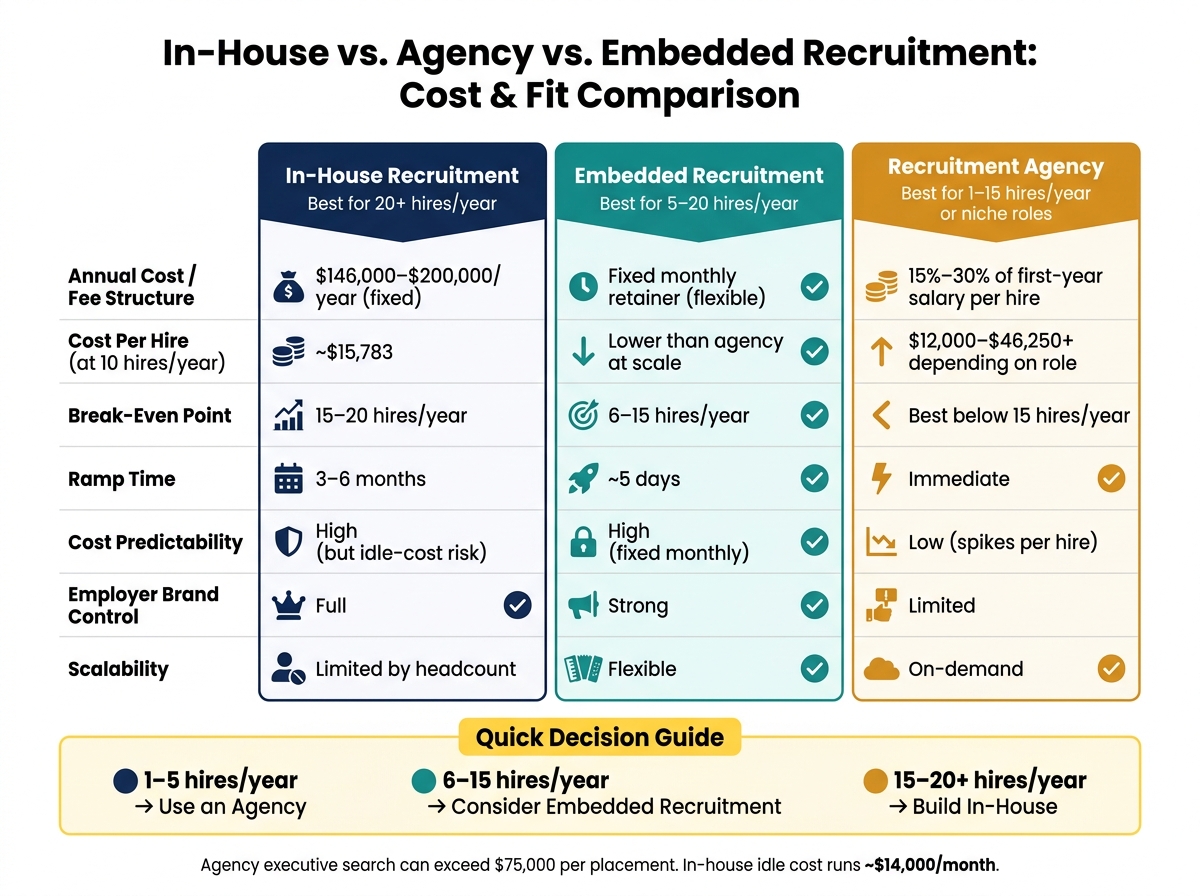
In-House vs. Agency vs. Embedded Recruitment: Cost & Fit Comparison
Quick Comparison
| Model | Cost shape | Best fit | Main trade-off |
|---|---|---|---|
| In-House Recruiter | Fixed annual cost | Steady hiring, usually 15 to 20+ hires a year | You carry idle cost if hiring slows |
| Traditional Agency | Fee per placement | Low-volume, niche, or one-off hiring | Cost stays high on every hire |
| Embedded Recruitment | Fixed monthly retainer | Growth phases, usually 5 to 20 hires | Monthly spend continues during the engagement |
For CEOs, CFOs, and HR leaders, the decision is simple in principle: match the hiring model to your hiring volume, salary bands, and need for control. That is what I cover in this article.
sbb-itb-a23bd6a
2. The Full Cost of Building an In-House Recruitment Function
Main cost categories for in-house recruitment
Recruiter salary is only one part of the in-house picture.
A recruiter at the national midpoint earns around $75,250 per year [5]. Add benefits and payroll taxes, usually 30% of base pay, and that cost moves to about $98,000.
Then come the other fixed costs. Recruiting tech, job board spend, and internal management time can push the annual total into the $146,000 to $200,000 range [2][5].
There’s also ramp time to deal with. New recruiters often need 3 to 6 months to become fully productive, and that period adds cost without full output [2][5]. In most cases, the hidden spend sits in three places: ramp time, tools, and management time.
So the issue isn’t whether in-house recruitment costs money. Of course it does. The real issue is how those fixed costs behave as your hiring volume goes up.
How cost per hire changes at 5, 10, and 20 hires per year
At lower hiring volume, fixed costs hit harder because they’re spread across fewer hires.
At 5 hires per year, cost per hire is roughly $31,565.
At 10 hires, it drops to about $15,783.
At 20 hires, it falls again to around $7,891 per hire [2][5].
That’s the part many teams miss. In-house recruitment starts to make more financial sense when hiring demand is steady enough to absorb the fixed cost.
Once you include ramp time and overhead, the break-even point is usually closer to 15 to 20 hires per year [2][5]. If hiring slows down or stops, those costs don’t stop with it. An underused recruiter still costs about $14,000 per month [2].
Table: Annual in-house cost by hiring volume
| Cost Category | Annual Cost (Est.) | Cost per Hire – 5 Hires | Cost per Hire – 10 Hires | Cost per Hire – 20 Hires |
|---|---|---|---|---|
| Base Salary (Mid-level) | $75,250 | $15,050 | $7,525 | $3,763 |
| Benefits & Payroll Taxes (30%) | $22,575 | $4,515 | $2,258 | $1,129 |
| Tools (ATS, LinkedIn, AI) | $25,000 | $5,000 | $2,500 | $1,250 |
| Job Board & Sourcing Spend | $20,000 | $4,000 | $2,000 | $1,000 |
| Management & Internal Time | $15,000 | $3,000 | $1,500 | $750 |
| Total Fully Loaded Cost | $157,825 | $31,565 | $15,783 | $7,891 |
At lower volumes, in-house cost per hire can often come in above agency fees. The next section looks at how agency costs change by salary band.
3. The Cost of Using Recruitment Agencies
How agency fees are typically charged
Agency fees are usually charged per hire. You do not pay a fixed monthly cost. You pay when a placement is made, and the fee is often tied to the salary of the person hired.
Most agencies also include a guarantee period, usually 30 to 90 days, where they will replace a candidate at no extra charge if the hire does not work out [1].
That model can feel low-risk at first. No monthly overhead. No recruiter sitting idle. But the trade-off is simple: every hire comes with a new fee.
When agency hiring is cheaper and when it gets expensive
For occasional or hard-to-predict hiring, agencies can make good commercial sense. If you hire in bursts, or only need support now and then, paying per placement may be the cheaper option. You avoid standing cost, ramp time, and the need to build internal recruiter capacity before you need it.
The picture changes once hiring becomes regular.
At that point, agency spend climbs in a straight line. Each placement triggers the full fee again. You do not get the same unit-cost drop that you get when in-house hiring cost is spread across more hires. Put bluntly, nothing stacks in your favour.
Agencies tend to be most useful when the role is hard to run through your normal process, such as:
- Confidential leadership searches
- Niche technical roles where internal sourcing reach is limited
- Expansion into new markets where your employer brand has little traction [2][4]
"Pay the agency fee only for the rare local leader you genuinely can’t find any other way. Build an in-house recruiter for your general hiring." – Matt Watson, CEO, Full Scale [4]
Table: Agency cost by role and salary band
These examples show how agency costs move up with salary band [2][4].
| Example Role | Typical U.S. Salary Band | Fee Structure | Est. Agency Cost per Hire |
|---|---|---|---|
| Entry-Level Ops / Trades | $50,000 to $70,000 | 15% to 20% | $7,500 to $14,000 |
| SDR / Junior Sales | $60,000 to $80,000 | 20% | $12,000 to $16,000 |
| Senior Software Engineer | $150,000 to $185,000 | 25% | $37,500 to $46,250 |
| Niche ML/AI Engineer | $180,000 to $250,000 | 25% to 30% | $45,000 to $62,500 |
| Executive / VP Level | $250,000+ | 30% | $75,000+ |
A senior executive search can easily cost $75,000 or more in placement fees alone [2]. Once you line that up against other hiring models, the cost gap becomes much easier to see.
4. Side-by-Side Cost Breakdown: In-House vs. Agencies vs. Embedded Recruitment
Direct costs, hidden costs, and break-even points
The true cost of hiring is not just salary or fees. It comes from overhead, ramp time, and how much control you keep as hiring demand shifts.
In-house recruitment comes with a fixed seat cost of roughly $14,000+ per month, plus a ramp period of 3 to 6 months [2][3]. If that recruiter leaves, replacement cost can land between 90% and 200% of annual salary [2][3].
Agency hiring removes fixed overhead, but the trade-off is a contingency fee of 20% to 25% of first-year salary on every hire [2][3]. That may feel simple at low volume, but costs stay high on each placement. You also give up some control over candidate experience and employer brand [2][3].
For in-house recruitment, the break-even point is usually closer to 15 to 20 hires per year. In many cases, it moves to 20+ hires once you add ramp time, tools, and internal management time [2][3].
Embedded recruitment sits between those two options. You get a recruiter working inside your team on a fixed monthly retainer, managing hiring end-to-end without adding permanent headcount. Companies using this model can cut hiring costs by up to 70% and save over 80 hours per month in internal hiring and admin time [6]. That makes it much easier to judge based on your hiring volume and how much control you want.
The table below shows how fixed cost, variable cost, and control play out in day-to-day hiring.
Table: In-house vs. agency vs. embedded recruitment
| Factor | In-House Recruitment | Recruitment Agency | Embedded Recruitment |
|---|---|---|---|
| Cost type | High fixed cost | Variable per-hire fee | Predictable monthly retainer |
| Pricing behavior | Per-hire cost falls as volume rises | Stays high per hire | Scales with hiring demand |
| Cost predictability | High, but with idle-cost risk | Lower, because costs spike with each search | High, with a fixed monthly structure |
| Management overhead | High, requires internal direction and coverage | Low, managed externally | Shared, embedded in your team |
| Scalability | Limited by headcount | On-demand | Flexible capacity |
| Employer brand control | Full ownership | Limited | Strong, integrated into your process |
| Reporting visibility | High | Limited to what the agency shares | High |
| Ramp time | 3 to 6 months [2] | Immediate | About 5 days [6] |
| Best-fit hiring volume | 20+ hires per year [2] | Fewer than 15 hires per year, or niche and one-off roles [2] | 5 to 20 hires per year, or rapid scaling phases [6] |
Where embedded recruitment fits for scaling companies
For growing SMEs, embedded recruitment gives you a recruiter who works as part of your team. That means more structure, clearer visibility, and a steadier hiring process, without adding permanent headcount.
Rent a Recruiter places experienced recruiters directly into client teams within days, managing hiring end-to-end. The model can cut costs by up to 70% and save over 80 hours per month in internal hiring and admin time [6].
5. Choosing the Right Model for Your Hiring Volume and Growth Stage
A decision framework for CEOs, CFOs, and HR leaders
This decision usually comes down to three things: how many roles you hire for each year, what those roles pay, and how steady your hiring demand is.
If you only hire now and then, around 1 to 5 roles a year, agency fees are often the simplest option. You only pay when someone is placed, so you are not carrying fixed cost in slower months. As a rule of thumb, start with hiring volume, then let role scarcity change the answer where needed.
Once you move into the 6 to 15 hires per year range, the numbers start to change. Embedded recruitment can often bring your cost per hire below agency spend, without locking you into a permanent salary cost. If hiring stays steady, in-house recruitment will often become the lower-cost option over time.
Use agencies for niche or confidential roles. Use in-house or embedded recruitment for repeat hiring. Agency search still makes sense for scarce roles where internal sourcing reach is limited [2].
Volume sets the base case. Role type sets the exception. The table below shows where each model tends to make sense.
| Annual Hiring Volume | Recommended Model | Why It Works |
|---|---|---|
| 1 to 5 hires | Agency | No fixed overhead; pay only on successful placements |
| 6 to 15 hires | Embedded | Lower cost per hire than agencies; no long-term salary commitment [6] |
| 15 to 20+ hires (steady) | In-House | Fixed salary costs fall below the cumulative fees of multiple agency placements [2] |
| Niche or executive roles | Specialized agency | High fees are justified by search difficulty and network access [2] |
Next steps: model your hiring costs before adding capacity
Before you commit, run the numbers. Take your fully loaded in-house cost and divide it by your projected annual hires. If that per-hire figure is well above a 20% to 25% agency fee on your average salary [2], the fixed seat may not make sense yet.
Then look at leadership time. If your leaders are still spending hours sourcing and screening, your recruitment capacity is too thin. That drag adds up fast. It slows product delivery, pulls focus from growth, and turns hiring into a management tax. Moving to a more structured model, either embedded recruitment or in-house, helps protect momentum and gives your team time back.
If your hiring plan still feels uncertain, a 3 to 6 month embedded pilot can be a smart way to test cost, speed, and visibility before adding headcount [6]. You get data first, then make the longer-term call with more confidence.
6. Conclusion: The Lowest-Cost Option Depends on Hiring Volume and Control Needs
Final takeaway for scaling U.S. SMEs
The lowest-cost model comes down to hiring volume, salary level, and how much control you want over the process. That decision shapes the spend model too. You either pay for fixed capacity, or you pay variable placement fees.
For occasional hiring or hard-to-fill specialist roles, traditional recruitment agencies can still be the cheapest route. But once hiring volume climbs, 20% to 25% on every placement gets expensive fast. The math becomes hard to ignore. At 15 hires with a $100,000 average salary, agency fees land at about $300,000 to $375,000, which is well above the fully loaded annual cost of an in-house recruiter at $146,000 to $200,000 [2].
In-house recruitment usually brings the cost per hire down over time. But you take on fixed overhead, and there is still a 3 to 6 month ramp period before a new recruiter is fully productive [2]. If you need hires this quarter, that delay can hit growth plans.
That is where embedded recruitment sits in the middle. You get much of the process control and team alignment of in-house hiring, but without adding permanent headcount. You can scale support up or down as demand shifts, which matters when hiring plans are moving month to month.
A simple way to think about it:
- If projected agency spend is higher than the cost of a recruiter seat, in-house often wins on cost
- If hiring demand is uneven, embedded recruitment can give you more control without locking you into fixed internal capacity
- If hiring is occasional and niche, agencies and executive search may still make financial sense
The key move is to model annual hiring volume first. Once you do that, it gets much easier to choose the setup that keeps cost, speed, and control in line.
FAQs
How do I calculate break-even hiring volume?
Compare your fully loaded in-house recruiter cost with the agency cost per displaced hire.
To work out your true cost per hire, use this formula:
(Total internal recruiting costs + total external recruiting costs) ÷ total number of hires
Then estimate your break-even hire volume with:
fully loaded annual in-house cost ÷ average agency fee per hire
Once you factor in ramp time and overhead, break-even usually lands at 15 to 20 hires per year.
That’s the point where building internal recruiter capacity often starts to make more financial sense than leaning on traditional recruitment agencies for each hire. For CFOs and hiring leaders, this is where the maths gets useful. You’re not just comparing salaries, you’re comparing cost per hire, team capacity, and spend control.
What hidden recruiting costs are easiest to overlook?
The easiest costs to miss are often the ones that never show up on an invoice or payroll report.
Think about the gap created by an unfilled role. Lost output, delayed projects, and missed revenue can hit harder than the hiring line item itself. Then there’s the time your hiring managers and interview panels spend screening, interviewing, and giving feedback. That time has a cost, even if it sits outside the recruitment budget.
Other hidden costs stack up fast too. Recruiter ramp-up time can slow early hiring output. Applicant tracking systems and recruiting tools add software spend. Employer brand work often sits inside the marketing budget, so it gets missed in hiring cost reviews. And when a poor-fit hire doesn’t work out, the cost of turnover can be steep.
For growing businesses, these costs build quietly, then all at once. If you’re only counting agency fees or salaries, you’re probably understating the full cost of hiring.
When does embedded recruitment make more sense than hiring in-house?
Embedded recruitment makes the most sense when hiring demand moves up and down, especially during rapid growth, post-funding scale-up, or a new product launch.
In those moments, you need more hiring capacity without taking on permanent headcount too early. That’s where embedded recruitment stands out. You keep more control over process, pace, and hiring standards than you typically get with external agencies, while still adding the support your team needs.
For SMEs, this can be a smart fit when you’re hiring for specialised roles, want a more consistent candidate experience, and need to cut wasted time across the business.
The commercial upside is hard to ignore:
- Reduce hiring costs by up to 70%
- Save more than 80 hours of admin time per month
- Add hiring support without increasing fixed internal headcount
That means less pressure on your leadership team, less time lost to back-and-forth admin, and a hiring process that stays under your control while the business scales.