If you wait until a role opens to start hiring, you lose time, money, and team output.
I’d sum this up simply: a talent pool gives you a small group of pre-checked people you can go to when hiring demand hits. That can cut time-to-fill from 3 to 6 weeks to 1 to 3 weeks and lower cost-per-hire by up to 40%. For scaling firms using talent acquisition services in SaaS, IT, fintech, engineering, security, insurance, and professional services, that means less delay, lower spend, and less pressure on managers.
Here’s the core idea:
- A talent pool is not a pile of CVs
- It is not the same as a live hiring pipeline
- It works best when tied to headcount plans
- It needs one owner, clear tags, and a set review cycle
- It only pays off if you keep candidate contact warm
If you want hiring to be less reactive and more controlled, this guide shows how to build a pool that helps you hire faster, spend less, and avoid starting from zero each time.
The Talent Pool in a Nutshell | AIHR Learning Bite
sbb-itb-a23bd6a
Understanding Talent Pools and Their Value to High-Growth SMEs
Before you build the strategy, it helps to get clear on one thing: a talent pool is not the same as a pipeline or a broad candidate network.
A talent pool is a curated group of pre-identified, pre-vetted candidates who could be a strong fit for future, often unspecified openings, and a repeatable hiring asset for growth-stage SMEs [1][2]. It is not a static CV list. It is a live hiring asset built before the need exists, so when a role opens, you are speaking to warm contacts instead of starting from scratch.
Talent Pools vs. Talent Pipelines vs. Talent Communities
| Dimension | Talent Pool | Talent Pipeline | Talent Community |
|---|---|---|---|
| Focus | Future, unspecified roles | An active, specific open role | Broader network of engaged people who may fit future roles |
| Timing | Proactive, built before a need exists | Reactive but targeted, activated when a role opens | Fully reactive |
| Interaction | Quarterly touchpoints | Active screening and interviews | CV review and filtering |
| Size (SME) | 20 to 50 people [1] | 3 to 8 candidates per role [1] | 10 to 200+ applicants [1] |
| Analogy | A stocked pantry | A funnel narrowing to one hire | A stack of CVs |
That difference matters because each model needs its own sourcing rhythm and engagement pattern.
For most growth-stage SMEs, the talent pool is the best place to start. It is small enough to manage, focused enough to use, and warm enough to help you move fast when hiring plans shift.
Where Talent Pools Deliver Commercial Value for SMEs
Only 25% of the workforce is actively looking for a job at any given time, but 85% are willing to have a conversation about a new opportunity [4]. That changes the hiring game.
Instead of waiting for applications, you are building relationships before a role opens. For SMEs, that matters. You often cannot afford long hiring cycles, missed revenue targets, or teams stuck waiting for headcount.
With pre-vetted candidates already in view, time to first qualified candidate can drop from 7 to 14 days to 1 to 3 days, and cost-per-hire can fall by up to 40% [1][3]. If you are paying high agency fees of 15% to 25% of first-year salary [1], that can mean a serious cost saving. (You can estimate your potential savings using an embedded recruitment ROI calculator).
Think of it like this: a talent pool does not just save recruiting time. It cuts the delay between approval and action.
Common Failure Modes and How to Avoid Them
Most talent pools do not fail because sourcing was poor. They fail because someone built them once, then left them alone.
When that happens, data goes stale, context gets lost, and candidate relationships cool off. What looked like a hiring asset turns into an old database that nobody trusts.
| Feature | Healthy Talent Pool | Unused Candidate Database |
|---|---|---|
| Data quality | Tagged by skill, seniority, and readiness; kept current | Unfiltered, stale, and potentially out of date |
| Engagement | Quarterly personal touchpoints | Zero contact until a role opens |
| Ownership | Clear owner with a set review cadence | No assigned owner; no process |
| Hiring outcome | 1 to 3 weeks time-to-fill; strong acceptance rates [1] | 3 to 6 weeks time-to-fill; high candidate drop-off [1][2] |
The fix is simple, but it needs discipline.
- Assign one clear owner
- Set a quarterly review cadence
- Send short, personal check-ins each quarter
That keeps the pool warm, current, and usable when hiring risk shows up fast.
Once the model is clear, the next step is to line the pool up with headcount plans, business-critical roles, and areas where hiring delays would cost you the most.
How to Design a Talent Pool Strategy That Matches Business Growth
Build the strategy before sourcing starts. Begin with the business plan, not a list of names.
Your talent pool should reflect the next 12 months of hiring demand, linked to business milestones and growth targets. If the company plans to enter a new market, launch a product, or scale delivery, your pool should mirror that. Otherwise, you end up sourcing for roles that are not urgent, while the hires that affect revenue or output sit exposed.
Start With Headcount Plans, Critical Roles, and Hiring Risk
Map the roles you expect to hire over the next year. Then rank them by business impact and hiring risk.
Focus first on seats tied to revenue, delivery, or team output. The average time-to-fill across industries is roughly 45 days [5], but that number can hide the real cost. When a key role stays open, projects slip, sales slow, and managers spend more time covering gaps than moving the business forward.
That is why you build those pools first.
From there, break the pool up based on two things:
- which roles matter most to the business
- how soon those roles are likely to open
This gives you a pool built for hiring demand, not guesswork.
Segment Pools by Function, Seniority, Location, and Readiness
Once priorities are set, segment the pool so outreach fits where each person is in their decision cycle.
Tag each candidate by job family, seniority, and location or work setup. That makes outreach more targeted and cuts wasted time when a role opens.
The most useful tag is readiness. Group candidates as "actively looking", "open to a conversation", or "not ready for 6+ months" [1]. That gives you a simple rule for action: who needs follow-up now, and who should stay in nurture mode.
Seniority matters here too. Senior hires often take far longer to convert. In many cases, these roles need 6 months to 2+ years of relationship-building before someone is ready to move [5]. If you wait until the vacancy opens, you are already behind.
Set Ownership, Systems, and Metrics From Day One
A talent pool only works if someone owns it.
Assign one person to stay accountable, whether that is a founder, hiring manager, or recruiter. That person should keep the pool current, run outreach, and review quality on a set rhythm. Without clear ownership, pools go stale fast.
Set your data fields early as well, so moving into an ATS or CRM later does not turn into a cleanup job when hiring volume increases. A tidy system at the start saves time and protects reporting later, especially if you rate your recruitment process to identify gaps early.
Track the numbers that show whether the pool is doing its job:
- conversion rate
- time-to-fill
- pool freshness
- response rate
Useful benchmarks include a 25% to 40% pool conversion rate, 40% to 60% faster time-to-fill, 70%+ of candidates contacted within the last 90 days, and a response rate above 20% [1][3].
Those metrics matter because they connect the pool back to business impact. If your pool is fresh and converting well, you cut hiring delays, save team time, and reduce the cost of reactive recruitment.
How to Build and Nurture High-Quality Talent Pools
Once you’ve set your pool priorities, the next step is simple: fill each pool with vetted people you can re-engage fast. The sequence is practical. Source from the right places, qualify in the same way every time, then keep the relationship warm.
Build Pools From the Right Sources and Qualification Standards
The best talent pools usually start with people you already know can do the job.
Silver medalists, final-round candidates you didn’t hire, are one of the best places to begin. They’ve already been pre-vetted and they already know your company [1][4]. Research suggests they can make up about 40% of a successful small business talent pool [1]. That matters because it cuts repeat work. If you add them to the pool, include past interview scores and feedback notes so your team doesn’t waste time re-screening someone you’ve already assessed.
You can also strengthen the pool with:
- Employee referrals
- Internal talent ready for upskilling or promotion
- Former employees who may return
- Niche communities like Slack groups, Discord servers, and Reddit forums for hard-to-fill technical roles
The source matters, but the standard matters more. Use the same qualification criteria before anyone enters the pool. Early knockout questions or short assessments help filter out weak-fit profiles before they clog the system.
Then tag each profile in a way your team can use later. Keep it simple and searchable:
- Role family
- Key skills
- Location or work setup
- Readiness level, from actively looking to open in 6+ months
If a candidate scored well in a past process, note that too. That structure is what turns a list of names into something your hiring team can actually use when a role lands with urgency.
Use Targeted Engagement Instead of Generic Outreach
Once the right people are in the pool, the goal is to stay in touch without creating noise.
A talent pool only works if you maintain contact, ideally every quarter. That doesn’t mean sending bland check-in emails nobody wants to read. It means sharing something that fits: an industry article, a company milestone, a behind-the-scenes update, or a Hiring Manager AMA. Small touchpoints like that show the relationship is about more than filling a seat.
The commercial upside is clear. When you keep people warm, you cut time-to-hire as you adapt your hiring as you scale and headcount opens up.
Segmentation also matters. A senior engineering leader shouldn’t get the same message as an early-career sales candidate. Tailor outreach by role family, seniority, location, and readiness level. Personalized messages can lift response rates by 30% [3]. On top of that, candidates now expect salary transparency and flexible work details even in early-stage conversations [2]. If you leave that out, you risk slow replies or no replies at all.
Balance Automation With Personal Follow-Up
Automation helps with timing and consistency. It should not do all the relationship work.
Use it for the moments that need structure: a branded welcome message when someone joins the pool, a prompt when a candidate hasn’t been contacted for a few months, or a role alert when a match opens up.
That saves recruiter time and keeps the pool from going stale.
But your best-fit profiles, especially senior hires and hard-to-find specialists, usually need more than a sequence. They need a real human touch. A short phone call or a personal note from a recruiter who knows the role will carry more weight than a templated email.
Automation plus personal follow-up turns contacts into hires.
That’s what makes pool maintenance faster, cleaner, and more useful when hiring demand picks up.
How to Build a Talent Pool Maintenance Plan That Lasts
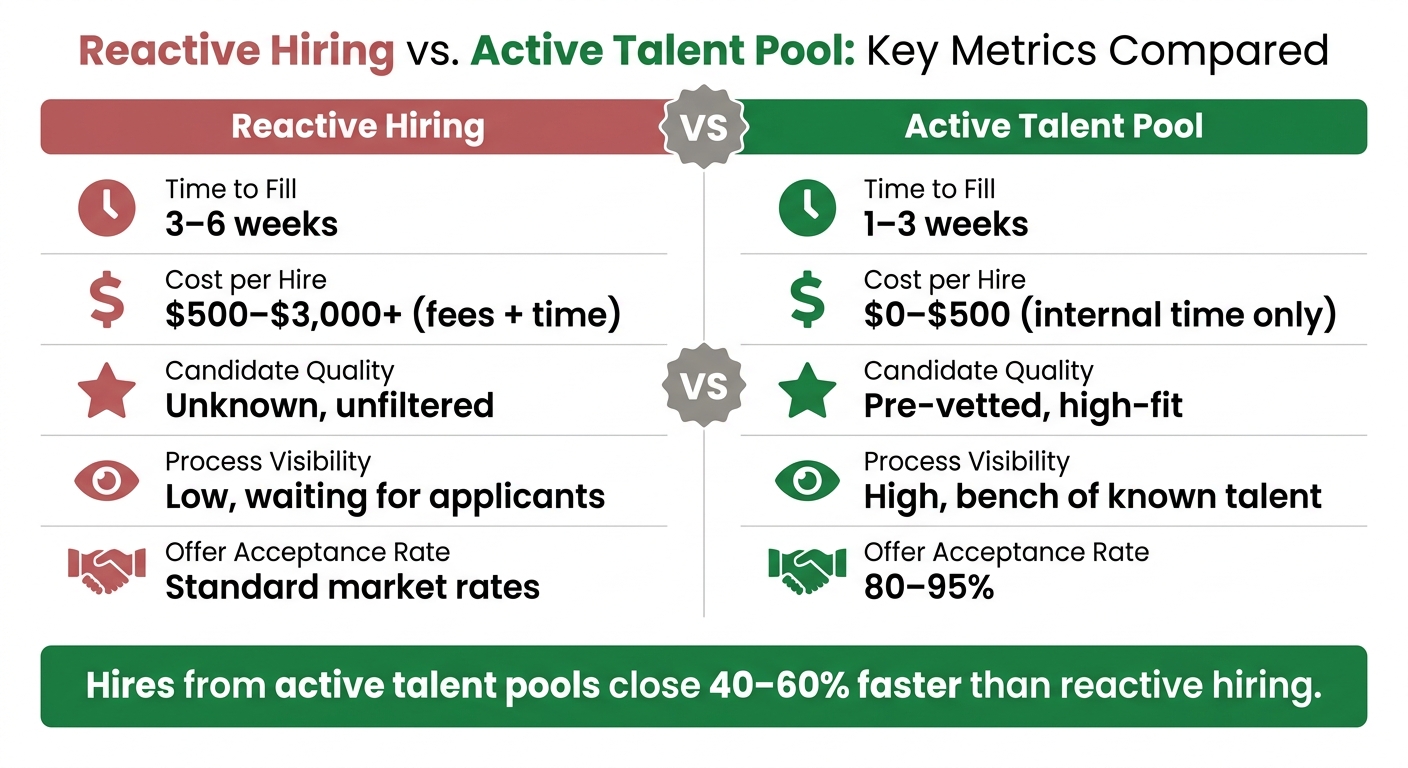
Reactive Hiring vs. Active Talent Pool: Key Metrics Compared
Once your pool is built and nurtured, maintenance is what keeps it usable. Without it, data slips out of date, candidate interest fades, and your team ends up sourcing from scratch when a role opens.
Define Pool Health and Review It on a Set Schedule
A healthy pool is not just a big one. It has enough qualified people for your priority roles, recent engagement, clean status data, and solid spread across seniority levels and locations. As a rule, more than 70% of contacts should have been touched in the last 90 days [1]. If that drops, the pool is losing value.
Keep the review cycle simple and consistent.
| Frequency | Task | Objective |
|---|---|---|
| Weekly | Intake Review | Add silver medalists and referrals from recent interviews |
| Monthly | Data Refresh | Update status changes, new roles, and availability |
| Quarterly | Nurture & Cleanup | Confirm readiness, role fit, and contact details; archive profiles after three unanswered touches |
| Every 6-12 Months | Strategy Alignment | Review headcount plans with leadership and adjust pool focus |
This kind of cadence helps you avoid a common problem: a pool that looks strong on paper but cannot support live hiring when you need it.
Refresh Data, Remove Stale Profiles, and Realign to New Hiring Needs
On a quarterly basis, check salary expectations, readiness, role fit, and location. If someone’s path no longer lines up with where the business is going, archive the profile.
That may sound basic, but it matters. A lean pool beats a bloated one every time. A long list of old contacts does not help you hire faster. A smaller group of current, well-matched people does.
This becomes even more important when the business changes direction. If you hit a funding milestone, shift product focus, or restructure a team, review the pool before paying for new sourcing. You may already have silver medalists who fit the new brief [1] [6].
That can save both time and budget, especially for scaling teams where each delayed hire affects output.
Measure Results and Use Maintenance as a Hiring Advantage
Measure maintenance by hiring outcomes, not admin activity.
Focus on metrics that show whether the pool is making hiring easier:
- Pool conversion rate
- Time to shortlist
- Time-to-fill for roles with active pools versus roles without them
- Offer acceptance rate
- Recruiter hours saved per quarter
| Metric | Reactive Hiring | Active Talent Pool |
|---|---|---|
| Time to Fill | 3–6 weeks | 1–3 weeks |
| Cost per Hire | $500–$3,000+ (fees + time) | $0–$500 (internal time only) |
| Candidate Quality | Unknown, unfiltered | Pre-vetted, high-fit |
| Process Visibility | Low, waiting for applicants | High, bench of known talent |
| Offer Acceptance Rate | Standard market rates | 80–95% |
The business case is pretty clear. Hires from active talent pools tend to close 40–60% faster than reactive hiring [1]. For a growth-stage SME, where every open role slows delivery, sales, or team capacity, that gap adds up fast.
With the right maintenance rhythm, the pool stops being a static database and starts working like a hiring asset your team can rely on.
Conclusion: Turn Talent Pools Into a Repeatable Growth Asset
Once you maintain it properly, your talent pool stops being a spreadsheet that goes stale and starts becoming a ready-to-use hiring asset.
Tie it directly to headcount plans. Focus on quality, not volume. Keep people engaged with steady outreach. Review the pool on a clear schedule. Do that well, and you build a pool you can activate when hiring demand spikes.
The commercial case is hard to ignore. Active talent pools can cut cost-per-hire by up to 40% and fill roles 40% to 60% faster than reactive hiring [1][3].
But results do not come from having a plan on paper. They come from doing the work consistently. 70% of recruiters report that building a talent pool reduces time-to-hire, yet only 35% have a systematic approach to managing them [3]. That gap comes down to execution.
Quarterly reviews. Clean data. Targeted outreach. Those are the habits that turn talent pools into something your business can rely on, not just another hiring idea that sounds good in theory.
If you need help putting that structure in place, Rent a Recruiter embeds experienced recruiters directly into your team within days. That helps scaling SMEs reduce hiring costs by up to 70% and save over 80 hours a month in internal hiring and admin time. For growing teams, that means faster hires, lower cost, and less drag on growth.
FAQs
How big should a talent pool be?
The ideal size depends on your organisation and the pace of hiring.
For smaller businesses, a practical range is usually 20 to 50 candidates. That is often enough to cover a mix of role types without turning the pool into something bloated or hard to manage. It also gives your team room to build personal relationships and keep engagement steady.
Larger or more specialised talent pools can grow to 200 or more. That can make sense if you hire across several functions or need niche skill sets on a regular basis.
But size on its own is not the goal. Quality matters more than volume. Once a pool grows past 500 candidates, it often becomes tougher to manage well, and engagement usually starts to fall. At that point, you may have a big database, but not a pool that helps you hire faster or better.
Which roles should we pool first?
Start with the roles that keep the business running and are hard to fill fast. Focus first on jobs where vacancy risk hits day-to-day output, especially roles with high turnover. For many companies, that means customer service, warehouse leads, and other core operational hires.
Why start there? Because these roles carry the biggest short-term cost when they sit open. Service levels slip. Team pressure builds. Managers lose time covering gaps instead of doing their actual job.
Once that base is in place, expand into more strategic or specialist hiring. That can include technical specialists, management roles, or positions that need niche expertise. This gives you a stronger bench and helps you move faster when new openings come up.
When should we start building one?
Start building a talent pool before you need to fill a role. If you wait until a vacancy becomes urgent, you’ve already lost time.
Talent pooling works best as an always-on activity, not a last-minute scramble. When you start early, you give your team time to build relationships with people who may be a fit later.
That puts you in a much better position when a role opens. You already have a warm, qualified pool to work from, which can cut time-to-hire and reduce the cost of reactive recruitment.