
Recruitment funnel conversion rates are the key to making hiring predictable and scalable. They show exactly where candidates drop off in your hiring process, helping you fix inefficiencies and improve outcomes. Without these metrics, you’re left guessing why roles stay unfilled or why costs spiral.
Why it matters:
- Tracking conversion rates can double your hiring throughput with a 10% improvement at each stage.
- CFOs increasingly demand funnel efficiency data before approving headcount budgets.
- Companies with strong funnel tracking report 30–60% faster time-to-hire and up to 19% lower cost-per-hire.
How to get started:
- Define your funnel stages clearly (e.g., Sourced → Applied → Screened → Interview → Offer → Hired).
- Use your ATS to track key metrics like apply rates, screen-to-interview rates, and offer acceptance rates.
- Segment data by source, role type, or recruiter to uncover patterns and bottlenecks.
- Act on insights to fix weak points (e.g., slow responses, poor job ads, or uncompetitive offers).
The bottom line: Recruitment funnels aren’t just data exercises. They’re tools to hire faster, reduce costs, and meet growth goals. If your team lacks the bandwidth to manage this, Rent a Recruiter can embed experienced recruiters into your team to build, track, and optimize your funnel from day one.
Recruitment Funnel KPI Dashboard in Google Sheets
This dashboard helps you visualize essential recruitment metrics to improve your overall hiring outcomes.
sbb-itb-a23bd6a
How to Define and Set Up Your Recruitment Funnel
Once you’ve grasped the value of tracking conversion rates, the next step is to design and implement your recruitment funnel for accurate measurement and analysis.
How to Define Funnel Stages for Your Organization
Start by clearly outlining each stage of your recruitment process. This ensures consistent tracking and avoids confusion. For instance, if one recruiter labels a candidate as "screened" after reviewing their resume, while another waits until a phone screen is completed, your data will lack consistency. A typical funnel for U.S.-based SMEs might include: Sourced → Applied → Screened → Hiring Manager Review → Interview → Offer → Hired. Use straightforward, action-oriented labels like "Screened for Qualifications" to keep things uniform across the board[2][7].
Once your stages are defined, align your team to ensure everyone follows the same process. This alignment is critical for maintaining data accuracy and making informed decisions. After that, configure your applicant tracking system (ATS) to reflect these stages precisely.
How to Configure Your ATS for Funnel Tracking
Your ATS should be set up to collect high-quality, consistent data. It needs to log key information every time a candidate moves to a new stage. This includes details like candidate ID, requisition ID, timestamps, the previous and updated stages, and the person initiating the change[8].
To enhance tracking, add two essential features:
- Mandatory disposition codes: These capture why candidates exit the process, using reasons like "compensation mismatch" or "failed skills assessment." This data helps identify where drop-offs occur and why[3][1].
- Stage-aging alerts: These alerts flag candidates who remain in a stage longer than your service-level agreement (SLA). For example, if hiring manager feedback is expected within 48 hours but no update is logged by day three, the ATS sends an alert for follow-up[8][2].
These configurations ensure that your system not only tracks progress but also prompts action when needed, keeping the process efficient and on track.
How to Segment Funnel Data for Deeper Insights
Looking at overall conversion metrics often hides the real story. Segmenting your data by factors like source channel, department, role type, or recruiter can reveal critical insights. For example, technical roles tend to have lower conversion rates – typically between 7–9% – compared to other positions[6]. Identifying these patterns allows you to adjust expectations and refine your approach.
Source segmentation is equally revealing. Referrals and proactive sourcing often convert 4–8 times better than inbound applications from job boards[6]. This insight can guide smarter sourcing strategies and budget allocation.
"The single most impactful thing you can do to improve recruitment performance is to measure, diagnose, and optimize every stage of your hiring funnel." – Celina, MokaHR[2]
Examining recruiter-level data is another powerful tool. Studies show a performance gap of 40–60% between top and bottom quartile recruiters[2]. Rather than penalizing lower performers, use this information to identify opportunities for coaching and process improvements. This approach not only boosts individual performance but strengthens your recruitment function as a whole.
How to Calculate Conversion Rates at Each Funnel Stage
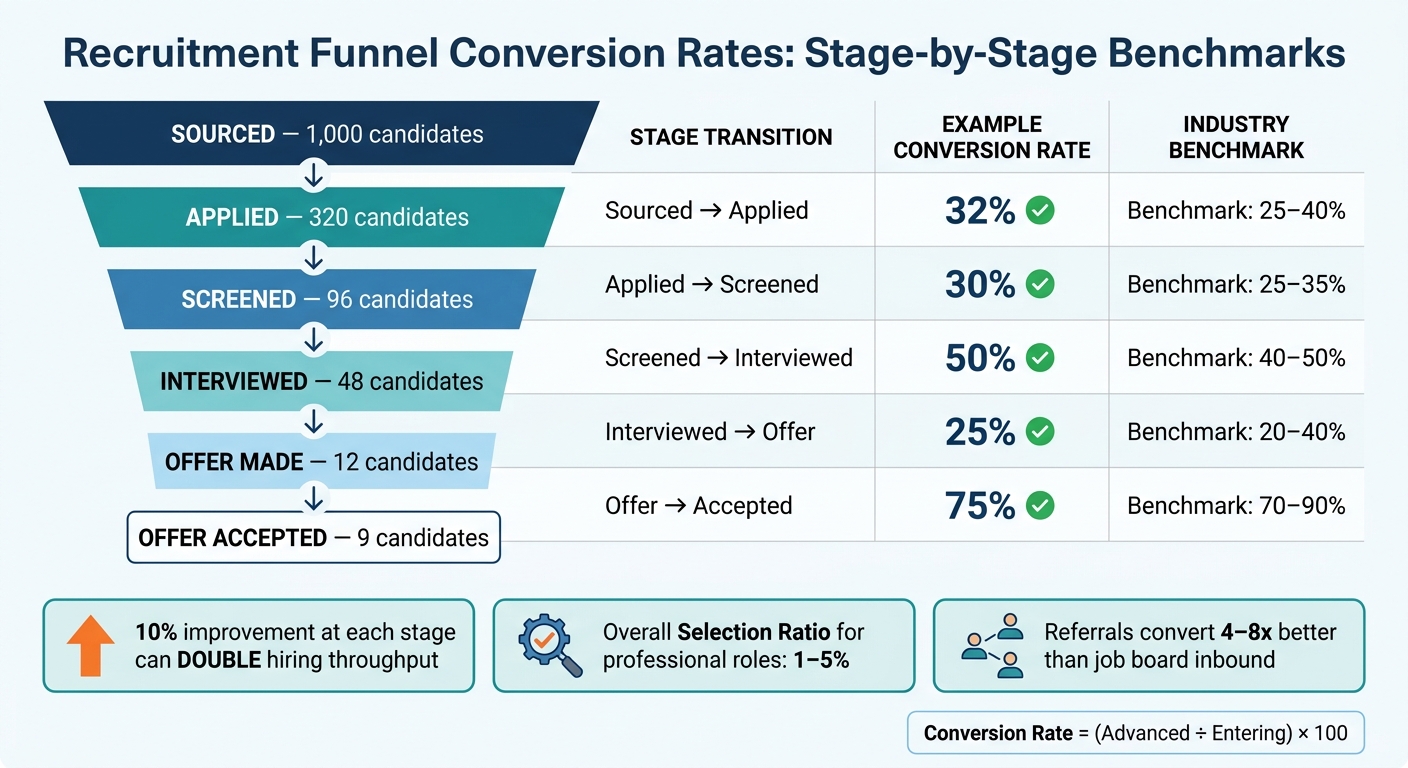
Recruitment Funnel Conversion Rates: Stage-by-Stage Benchmarks
Once you’ve defined your funnel stages and set up your ATS, the calculations become straightforward. Applying these consistently at every stage will give you actionable insights.
The Conversion Rate Formula and Its Application
The formula is simple:
(Advanced candidates ÷ Entering candidates) × 100 = Conversion rate for that stage
For example, if 320 candidates applied and 96 were screened, the conversion rate is 30%. Use this formula at every stage of your funnel to uncover unique insights at each transition.
To gain deeper insight into your process, track two additional metrics:
- Overall Yield: (Offers ÷ Applicants) × 100. This shows how well your funnel turns candidate volume into offers.
- Selection Ratio: (Hires ÷ Applicants) × 100. This measures how selective your process is. For professional roles, this usually falls between 1% and 5% [1].
"Time-to-hire is an outcome metric. Funnel conversion rates are the diagnostic metrics that explain why time-to-hire is high or low." – MokaHR [2]
Stage-by-Stage Conversion Rate Calculations
Breaking down conversion rates at each stage helps you see where candidates progress or drop off. Here’s an example funnel with some real numbers:
| Funnel Stage Transition | Example Calculation | Conversion Rate | Industry Benchmark |
|---|---|---|---|
| Sourced to Applied | 1,000 Sourced → 320 Applied | 32% | 25–40% [2] |
| Applied to Screened | 320 Applied → 96 Screened | 30% | 25–35% [2] |
| Screened to Interview | 96 Screened → 48 Interviewed | 50% | 40–50% [7] |
| Interview to Offer | 48 Interviewed → 12 Offers | 25% | 20–40% [1] |
| Offer to Accepted | 12 Offers → 9 Accepted | 75% | 70–90% [1] |
These calculations give you a clear picture of your funnel’s performance and highlight areas that need attention. For instance, if your screen-to-interview rate is strong but your offer-to-accept rate is low, you may need to address issues like compensation or candidate experience.
Keeping Your Funnel Data Accurate
Accurate conversion rates rely on clean, consistent data. Here’s how to maintain data integrity:
- Track unique candidates: If someone applies to multiple roles, treat each application separately and assign one final outcome per requisition – accepted, declined, withdrawn, or rejected [1].
- Standardize rejection reasons: Keep vague categories like "other" below 10% [1]. This ensures you can identify why candidates leave at specific stages.
- Exclude "on hold" requisitions: These can artificially inflate metrics like time-in-stage and distort your conversion data [1].
- Use a consistent cohort window: For example, group candidates by the month a requisition was approved or an offer was made. This avoids including candidates still in progress, which can skew your data [1].
Clean, accurate data is the foundation for identifying bottlenecks and improving your recruitment process as you scale.
How to Read and Act on Conversion Rate Data
Turn your conversion rate data into meaningful actions by identifying where your hiring process slows down and addressing inefficiencies.
How to Spot Bottlenecks in Your Funnel
Bottlenecks are evident when a conversion rate drops well below your historical averages or industry standards. The stage where this occurs often points directly to the issue. For example:
- A weak Application → Screen rate usually signals problems with sourcing quality or overly strict rejections by recruiters.
- A low Screen → Interview rate could mean the role is being misrepresented or the wrong criteria are being used to filter candidates.
- A low Offer → Accept rate often points to challenges like uncompetitive compensation, delays in decision-making, or a poor candidate experience [5].
Here’s a practical way to diagnose the issue: if your Application → Screen rate seems off, randomly re-screen 20 recent rejections. If a significant number of those candidates were actually qualified, the problem lies in calibration rather than sourcing [5]. Also, keep an eye on time-in-stage metrics. Candidates stuck in one stage for over five business days are at risk of dropping out. In fact, 42% of candidates withdraw from processes when interview scheduling takes too long [6].
"The product of these five [conversion rates] is your overall funnel efficiency. The individual rates tell you where the leak is." – ClarityHire [5]
Once you’ve pinpointed bottlenecks, move on to analysing broader data trends for deeper insights.
How to Analyze Patterns and Trends in Your Data
Looking at aggregate conversion rates can be misleading. A strong overall funnel average might hide underperformance in specific areas like a department, source channel, or role type. To uncover these hidden issues, break your data into segments and monitor trends over time. This helps you see whether improvements in one stage are positively affecting the entire funnel.
Pay attention to deviations from historical norms in your segmented data. For example, if your offer acceptance rate drops from 85% to 50%, it’s a clear sign that immediate action is needed [5]. As Ayush Bansal, CEO & Co-Founder of HireZapp, explains: "Data provides incredible clarity, but it is not a magic wand. Tracking your funnel is crucial, but remember that it cannot solve foundational business issues." [4]
Trends over time are just as important as the numbers themselves. They reveal whether isolated problems are becoming systemic.
How to Prioritize Which Stages to Fix First
Once you’ve identified bottlenecks and trends, focus on the stages with the biggest gaps compared to benchmarks. Start by ranking each stage by the size of the gap, and then target the top two for improvement [2].
One of the most costly stages to ignore is Onsite → Offer. By the time a candidate reaches an onsite interview, your team has already invested 4+ hours of time per candidate. A low conversion rate here means that effort is being wasted at scale [5]. On the other hand, even small gains at the top of the funnel, such as increasing your Sourced → Applied rate, can have a compounding effect as more qualified candidates move through each stage [2].
Prioritize where the volume loss is most significant and where delays in hiring will have the greatest business impact. Focusing here will deliver the quickest and most noticeable results.
How to Build a Continuous Funnel Improvement Process
Once you’ve pinpointed leaks in your recruitment funnel, the next step is making regular tracking a habit. This ongoing feedback loop ensures your funnel stays efficient and avoids future setbacks.
How to Set Review Schedules and Conversion Targets
Regular reviews turn raw data into actionable steps.
Here’s an example of a three-tier review schedule:
| Review Frequency | Primary Audience | Focus Area |
|---|---|---|
| Weekly | Recruiters & TA Leads | Immediate bottlenecks, stage-aging alerts, and active role health [2][4] |
| Monthly | TA Managers & Dept. Heads | Trend analysis by role family, channel ROI, and 30-day conversion health [1][7] |
| Quarterly | TA Leadership, HMs, & CFOs | Strategic target setting, root-cause analysis, and budget/headcount alignment [2] |
Weekly reviews are for tackling immediate issues like delays flagged by stage-aging alerts. Monthly reviews help uncover trends and evaluate performance across channels. Quarterly sessions, on the other hand, focus on long-term goals, identifying root causes, and aligning recruitment metrics with business objectives.
It’s worth noting that 68% of CFOs now request funnel efficiency and cost-per-hire data before approving additional headcount [2]. This makes consistent and accurate data at the quarterly level a must-have for many teams.
When setting conversion targets, rely on at least 90 days of historical data – ideally, 12 months to account for seasonal fluctuations [2]. Assign clear ownership for each stage of the funnel to ensure accountability if metrics fall short.
How to Test and Refine Your Funnel for Better Results
"The best TA teams treat this like a product team’s sprint review: hypothesis → experiment → measure → iterate." – MokaHR [2]
Break down and test each stage of your funnel individually. For instance, if your Sourced → Applied rate is low, start with a hypothesis like "Our job description is too complex." Simplify the description and track how it impacts conversions over 30 days.
Some high-impact areas to test include:
- Job description clarity and length
- Salary transparency
- Number of application steps
- Tone of outreach messaging
For example, research shows that cutting application steps from six to two can boost completion rates by up to 300% [3], while applications taking over 15 minutes to complete see a 365% higher abandonment rate [2]. These adjustments aren’t just cosmetic; they directly influence how many qualified candidates make it into your funnel.
To dig deeper, combine ATS data with brief exit surveys (3–5 questions) for candidates who drop out after the initial screen. Your ATS will pinpoint where drop-offs happen, while surveys reveal why.
For teams that lack the bandwidth to consistently refine their funnel, embedded recruitment service can ensure ongoing improvements.
How Embedded Recruitment Support Can Strengthen Your Funnel
When hiring teams are stretched thin or undergoing changes, maintaining a consistent funnel improvement process becomes difficult. Without standardised processes, funnel data often becomes unreliable – recruiters track stages differently, SLAs are inconsistent, and accountability for metrics is unclear.
This is where embedded recruitment support makes a difference. Rent a Recruiter places experienced recruiters directly into your team, ensuring standardised workflows, clear accountability at every stage, and reliable tracking from day one. For scaling companies in SaaS, fintech, and technology, this approach can cut reporting time by up to 67% [2] and save over 80 hours per month in internal hiring admin.
Conclusion: Using Funnel Metrics to Scale Your Hiring
Tracking recruitment funnel conversion rates is more than just crunching numbers – it’s about turning hiring into a predictable, data-backed process. When you pinpoint where candidates drop off, you can fix specific issues instead of relying on guesswork by identifying hidden recruitment bottlenecks.
Small changes can make a big difference. As Adithyan RK, Author at Hyring, explains:
"A 10% improvement in conversion rate at each funnel stage can effectively double your end-to-end hiring throughput without adding a single recruiter to your team." [3]
This efficiency is crucial when budgets and timelines are tightly linked to headcount goals. Companies with well-structured, data-driven hiring funnels report 30–60% faster time-to-hire [2] and cut cost-per-hire by as much as 19% [9]. These results help businesses grow without driving up overhead.
The formula is simple: clearly define your stages, track conversions consistently, review data regularly, and act on the insights. Predictable hiring means growth you can plan for.
If your team lacks the time or resources to build this structure, Rent a Recruiter can help. By embedding experienced recruiters into your team, we bring the processes, transparency, and accountability needed to run a high-performing recruitment funnel from day one. The result? Faster hiring, lower costs, and a recruitment function that scales with your business in SaaS, fintech, and technology.
FAQs
How do I choose funnel stages that everyone will use consistently?
To keep your recruitment funnel stages consistent, it’s essential to standardize definitions across your company. Create clear, actionable criteria for advancing candidates through each stage. For example, replace ambiguous labels like In Review with specific milestones such as Skills Screening Completed or Assessment Finalized.
Ensure your Applicant Tracking System reflects these definitions accurately. Involve both recruiters and hiring managers in defining and refining these criteria, and conduct regular audits to confirm everyone is on the same page. By maintaining a single, reliable source for these definitions, you’ll streamline your process and improve overall alignment.
What’s the best cohort window to use so conversion rates aren’t skewed?
To ensure conversion rates remain precise and avoid issues like right-censoring, stick to a consistent cohort window. You can base this on either the requisition approval month or the offer month, depending on your tracking preferences.
When reporting, focus on median and P75 values rather than averages. This approach minimizes the impact of outliers that could distort your data. For a solid starting point, use a quarterly window as your baseline. To capture broader trends and seasonal fluctuations in hiring, extend your analysis to cover 12 months of data.
How do I tell if a conversion drop is a sourcing issue or a screening issue?
To figure out if a drop in conversions at the application-to-screen stage is due to sourcing or screening, start by comparing your current rates against historical data. If you notice few qualified applicants, it’s likely a sourcing issue. On the other hand, if you see high application numbers but few candidates moving forward, the problem is probably in your screening process.
One way to confirm is by re-screening rejected applications to check for missed opportunities. If you’re still unsure, Rent a Recruiter can step in to audit and fine-tune your hiring process.