
Hiring passive candidates is about more than just filling roles – it’s about finding top talent that isn’t actively job hunting. Around 70% of the global workforce falls into this category, meaning if you’re only targeting active job seekers, you’re missing out. But reaching passive candidates requires a different approach. Here’s what works:
- Build a strong employer brand: Share content like blogs or industry insights to make your company recognizable. This reduces hiring costs by up to 50% and speeds up time-to-fill by 30%.
- Use direct outreach and referrals: Personalize messages and re-engage past candidates. Referrals cut hiring costs by 40–60% and fill roles 55% faster.
- Leverage embedded recruitment: An embedded recruiter integrates into your team to manage hiring. This approach reduces costs by up to 70% and saves over 80 hours per month in admin work.
The takeaway? Combining these methods creates a system that delivers results: lower costs, faster hires, and better candidate experiences. For scaling companies, this is how you compete for top talent without overspending.
The Secret to Recruiting Passive Candidates (Most Companies Miss This)
sbb-itb-a23bd6a
1. Employer Brand-Led Outreach
Employer brand-led outreach is all about making your company known and respected before sending any recruiting messages. Instead of cold-pitching strangers, you’re connecting with people who already recognize your name.
"Building relationships with passive candidates positions your company as their first choice when they decide to move, eliminating the need for job postings [and] frantic recruiter efforts." – Suzan Cooper, Recruiting Tech Expert [3]
The focus here is on sharing meaningful content – like engineering blogs, leadership perspectives, or industry insights – rather than jumping straight into job offers. Over time, this approach builds trust, making passive candidates more likely to engage when you do reach out. Our embedded recruitment case studies show how this impacts costs, scalability, hiring speed, and candidate experience.
Cost Efficiency
Employer branding isn’t just about visibility; it’s a cost saver too. Companies with a strong employer brand can reduce their cost-per-hire by up to 50% [5]. Why? Candidates who already admire your brand require less effort to attract and convince. On top of that, employee referral programs – often boosted by a solid brand – can lower cost-per-hire by another 40%–60% while delivering hires 55% faster than other methods [1].
Scalability
The beauty of employer brand-led outreach is that its benefits grow over time. Every blog post, industry contribution, or referral builds a network of warm leads. By tagging near-final candidates in your ATS, you create a talent pool that can cut future hiring timelines by 50%–70% [1].
Time to Hire
Proactive engagement with passive candidates has another major advantage: it slashes time-to-fill by 30% annually [3]. While inbound efforts from branding compound gradually, outbound sourcing under a strong brand can fill roles in just 29 days compared to the average 44 days [6]. It’s not a quick fix, but it lays the groundwork for faster, more efficient hiring in the long run.
Candidate Experience
Passive candidates respond best when outreach feels personal and low-pressure. For example, offering a "15-minute exploratory chat" instead of a formal interview can ease initial hesitation [1][3]. Personalizing messages – mentioning a candidate’s GitHub project, a talk they gave, or a relevant company initiative – can boost response rates to 25%–35%, compared to just 8%–12% for generic messages [1]. The secret isn’t more effort; it’s making the effort relevant to the candidate.
2. Direct and Network-Based Outreach
While employer branding lays the foundation for long-term relationships, direct and network-based outreach delivers immediate, focused results. This approach targets specific individuals – whether through referrals, re-engaging past candidates, or carefully planned multi-channel outreach – rather than relying on your brand to attract talent over time.
"Passive candidates aren’t unreachable – they’re underserved by one-and-done messages." – Christopher Good, everworker.ai [4]
Cost Efficiency
Referrals can reduce hiring costs by 40–60%, cutting out job board expenses and lowering reliance on agencies [1]. Similarly, reaching out to past finalists – often called "silver medalists" – saves on screening costs compared to starting a fresh search [1][3].
Scalability
The challenge with direct outreach lies in scaling it without losing quality. Generic mass messages typically see response rates of just 1–3% and can harm your reputation [2]. The solution? A structured, multi-touch approach. For example:
- Day 1: Send a LinkedIn InMail.
- Day 3: Follow up with an email.
- Day 7: Use a "Send-On-Behalf-Of" (SOBO) email from the hiring manager.
- Day 12: Share a value-add message, such as an industry report.
This four-step cadence ensures consistency without burdening your team. It’s also effective: 80% of positive responses happen after the first touch, making follow-ups essential [2]. This method not only scales outreach efficiently but also speeds up the hiring process.
Time to Hire
Referrals are the quickest route to a hire, with referred candidates joining companies 55% faster than those sourced through other methods [1]. Silver medalists come close, as their vetting is already complete, cutting time-to-hire by 50–70% [1]. Even for cold outreach, a well-executed passive sourcing strategy can shrink time-to-fill from over 60 days to just a few weeks for high-priority roles [3].
Candidate Experience
Efficiency and scalability are important, but candidate experience can’t be overlooked. Passive candidates assess your company as much as you evaluate them. Referrals and warm introductions build trust from the start, leading to 40–60% engagement rates, far higher than cold outreach [2]. Timing also plays a role: contacting candidates Tuesday through Thursday between 7 a.m. and 9 a.m. increases the likelihood of catching them before their day gets busy [2]. For senior roles, using personal email and maintaining confidentiality avoids counter-offer risks, showing respect and building trust from the first interaction.
3. Embedded Recruitment Expertise (e.g., Rent a Recruiter)
Embedded recruitment offers a practical, scalable solution for companies aiming to maintain consistent hiring without stretching internal resources or relying on external agencies. Providers like Rent a Recruiter embed experienced recruiters directly into your team, allowing them to integrate seamlessly into your processes from day one. This approach ensures your hiring efforts are handled with the expertise and attention they need.
Cost Efficiency
Traditional recruitment agencies charge a percentage of a candidate’s salary, which can quickly escalate costs. In contrast, embedded recruitment operates on a flat monthly subscription, eliminating commission-based fees and keeping expenses predictable [7].
"The subscription model removes commissions, reduces downtime on open roles, and creates clearer forecasting for talent and finance teams." – Rent a Recruiter [7]
For many companies, this translates to savings of up to 70% compared to agency fees [7]. These cost efficiencies are particularly impactful for small and medium-sized businesses (SMEs) working within tight budgets. And because the model adapts to your hiring needs, you only pay for what you require, avoiding unnecessary expenditure.
Scalability
Embedded recruitment is designed to adjust to the shifting demands of high-growth businesses. Whether you’re ramping up hiring after securing funding or maintaining steady recruitment efforts, this model provides the flexibility to scale up or down as needed. This adaptability is especially valuable for industries like technology, SaaS, and fintech, where workforce requirements can change rapidly.
Time to Hire
With embedded recruitment, sourcing begins within a week. By leveraging talent mapping and market data, time-to-slate is reduced by 30–50% [2]. These recruiters use AI-powered recruitment tools to identify and engage passive candidates – those not actively job hunting but open to the right opportunity. This proactive approach ensures that roles are filled faster without compromising on quality.
Candidate Experience
Effective hiring isn’t just about speed and cost – it’s about creating a positive candidate experience. Embedded recruiters act as an extension of your team, ensuring communication feels personal and aligned with your company’s values. This approach resonates particularly well with passive candidates, who are often wary of generic outreach.
As Karen Woulfe, HR Manager at Mastertech, explained:
"The service we receive is second to none, professional and efficient. We have a personal recruiter assigned to our company who works closely with our HR manager." – Karen Woulfe, HR Manager, Mastertech [7]
Pros and Cons
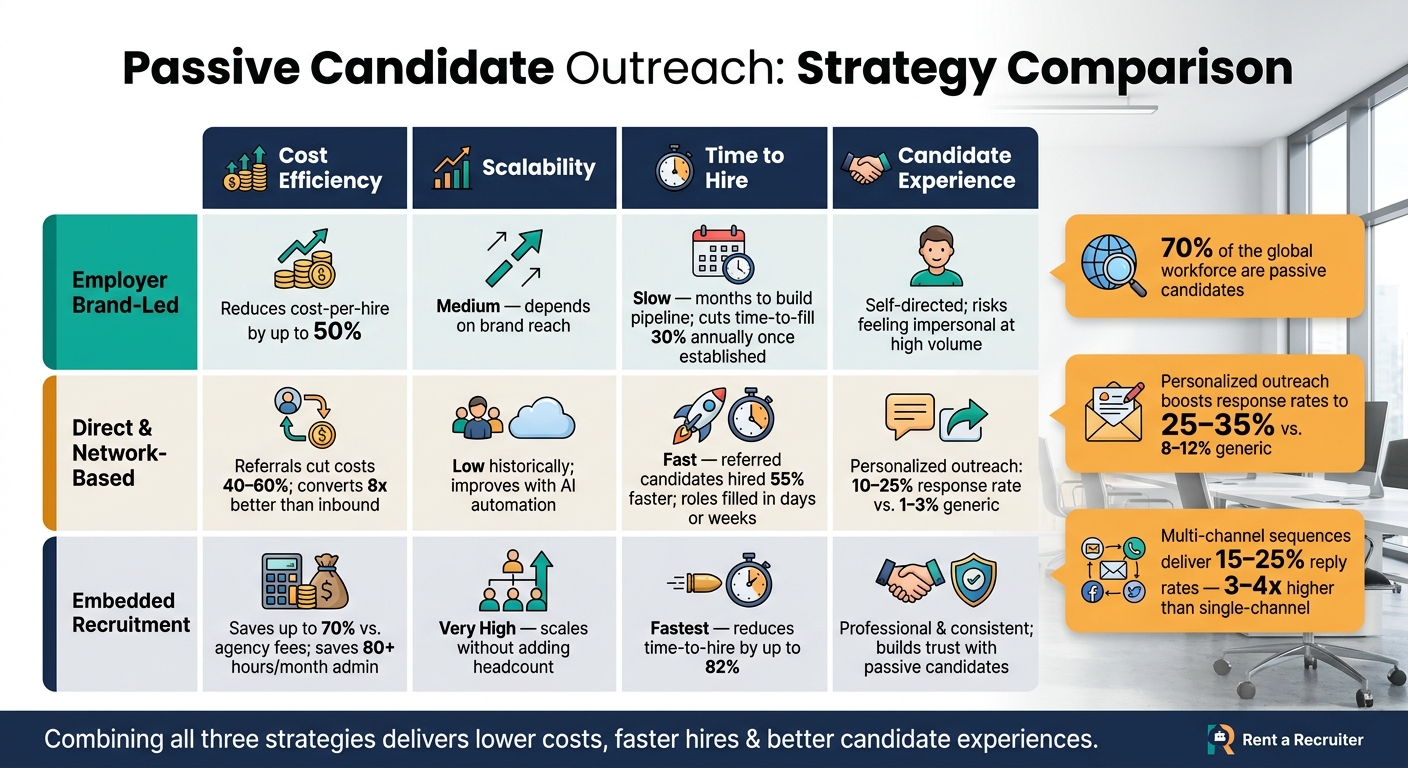
Passive Candidate Outreach Strategies: Cost, Speed & Results Compared
Every hiring strategy comes with its own strengths and limitations. The table below breaks down how each method performs across four key areas.
| Strategy | Cost Efficiency | Scalability | Time to Hire | Candidate Experience |
|---|---|---|---|---|
| Employer Brand-Led | High long-term ROI; can cut cost-per-hire by up to 50% [5] | Medium – depends on brand reach and ad spend | Slow – takes months to establish a steady pipeline | Self-directed; risks feeling impersonal when handling a high volume of applications |
| Direct & Network-Based | Moderate – higher per-candidate cost, but converts 8x better than inbound [5] | Historically low; improves with AI-based automation | Fast – delivers candidates in days or weeks | Personalized outreach drives better engagement; generic outreach sees only 1–3% response rates versus 10–25% for tailored multi-channel sequences [2] |
| Embedded Expertise | High – can cut hiring costs by up to 70% and save 80+ hours a month in admin work | Very high – boosts capacity without increasing internal headcount | Fastest – reduces time-to-hire by up to 82% [5] | Professional and consistent; builds trust, especially with passive candidates |
Employer Brand-Led Recruitment
This approach focuses on creating a strong employer brand to attract talent organically. Over time, it reduces cost-per-hire by building a sustainable talent pipeline. However, it requires patience, as results take months to materialize. Additionally, increased application volumes can overwhelm internal teams if resources aren’t scaled accordingly.
Direct and Network-Based Outreach
Referral programs and direct outreach yield faster results by leveraging personal networks and targeted follow-ups. Referrals are particularly effective, while multi-touch, personalized outreach campaigns significantly outperform generic messages. For example, personalized sequences can achieve engagement rates of 10–25%, compared to just 1–3% for generic outreach [1][2].
Embedded Expertise
Placing experienced recruiters directly within your team delivers immediate results. This model slashes administrative work, reduces hiring costs, and dramatically shortens time-to-hire. It’s particularly advantageous for scaling companies in industries like technology, SaaS, or fintech, where hiring needs often fluctuate. The embedded model also ensures a seamless, professional candidate experience, which is crucial for engaging passive talent.
Conclusion
There’s no one-size-fits-all solution for hiring. The right approach depends on your current challenges. But as outlined above, combining brand-led strategies, direct outreach, and embedded recruitment creates a hiring system that delivers results.
For urgent roles, start with your talent database. Re-engaging past candidates can speed up hiring by 50–70%, while employee referrals not only cut time-to-hire by 55% but also improve retention by 25% [1].
When it comes to technical roles, ditch the generic LinkedIn messages. Instead, focus on specifics – like referencing a candidate’s GitHub project or open-source work. This can boost response rates to 30–45% [1], compared to just 1–3% with standard outreach [2]. Pairing these tactics with expert recruitment support takes your hiring to the next level.
The best results come from integrated strategies. A strong employer brand fuels better direct outreach. Combine that with personalized, multi-channel contact (LinkedIn, email, phone) over 10–14 days, and you’ll see reply rates of 15–25% – three to four times higher than single-channel efforts [2]. Adding embedded recruitment expertise ensures you have the capacity to run these systems consistently, making your hiring both scalable and reliable.
"Passive candidate sourcing is a repeatable system, not a one-off LinkedIn search." – Suzan Cooper, Recruiting Tech Expert [3]
If you’re ready to put these strategies into action, Rent a Recruiter can help. By embedding experienced recruiters directly into your team, we manage outreach, pipelines, and hiring end-to-end – without the steep fees of traditional agencies. For technology, SaaS, fintech, and engineering SMEs, this is a practical way to build a hiring system that works.
FAQs
How do I start passive outreach with a small team?
To kick off passive outreach with a small team, prioritize focused and personalized tactics. Start by clearly outlining your ideal candidate profile. Next, pinpoint where these individuals spend their time, whether that’s niche online communities, industry-specific forums, or professional platforms like LinkedIn.
Leverage tools that simplify sourcing and help you identify the right talent efficiently. When reaching out, keep your messages short and impactful. Highlight specific accomplishments or skills that align with the candidate’s expertise to grab their attention.
Finally, think long-term. Build a talent pool by staying in touch, sharing relevant updates, and fostering genuine connections over time. This approach ensures you’re not just filling roles but creating a network of potential hires for the future.
What should I say in a first message to a passive candidate?
Your initial message to a passive candidate should be short, tailored, and directly connected to their experience or achievements. Mention a specific detail from their background to demonstrate genuine interest and avoid sounding generic. Emphasize what makes the opportunity appealing to them specifically, focusing on how it aligns with their career aspirations or interests. Keep the tone casual and suggest an informal, no-pressure conversation to explore further. Avoid pushy language – make it about their potential growth, not just filling a vacancy.
When does embedded recruiting make sense for an SME?
Embedded recruiting is a perfect fit for SMEs navigating changing hiring demands with limited in-house resources. It’s especially effective during periods of steady growth, scaling after securing funding, or rolling out new products – times when adaptable hiring support is essential. By embedding seasoned recruiters into your team, you can achieve faster hires, predictable costs, and alignment with your business objectives, even when your internal HR team is stretched thin or lacks the necessary expertise for specialized roles.