
Struggling to hire top developers? Open source recruitment could be your answer.
With 250,000 unfilled developer roles in the U.S. today, scaling companies face fierce competition for talent. Traditional hiring methods are costly, slow, and often fail to verify technical skills. Open source platforms like GitHub offer a smarter alternative, connecting you to highly skilled, passive candidates while slashing hiring costs.
Why it works:
- Skill verification: Evaluate actual code, not résumé claims.
- Higher response rates: GitHub outreach sees 25–40% reply rates, compared to LinkedIn’s 10–15%.
- Lower costs: Avoid hefty agency fees by sourcing directly through open source communities.
Key benefits for scaling companies:
- Faster hiring cycles by pre-screening candidates via public repositories.
- Access to a hidden talent pool of developers actively contributing to projects.
- Reduced risk by assessing communication and collaboration skills upfront.
Ready to rethink your hiring strategy? Open source recruitment is a practical, cost-effective way to build strong technical teams. Learn how to get started, from sourcing candidates on GitHub to embedding recruitment expertise into your team.
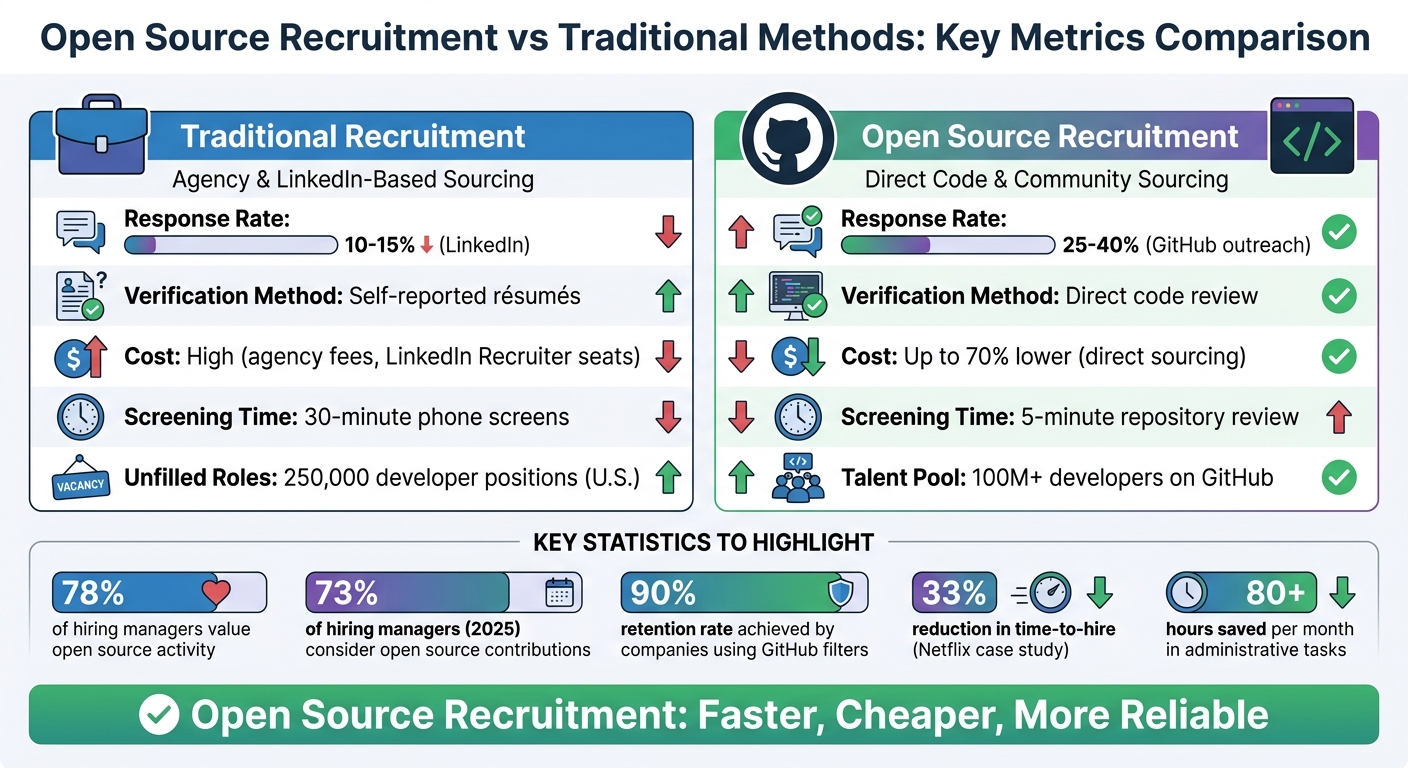
Open Source vs Traditional Recruitment: Key Metrics Comparison
How to Hire Developers from GitHub (Step-by-Step)
sbb-itb-a23bd6a
Where to Find Open Source Talent
GitHub is home to over 100 million developers and 330 million repositories, making it a treasure trove for finding open source talent. Unlike LinkedIn, where skills are self-reported, GitHub provides direct evidence of what developers have built through their code.
Other platforms like GitLab, Bitbucket, and Stack Overflow also offer valuable opportunities to connect with open source contributors. GitLab is particularly popular with DevOps professionals, while Stack Overflow highlights how developers explain technical concepts and assist others.
Let’s break down how to use these resources effectively, starting with GitHub.
Finding Developers on GitHub
GitHub’s advanced search operators are your best friend when sourcing talent. Use filters like:
language:to find developers skilled in your tech stacklocation:to narrow down by geographypushed:>to ensure recent activity
For example, searching language:python location:austin pushed:>2026-01-01 will return active Python developers in Austin. You can also use followers:> to identify developers recognized by their peers or org: to find contributors to specific companies. In early 2025, Netflix’s talent team used a query like org:netflix language:go followers:>100 to hire 15 senior engineers in just two months, cutting their time-to-hire by 33% [6].
To dig even deeper, try Google X-Ray with Boolean queries. For instance:
site:github.com "rust developer" "portfolio" location:seattle
This approach can uncover candidates who might not appear in GitHub’s standard searches.
When evaluating potential candidates, focus on more than just surface metrics. Repository stars reflect peer recognition – 100 stars is solid, while 1,000 or more suggests high visibility. Prioritize original repositories over forks to evaluate creativity and ownership. Additionally, the quality of pull requests on major projects like React or Kubernetes often speaks louder than overall activity levels [7].
GitHub outreach has a response rate of 25–40%, significantly outperforming LinkedIn’s 10–15% [5]. For example, if most of a developer’s code is in TypeScript, you can be confident in their expertise [1].
Other Platforms for Open Source Developers
While GitHub is the go-to platform, others like GitLab and Stack Overflow offer unique insights into developer skills.
- GitLab: Ideal for roles involving DevOps and infrastructure. Many companies use GitLab for private repositories, and its community often has deep experience with CI/CD pipelines and deployment automation.
- Stack Overflow: While it doesn’t display code, developers with strong answers and clear explanations demonstrate excellent communication skills, a critical trait for roles requiring cross-functional collaboration.
You can also explore package registries like npm (JavaScript), PyPI (Python), and RubyGems (Ruby). Developers maintaining popular libraries on these platforms showcase not only technical expertise but also a commitment to their communities.
How to Assess Open Source Contributors
Evaluating open source contributions is key to hiring the right talent. Here’s how to assess candidates effectively:
- Check documentation quality: Look for clear README files with setup instructions, logical project structures, and detailed pull request descriptions. These are signs of professionalism and strong communication.
- Review commit messages: Detailed, thoughtful commit messages like "Resolved token expiration issue by implementing refresh logic in auth middleware" give insight into a developer’s problem-solving approach.
- Observe interactions: Contributions in issue threads and pull request comments can reveal how collaborative and responsive a developer is.
For example, a Berlin-based fintech startup in 2024 used GitHub filters like language:rust stars:>20 pushed:>2024-06-01 to build their engineering team in just eight weeks, achieving a 90% retention rate [6].
When reaching out, avoid public channels like Issues or Pull Requests. Instead, use their email, which can often be found by appending .patch to a commit URL. Personalize your message by referencing specific technical decisions they’ve made – this can triple your reply rates compared to generic outreach [5].
"Resumes tell you what someone claims they can do. GitHub shows you what they have actually built."
- Vamo [5]
How to Recruit from Open Source Communities
Building meaningful connections within open source communities is a smart move for SMEs looking to secure top-tier technical talent. These relationships form the backbone of effective recruitment strategies tailored to this unique talent pool.
Participate in Relevant Open Source Projects
To tap into the potential of open source, active participation is key. Get involved in the projects your business depends on by encouraging your developers to contribute. Take Samsung’s "50% rule" from 2018 as an example – they required their developers to dedicate half their working hours to upstream contributions. This approach not only positioned Samsung as a leader in key projects but also attracted highly skilled professionals to their team [3].
Contributions don’t always have to be monumental. Improving documentation, updating READMEs, or engaging in GitHub Discussions and Discord channels are excellent starting points. These contributions increase your visibility and naturally foster relationships with other contributors – many of whom could be your future hires [8]. By engaging in these activities, you’re not just assessing technical skills but also building trust within the community.
It’s important to note that influence in open source communities is tied to individuals, not companies [4]. Hiring a respected maintainer or contributor can bring not only their technical expertise but also their network and credibility within the community [3]. This is particularly advantageous for SMEs venturing into new technologies.
Attend Open Source Events and Conferences
Events like OSCON and FOSDEM are treasure troves for connecting with developers who are passionate about open source. These gatherings attract professionals who value meaningful technical discussions far more than traditional recruiting pitches.
Participating in these events allows you to showcase your technical expertise and commitment to the open source ecosystem. This not only strengthens your employer brand but also creates opportunities for genuine conversations about potential roles within your company.
Authenticity is crucial here. Developers can easily spot insincere recruiting efforts. Guy Martin, Director of Open at Autodesk, put it best:
"Open source becomes a double-edged sword… You want to become a place where people are free to be open… the pushback you’ll get from companies is ‘if they make themselves so appealing, they can get poached.’ My response is – yes, absolutely – which is why having an open culture that they want to continue to work in is so critical." [3]
Release Your Own Open Source Projects
Publishing your own open source projects is another way to attract top contributors while showcasing your team’s technical capabilities [8]. Companies like Vercel, Supabase, Cloudflare, and Stripe have successfully hired from their own open source contributor pools [8].
A great example is Western Digital. Around 2017, after acquiring a company known for its open source contributions, they established a company-wide open source working group. This initiative allowed respected developers to mentor their engineers on upstream contributions, strengthening both their technical expertise and their community presence [4].
Start small. Releasing a utility library or developer tool is a great way to highlight your coding standards and engineering culture. The goal isn’t to create the next viral project but to provide a space where potential candidates can evaluate your work, interact with your team, and see your company’s technical excellence in action. With 73% of hiring managers in 2025 expected to consider open source contributions when assessing candidates [8], your projects can become a direct pipeline for identifying and engaging top talent.
Adding Open Source Recruitment to Your Hiring Process
Incorporating open source recruitment into your hiring strategy can help you fill critical roles faster while keeping costs down. By aligning this approach with your technical goals, you can streamline the hiring process and ensure it supports your broader business objectives.
Connecting Open Source Hiring to Business Goals
Start by identifying open source projects that align with your technical needs. For example, if cloud infrastructure is a focus, look for contributors to projects like Kubernetes or Terraform. If machine learning drives your product, target developers active in repositories such as PyPI or TensorFlow. This approach ensures you’re reaching professionals with experience in the technologies that matter most to your team [3].
Open source contributions act as a transparent résumé. Platforms like GitHub showcase a developer’s skills through their code, stars, and forks, making it easier to verify expertise while reducing the need for lengthy technical assessments [4]. In fact, reaching out to developers via GitHub often results in response rates of 25–40%, compared to just 10–15% on LinkedIn [1].
Leveraging Support for Open Source Recruitment
For many small to mid-sized businesses, sourcing talent from open source communities can be challenging without dedicated resources. This is where services like Rent a Recruiter can make a difference. With an embedded recruiter integrated into your team, you gain end-to-end support – from identifying contributors on platforms like GitHub to managing interviews. This approach can cut hiring costs by up to 70% and save over 80 hours per month in administrative hiring tasks.
Such a model is particularly effective when scaling after securing funding, launching a new product, or facing a sudden increase in hiring needs. Beyond sourcing talent, an embedded recruiter evaluates not just code quality but also how candidates engage within open source communities [4]. While external expertise strengthens your recruitment efforts, fostering an open source-friendly environment internally ensures long-term success.
Building a Culture That Embraces Open Source
Hiring developers from open source communities is only the beginning. To retain these professionals, your company must support their ongoing contributions to the projects they value. For example, Samsung’s open source group, led by Guy Martin and Ibrahim Haddad, implemented a "50% rule", allowing developers to dedicate half their work hours to upstream contributions. This policy not only maintained Samsung’s influence in key projects but also attracted top-tier talent [3].
It’s important to recognize that open source developers often balance their loyalty between your company and the community projects they contribute to. As highlighted in Producing Open Source Software, asking employees to compromise their community standing is counterproductive [4]. Instead, encourage their public involvement by funding conference attendance and supporting opportunities for them to showcase their work. Gil Yehuda, Senior Director of Open Source at Oath, captures this balance well:
"We seek to create a working environment that talent wants to be part of. Our engineers know that they work in an open source friendly environment where they are supported and encouraged to work with the open source communities." [3]
Make your commitment clear by updating job descriptions to specify roles involving open source contributions or leadership. This transparency attracts candidates who value these opportunities and ensures better alignment with your company’s culture. Additionally, mentorship programs pairing experienced contributors with junior developers can bridge skill gaps and provide a meaningful benefit that boosts retention [3].
Next Steps
Main Benefits of Open Source Recruitment
Open source recruitment offers a smarter, faster way for SMEs to find top technical talent. Instead of relying on self-reported résumés, you can directly verify a developer’s skills. A quick five-minute review of their GitHub repository can reveal far more than a traditional 30-minute phone screen. You’ll see their code quality, whether they write tests, how they document their work, and how they respond to feedback in pull request discussions.
The numbers back this up. A significant 78% of hiring managers value open source activity [2], and personalized GitHub outreach gets response rates of 25–40% [1]. This approach connects you with passive talent – developers who aren’t actively job hunting but are open to the right opportunity.
By sourcing directly from platforms like GitHub, you can also cut costs. Expensive LinkedIn Recruiter seats and InMail fees become unnecessary. This reduces screening time, speeds up hiring cycles, and delivers measurable ROI.
Get Started with Open Source Hiring
Need help tapping into open source talent? Rent a Recruiter can embed experienced recruiters into your team to manage the entire process. Our recruiters know how to identify, assess, and engage developers from open source communities. From analyzing GitHub contributor lists to crafting outreach that references specific code contributions, we handle it all, so you can focus on your business.
FAQs
How do I tell real skill from GitHub activity?
Focus on the substance of contributions, not just flashy metrics like commit counts or activity graphs. Pay attention to meaningful code, involvement in complex projects, and how well the developer responds to feedback. Evaluate whether their work tackles practical challenges and consider the broader context – whether it’s open-source, personal projects, or professional roles. Keep in mind that some skilled developers might have limited GitHub activity due to working on closed-source projects or in positions where public contributions are less common.
What’s the best way to contact a GitHub contributor privately?
GitHub doesn’t include a private messaging option, but there are ways to reach out to contributors. Start by checking their profile for a publicly listed email address. If you don’t find one, look through their commit history, as contact details are sometimes included there. Another approach is to leave a comment on their issues or pull requests. Engaging publicly this way might encourage them to respond.
How can an SME retain open source developers after hiring?
SMEs can keep open source developers engaged by creating a workplace that feels supportive and rewarding. This means focusing on building strong connections, recognizing their efforts, and offering clear paths for career growth. Regular and transparent communication plays a big role too.
By acknowledging their open source contributions as part of their professional achievements, developers are more likely to feel appreciated and committed. When developers see their work valued and tied to their growth, it strengthens their loyalty. Ultimately, fostering an environment where people feel included, respected, and encouraged to grow is key to retaining open source talent.