
Passive candidates make up 70% of the talent pool, but most companies fail to engage them effectively. This oversight can lead to longer hiring cycles, higher costs, and missed opportunities to secure top talent. By building relationships with passive candidates before roles open, you can reduce time-to-fill, lower recruitment costs, and improve hire quality.
Here’s what you need to know:
- Passive candidates are 5x more likely to be hired than inbound applicants and 17% less likely to need skill development.
- 85% of professionals are open to new roles, but they won’t apply – you need to approach them directly.
- Companies with a passive talent pipeline cut hiring timelines by up to 70% and reduce reliance on costly recruitment agencies.
The solution? A structured approach to identifying, engaging, and maintaining relationships with passive talent. This includes personalized outreach, consistent communication, and leveraging tools like CRMs to track progress. It’s not about filling roles; it’s about creating a steady flow of qualified professionals who are ready when you are.
If your team struggles to manage this process, Rent a Recruiter can help. Our embedded recruitment service integrates directly with your team, saving time and cutting costs by up to 70%.
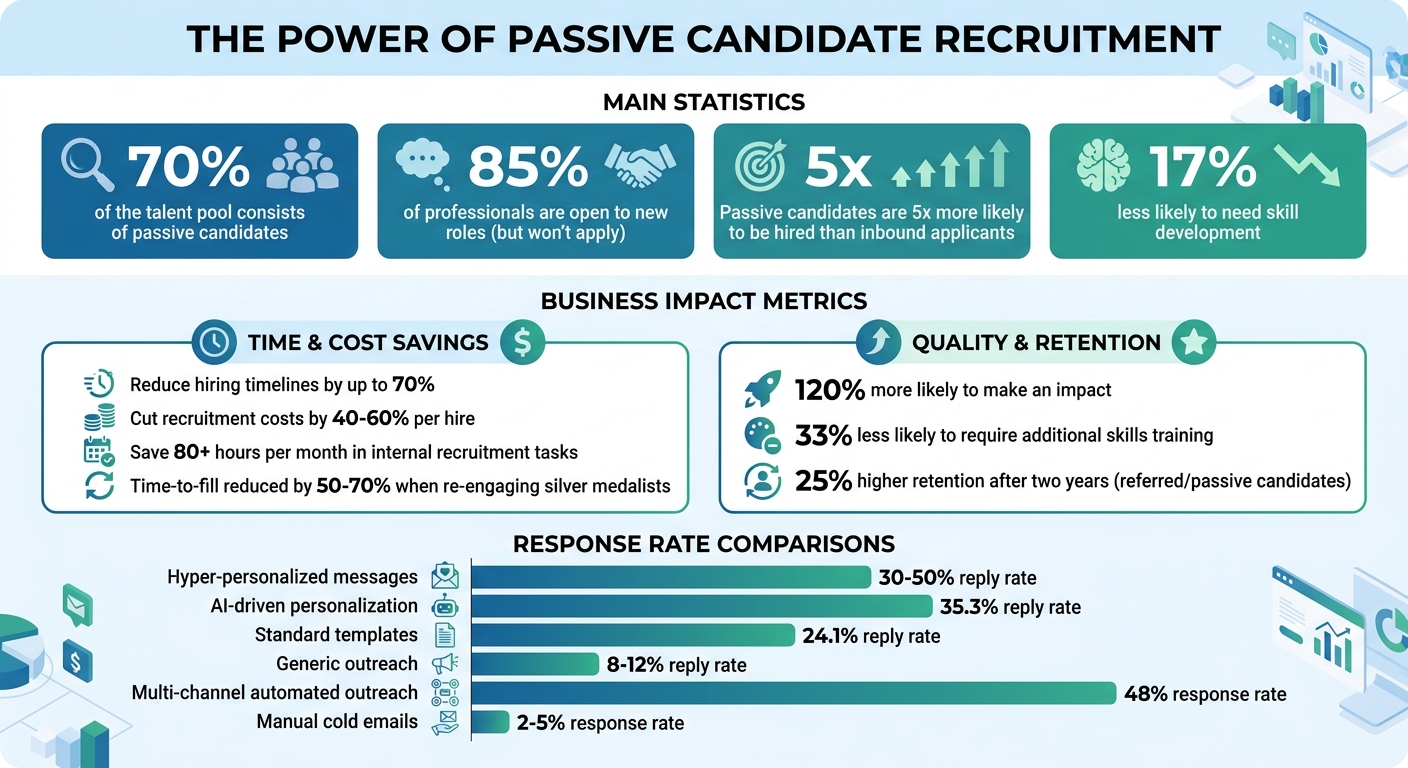
Passive Candidate Recruitment Statistics and Benefits
Passive Recruiting Methods That Work
sbb-itb-a23bd6a
Step 1: Research and Build Your Candidate Pipeline
Building a strong passive candidate pipeline starts with identifying where top talent gathers. This phase is all about laying the foundation for future hiring by establishing relationships with professionals who might not be actively looking for a job but have the skills your company will need soon.
How to Find the Right Passive Candidates
Start by using LinkedIn‘s advanced Boolean search to narrow down your candidate pool. Boolean operators like AND, OR, and NOT let you combine and exclude specific terms. For example, a search like ("senior" OR "lead") AND "TypeScript" NOT "sales engineer" focuses on technical leaders while filtering out irrelevant roles. Personalized messages sent to these targeted profiles can generate response rates of 25–35%, far outperforming the 8–12% response rates of generic outreach[3].
Go beyond keywords and look for "excellence signals" – public indicators of high performance. Examples include speaking at industry conferences, contributing to open-source projects on GitHub, or working at well-known high-growth companies. For technical roles, GitHub can be particularly effective, often yielding response rates of 30–45%, compared to LinkedIn’s typical 20–30%. This is because GitHub outreach is based on tangible work samples and is less saturated with recruiters[3].
Niche communities are another goldmine for specialised talent. Platforms like Stack Overflow (for developers), Behance or Dribbble (for designers), and Kaggle (for data scientists) allow you to see candidates’ actual work and engagement before reaching out. Competitor mapping is also a smart strategy: identify professionals at 5–10 leading companies and focus on those who’ve been in their roles for 2–3 years, as they’re statistically more open to new opportunities.
Don’t forget your "silver medalist" pipeline – candidates who made it far in previous hiring rounds but didn’t get the job. These individuals are 4x more likely to respond to outreach and can cut your time-to-hire by 50–70%[3][4]. Keeping track of these candidates ensures you’re ready to re-engage when the right role comes along.
Organize and Track Your Talent Pipeline
Once you’ve identified high-potential candidates, centralize their information to maintain consistent engagement. A Recruiting CRM (Candidate Relationship Management system) is ideal for this. Unlike an ATS, which focuses on applicants, a CRM is designed to track and nurture relationships with passive candidates. Tools like Ashby, Gem, and Treegarden allow you to store contact details, log past interactions, and set automated reminders to check in with top talent every 60–90 days[2].
To keep things organized, tag and segment candidates based on their potential fit and readiness. Use labels like "Silver Medalist", "Future Leader", or "Highly Interested, Bad Timing" to quickly identify the right candidates when a new role opens. You can also segment by job function, seniority, or specific skills, ensuring you’re not starting from scratch each time.
Pay attention to digital breadcrumbs – updates like work anniversaries, funding announcements, or company layoffs. These events often signal that a candidate’s circumstances have shifted, making them more open to new opportunities[2]. Tracking these changes allows you to time your outreach for when they’re most likely to respond.
Step 2: Start with Low-Pressure Contact
Once you’ve pinpointed the right passive candidates, the way you approach them matters. That first message? It sets the tone for everything that follows. Ditch the cookie-cutter "great opportunity" pitch that clogs inboxes. Most passive candidates are content where they are, focused on their current projects and goals. They’re not actively looking, so a hard sell won’t land well.
Instead, aim to spark a genuine conversation, not deliver a sales pitch. Reference something specific they’ve done – a standout GitHub project, a conference talk, or an article they’ve written. Showing that you’ve done your homework makes it clear this isn’t just another mass outreach. Personal touches like these can make a huge difference: hyper-personalized messages mentioning a specific project or event can achieve reply rates of 30–50%[2], compared to just 8–12% for generic templates[3].
How to Begin the Conversation
Start with a relaxed and personal tone. Use phrases like "open to a quick chat?" or "I’d love to hear more about your work" to keep things light and approachable. Don’t rush to ask for a resume – suggest a brief 15–20 minute chat instead. This keeps the pressure low and the conversation natural.
Craft a specific subject line that grabs their attention. Skip generic lines like "Job Opportunity" and opt for something tailored, such as "Your recent presentation on [Topic]" or "Loved your work on [Project]." If you share a mutual connection, bring it up early. Candidates are 46% more likely to respond to an InMail when they have a connection at your company[6]. Also, keep your message concise – between 200 and 400 characters – to boost response rates by 16%[6].
Focus on their career goals, not just your hiring needs. As TalentAlly puts it:
"You’re not selling a job. You’re starting a conversation about their career trajectory – and how your organization might support it"[7].
Ask questions like, "What would make you consider a new opportunity?" rather than diving straight into a pitch. This approach shows you value their current situation and opens the door to a more meaningful dialogue.
Respect Their Timeline
Patience is key when dealing with passive candidates. Recognize that the timing might not be ideal and offer to stay in touch. This builds trust and keeps the relationship alive without adding pressure.
If they respond with "not now", acknowledge it and step back. Send one thoughtful follow-up 5–7 days later, and if there’s still no response, stop after a second follow-up. Over-persistence can harm your employer brand[3]. Instead, add them to your talent pool and plan to reconnect in 4–6 months. Timing this with a work anniversary or the end of a major project can make your outreach feel thoughtful and well-timed.
Throughout your communication, use low-pressure language. Phrases like "no obligation" or "just to explore" make it easier for candidates to engage. Candidates are nearly three times more likely to respond when your message aligns with their values, interests, or career aspirations rather than focusing solely on job requirements[7]. Position yourself as someone who removes barriers, not as a gatekeeper demanding resumes before a conversation even begins. This respectful approach lays the groundwork for a lasting relationship with passive talent.
Step 3: Customize Your Outreach
Once you’ve established initial connections, it’s time to focus on targeted personalization. Passive candidates, often content in their current roles, are unlikely to respond to generic messages. In fact, emails tailored with AI-driven personalization see a 35.3% reply rate, compared to just 24.1% for standard templates – a 46% increase in engagement[8].
Reference Their Work and Achievements
After your initial low-pressure contact, dive deeper by referencing specific details about a candidate’s career. Highlight their measurable achievements or key milestones to show genuine interest. For example, instead of a vague "You’d be great for this role", try something like, "I noticed you’ve spent three years building data pipelines at [Company]." This type of detail not only grabs attention but also demonstrates that you’ve done your homework.
Rich Rosen, an Executive Recruiter at Cornerstone Search, used a personalized multi-channel outreach strategy between late 2025 and early 2026. His tailored approach resulted in over $250,000 in revenue, underscoring the power of targeted messaging[8].
Balance Personalization with Efficiency
Personalization doesn’t mean you need to spend hours researching every candidate. Dedicate 5–10 minutes to uncover one meaningful connection point for top-tier candidates, like a recent project or a standout career milestone[2]. For lower-priority candidates, automation can handle basic details – such as their name, current role, or key skills – while still maintaining a professional touch.
Segment your candidates into tiers to optimise your hiring strategy and streamline your efforts:
- Tier 1 (High Priority): Send deeply personalized messages that reference specific achievements or skills.
- Tier 2 and Tier 3: Use automated sequences to share relevant job alerts, salary insights, or company updates.
This tiered approach ensures your outreach is both thoughtful and efficient, keeping candidates engaged while respecting your time and resources. It’s about striking the right balance between personal touches and scalable processes.
Step 4: Offer Ongoing Value to Candidates
If you only reach out to passive candidates when you have an open role, they’re unlikely to stay engaged. Instead, focus on consistently providing value that supports their career growth, whether or not they’re actively job hunting. This positions you as a trusted partner, not just someone filling roles.
Ways to Deliver Value
Think about what helps candidates grow professionally. Sharing industry insights – like salary benchmarks, hiring trends, or niche market reports – can highlight your expertise and show that you understand the landscape.
Career development resources are another great option. Share tailored content such as resume tips for their field, interview prep guides, or information on professional certifications. If growth is a priority for them, showcasing internal career paths or training programs can be particularly effective.
You can also bring your workplace to life with behind-the-scenes content. Employee testimonials, day-in-the-life videos, and other culture-focused media help candidates imagine themselves as part of your team. Video, in particular, is powerful: people retain 95% of a message when it’s delivered via video, compared to just 10% from text [1].
Finally, offer exclusive opportunities to connect. Low-pressure events like networking meetups, webinars, or industry conferences can build credibility and keep you on their radar. Even small gestures, like congratulating them on a promotion or work anniversary, go a long way in maintaining relationships.
Personalize Based on Career Goals
Generic outreach doesn’t work. Tailor your communication to match each candidate’s career goals and where they are in their journey. For example, if someone is aiming for leadership roles, send them insights on management strategies or organizational effectiveness. For those focused on technical growth, updates about cutting-edge tools or exciting projects in their field can spark interest.
Segment your talent pool to adjust the type and frequency of engagement. For top-tier candidates (Tier 1), send personalized notes and relevant industry content every few weeks. For mid-tier candidates (Tier 2), monthly updates like market trends or salary benchmarks work well. Candidates in the colder pool (Tier 3) might only need quarterly updates about company news or new opportunities.
Keep an eye on trigger events that signal a candidate might be open to a conversation. If their company announces layoffs, an acquisition, or a funding round, it’s a great time to reach out with market insights or potential opportunities. Timely, thoughtful outreach shows you’re paying attention and invested in their career, building trust over time. Regular, value-driven engagement creates a foundation for long-term communication.
Step 5: Create a Regular Communication Schedule
Consistency matters. Research highlights that 34% of candidates think they’ve been ghosted after just a week of silence, and 36% disengage completely if they hear nothing for a month [8]. Establishing a predictable communication routine keeps you on their radar while avoiding being overly intrusive. The key is to tailor the frequency of your outreach to different candidate groups.
How Often to Reach Out
Your communication rhythm should align with how engaged each candidate is:
- Tier 1 candidates: These are the individuals you’ve interviewed or had meaningful conversations with. Reach out every 3–4 weeks to keep them engaged and informed.
- Tier 2 candidates: These are interested but not ready to move forward. Monthly updates work well for this group.
- Tier 3 candidates: For cold but qualified leads, quarterly check-ins are enough to maintain a connection without overwhelming them [8].
Timing is also crucial. Aim for mid-week mornings (Tuesday–Thursday, 9:00–11:00 AM) or afternoons (12:00–6:00 PM local time) for the best response rates [2][8]. Avoid contacting candidates who have been in a new role for less than 12 months unless there’s a significant event like layoffs or a major funding announcement [9]. Above all, make sure every interaction has a clear purpose.
Make Each Touchpoint Count
With your schedule in place, focus on making every message meaningful. Each communication should offer something of value. Share salary benchmarks, invite candidates to webinars on industry trends, or acknowledge milestones like work anniversaries. If their company announces funding or restructuring, use that as an opportunity to provide relevant insights or discuss potential roles. These timely, trigger-based messages resonate more effectively [2][9].
Keep follow-ups concise and spaced out. Send 1–2 thoughtful messages, allowing 5–7 days between each. If there’s no response after three attempts, it’s better to step back to avoid appearing overly persistent, which could harm your employer brand [8][9]. Using multiple channels – email, LinkedIn, and SMS – can boost response rates by up to 45% compared to email alone. Once a candidate replies, pause outreach on other platforms to streamline communication [8].
Step 6: Use Employer Branding to Draw Interest
A strong employer brand is like a magnet for passive talent. Since 70% of the global workforce consists of passive candidates [2], these individuals aren’t actively looking for new roles. They need a compelling reason to even consider making a move. That’s where your employer brand comes in – it shows why joining your company is worth the change. This foundation sets the stage for the personalized outreach steps you’ll take later.
"The question is not ‘is this a job?’ but ‘is this worth disrupting my current situation?’ Your sourcing message, employer brand, and compensation transparency must justify the disruption." – Treegarden Team [3]
Passive candidates – who are 120% more likely to look for roles with purpose and impact [3] – approach opportunities differently from active job seekers. They care about mission, growth, and meaningful work far more than just perks and benefits. Your brand narrative needs to reflect this, keeping them interested over time.
Communicate Your Company’s Value
Your Employee Value Proposition (EVP) should clearly highlight what makes your company stand out. Focus on aspects that matter most to passive candidates: workplace culture, career growth, and work-life balance. For example, 87% of Millennials place a high value on professional development, and 80% of workers consider cultural fit a key factor when choosing a job [5].
Avoid clichés and overused stock photos. Passive candidates respond better to content that feels genuine. Think unscripted “Day in the Life” videos, authentic employee testimonials, and real DEI recruitment best practices [4]. You can also showcase your expertise through engineering blogs, open-source projects, or leadership insights. These “excellence signals” help attract high-performers by proving your company’s credibility [2].
Take Ramp, for instance. Their proactive employer branding allowed them to build a pipeline of engaged talent well before they had open roles. Between 2024 and 2026, they grew their finance team from 3 to 30 people in just 18 months. By identifying and nurturing top-tier passive candidates six months ahead of time, they were able to fill roles within days instead of months once the positions became available [2].
Build Visibility Through Social Media and Events
A strong employer brand naturally extends to active engagement on social media and at industry events. LinkedIn is a must – companies with an active presence there get 30% more views from potential candidates [11]. But don’t stop there. Explore niche communities where your ideal candidates are already active. For instance:
- Engineers: GitHub, Stack Overflow
- Designers: Dribbble
- Other professionals: Specialized Slack channels or Discord servers [3]
Before posting job openings, spend 2–4 weeks contributing to discussions and sharing insights on these platforms. Being too transactional right away can hurt your brand [3]. When reaching out, referencing specific contributions – like a candidate’s recent blog post or conference talk – can lead to response rates as high as 50–70% [3].
Industry events and webinars are also excellent for finding passive talent. Use speaker lists from conferences like AWS re:Invent to identify experts in the field, and follow up with personalized messages that reference their presentations. Don’t overlook your alumni network either – former employees with positive experiences can act as ambassadors for your brand. Plus, boomerang hires (returning employees) often ramp up 40–50% faster than new hires [3].
Finally, consider retargeting ads for visitors to your careers page. These ads keep your brand in front of potential candidates as they browse other platforms, subtly reminding them of opportunities without being overly pushy [5].
Step 7: Use Tools to Scale Your Nurturing Efforts
Personalized outreach and regular communication are great foundations, but as your candidate pipeline grows, automation becomes essential. Technology helps you maintain meaningful connections with hundreds of passive candidates without losing the personal touch that makes your outreach effective. The key is knowing when to scale with automation and when to rely on personal follow-up.
When Automation Makes Sense
Automation shines when it comes to staying in touch with a large pool of talent. Tools can automatically schedule outreach sequences based on where a candidate is in the pipeline, ensuring consistent communication. For example, you can set up touchpoints for Day 1, Day 4, Day 10, and Day 21, followed by regular updates every 60–90 days for high-value passive candidates [2][8][10].
The efficiency gains are clear. Multi-channel automated outreach – using email, LinkedIn, and SMS – can achieve response rates of 48%, compared to just 2–5% for manual cold emails [8]. Generative AI tools save recruiters nearly a full workday each week and improve the likelihood of making quality hires by 9% [8]. These tools also coordinate outreach across channels, pausing emails as soon as a candidate responds [8][10]. AI can even personalise messages by pulling details like job titles, tenure, or recent projects, making each interaction feel relevant and thoughtful [2][8]. Behavioral triggers, such as repeated email opens, can automatically adjust a candidate’s engagement level, ensuring your efforts are focused where they matter most [8][10].
A great example of automation’s impact comes from a Series A FinTech startup. In July 2025, they adopted an AI sourcing platform with advanced filters and automated outreach. Over just eight weeks, their candidate reply rate tripled from 8% to 24%, and their time-to-first-interview dropped from 21 days to just 7. This allowed them to fill four critical Machine Learning roles ahead of schedule [13].
Combine Manual and Automated Outreach
The best nurturing strategies balance automation with human judgment. Automation works well for maintaining contact with passive candidates or those further along in the funnel. However, high-priority prospects – those who show strong interest or meet urgent hiring needs – benefit from a more personalized, manual approach [8]. For example, you can set up triggers for high-intent actions, like a candidate clicking on a job posting, to alert recruiters to follow up within 48 hours [10].
"Automation handles frequency; human contact handles relationship depth." – SHRM [12]
Generative AI can draft personalized messages based on candidate data, but combining these drafts with human editing ensures the tone feels genuine and tailored [8][10]. One tech company reported a 40% improvement in recruiter response rates by blending AI-driven messaging with manual refinement [10]. However, automation should never replace human judgment during sensitive times, such as layoffs or public controversies, where empathy and careful communication are critical [8].
In early 2025, a regional SMB with around 50 annual hires repurposed its sales CRM into a talent CRM. By tagging alumni and conference connections and sending out quarterly employer brand newsletters, they reduced time-to-fill for senior roles by 22% within six months [10]. Their approach combined automated nurture campaigns with manual follow-ups for warm leads, building genuine relationships while reducing reliance on external recruitment agencies.
Scaling recruitment requires a thoughtful mix of technology and human insight. At Rent a Recruiter, we integrate advanced tools with expert recruiter input to nurture passive candidates effectively – keeping your hiring process agile and impactful.
Conclusion
Key Takeaways
Focusing on passive candidates transforms recruitment into a proactive strategy. By connecting with the 70% of the workforce not actively job hunting, you build a talent pipeline filled with pre-qualified individuals ready to step in when opportunities arise [2]. Passive candidates bring measurable benefits – they’re 120% more likely to make an impact and 33% less likely to require additional skills training [3]. Plus, they tend to stick around longer, with referred candidates (many of whom are passive) showing 25% higher retention after two years [3].
Companies that invest in nurturing passive talent see significant cost and efficiency gains. By reducing dependency on job boards and external agencies, recruitment costs drop by 40–60% per hire [3]. Time-to-fill also improves dramatically, especially when re-engaging "silver medalists", which can cut hiring timelines by 50–70% [3].
"Engaging passive candidates isn’t just a tactic; it’s a strategic shift from reactive hiring to proactive talent acquisition." – Aditya Sheth, Juicebox.ai [2]
This approach emphasizes ongoing, meaningful communication to keep candidates engaged and informed, aligning with the strategies outlined throughout this guide.
Next Steps
Take action on these insights by fine-tuning your talent nurturing strategy. Begin with an audit of your recruitment metrics. How many of your hires come from passive candidates versus active applicants? What’s your time-to-fill for sourced talent compared to inbound applications? These metrics will highlight whether you’re fully leveraging the passive talent market [2].
From there, establish a "keep-warm" strategy. Reach out to passive candidates every 60–90 days with valuable content, such as industry updates or company news, without immediately pitching a role [2]. Consistent, value-driven communication ensures candidates remain engaged.
If your team is stretched thin or facing a surge in hiring needs, Rent a Recruiter can step in. Our embedded recruiters integrate into your team within days, bringing the expertise and tools to manage passive talent pipelines at scale. We help streamline your hiring process, cutting costs by up to 70% compared to traditional agencies and saving over 80 hours a month in internal recruitment tasks. Book a call to see how we can help you build a stronger, faster, and more cost-effective hiring strategy.
FAQs
What should I say in my first message to a passive candidate?
When contacting a passive candidate for the first time, craft a personalized and genuine message. Reference something specific about their work, like a recent project they led, an article they wrote, or even a shared connection. Avoid using generic or templated pitches – it’s about showing that you’ve done your homework.
Instead of diving straight into a job offer, focus on starting a conversation. This approach builds trust and sets the stage for meaningful engagement.
How do I keep passive candidates warm without annoying them?
Maintaining relationships with passive candidates requires a thoughtful, long-term approach. Regular, personalized outreach is key – whether that’s through direct messages, emails, or casual check-ins. Engage with them on platforms where they’re active, share insights that align with their interests, or even connect at industry events.
The goal? Add value without making it about an immediate hire. Offer helpful resources, share industry trends, or facilitate introductions to expand their network. Authenticity is critical here – when your outreach feels genuine rather than transactional, trust builds naturally over time. Patience pays off, as these relationships often lead to stronger, more meaningful hires down the line.
What metrics should I track to prove passive recruiting is working?
When evaluating the success of your passive recruiting efforts, tracking the right metrics is essential. Here are the key ones to focus on:
- Response rate: This measures the percentage of candidates who engage with your outreach efforts. A higher response rate indicates that your messaging is resonating with the talent pool.
- Quality of replies: It’s not just about who responds, but how relevant their responses are. This metric helps gauge whether you’re targeting the right individuals with your outreach.
- Conversion rates: Monitor how many candidates move from initial contact to interviews or even job offers. This shows how effectively you’re turning interest into tangible results.
- Speed to qualified candidates: Time is money. Track how quickly you’re able to identify and engage suitable candidates for your roles.
- Pipeline ROI: This metric evaluates the overall efficiency of your sourcing efforts, balancing the cost of outreach against the quality and quantity of candidates added to your pipeline.
Together, these metrics provide a clear picture of how well your passive recruitment strategies are performing and where adjustments might be needed.