
Building a talent community can cut hiring costs by 60% and time-to-hire by half. Yet, most companies fail to leverage this approach effectively, treating it as a static database rather than a dynamic network of engaged candidates.
Here’s the reality: a well-run talent community is more than just a list of names. It’s an active pipeline of pre-qualified candidates who already know your brand, reducing your reliance on in-house talent vs recruitment agencies. For scaling companies, this means faster hiring, lower costs, and better-quality hires – all while saving internal resources.
Key Takeaways:
- Define and segment your audience: Focus on specific skills or roles, and group candidates for targeted outreach.
- Offer value to candidates: Share exclusive content, career resources, and early access to opportunities.
- Engage with tailored content: Use personalized updates, employee stories, and industry insights to keep candidates interested.
- Leverage multiple channels: Combine email, social media, and live events for consistent engagement.
- Activate employee and alumni networks: Referrals and advocacy can significantly boost response rates and reduce hiring costs.
- Use the right tools: Talent Relationship Management (TRM) platforms streamline engagement and improve hiring outcomes.
The result? Companies with active talent communities report up to 40% of new hires coming directly from these networks within nine months. If you’re scaling fast, this could be your hiring edge.
Want to build a talent community that works? Rent a Recruiter can help you reduce hiring costs by up to 70% while saving 80+ hours of admin every month.
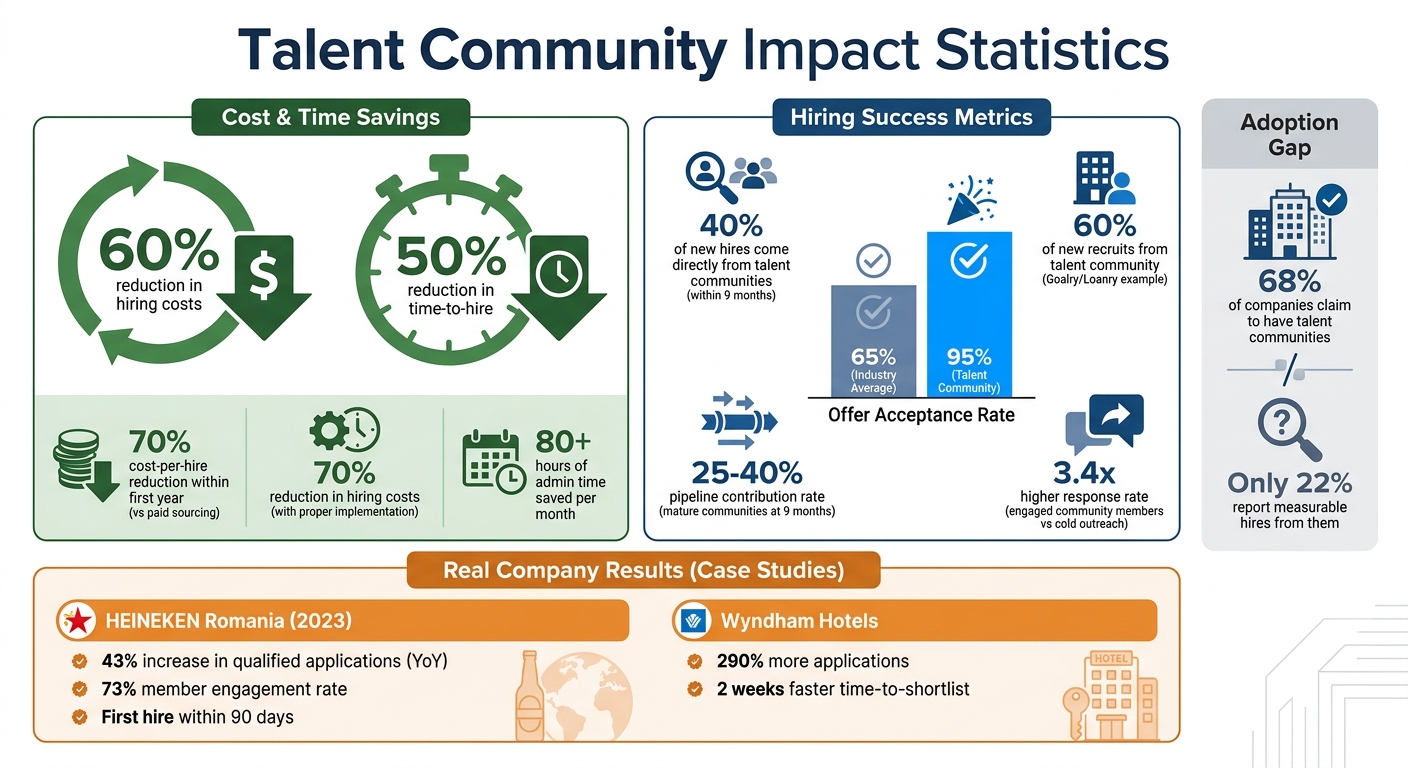
Talent Community Benefits: Key Statistics and ROI Metrics
Strategy 1: Identify and Segment Your Target Candidates
Define Your Key Talent Profiles
Pinpointing your key talent profiles starts with identifying gaps in skills and roles that are challenging to fill [4]. Avoid vague descriptions like "all tech talent." Instead, craft a focused one-page "community thesis" that defines your target audience, what you offer them, and the outcomes you aim to achieve. For instance, consider targeting "Engineers building cloud-native products in Central and Eastern Europe" [3].
"Narrow audiences simplify content creation and boost engagement." – Jobful [3]
Dig into interview data and performance metrics to uncover the attributes that make top performers successful. Use these insights to refine your talent profiles. You can also rate your recruitment process to identify further optimization gaps. A helpful way to structure this is the "5 Cs" framework: Competence (technical expertise), Character (integrity and empathy), Commitment (dedication to the role), Communication (active listening skills), and Collaboration (teamwork) [5]. This approach ensures you know exactly what a "good fit" looks like for your team.
Once you’ve defined these profiles, you can move on to segmenting candidates into pools for more targeted and effective outreach.
Organize Talent Pools for Targeted Outreach
Segmenting your talent pool allows for tailored communication. Group candidates by factors like job function, career stage, location, and professional aspirations [1]. For example, engineers might appreciate updates on the latest technical advancements, while marketing professionals might engage with content about brand strategy [4].
HEINEKEN Romania showcased the power of this approach in 2023. They created a talent community for early-career professionals using gamified challenges. The results? A 43% increase in qualified applications year-over-year, their first hire from the community within 90 days, and 73% of members engaging with at least one challenge [3].
A great starting point for building your segments includes "silver-medalist" candidates – those who impressed in interviews but weren’t hired – along with employee referrals and alumni [1][3]. Using CRM tools like Beamery, Lever, or Ashby can help automate the segmentation process and streamline communication [4]. By organizing your talent into targeted pools, you’ll create a dynamic pipeline that supports talent acquisition strategies for scaling SMEs.
sbb-itb-a23bd6a
Strategy 2: Create Talent Communities with Clear Value Offers
Provide Clear Benefits to Candidates
Candidates want more than just job alerts – they’re looking for something meaningful in return for their time and data. This is where a clear value exchange becomes essential. Think of it as starting a relationship long before a job offer is even on the table.
The best talent communities deliver exclusive content that candidates can’t find elsewhere. This could include behind-the-scenes glimpses into your company culture or authentic employee stories that highlight what it’s like to work with your team [4][1]. Career-focused resources are another big draw. Offer tools like resume tips, interview guides, salary negotiation advice, or learning materials tailored to your industry. These resources provide immediate value and keep candidates engaged [1][3].
Early access perks also make a difference. Personalized job alerts, invites to exclusive webinars, or even Q&A sessions with hiring managers can help candidates feel like insiders [4][1]. Some companies take it up a notch with gamified challenges – think coding tasks, case studies, or simulations. These not only engage candidates but also give them a chance to showcase their skills while staying connected to your brand [3].
"A talent community is a permission-based, branded relationship with future candidates – not an ATS database, not an email list, not a careers page." – Jobful [3]
Once you’ve defined these benefits, the next step is to make it as easy as possible for candidates to join.
Use Multiple Opt-In Methods
To build a thriving talent community, you need to make signing up simple and accessible. The more options candidates have to join, the more likely they are to get involved. Use multiple touchpoints to capture interest: embed sign-up forms on your careers page, include links in social media posts, follow up with opt-ins after interviews, and add registration links to event pages [4][1].
Interactive tools can be especially effective. Chatbots, for instance, can quickly collect candidate details without friction [3]. Newsletters focused on career advice or industry trends provide ongoing value, while personalised invitations can help re-engage former candidates [1][3].
A custom-branded sign-up hub – something like talent.yourcompany.com – can establish credibility and make it easy for candidates to find you [3]. Ensure the sign-up process is seamless. For example, when candidates apply for a role, pre-fill their information from the community database for a one-click application experience [3].
By combining clear value with effortless sign-up options, you create a smooth path from initial interest to active participation in your community.
Take Wyndham Hotels, for example. By introducing a dedicated recruitment platform for their talent community, they saw 290% more applications and reduced their time-to-shortlist for hospitality roles by nearly two weeks [3]. This shows how a well-designed talent community can deliver measurable results.
Strategy 3: Engage Candidates with Customized Content
Build Personalized Communication Paths
Once candidates join your talent community, the real challenge is keeping them engaged. Sending out generic mass emails simply doesn’t cut it. Instead, personalized communication turns a static contact list into an active, thriving talent pipeline.
Start by segmenting your community based on factors like location, job function, or experience level. Then, share content that resonates. For example, send location-specific updates, share employee stories tailored to their roles, or provide resources that support their career growth. Think interview tips, salary negotiation advice, or skill-building guides – content that offers immediate value while keeping your company front and center.
A good rhythm to follow is a twice-weekly schedule: one insider-focused piece, like a leadership Q&A or a technical deep dive, and one practical resource, such as market salary insights or resume advice [3][7]. This approach avoids the hard sell and instead makes candidates feel like they’re gaining something valuable from staying connected [7].
By creating these personalized communication paths, you not only keep candidates engaged but also lay the groundwork for a stronger employer brand.
Use Employer Branding to Build Credibility
Tailored messaging is a start, but a strong employer brand takes engagement to the next level. Today’s candidates scrutinize everything – from job postings to Glassdoor reviews – looking to align what you say publicly with what your employees experience internally. If there’s a mismatch, it can hurt your ability to attract top talent [2].
Your employer brand should reflect your company’s personality and culture. Highlight what it’s genuinely like to work there. One of the most effective ways to do this is by empowering current employees to act as brand ambassadors. Their stories and experiences often feel more relatable and trustworthy than polished corporate messaging. Sharing behind-the-scenes content, like team collaboration snapshots or insights into how decisions are made, helps build authenticity and trust.
"The employer brand should be in congruence with [the customer brand], and it should be the same kind of tone but show what it is like to be on the inside." – Denise Graziano, CEO, Graziano Associates [2]
Creating a dedicated community hub, such as a branded talent portal (e.g., talent.yourcompany.com), adds another layer of credibility. It gives candidates an easy way to interact with your content and reinforces the idea that they’re more than just a number. This approach transforms your talent pool into a dynamic, long-term asset.
Recruitment Marketing: How to Build an Engaged Talent Community
Strategy 4: Maintain Contact Across Multiple Channels
Personalized content is just the starting point. To truly engage candidates, you need to connect with them across multiple platforms.
Use Social Media and Direct Messaging
Relying on email alone won’t cut it anymore. Candidates spend their time on various platforms, and your outreach needs to reflect that. Use LinkedIn, Instagram, and YouTube to share engaging content like employee stories, team spotlights, and "day-in-the-life" videos. Pair this with newsletters that provide updates on employee achievements, career advice, and behind-the-scenes glimpses into your company [4][7].
Direct messaging is where the real magic happens. Sending a personal message after someone interacts with your content or attends an event builds a stronger connection. The numbers back this up: candidates already engaged with your community are 3.4× more likely to respond compared to cold outreach [3].
To keep the momentum going, post regularly – at least twice a week. Mix up your content to include behind-the-scenes insights (like leadership Q&As or technical deep-dives) alongside practical resources (think salary guides or skills challenges) [3]. Audience segmentation is also critical. For instance, send marketing-related updates to marketers and technical opportunities to engineers. This ensures your audience gets relevant content, keeping them engaged without feeling overwhelmed [4].
But digital efforts alone aren’t enough. Real connections often come from live, interactive experiences.
Host Events to Build Real Connections
Virtual panels, career Q&A sessions, office tours, and "day-in-the-life" events can turn casual interest into genuine enthusiasm [4]. These events allow candidates to meet your team, ask questions, and get a true sense of your workplace. Including hiring managers and current employees adds credibility and gives attendees an authentic look at your company culture.
Strategy 5: Activate Employee Advocacy and Alumni Networks
Tapping into your employee and alumni networks can add a powerful dimension to your recruitment strategy. Your current and former employees are invaluable resources – they know your company inside out and are connected to professionals with similar skills and interests. When they share their genuine experiences or promote job openings, they can reach candidates that job boards simply can’t touch [1][2].
Engaged employees and alumni often achieve better response rates than traditional cold outreach. Plus, while external recruiters might charge 15–25% of a new hire’s first-year salary, referrals from employees come at a fraction of that cost [8]. You can compare agency fees vs embedded recruitment to see how these savings impact your bottom line.
Here’s how to empower your employees and alumni to become effective recruitment advocates.
Enable Employees to Share Opportunities
Your employees are already talking about their work, so why not make it easier for them to share job opportunities? Start by identifying those who naturally advocate for your company – employees who’ve referred candidates before or are active on professional platforms [8].
Provide tools that make sharing simple. These could include social media templates, LinkedIn tips, or even offering professional headshot workshops [8]. Encourage employees to create content like "day-in-the-life" videos, participate in Q&A sessions with leaders, or share insights into technical projects. These activities give potential candidates a glimpse into your company culture [3].
Companies with strong employee advocacy programs often see a noticeable boost in qualified leads and faster hiring timelines.
"Staying connected to who your friends know can build up your talent communities pretty quickly. Then, working on social media to spread the news further can expand that even more." – Ethan Taub, CEO, Goalry and Loanry [2]
Recognition plays a big role in keeping employees engaged. Acknowledge advocacy efforts, even if they don’t immediately result in a hire. Employees who feel fairly compensated are 2.8 times more likely to promote their company’s brand [8].
Reconnect with Former Employees
Beyond your current workforce, former employees – especially boomerang hires – can be a valuable part of your talent network. They already understand your culture and can quickly adapt to roles that align with their updated skills [1].
Keep alumni engaged through newsletters or dedicated social media groups that share company updates, new services, and open positions [1]. Don’t stop at former employees – include "silver medalists" (candidates who made it far in the hiring process but weren’t selected) and university alumni networks in your outreach [1][3]. These warm leads are often more receptive than cold prospects.
Ensure your alumni network is a two-way street. Encourage interaction between alumni, recruiters, and current employees rather than relying solely on email updates [1]. Tailor your communication to different segments, such as job function, experience level, or location, to keep it relevant [1]. At Goalry and Loanry, roughly 60% of new hires come directly from their talent community [2].
"Overall, it is a wise play to create a talent community. Even if it is a small enterprise that does not have the bandwidth to make an elaborate portal… just keep the people close in whatever way you can and keep up the interaction." – Denise Graziano, CEO of Graziano Associates [2]
Strategy 6: Use Technology to Manage Talent Communities
Managing a large and diverse talent community without the right tools can quickly become chaotic. But with the right technology, you can turn a static database into a vibrant, active network that consistently delivers hires.
Here’s the difference: traditional hiring tools, like Applicant Tracking Systems (ATS), are built for transactions. They track applications and hiring stages, focusing on the mechanics of filling open roles. Talent Relationship Management (TRM) platforms, on the other hand, focus on relationships. They store engagement history, track skills assessments, and even monitor candidates’ learning progress over time, helping you build lasting connections [9].
The numbers back it up. Companies that prioritize candidate experience through proper technology report a 70% improvement in the quality of hires [9]. Yet, only 22% of talent acquisition leaders say their talent communities produce measurable hires, even though 68% claim to have one [3]. Why? Often, they’re using the wrong tools or treating their communities as nothing more than email lists.
Implement Talent Relationship Management (TRM) Platforms
TRM platforms are designed to do much more than store resumes. They create an interactive environment where candidates stay engaged over time. Modern systems leverage AI to identify potential members, update contact information, and send personalized follow-ups based on candidate behavior. This proactive approach builds stronger, long-term relationships.
Take HEINEKEN Romania as an example. In 2023, they launched a branded talent community on the Jobful platform, targeting early-career professionals in marketing, sales, and supply chain roles. By incorporating gamified challenges that allowed candidates to showcase their skills, they saw a 43% year-over-year increase in qualified applications. Within three months, they made their first hire directly from the community, with 73% of members participating in at least one challenge [3].
Gamification isn’t just about engagement; it also provides objective data on candidates’ skills – something a traditional resume can’t do. Wyndham Hotels experienced similar success with Jobful, achieving a 290% increase in applications and cutting their time-to-fill hospitality roles by two weeks [3].
Advanced TRM platforms can even rank candidates using multi-dimensional analysis, considering over 25 factors like engagement history, challenge performance, and verified skills. When integrated with your ATS, these systems give recruiters a complete view of a candidate’s journey, making the hiring process more informed and efficient [9].
Monitor Engagement Metrics Regularly
Once you’ve implemented a TRM platform, it’s essential to measure its impact. The right metrics will help distinguish a thriving talent community from one that’s just an expensive email list.
One key metric is Weekly Active Members (WAM) – the number of people interacting with your community each week. This is far more telling than simply tracking total registrations [3]. Another critical measure is the pipeline contribution rate, or the percentage of new hires sourced directly from your community. Mature communities often reach a 25–40% contribution rate within nine months [3].
You should also monitor the time-to-shortlist delta, which tracks the time saved per role when sourcing from a warm community versus starting from scratch. And don’t overlook the cost-per-hire (CPH) delta – effective talent communities can reduce CPH by 50–70% within a year compared to paid sourcing channels. Engaged community members are also 3.4 times more likely to respond to outreach than cold leads [3].
Beyond these core metrics, keep an eye on behavioral signals like course completions, challenge participation, and event attendance. These can often predict job performance better than resumes. Pay attention to which types of content – whether it’s leadership spotlights, technical deep-dives, or skills challenges – drive the most engagement, and double down on what works.
"What gets measured gets improved. Monitor open rates, click-through rates, and conversion rates from your talent community to job applications." – Metaview [4]
Consistency is key. Update your community content at least twice a week to keep engagement levels high [3]. If activity drops off for more than a few days, engagement can plummet. Use automated alerts to flag when metrics fall below your baseline so you can take action quickly.
Conclusion
A talent community shifts recruitment from simply collecting resumes to building meaningful, proactive relationships. By pinpointing and segmenting your ideal candidates, offering clear value, engaging with tailored content, staying connected across multiple channels, activating employee networks, and using the right tools, recruitment evolves into a strategic advantage rather than just a cost.
The results speak for themselves. Active talent communities can slash time-to-hire by up to 50%, reduce sourcing costs by about 60%, and achieve a 95% offer acceptance rate compared to the industry average of 65% [3][6]. These numbers highlight how powerful a well-built talent community can be.
"Around 60 percent of our new recruits come from the talent community, which is great." – Ethan Taub, CEO, Goalry and Loanry [2]
For fast-growing SMEs in sectors like technology, SaaS, fintech, and professional services, these strategies create long-term savings. Whether you’re scaling after funding, launching a new product, or managing hiring surges, having a pool of pre-qualified candidates ready to go means you can act quickly without relying on expensive recruitment agencies.
Need help scaling your hiring efforts? Rent a Recruiter places experienced recruiters directly within your team, helping you build and manage talent communities effectively. Our approach reduces hiring costs by up to 70% and saves over 80 hours of internal admin each month. Whether you’re looking for short-term support to meet hiring goals or a long-term solution for predictable recruitment, we’re ready to deliver results fast.
FAQs
How do I start a talent community with no existing database?
To create a talent community from the ground up, start by building genuine connections with potential candidates. Use opt-in methods like sign-up forms on your website, event applications, or other platforms to gather their contact information. Spread the word about your company through social media, career fairs, and industry events to draw in both active job seekers and passive talent. Once they’re part of your network, keep the conversation going with regular updates, job openings, and insights into your company. This approach ensures you have a reliable pool of talent ready for future hiring needs.
How often should I message my talent community without spamming people?
To keep your audience engaged without overwhelming them, aim for a balanced approach to messaging. A good rule of thumb is sending updates every 4 to 6 weeks, ensuring each message offers something useful or relevant.
Leverage automation tools and segmentation to personalize your outreach, so your audience only receives content that aligns with their interests or needs. Prioritize updates that matter – like key company announcements or actionable industry insights – and keep an eye on engagement metrics to fine-tune your timing and content.
The goal? Consistency and relevance. These two elements build trust and ensure your brand stays on your audience’s radar without feeling intrusive.
What metrics show a talent community is generating hires?
Key metrics to watch are cost-per-hire reduction, time-to-fill improvement, pipeline quality, and the number of roles filled through inbound interest. These figures reveal how effectively your talent community is engaging and turning potential candidates into successful hires.