If you rely only on job applicants, you could miss much of your hiring market. LinkedIn estimates that about 70% of the global workforce is passive talent: people who are not actively looking for a job.
We recommend starting with one hard-to-fill role, using personal outreach and referrals alongside job ads. Assess everyone against the same criteria, then track qualified conversations, hiring time, and cost per hire.
The aim is not more messages. It is <u>better access to people who meet your hiring needs</u>. If your team lacks time to run the process, dedicated recruiting support can add capacity at a fixed monthly cost.
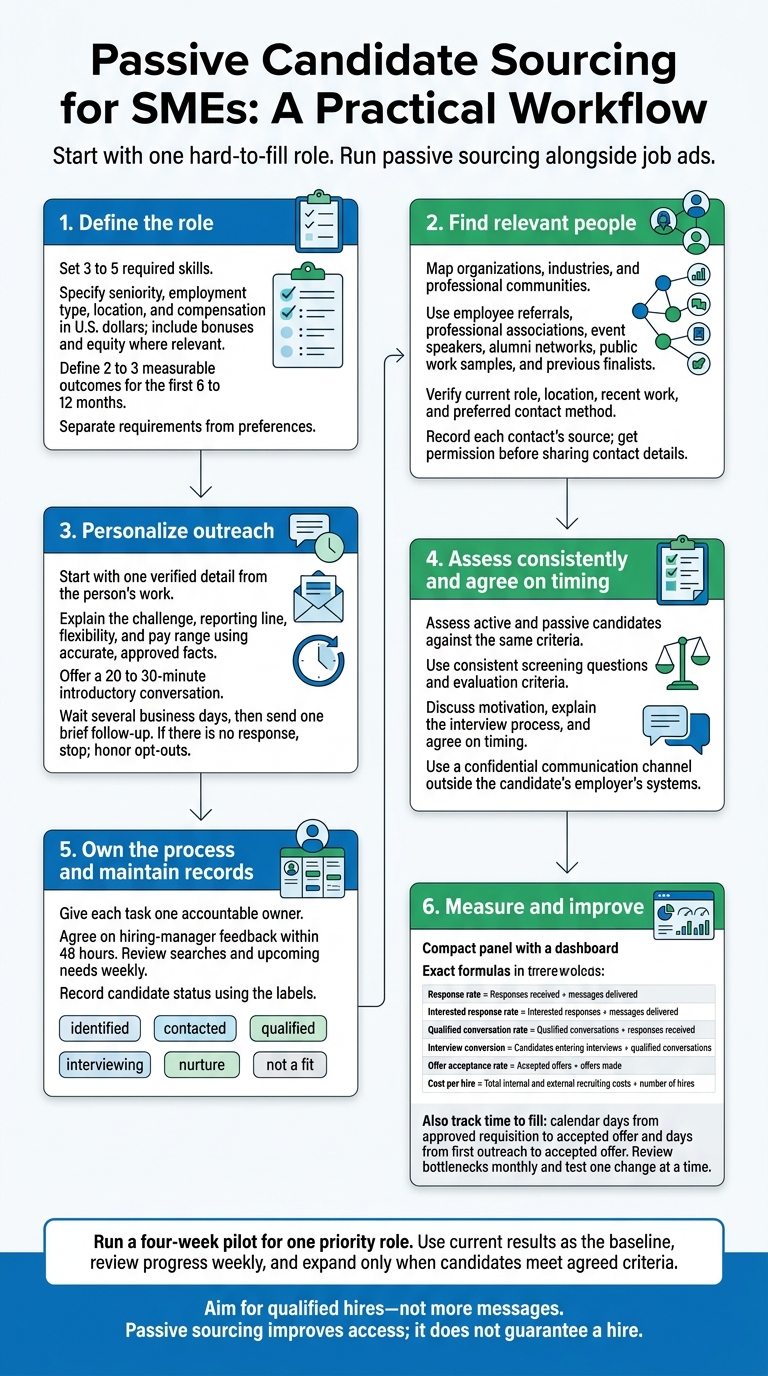
Passive Candidate Sourcing for SMEs: A Practical Workflow
Hiring Challenges Passive Sourcing Can Help Address
Low employer visibility, limited applicant flow, and skills shortages can make it harder for SMEs to reach qualified people. Passive sourcing lets you approach relevant professionals rather than wait for applications. It improves access, but it does not guarantee a hire.
The aim is better access to people with the skills you need, not more sourcing activity.
How Active and Passive Candidate Outreach Differs
The difference starts with the conversation. An applicant has already expressed interest. A passive candidate needs a reason to consider a move. Using both approaches expands your access to relevant experience without assuming either group is better.
| Factor | Active candidates | Passive candidates |
|---|---|---|
| Discovery method | Job postings, career pages, and inbound applications | Professional networks, referrals, and direct outreach |
| Communication needs | Clear role details and next steps | A personal explanation of how the role relates to their goals |
| Decision timeline | Often ready to discuss a move now | May need more time or prefer future openings |
| Recommended SME response | Screen promptly | Discuss motivation and agree on follow-up timing |
Assess every candidate against the same criteria. Define the required skills before reviewing people, then use consistent screening questions and evaluation criteria. Employment status alone does not prove skill or fit.
Match Hiring Challenges to Sourcing Actions
Focus your sourcing effort on the bottleneck slowing hiring. Measure qualified conversations and progress through assessment, not just messages sent. That shows whether the work is improving access to suitable people.
| Hiring challenge | Sourcing action | Outcome to measure |
|---|---|---|
| Low employer visibility | Contact relevant professionals with a clear explanation of your company and role | Outreach response rate and interest in an initial conversation |
| Limited applicant flow | Ask for referrals and revisit past contacts | Additional candidates who meet the role’s minimum requirements |
| Skills shortages | Look for evidence of the specific expertise the role requires | Percentage of sourced candidates who pass the skills assessment |
| Recruiting capacity | Assign dedicated sourcing support; consider Rent a Recruiter when your internal team is stretched | Internal sourcing hours and time to identify qualified candidates |
| Urgent demand | Reconnect with previously assessed contacts and confirm current interest and availability | Time to identify qualified candidates willing to proceed |
Building relationships from scratch takes time. It is not a dependable shortcut for an urgent vacancy. Existing contacts may help you find suitable people sooner, but you still need to check their availability.
sbb-itb-a23bd6a
How to Find and Engage Passive Candidates
Define the Role and Map Relevant Talent
Build a focused target list before you start outreach. A clear role brief helps your talent acquisition team assess fit without spending time on the wrong profiles.
Set out 3 to 5 required skills, seniority, employment type, location, and compensation in U.S. dollars. Include bonuses and equity where they matter to the role. Define 2 to 3 measurable outcomes for the first 6 to 12 months. Separate requirements from preferences so a familiar title or exact technology match doesn’t outweigh relevant experience.
Map the organizations, industries, and professional communities where suitable people work. Include transferable experience, not just matching job titles. Keep the list small enough to check responsibilities and fit before making contact. Use it to guide your referral and network searches.
Find Candidates Through Referrals, Networks, and Past Contacts
Ask employees for introductions to people with the required skills, and get permission before sharing contact details. Look through relevant professional associations, event speakers, alumni networks, and public work samples. Revisit previous finalists, too.
Verify each person’s current role, location, recent work, and preferred contact method. Record where each contact came from so you can see which channels lead to qualified conversations and hires, then direct your team’s time accordingly. Review our recruitment case studies to see how data-driven sourcing improves hiring outcomes.
Personalize Outreach and Respect Candidate Timing
Send a short message that makes the relevance clear. Start with one verified detail from the person’s work, then explain the challenge, reporting line, flexibility, and pay range. Use only accurate, approved facts, and check applicable state and local pay-transparency requirements.[1][2][3]
Base your message on professional information, not assumptions about personal circumstances. Offer a 20 to 30-minute introductory conversation rather than asking for an application.
Wait several business days before sending one brief follow-up with a relevant update. If there’s no response, stop, and honor opt-outs. Track positive responses and qualified conversations separately from total replies so reply volume doesn’t mask poor fit.
For interested candidates, discuss what would make a move worthwhile, explain the interview process, and agree on timing. Set up a confidential communication channel outside their employer’s systems.
Build and Measure Your Sourcing Process
Once outreach starts, a clear process keeps interested candidates from slipping through the gaps and saves your team time.
Assign Responsibilities and Keep Candidate Records Current
Document the workflow before hiring becomes urgent. Create a one-page playbook covering sourcing, outreach, follow-up, scheduling, record updates, and reporting. Give each task one accountable owner, agree on hiring-manager feedback within 48 hours, and review searches and upcoming needs weekly.
Organize records by role fit, location or time zone, availability, and pipeline stage. Use clear stages: identified, contacted, qualified, interviewing, nurture, and not a fit.
Keep approved message templates and follow-up rules in the playbook, including when to stop contacting someone. Review inactive records regularly, update preferences, remove duplicates, and honor no-contact requests. Limit access and follow privacy and recordkeeping requirements.
This helps you maintain relationships with passive candidates between searches while respecting their preferences. It also gives you the records needed to see which sources and messages lead to qualified conversations.
Measure Sourcing Results, Hiring Time, and Costs
Define each metric before building your dashboard. Consistent definitions and clear denominators help you assess whether passive sourcing generates qualified interest and hires.
| Metric | Definition |
|---|---|
| Response rate | Responses received ÷ messages delivered |
| Interested response rate | Interested responses ÷ messages delivered |
| Qualified conversation rate | Qualified conversations ÷ responses received |
| Interview conversion | Candidates entering interviews ÷ qualified conversations |
| Offer acceptance rate | Accepted offers ÷ offers made |
| Time to fill | Calendar days from approved requisition to accepted offer |
| Days from first outreach to accepted offer | Calendar days from first outreach to accepted offer |
| Hires from preexisting relationships | Hires whose documented recruiting relationship began before the vacancy opened |
Compare results by role, seniority, location, compensation range, hiring period, and source. Track recruiting spending and internal hours. Calculate cost per hire by dividing total internal and external recruiting costs by the number of hires.[4][5]
Review bottlenecks monthly and test one change at a time so you can see what affects results. Compare hires using the same retention and performance measures at 90 days, 6 months, and 12 months.
When your process is clear but your team lacks the time to run it, dedicated recruiting support can add capacity.
Add Recruiting Capacity With Rent a Recruiter
If sourcing and coordination exceed your team’s capacity, Rent a Recruiter places experienced recruiters inside your team on fixed monthly pricing to manage hiring from start to finish. They handle timely outreach, follow-ups, record updates, and candidate relationships between searches.
The company says recruiters can join within days. It reports hiring cost reductions of up to 70% and more than 80 hours saved per month in internal hiring and admin time. Results depend on role scope and hiring needs.
Conclusion: Start With One Priority Role
For SMEs, passive sourcing helps you reach qualified people when applications fall short. Keep it focused, measure results, and tie it to one business-critical hire.
Choose a role that holds back revenue or delivery while vacant. Before outreach, agree on must-have qualifications, trainable skills, compensation, and a start date. Assign one owner to run a four-week pilot alongside active recruiting. Use the same screening criteria for both.
Use your current results as the baseline and review progress weekly. You can also perform a recruitment health check to identify further process gaps. Expand only when candidates meet your agreed criteria. Aim for qualified hires and a more predictable process, not a longer contact list.
Short on recruiting time? Contact Rent a Recruiter for support with your priority role.
FAQs
How can my SME attract passive candidates without offering higher pay?
Attracting passive candidates without offering higher pay starts with their career goals, not a standard recruitment pitch. Show what your business offers beyond salary, and build your employer brand by sharing industry insights and leadership perspectives.
Make outreach personal. Reference their work, such as a GitHub project or conference talk, then suggest a low-pressure, 15-minute chat about their career goals.
Stay in touch with relevant updates or career resources, even when you don’t have an open role. That gives you a relationship to build on when hiring starts.
How long should I nurture a passive candidate?
Match candidate follow-ups to engagement and readiness, not a fixed schedule. This keeps your team’s effort focused:
- Check in quarterly with qualified candidates who aren’t engaged.
- Contact interested candidates who aren’t ready to move monthly.
- Stay in touch with top-tier candidates every 3 to 4 weeks.
When a candidate replies, pause other outreach and adjust your approach to their response. After three unanswered attempts, step back and plan to reconnect in 4 to 6 months.
Review your full talent pool quarterly to plan follow-ups and clean up records.
What should I do if my outreach gets no interest?
Send one follow-up 5 to 7 days after your first message. If there’s still no reply, respect the candidate’s silence and pause contact. Too much persistence can damage your employer brand.
Add them to your talent pool and plan to reconnect in 4 to 6 months. Share useful content, such as industry reports or company news, to keep the relationship open without pressure.