
Scaling your team comes with hidden risks. Misclassify just 10 workers, and you could face up to $680,000 in penalties. For high-growth SMEs, wage compliance often falls through the cracks as hiring accelerates, processes become inconsistent, and state-specific rules pile up. Without the right systems, even minor errors can lead to audits, lawsuits, or fines.
Here’s the bottom line: compliance isn’t just about avoiding penalties – it’s about protecting your business as you grow. This checklist breaks down key wage compliance areas like worker classification, overtime rules, multi-state payroll, and pay transparency into actionable steps. It’s designed to help you stay compliant as your team scales, saving time, money, and potential legal headaches.
Key Areas to Address:
- Worker Classification: Ensure roles meet FLSA exempt/nonexempt criteria to avoid misclassification penalties.
- Overtime Rules: Calculate overtime correctly, including bonuses and commissions.
- Minimum Wage Laws: Pay the highest applicable rate for federal, state, or local laws.
- Pay Transparency: Comply with salary disclosure laws in 14+ states.
- Multi-State Payroll: Manage compliance for remote teams across different locations.
Struggling to keep up with compliance as you scale? Embedded recruitment providers like Rent a Recruiter can help. They integrate compliance into your hiring process, ensuring every role aligns with wage laws from day one. For growing companies, this means fewer risks and more time to focus on growth.
Wage Compliance Checklist for High-Growth Hiring
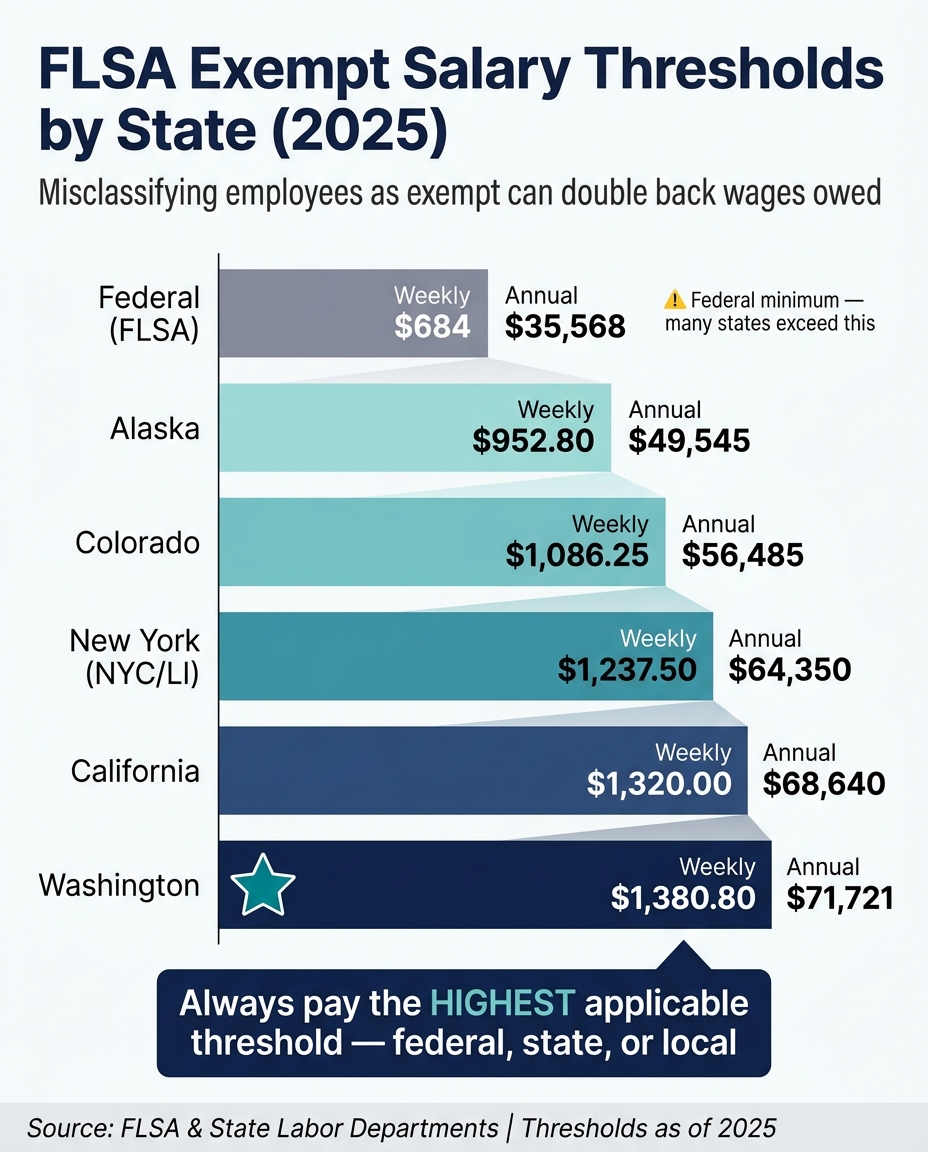
FLSA Exempt Salary Thresholds by State (2025)
As your business scales, staying on top of wage compliance becomes more complex. This checklist offers practical steps to help you navigate the challenges of rapid growth. Think of it as an ongoing guide rather than a one-time task. Each point addresses areas where fast-growing companies often face compliance risks, especially when hiring accelerates and processes lag behind.
1. Map Roles to the Correct FLSA Exempt or Nonexempt Status
Before classifying any role as exempt under the Fair Labor Standards Act (FLSA), make sure it meets the Salary Basis Test, the Salary Level Test, and the Job Duties Test. All three must be satisfied.
The default classification is nonexempt, meaning employees are eligible for overtime unless you can prove otherwise. Alarmingly, nearly 40% of business owners mistakenly believe that salaried workers are automatically exempt, which can lead to costly errors [3].
"Salaried is not synonymous with exempt." – Enzo O’Hara Garza, HR Specialist [3]
Classification depends on what employees actually do, not their job titles. For example, calling someone a "Manager" or "Director" doesn’t automatically make them exempt. When in doubt, classify borderline roles as nonexempt to avoid risks like liquidated damages, which can double back wages owed [3].
Keep in mind the federal salary threshold is $684 per week ($35,568 annually), but certain states have higher thresholds. For example:
| Jurisdiction | Weekly Threshold | Annual Equivalent |
|---|---|---|
| Federal (FLSA) | $684.00 | $35,568 |
| California | $1,320.00 | $68,640 |
| Washington | $1,380.80 | $71,721 |
| New York (NYC/LI) | $1,237.50 | $64,350 |
| Colorado | $1,086.25 | $56,485 |
| Alaska | $952.80 | $49,545 |
Source: [1]
To demonstrate compliance, maintain a standardized FLSA worksheet for every role. This not only ensures proper classification but also shows "good faith" during audits [3][5].
2. Standardize Job Descriptions and Pay Bands
Job descriptions aren’t just for attracting candidates; they back up your FLSA classification decisions. If a description doesn’t align with actual duties, it opens the door to compliance issues [3][5].
Create clear pay bands tied to responsibilities and minimum wage laws. Update job descriptions whenever a role’s duties change significantly.
3. Track Federal, State, and Local Minimum Wage Requirements
Always pay employees the highest applicable minimum wage – whether it’s federal, state, or local [1][6]. While the federal minimum remains $7.25 per hour, many states and cities have much higher rates. For instance, by 2025, California will be at $16.00 per hour, Washington at $16.66, and New York City at $16.50 [1].
This rule applies to remote employees too. For example, if someone works remotely from Colorado, you must pay them at least Colorado’s minimum wage, even if your company is based elsewhere. Use a compliance calendar with automated reminders for state wage updates, and register with tax authorities in every state where your employees are based [7].
4. Apply Overtime Rules and Premium Pay Correctly
For nonexempt employees, overtime pay is 1.5 times the regular rate for hours worked over 40 in a workweek [7]. While this sounds simple, it can get tricky when bonuses, shift differentials, or multiple pay rates are involved.
Non-discretionary bonuses (e.g., tied to performance or attendance) must be included in the regular rate before calculating overtime. Train managers to understand what counts as "hours worked", such as pre-shift prep, post-shift emails, and mandatory training. Avoid using informal "comp time" as a substitute for overtime pay [3][5].
5. Structure Variable Pay, Bonuses, and Commissions to Meet Wage Laws
Variable pay, such as bonuses or commissions, cannot replace the minimum wage. Employees must still receive at least the applicable minimum wage in cash for every hour worked [1].
"You cannot pay employees with equity alone. FLSA requires paying at least minimum wage in cash." – Promise Legal [1]
For nonexempt employees, non-discretionary bonuses and commissions must be factored into the regular rate when calculating overtime. Equity compensation, like stock options, is supplemental and doesn’t count toward FLSA minimum wage requirements. Ensure all variable pay plans are documented, and clearly outline base salary, payment schedules, and classification in offer letters [1].
6. Use Accurate Timekeeping for All Hours Worked
Accurate timekeeping is critical. Your system must capture all hours worked – including early starts, late finishes, and work done outside normal hours [6].
Off-the-clock work is a serious liability. If a manager knows an employee is working and does nothing, the employer must compensate that time. Use consistent timekeeping systems and audit them regularly to identify and address gaps.
7. Verify Deductions, Withholdings, and Payroll Calculations
All payroll deductions must comply with the law. Deductions that bring a nonexempt employee’s pay below minimum wage – or violate the salary basis test for exempt employees – can lead to immediate compliance problems [3].
Statutory withholdings include FICA taxes (6.2% for Social Security on earnings up to $176,100 in 2025, and 1.45% for Medicare) and FUTA tax at 6.0% on the first $7,000 of wages, reducible to 0.6% with timely state filings [7]. Conduct quarterly audits to catch errors, and document everything for potential audits.
"The business owner is always responsible for payroll compliance." – Scott Leitner, Senior Manager of Payroll Operations, Homebase [7]
8. Meet Equal Pay, Pay Transparency, and Anti-Discrimination Requirements
Pay equity isn’t optional. As of 2025, 14 states require public pay transparency, meaning salary ranges must be disclosed in job postings or provided upon request [7]. Laws like the Equal Pay Act prohibit wage gaps based on sex for substantially equal roles, with some states extending protections further.
Conduct annual pay equity analyses to identify and address any unexplained wage gaps. Document pay decisions and the criteria behind them. If hiring in states with pay transparency laws, include salary ranges in all job postings.
9. Follow Meal, Rest, and Off-Duty Time Rules
While federal law doesn’t mandate meal or rest breaks for adults, many states do – and their rules vary. Rest breaks (typically under 20 minutes) are generally paid, while meal breaks (usually 30 minutes or more) are unpaid if employees are completely relieved of duties [6].
As your team grows, managing break schedules consistently can be challenging. Use timekeeping systems to enforce break policies and train managers on state-specific rules. For example, California requires a 30-minute unpaid meal break for shifts over five hours and a paid 10-minute rest break for every four hours worked.
10. Keep Required Wage and Hour Records
The FLSA mandates that payroll records be kept for at least three years [4], while the IRS recommends retaining employment tax records for at least four years [7]. These records should detail hours worked, wages paid, overtime, and deductions.
Organize records for quick access. If a wage claim or Department of Labor investigation occurs, you’ll need to provide documentation promptly. Store records securely and ensure your system can generate detailed reports by employee, pay period, and location.
11. Manage Wage Compliance Across Multiple States and Remote Teams
Hiring across state lines adds layers of compliance complexity. Each state where an employee works has unique rules for minimum wage, overtime, and breaks. Establish systems to manage these obligations effectively, especially for remote teams.
sbb-itb-a23bd6a
Embedding Wage Compliance into Your Hiring Infrastructure
Building a Compliance-First Recruitment Process
Wage compliance doesn’t begin on payday – it starts the moment you open a job requisition. Embedding compliance into every step of recruitment ensures that every hire aligns with wage laws from day one. One of the best ways to avoid costly errors is by linking payroll setup directly to recruiting.
Before posting a role, ensure each job requisition confirms its FLSA classification. Offer letters should clearly outline the position title, whether the role is salaried or hourly, overtime eligibility, and at-will employment terms. Skipping these details can increase legal exposure. For context, the average settlement for a discrimination lawsuit ranges between $40,000 and $400,000, not including legal fees [1].
Onboarding also comes with strict timelines, even during periods of rapid hiring. For instance, I-9 forms must be completed within specific deadlines: Section 1 on the first day of work and Section 2 by the third day. Additionally, new hire reporting must occur within 20 days. Missing the Work Opportunity Tax Credit (WOTC) submission deadline of 28 days from hire can cost your company between $2,400 and $9,600 per qualifying hire [8]. A standardized onboarding checklist for all hires – regardless of their role or seniority – helps prevent these costly oversights and ensures processes stay consistent as your team grows.
"Payroll mistakes often begin as onboarding mistakes." – Employees.info [5]
These early steps establish a compliance framework that scales with your hiring needs, as discussed further below.
Using External Support to Scale Compliance
When hiring accelerates, internal teams often struggle to maintain compliance. Job classifications may be informal, offer letters rushed, and onboarding steps overlooked – turning minor gaps into major liabilities.
This is where Rent a Recruiter steps in. By embedding experienced recruiters into your team, they ensure compliance measures are baked into your recruitment process from the start. Their approach standardizes job requisitions, offer letters, and onboarding workflows, maintaining consistency even during high-growth periods. This structured method pairs seamlessly with automated compliance systems, creating a bridge between internal processes and technology for end-to-end reliability. For scaling companies in technology, SaaS, fintech, and professional services, this consistency is critical when hiring demands outpace internal resources. On average, clients save over 80 hours per month in hiring and admin tasks, allowing HR and finance teams to focus on higher-value activities like audits and risk management.
Technology further simplifies compliance management, especially as your team expands.
Using Technology to Manage Wage Compliance
Manual compliance methods – like spreadsheets and paper records – quickly become unmanageable as your workforce grows. By 2026, it’s estimated that 60% of companies with fewer than 200 employees will have staff in multiple states [9]. This creates a much broader compliance challenge than most small and mid-sized businesses anticipate.
Integrated platforms that combine HRIS, payroll, and timekeeping systems can automate many compliance tasks. For example, they can flag when a remote employee’s work location changes, identify applicable minimum wage and leave laws, and send alerts before deadlines are missed. Features like digital I-9 management and regulatory dashboards ensure your documentation is always audit-ready with minimal manual effort. What once took days to retrieve can now be done in minutes [10].
| Compliance Task | Manual Approach | Software-Assisted Approach |
|---|---|---|
| Deadline tracking | Spreadsheets prone to human error | Automated alerts sent to responsible team members [10] |
| Multi-state rules | Manual research for each employee | Automatic flags based on work location [10] |
| I-9 management | Physical filing and manual storage | Digital I-9 with audit trails and re-verification prompts [10] |
| Regulatory changes | Reactive discovery of new requirements | Proactive dashboard notifications before deadlines [10] |
"Technology can be a game-changer for startups in recruitment compliance." – Josh Bersin, Founder, Josh Bersin Academy [11]
HR software platforms offering these features typically start at around $98/month [8]. Compared to the financial and reputational damage of a single compliance violation, this is a small price to pay for peace of mind.
Conclusion: Growing with Wage Compliance in Place
This section emphasizes how integrating wage compliance into your growth strategy isn’t just a legal necessity – it’s a foundation for sustainable growth.
Key Takeaways for High-Growth SMEs
The stakes are high. Misclassifying just one worker could cost over $50,000 in liabilities [1]. Since 2000, U.S. companies have collectively paid approximately $3 billion in employment-related lawsuits [2]. Proper worker classification and maintaining accurate wage records are critical safeguards. And here’s the reality: pay transparency is no longer optional. At least 14 states now require salary ranges in job postings [12].
"Minor missteps can lead to hefty fines, litigation, and significant damage to your company’s reputation." – Cristina Amyot, President of EnformHR [2]
Next Steps: Putting the Checklist to Work
To stay ahead, take a proactive approach. Here’s a practical four-week plan to address compliance risks:
- Week one: Audit worker classifications to ensure accuracy.
- Week two: Update offer letters and job descriptions to align with current regulations.
- Weeks three and four: Conduct payroll audits and provide manager training to close any gaps.
If your hiring pace is outstripping your internal resources, external solutions can help. Rent a Recruiter places skilled recruiters directly within your team. This ensures compliance is integrated into every step – requisitions, offer letters, and onboarding – right from the start. For high-growth industries like technology, SaaS, fintech, and professional services, this consistency is vital when hiring scales quickly.
"Treat payroll compliance as a recurring operating process, not a once-a-year tax task. The businesses that avoid the worst penalties are usually the ones that standardize job offers, timekeeping, approvals, and payroll reviews before problems occur." – Employees.info [5]
FAQs
How can I confirm if a role is FLSA-exempt?
To determine if a role qualifies as FLSA-exempt, check if the employee satisfies both the salary basis and duties tests under the Fair Labor Standards Act (FLSA). This means the employee must:
- Earn at least the minimum salary threshold set by the FLSA.
- Perform exempt duties, such as tasks categorized under executive, administrative, or professional roles.
It’s essential to review the detailed criteria provided by the FLSA to ensure the role meets compliance standards.
What overtime mistakes trigger audits most often?
Mistakes in handling overtime can quickly draw the attention of regulators, especially when it comes to compliance with the Fair Labor Standards Act (FLSA). Some of the most frequent errors include:
- Misclassifying employees: Incorrectly labeling workers as exempt or non-exempt can lead to unpaid overtime claims. Exempt employees aren’t entitled to overtime pay, but misclassification could mean you’re unintentionally violating wage laws.
- Inaccurate tracking of hours: Failing to properly monitor and record overtime hours worked is another common pitfall. Without clear records, it’s difficult to ensure employees are compensated fairly.
- Improper overtime calculations: Missteps in calculating overtime pay – such as not including bonuses or other earnings in the regular rate – can result in underpayment and compliance issues.
Regularly reviewing employee classifications and payroll practices is critical to avoiding these errors and staying compliant with FLSA regulations.
What changes when I hire employees in multiple states?
When hiring in multiple states, you’ll need to navigate each state’s specific rules and requirements. These include payroll taxes, minimum wage laws, overtime regulations, pay frequency, and leave policies. The more states you hire in, the more complex it gets, and the risk of non-compliance grows.
Staying compliant means keeping track of these regulations and ensuring your processes are aligned. Staying informed and organized isn’t just important – it’s essential to avoid costly penalties or legal issues.