Hiring across state lines does not create a separate set of union rules for your remote team. We recommend starting with accurate work-location records, clear reporting lines, and a named contact for legal questions. These steps help you limit rework, avoid conflicting manager responses, and keep hiring decisions on track.
For employers, the priorities are straightforward:
- Know your workforce. Record where people work, which entity employs them, and what they do.
- Prepare managers. Set clear escalation steps before anyone responds to organising activity.
- Check before making changes. Pay, schedules, monitoring, and remote-work terms may require legal review.
- Keep hiring records consistent. Give HR, payroll, and embedded recruitment teams clear ownership so missing information does not delay decisions.
State lines alone do not decide who can belong to a bargaining unit. <u>Accurate records and early legal advice come first.</u> We’ll explain what that means for your remote team and hiring process.
Employee Location, Jurisdiction, and Bargaining Units
Once coverage is settled, establish where each remote employee actually works for bargaining-unit analysis.
Keep location records separate from legal conclusions. Location facts inform jurisdiction and unit analysis. The NLRB office handling a petition administers the case, but it does not decide unit membership.[8]
Work Location Records to Maintain
Maintain each employee’s actual work state and worksite, duties, classification, supervisor, employing entity, assigned reporting location, and remote-work agreement. Record schedules, regular interstate travel, and shared reporting relationships.
Cross-check this information against payroll and HR data. Neither system provides a definitive answer on its own.
| Factor | Relevance | Limits |
|---|---|---|
| Actual employee work location | Establishes state and site facts. | Does not alone determine unit membership. |
| Headquarters or assigned office | Shows reporting structure and operational control. | Does not establish actual work location. |
| Employing legal entity | Identifies the employer for bargaining and employment decisions. | Shared branding or ownership does not automatically combine separate entities into one employer. |
| Payroll location | Supports record reconciliation. | May differ from actual work location. |
| Proposed bargaining-unit scope | Identifies employees sought for representation. | The NLRB determines whether the grouping is appropriate. |
Track relocations, effective dates, and previous and current work locations to support eligibility-date analysis. Restrict access to home addresses, store them separately from routine unit-analysis records, and apply retention limits. Use the same update process before and during organizing activity.
Bargaining Units Across State Lines
The NLRB evaluates community of interest, which covers shared duties, supervision, schedules, and working conditions. It also considers skills, employee interaction, operational integration, and bargaining history.[7]
Units may cover a single site, multiple sites, or a company-wide remote workforce. Shared assignments, managers, and policies can support a broader unit. Material differences can support separate units.
Compare employees inside and outside the proposed unit using actual duties, organizational charts, schedules, compensation, and cross-site project records. The proposed unit must be appropriate, even if other groupings would also be appropriate.[5][6] Have labor counsel verify the controlling standard before you accept or contest the proposed boundary.
sbb-itb-a23bd6a
Responding to Remote Employee Organizing
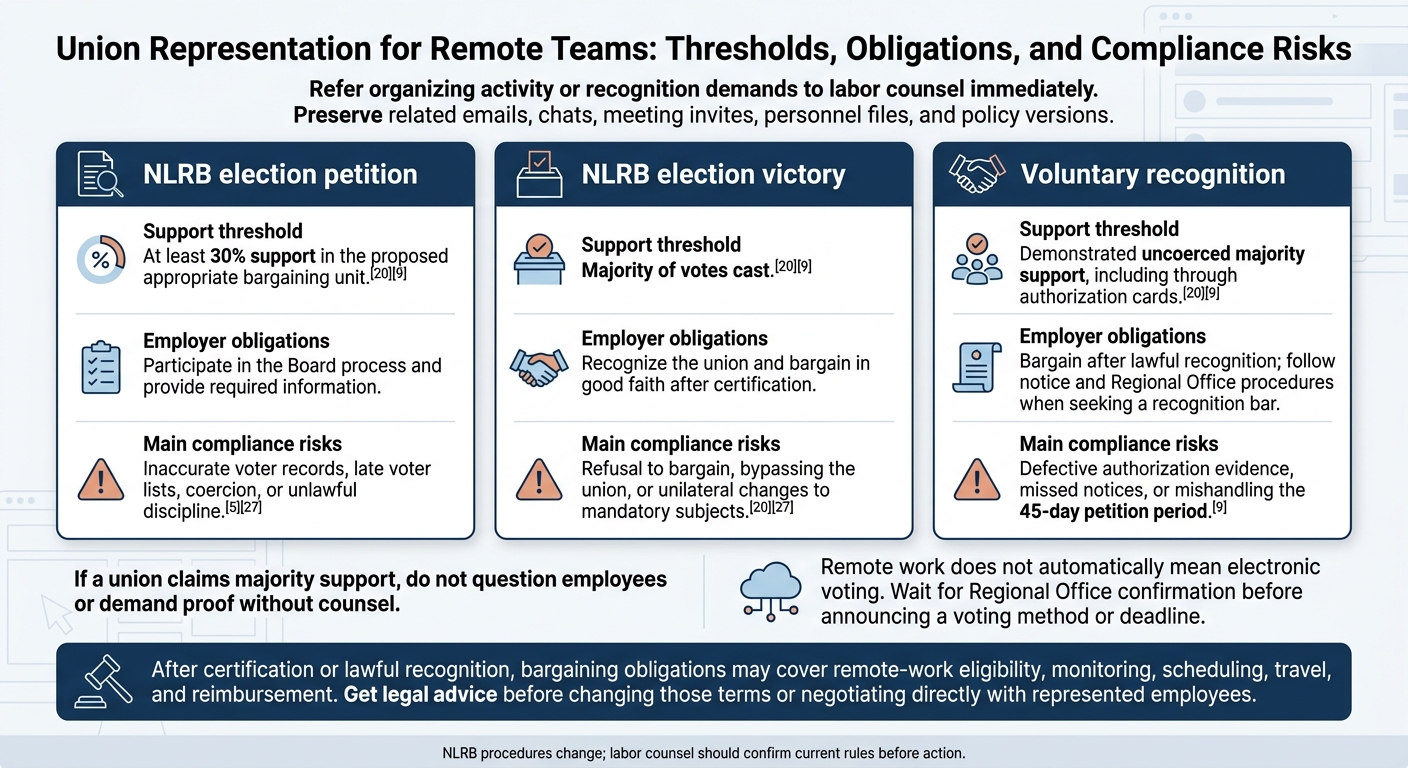
Remote Team Union Recognition: Thresholds and Employer Duties
Once the likely bargaining unit is clear, respond to any organizing demand promptly and with legal oversight.
Refer organizing activity or recognition demands to labor counsel immediately. Preserve related emails, chats, meeting invites, personnel files, and policy versions. NLRB procedures change, so counsel should confirm the current rules before you act.
Union Recognition and NLRB Elections
Employees gain representation through an NLRB election or voluntary recognition. If a union claims majority support, do not question employees or demand proof without counsel. Before any recognition decision, counsel should review authorization-card language, the unit definition, authorization validity, and any signs of coercion.[5][9] Your response should also align with your remote-work rules and recordkeeping practices.
Use this table to check the required response and compliance risks.
| Pathway or stage | Support threshold | Employer obligations | Main compliance risks |
|---|---|---|---|
| NLRB election petition | At least 30% support in the proposed appropriate bargaining unit[9][5] | Participate in the Board process and provide required information | Inaccurate voter records, late voter lists, coercion, or unlawful discipline[4][14] |
| NLRB election victory | Majority of votes cast[9][5] | Recognize the union and bargain in good faith after certification | Refusal to bargain, bypassing the union, or unilateral changes to mandatory subjects[9][14] |
| Voluntary recognition | Demonstrated uncoerced majority support, including through authorization cards[9][5] | Bargain after lawful recognition; follow notice and Regional Office procedures when seeking a recognition bar | Defective authorization evidence, missed notices, or mishandling the 45-day petition period[5] |
After certification or lawful recognition, bargaining obligations may cover remote-work eligibility, monitoring, scheduling, travel, and reimbursement. Get legal advice before changing those terms or negotiating directly with represented employees.[11]
Election Rules for Remote Employees
The NLRB controls voter eligibility, unit scope, timing, notices, and voting procedures. Remote work does not automatically mean electronic voting. Depending on the case and any party agreements, voting may be in person, by mail, manual, or through other authorized methods. Wait for Regional Office confirmation before announcing a voting method or deadline. Where required, employers that normally communicate electronically must also distribute the Notice of Petition for Election electronically.[5]
Keep underlying eligibility records separate from the voter list. Maintain payroll records, classifications, status, and contact details, including personal email addresses and phone numbers. Confirm the list format, recipients, delivery method, and deadline with counsel and the Regional Office to avoid submission errors.[10]
Manager Conduct During Digital Organizing
Managers must not threaten, interrogate, surveil, promise benefits, retaliate, or discipline selectively. The same restrictions apply across video calls, email, chat, texts, and monitoring tools. Use only accurate, counsel-approved statements.[11][13]
Board and court rulings on mandatory captive-audience meetings can change quickly. Counsel must confirm the current rule, including required disclosures, protections for employees who decline or leave voluntary meetings, and restrictions on attendance tracking.[12]
Preserve records, stop any retaliatory conduct, and route all manager communications through HR and labor counsel.[11][12][13] Audit email, chat, remote-work rules, and monitoring tools before the campaign extends into handbook and hiring issues. For ongoing support with compliant hiring practices, consider a recruitment as a service model.
Keeping Hiring and Remote Policies Compliant
Once you’ve organized risk, review the policies and records that guide day-to-day hiring and remote work.
Records and Policies to Review
Use one national baseline policy, with state and local supplements covering paid leave, wage discussions, privacy, monitoring, and required notices. Check that confidentiality rules do not broadly restrict protected discussions about working conditions.[15] Preserve evidence and check bargaining obligations before changing mandatory subjects.
| Check | Documentation or control | Owner | Review trigger |
|---|---|---|---|
| Workforce data | Work state/locality, location history, employing entity, reporting location, classification, supervisor, schedule, pay basis, and bargaining-unit status | HR | Hire, relocation, entity change, reorganization, or quarterly audit |
| Manager training | Consistent hiring criteria, escalation instructions, and documented legitimate reasons for personnel decisions | HR and labor counsel | New manager, complaint, or policy change |
| Technology use | Approved monitoring purpose, access permissions, recording rules, retention settings, and notices | IT and privacy counsel | New tool or configuration change |
| Employee communications | Neutral rules covering social media, confidentiality, solicitation, distribution, communications with coworkers, and wage discussions | HR and labor counsel | Handbook update or new state |
| Records | Hiring decisions, time and pay records, policy versions, acknowledgments, access logs, training records, personnel actions, and litigation holds | HR, payroll, IT, and legal | Audit, complaint, investigation, or agency charge |
| Legal review | Federal NLRA requirements; state and local wage, leave, privacy, monitoring, notice, and employment rules; preemption and bargaining duties | Labor and employment counsel | New state, employing entity, union petition, contract, or material workplace change |
Follow the longest applicable retention period and suspend deletion whenever a preservation duty applies.[16][17]
Have counsel determine whether federal labor law preempts a state rule and whether notice, information sharing, or bargaining is required. Even when a decision is not bargainable, its effects may be. Do not change mandatory subjects unilaterally when bargaining applies.[11]
As headcount grows, assign compliance ownership before gaps create labor-law exposure.
Compliance Responsibilities as Hiring Grows
Put responsibilities in writing: HR owns workforce records; IT owns approved technology practices; managers own lawful conduct; counsel owns legal interpretation.
Recheck those assignments when you enter a state, change remote arrangements, reorganize teams, or add employing entities. Track issues affecting protected activity, bargaining duties, and record accuracy.
Measure record completeness, training completion, and escalation response times, not union support or protected conversations. Hiring support should improve record discipline without replacing legal judgment.
Recruitment Support from Rent a Recruiter
Rent a Recruiter can help organize hiring workflows, candidate records, job information, location data, compensation ranges, and classification inputs within your existing process.
Checks Before Taking Action
When organizing activity appears, complete these checks before any manager responds.
- Confirm supervisor status and unit scope. Check each employee’s duties, work state, and employing entity against the proposed bargaining unit. State lines alone do not prevent a multi-state unit.[18]
- Escalate immediately. Send any union demand or NLRB petition to labor counsel, record the receipt date, and assign one response team.
- Review workplace changes before implementation. Have labor counsel review proposed changes to pay, scheduling, discipline, monitoring, or system access before putting them into effect.
- Keep manager communications within NLRA limits. Remote work does not remove organizing rights. Covered employees retain rights to protected organizing activity in email, chat, and video meetings.[18]
FAQs
How do right-to-work laws affect a multistate remote union?
Right-to-work laws limit a union’s ability to require employees to pay dues as a condition of employment. This can reduce union funding and bargaining leverage.
For a remote workforce covered by a union across multiple states, each employee’s physical work location determines which state rules apply, not your company’s headquarters. Apply the rules for the state where each employee works.
What happens if a unionized remote employee moves states?
The employee’s new work location generally determines which employment laws apply, not your headquarters. That includes stricter state rules on minimum wage, paid leave, overtime, breaks, notices, filings, and tax withholding.
Treat the move as a compliance re-check. Update payroll, benefits, registrations, records, and forms as needed. If the work arrangement changes, review employee classification and any other compliance assumptions. [1][2][3]
Which remote managers qualify as supervisors under the NLRA?
The provided Rent a Recruiter search results don’t define “supervisors” under the NLRA or explain which remote managers qualify.
They address other multi-state compliance topics: wages, FLSA exempt/nonexempt classification, and remote-work jurisdiction rules. The supplied sources don’t contain enough information to answer this question. [1][2]