
DEI metrics in hiring are critical for scaling companies to attract top talent, reduce bias, and improve hiring outcomes. Tracking data at every stage of recruitment helps you identify gaps, improve processes, and align hiring efforts with business goals. Companies with diverse teams outperform peers financially and drive higher innovation revenue, making DEI not just a moral imperative, but a competitive advantage.
Here’s what you’ll learn:
- Why measure DEI metrics? To eliminate bias, make data-driven hiring decisions, and strengthen your employer brand.
- What to track: Applicant demographics, interview progression rates, and offer acceptance ratios.
- How to implement: Use your ATS to track data, create DEI scorecards, and monitor real-time dashboards.
Scaling companies that integrate DEI metrics into their hiring processes can reduce turnover, improve retention, and attract better talent. Want to see results faster? Partner with Rent a Recruiter for expert support in building a diverse, high-performing team.
Top 4 DEI (Diversity, Equity, Inclusion) Metrics Every HR Leader Should Track| greytInsights
sbb-itb-a23bd6a
Why Track DEI Metrics in Hiring
Tracking DEI metrics goes beyond meeting compliance requirements – it’s about making informed business decisions that drive better outcomes. By measuring diversity at every stage of your hiring process, you can pinpoint where qualified talent is being overlooked and uncover opportunities to bring fresh perspectives and innovation into your team.
Better Hiring Decisions with Data
Relying on assumptions or gut instincts often falls short when it comes to fairness. Data reveals where diverse candidates are dropping out of the hiring funnel, enabling you to make targeted adjustments. This shift from subjective evaluations to objective, competency-based assessments ensures a more equitable hiring process.
For example, tracking your Diversity Sourcing Ratio can show which recruitment channels are most effective at attracting qualified, diverse candidates. Armed with this insight, you can reallocate your budget to maximise results. The benefits aren’t just operational – companies in the top quartile for ethnic diversity achieve 19% higher innovation revenue from new products compared to their less diverse peers [6].
By identifying where candidates from underrepresented groups are falling through the cracks, you can address biases that hinder their progression.
Reducing Unconscious Bias
Data also shines a light on unconscious bias, which can otherwise go unnoticed. As Rod Danan, Founder of Prentus, explains:
"Without [metrics], bias is invisible. With them, organizations can identify exactly which stage of their process is losing diverse talent and make targeted improvements." [1]
Metrics like pass-through rates – tracking how candidates from underrepresented groups move through each stage – help uncover hidden patterns. For instance, are women advancing to interviews at the same rate as men with similar qualifications? Are candidates from underrepresented ethnic groups receiving offers in proportion to their presence in the finalist pool? Research shows that when a final candidate pool includes at least two women, the likelihood of hiring a woman increases 79 times; with two candidates from underrepresented groups, the odds rise to 194 times [7].
Bias-reduction strategies, such as anonymizing resumes or using structured interview scorecards, are effective, but metrics reveal whether they’re achieving the desired impact. If data shows that diverse candidates are disproportionately eliminated during resume screening, you know exactly where to focus your efforts [4].
Strengthening Employer Brand and Retention
DEI metrics don’t just improve hiring – they also enhance your employer brand and boost employee retention. Today’s job seekers are paying attention: 86% of candidates consider a company’s DEI reputation when job hunting, and 62% would reject an offer from a company that doesn’t demonstrate DEI commitment [8]. Losing out on such a significant talent pool could cost your business dearly.
Retention is another critical area. Tracking demographic-specific retention rates helps you assess whether your workplace culture supports all employees equally. The consequences of falling short are steep – employees who experience bias or microaggressions are 1.4 times more likely to leave [1], and 81% of employees would consider leaving if their employer showed a lack of commitment to DEI [6]. On the flip side, companies with strong inclusion policies see a 50% reduction in employee turnover [6].
As Erik van Vulpen, Founder and Dean at AIHR, explains:
"Knowing how to use DEI metrics to assess your organization’s efforts and then acting on the data is key to furthering the DEI mission." [3]
Segmenting your Employee Net Promoter Score (eNPS) by race, gender, and age can uncover disparities in employee satisfaction. Proactively addressing these gaps through methods like stay interviews or anonymous pulse surveys helps you keep diverse talent engaged and avoid costly turnover [2][9].
Which DEI Metrics to Track
Understanding why DEI metrics matter is just the beginning. To truly evaluate your hiring pipeline, focus on three key data groups. These metrics will highlight where diverse talent enters your funnel, where drop-offs occur, and whether your DEI efforts lead to successful hires. Here’s what to track.
Applicant Demographics and Diversity
Start by analyzing the demographic makeup of your candidate pool during the application stage. This helps determine whether your sourcing strategies and job descriptions are resonating with underrepresented groups.
Pay close attention to your Diversity Sourcing Ratio, which measures how effectively different recruitment channels attract diverse candidates. For instance, partnerships with organizations like Historically Black Colleges and Universities (HBCUs) or veteran-focused programs may bring in more underrepresented talent than standard job boards. Use these insights to adjust your recruiting budget, prioritizing the talent acquisition services and channels that deliver results.
Once you’ve gathered this data, examine how candidates from diverse backgrounds progress through your hiring stages.
Interview Progression Rates by Group
Tracking pass-through rates – how candidates move from one interview stage to the next – can highlight potential biases in your hiring process. For example, if women make up a significant portion of applicants but a much smaller percentage advance to interviews, it could signal issues in the screening process.
The Diversity Interview Ratio is another critical metric. It shows the percentage of underrepresented candidates who move from application to interview. A low ratio may point to unconscious bias during initial screenings. By comparing demographic data at each stage – screening, first interview, and shortlist – you can identify where representation drops off and take action to address it[2].
The final step is to measure how these efforts translate into actual hires.
Offer Acceptance and Hiring Ratios
The Diversity Hiring Rate measures the percentage of diverse candidates who receive and accept job offers. This metric is essential for understanding whether your DEI initiatives are leading to real outcomes. If underrepresented candidates are declining offers at higher rates, it’s worth examining factors like compensation, workplace culture, or the overall interview experience.
Regularly reviewing offer acceptance rates can uncover disparities and ensure your compensation packages are fair and competitive for all groups. Beyond numbers, gather qualitative feedback through candidate experience surveys to identify barriers that data alone might not reveal. These insights can provide a fuller picture of where your hiring process needs improvement.
How to Implement DEI Metrics
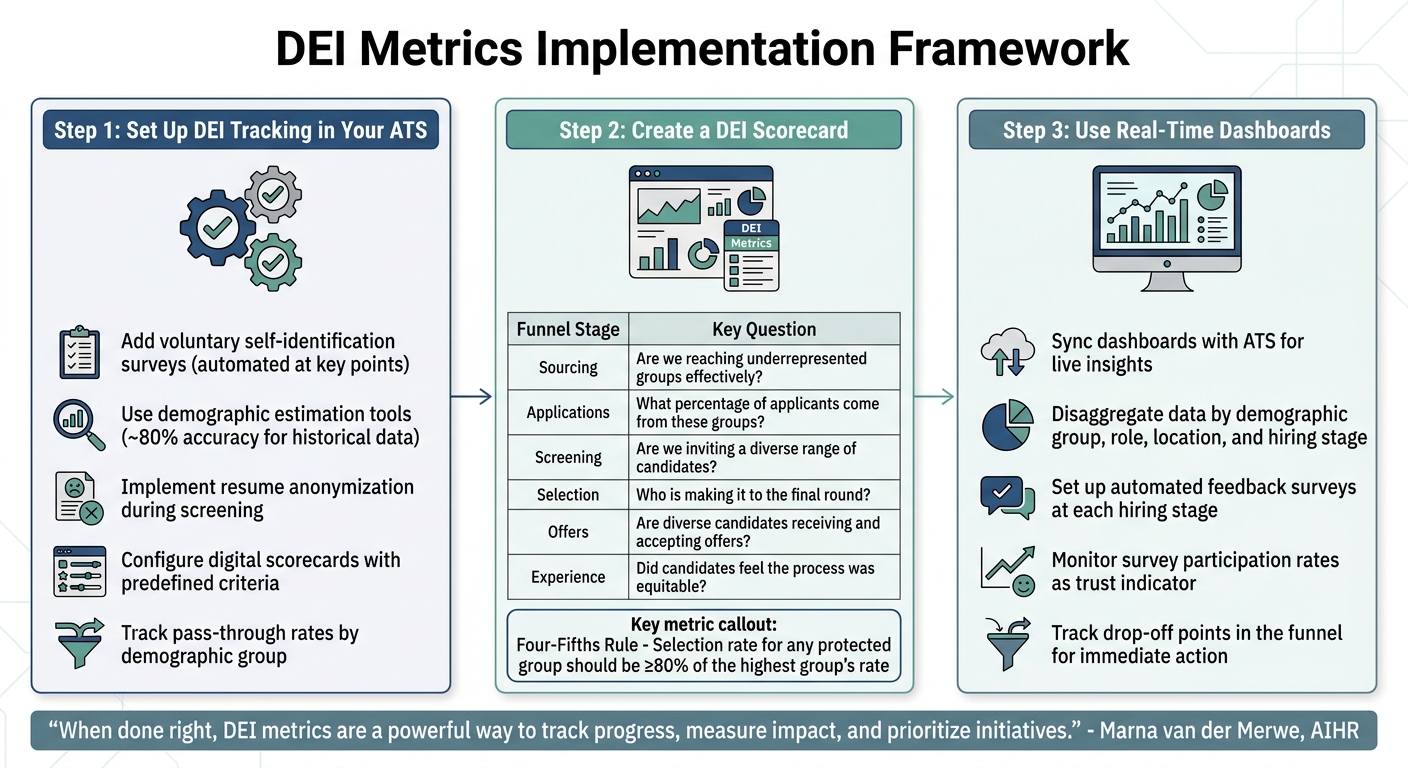
DEI Metrics Implementation Framework for Hiring
Once you’ve identified the right DEI metrics, the next step is putting them into action. For most SMEs, this can be done by making a few smart adjustments to your existing ATS, enabling you to track DEI data efficiently.
Setting Up DEI Tracking in Your ATS
Your ATS plays a central role in gathering DEI data. Start by incorporating voluntary self-identification surveys into your hiring workflow. These surveys should be automated and triggered at key points, such as after a candidate applies or accepts an interview invitation. Timing is critical – sending surveys promptly increases the likelihood of completion.
For situations where historical data is needed, or survey participation is low, tools that estimate demographics based on names and census data can be helpful. These tools typically provide around 80% accuracy and are useful for understanding past hiring trends. However, for crucial decisions like final hiring stages, recruiter-led identification – where recruiters manually tag candidate demographics – can provide greater precision.
To reduce bias during the hiring process, anonymize resumes during the initial screening phase. Combine this step with digital scorecards that require interviewers to rate candidates based on predefined criteria. With everyone evaluated using the same standards, subjective bias is minimized, and fairness improves.
Additionally, configure your ATS to track pass-through rates by demographic group. This will help you identify where certain groups are exiting the hiring funnel, offering a clear view of where interventions are needed.
Creating a DEI Scorecard
A DEI scorecard helps turn raw metrics into actionable insights. Define the key stages of your recruitment funnel and ask targeted questions for each:
| Funnel Stage | Key Question for Scorecard |
|---|---|
| Sourcing | Are we reaching underrepresented groups effectively? |
| Applications | What percentage of applicants come from these groups? |
| Screening | Are we inviting a diverse range of candidates? |
| Selection | Who is making it to the final round? |
| Offers | Are diverse candidates receiving and accepting offers? |
| Experience | Did candidates feel the process was equitable? |
Before setting any goals, document your current metrics to establish a baseline. Compare these to industry benchmarks or local workforce demographics to set realistic and measurable targets. For example, you might aim to increase women in engineering roles from 18% to 30% over two years.
To identify potential disparities, apply the Four-Fifths Rule. This guideline states that the selection rate for any protected group should be at least 80% of the rate for the group with the highest selection rate. For instance, if men are hired at a 40% rate but women are hired at 20%, there’s a gap that needs addressing.
"When done right, DEI metrics are a powerful way to track progress, measure impact, and prioritize initiatives. Instead of only focusing on the numbers, look at the story that the data tells in relation to where you are spending DEI efforts." – Marna van der Merwe, Subject Matter Expert, AIHR[3]
Using Data Dashboards for Real-Time Monitoring
Once your tracking and scorecards are in place, real-time monitoring allows you to respond quickly to any disparities. Real-time dashboards that sync with your ATS eliminate the need for manual updates, providing live insights into your hiring data.
The real value of dashboards lies in disaggregation. While overall averages might look positive, they can hide disparities within specific groups. Set your dashboard to display data by demographic group, role, location, or hiring stage, so you can pinpoint issues with a single click.
For example, McKinsey & Company’s 2026 "Women in the Workplace" report highlighted a "broken rung" in corporate advancement. The data showed that for every 100 men promoted to manager, only 93 women and 74 women of color advanced. This insight helped organizations target early management promotions as a key area for improvement[1].
Dashboards also make it easier to track where candidates drop out of the funnel. If data shows that Black candidates advance from application to phone screen at half the rate of white candidates, you can investigate immediately. This might involve reviewing job descriptions, adjusting screening criteria, or providing recruiter training.
Pair these quantitative insights with qualitative feedback by setting up automated feedback surveys at the end of each hiring stage. While metrics tell you what’s happening, candidate feedback reveals why.
Finally, monitor survey participation rates as an indicator of trust. If certain groups are less likely to respond, it may signal a lack of psychological safety – an important factor in understanding the full candidate experience[5].
Real-time dashboards ensure that you can balance speed with quality, helping you make adjustments that enhance diversity without compromising retention[10].
Common Challenges and Solutions
Even with the right tools, tracking DEI metrics involves real-world challenges. To create a hiring process that is both fair and effective, it’s crucial to address these issues head-on. Tackling these obstacles can turn a basic data-driven hiring strategy into an embedded recruitment service that truly delivers results.
Maintaining Data Privacy and Compliance
Collecting demographic data requires a transparent approach that respects candidate privacy. Candidates need to know why their information is being collected, how it will be used, and that it’s strictly for tracking overall diversity efforts – not for making individual hiring decisions [2].
To build trust, make demographic questions optional and ensure responses are stored separately from candidate profiles. Your Applicant Tracking System (ATS) should limit access to this information to those responsible for reporting, keeping it entirely separate from screening decisions. For businesses operating internationally, compliance is key: align with EEOC standards in the U.S., follow GDPR rules in Europe, and conduct regular audits to avoid compliance issues [2].
Once privacy measures are in place, the next step is addressing participation rates.
Increasing Survey Participation Rates
Low response rates to demographic surveys can leave critical gaps in your data. To encourage participation, include a short, clear explanation with each question, reassuring candidates about how their data will be used and protected.
Timing matters too. Automate survey requests at different stages of the hiring process – after application submission, when interview invitations are sent, and after offers are made. This approach increases the likelihood of capturing responses from candidates who might otherwise skip the form [10]. If certain groups still show lower response rates, treat this as a trust indicator and investigate whether psychological safety concerns might be at play [5].
For persistent gaps, consider a hybrid approach. Combine candidate self-identification with algorithmic inference and recruiter-led identification. This method expands data coverage across the hiring funnel while maintaining candidate comfort [10].
Connecting DEI Metrics to Business Results
To make DEI initiatives impactful, link them to clear business outcomes. For example, expanding your candidate pool may initially increase time-to-fill metrics as sourcing channels widen, but it can lead to better retention rates and a stronger employer brand over time [10].
A DEI scorecard can help identify bottlenecks in your hiring process. If underrepresented candidates are dropping out at specific stages – like from application to phone screen – it’s worth examining whether factors like biased job descriptions or screening criteria are to blame. Pair quantitative data with feedback from candidate surveys to understand both the “what” and the “why” behind these trends [10].
Conclusion
Key Takeaways for Scaling SMEs
DEI metrics turn intentions into measurable outcomes. Without tracking data, bias in recruitment stays hidden – making it impossible to address. By monitoring each stage of the hiring process, you can pinpoint where diverse candidates are falling off and take action.
Companies in the top quartile for ethnic diversity consistently outperform others financially and generate more innovation revenue [1]. Failing to close leadership diversity gaps means missing out on both growth and innovation opportunities.
Start by setting baseline metrics for your hiring funnel. Use tools like the Four-Fifths Rule to uncover adverse impact, and implement structured interviews to minimize bias. Review your sourcing channels to identify which partnerships deliver the best diverse talent.
It’s worth noting that 76% of job seekers view workforce diversity as a key factor when choosing an employer. Additionally, 52% of employees dissatisfied with their company’s DEI progress are likely to leave within two years [1]. Tracking DEI metrics is essential to reducing bias, making informed decisions, and executing strategic hiring.
With a clear picture of your progress, the next step is to bring in expert recruitment support.
Next Steps: Partnering with Rent a Recruiter
Scaling SMEs can take these insights and pair them with professional hiring support to achieve real results. Inclusive, data-driven hiring requires both expertise and capacity. With Rent a Recruiter, you get experienced recruiters embedded directly into your team. They’ll set up DEI scorecards, tracking systems, and dashboards to deliver immediate improvements.
Our extensive, pre-vetted networks – from HBCUs to specialized bootcamps – connect you with diverse talent quickly, while cutting hiring costs by up to 70% and saving over 80 hours of admin time each month. We also implement structured interviews and standard evaluation processes to eliminate unconscious bias and ensure fair, merit-based hiring.
Whether you’re scaling after securing funding, launching a product, or managing a hiring surge, we provide fast, effective recruitment solutions. Book a call to discover how we can help you build a diverse, high-performing team.
FAQs
What are the most important DEI hiring metrics for an SME?
For small and medium-sized enterprises (SMEs), tracking specific DEI (Diversity, Equity, and Inclusion) metrics is crucial. Focus on areas like the diversity of your candidate sources, the composition of your candidate pool, and how diversity shifts across each hiring stage – such as interviews and offers.
It’s also important to monitor hiring and retention rates across different demographic groups. These metrics not only highlight potential gaps but also ensure your processes are inclusive. By analyzing this data, you can fine-tune your DEI strategies to align with your broader diversity objectives.
How can I track DEI data in my ATS without violating privacy laws?
To monitor DEI data in your ATS while adhering to privacy laws, focus on voluntary collection of demographic details. Make it clear to candidates that providing this information is optional and will remain confidential. Use anonymized and aggregated data for reporting purposes, ensuring no individual can be identified. Avoid any actions that might pressure candidates into sharing sensitive information. Stay up to date with privacy regulations, like EEOC guidelines in the U.S., to ensure compliance and safeguard privacy.
What should I do if diverse candidates drop off at one hiring stage?
If you’re noticing diverse candidates dropping out at a particular stage of your hiring process, it’s time to take a closer look at what might be causing the issue. Often, the problem lies in areas like screening or interviews, where unconscious biases can creep in. Addressing this could mean revising your interview questions or investing in bias training for your team.
Other steps to consider include improving how you provide feedback to candidates, ensuring your interview panels are more diverse, and expanding your sourcing channels to attract a wider range of talent. If these efforts don’t resolve the issue, it might signal deeper challenges. In such cases, implementing structured DEI (Diversity, Equity, and Inclusion) initiatives or working with specialists can help uncover and tackle systemic barriers in your hiring process.