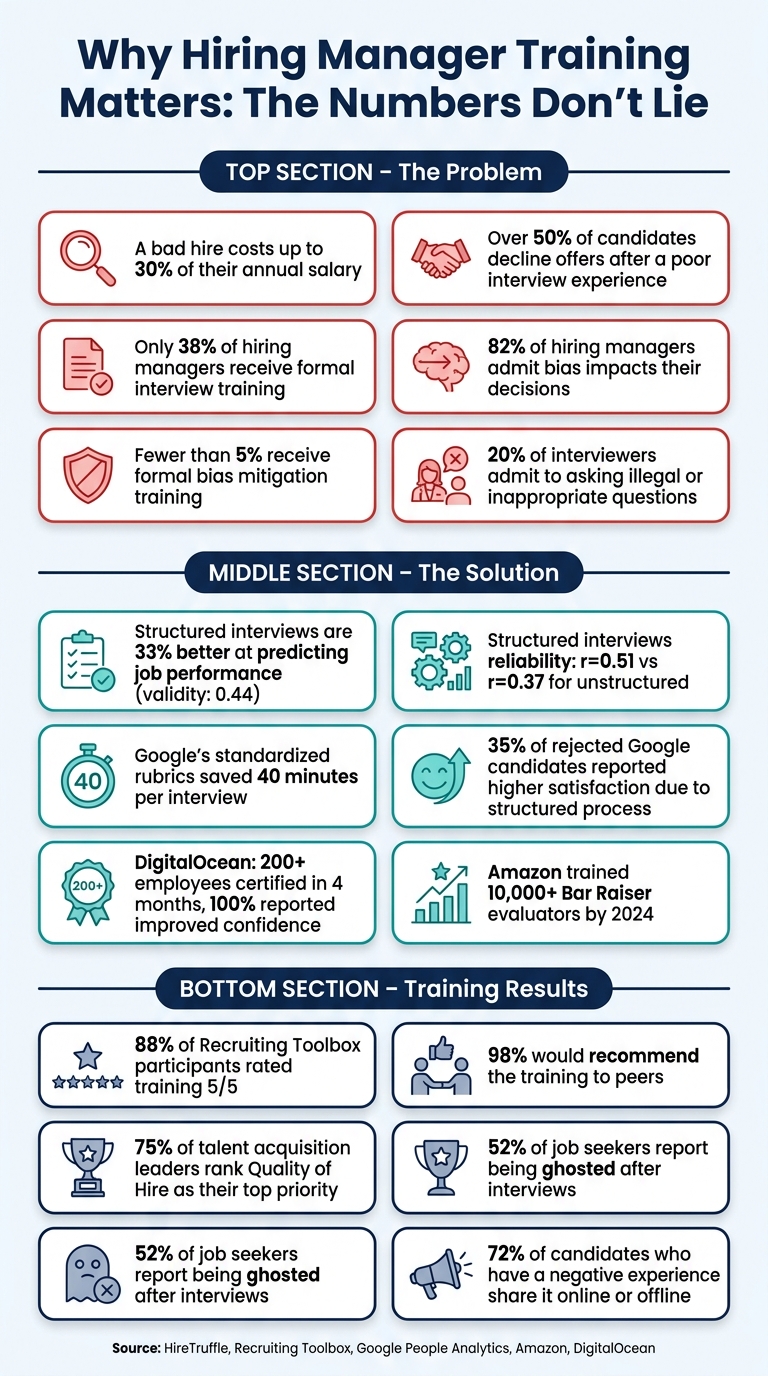
Untrained hiring managers cost businesses time, money, and top talent. A bad hire can set you back up to 30% of their annual salary, while poor interview experiences drive over 50% of candidates to decline offers. Yet, only 38% of hiring managers receive formal interview training, leaving decisions to gut instinct and inconsistent processes.
The fix? Structured training that aligns hiring managers with your recruitment goals. This approach improves candidate experience, reduces turnover, and ensures faster, better hiring decisions. Companies like HubSpot and Salesforce have seen success by prioritizing hiring manager training as a core competency.
Here’s what works:
- Define clear hiring roles and goals to eliminate confusion.
- Use data to identify gaps – like interview-to-offer ratios or retention rates.
- Train on structured interviews, scorecards, and bias reduction for consistent results.
- Standardize processes to ensure fairness and efficiency.
- Measure success with metrics like Quality of Hire and candidate satisfaction.
Scaling companies can’t afford to overlook this. Investing in hiring manager training builds a stronger, more effective recruitment function that directly impacts business growth.
Why Hiring Manager Training Is Critical: Key Stats & Impact
Practical Interviewing Techniques For HR & Managers With Jo Irwin
sbb-itb-a23bd6a
Identifying Training Needs and Aligning Recruitment Goals
Before launching a training program, take a step back to evaluate how hiring managers are performing and what the company truly needs.
Define Recruitment Goals and Manager Responsibilities
Set recruitment goals that are both clear and measurable. Are you planning to grow your team by 30% in the next year? Looking to cut down early turnover in a specific department? Hoping to boost offer acceptance rates? Ambiguous goals lead to ineffective training. Focus on measurable outcomes, like improving six-month retention rates by 10% or reducing time-to-fill for key roles.
Once your goals are in place, outline the specific responsibilities of hiring managers at each stage of the recruitment process. This clarity is critical to avoid confusion or overlap with recruiters. Typically, recruiters handle the early stages – like sourcing, screening, and managing the process – while hiring managers focus on evaluating skills, assessing team fit, and making the final decision. Simply clarifying these roles can be an informal form of training in itself.
After defining roles and goals, dive into your recruitment metrics to uncover areas needing improvement.
Use Data to Assess Current Gaps
Your recruitment data holds the answers to where hiring managers might be struggling. Key metrics to monitor include:
| Metric | What It Reveals |
|---|---|
| Interview-to-Offer Ratio | If a manager needs to interview 15+ candidates for one hire, there may be issues with role definition or screening [3] |
| Candidate NPS (cNPS) | Low scores often indicate managers who seem unprepared or fail to communicate the role effectively [3] |
| New Hire Retention Rate | Poor retention in certain teams may highlight a disconnect between job expectations and reality [3] |
| Feedback Turnaround Time | Slow or unclear feedback suggests low engagement or a lack of structured evaluation criteria [2][3] |
Recruiters can offer additional insights that numbers alone might miss. For example, they might notice recurring rescheduling, vague scorecards, or repetitive interview questions. Regular check-ins and structured debriefs provide this qualitative feedback, helping you pinpoint where training can make the biggest difference.
"Interviewing experience is not interviewing skill. A VP who has sat through 500 interviews may still be using gut feel, asking different questions every time, and anchoring on first impressions." – HireTruffle [2]
Finally, validate these findings by consulting leadership and recruitment partners.
Get Input from Leadership and Recruitment Partners
While data highlights the gaps, leadership helps prioritize them. Before finalizing your training plan, speak with senior leaders to understand which skills and qualities matter most at this stage of your company’s growth. Tailor your training to address these priorities directly.
If you’re partnering with an embedded recruiter like Rent a Recruiter, their observations can be a goldmine. Embedded recruiters, working closely with your team, often spot recurring issues – like misalignment on what makes a "good" candidate – that internal teams might overlook. Incorporating these insights ensures your training tackles real challenges instead of hypothetical ones.
Companies such as HubSpot and Salesforce have made hiring manager alignment a key focus. HubSpot, for instance, runs a structured certification program that requires managers to demonstrate specific competencies before conducting interviews. This has led to more consistent evaluations and better candidate experiences [1][4]. Similarly, Salesforce tracks training compliance as a critical metric, treating hiring as a core organisational skill alongside sales and product development [1]. Both companies started by defining what "good" looks like and built their training programs around achieving that standard.
How to Design a Hiring Manager Training Program
Create a program that builds structured habits aligned with your recruitment goals, transforming how hiring managers approach their role.
Cover the Core Training Topics
Start with structured interviewing. Teach managers to use a consistent set of competency-based questions, scored objectively. Research shows structured interviews have a validity coefficient of 0.44, making them 33% better at predicting job performance than unstructured approaches [2].
Address unconscious bias. Cover biases like affinity bias and the halo/horn effect, and ensure managers understand legal boundaries. Federal law prohibits questions about race, religion, age, gender, or family status. Despite this, 20% of interviewers admit to asking illegal or inappropriate questions [2]. Alarmingly, while 82% of hiring managers believe bias impacts their decisions [2][6], fewer than 5% receive formal training to mitigate it [6].
Incorporate role scoping and candidate evaluation tools like scorecards. Replace vague "culture fit" judgments with weighted competency matrices. By focusing on these essentials, you’ll lay the groundwork for a more consistent and fair hiring process.
Choose the Right Training Formats
Not all managers learn the same way, so a blended approach works best. Combine self-paced modules, live workshops, and practical exercises to reinforce key concepts.
| Format | Best For | Limitation |
|---|---|---|
| Self-Paced Modules | Legal compliance, onboarding basics, and scalable training | No live feedback or practice opportunities |
| Live Workshops | Role-play, mock interviews, and real-time calibration | Scheduling challenges; harder to scale |
| Blended Learning | Combining theory with hands-on practice | Requires more coordination to implement |
| Micro-learning | Quick refreshers for busy managers (15–20 minutes) | May not cover complex topics in depth |
Mock interviews are particularly effective. They give managers practical experience and immediate feedback, building confidence and skills. As John Vlastelica, CEO of Recruiting Toolbox, says:
"Great hiring manager training attendees should feel like they earned a license to hire for your company." [5]
His firm’s live sessions back this up: 88% of participants rated the program 5 out of 5, and 98% would recommend it to peers [5].
Once you’ve chosen formats, tailor the content to meet each manager’s experience level.
Tailor Training to Manager Experience Levels
Training needs vary widely between first-time managers and seasoned leaders.
For new managers, focus on the basics: legal compliance, the STAR interview method, and scorecard use. Shadowing experienced interviewers can also help them gain confidence before leading their own panels.
For experienced managers, delve into advanced topics like evaluating leadership potential and prioritizing "culture add" over culture fit. Help them calibrate their interview panels to ensure consistency.
Customizing training by department can also make it more relevant. For example, an embedded recruiter from Rent a Recruiter can help tailor content. Engineers might benefit from pair-programming exercises, while sales teams could focus on evaluating presentations. This departmental focus ensures training feels practical and immediately applicable.
How to Put Training into Practice
Having a tailored training program is great, but the real impact comes when it’s applied to daily hiring routines. Training only delivers results when it changes how managers approach recruitment, embedding new skills into everyday practices.
Formalize Intake and Collaboration Processes
The intake meeting is where hiring either takes off or derails before it even begins. Use this meeting to align on what success looks like for the role in the first 6–12 months. From there, break it down into clear must-haves, nice-to-haves, and red flags. Assign specific competencies to each interview round to avoid redundant questions or missing critical evaluations.
Set clear expectations from the start. Establish feedback deadlines, clarify who’s responsible for communication, and require scorecards to be completed within 24 hours. Slow feedback loops frustrate candidates and can kill hiring momentum.
A great example of structured accountability is DigitalOcean’s "Sailor Certification" program. In 2017, they required all employees to become certified before conducting interviews. Within just four months, over 200 employees had completed the program, with 100% reporting improved confidence in their hiring skills [8]. This kind of structure begins at the intake stage.
Once the intake process is solid, the next step is to standardize how interviews and assessments are conducted.
Standardize Interview and Assessment Processes
Consistency is key to ensuring fairness and reliability in hiring. Every candidate for the same role should face the same questions, in the same order, and be evaluated using the same criteria. Research shows that structured interviews have a reliability score of r = 0.51, compared to r = 0.37 for unstructured ones [8]. That consistency leads to better hiring decisions.
"Good conversation is not the goal. Comparable evidence is the goal." – HireTruffle Editorial [2]
To avoid biases, require managers to complete scorecards and notes independently before group discussions. This prevents anchoring, where one opinion can disproportionately influence others. During debriefs, recruiters should challenge vague feedback like "not a great fit" by asking managers to provide specific evidence tied to the agreed rubric.
A model worth noting is Amazon’s "Bar Raiser" program. By 2024, Amazon had trained over 10,000 evaluators through a rigorous 3–12 month program. These evaluators are tasked with maintaining hiring standards and can even override hiring managers if the candidate doesn’t meet the bar [8].
With standardized processes in place, the next step is to use tools that reinforce these practices.
Use Tools and Templates to Support Training
Once consistent processes are established, practical tools ensure these standards are upheld in daily hiring. A structured interview guide with 4–6 role-specific questions ensures evaluations remain consistent across candidates. Pair this with a competency-based scorecard that weights skills from 1 to 3 and scores responses from 1 to 5, as recommended by Harvard Medical School’s hiring guide [2].
Google’s People Analytics team found that using vetted questions and standardized rubrics saved an average of 40 minutes per interview. Even rejected candidates appreciated the structured process, with 35% reporting higher satisfaction due to perceived fairness [7]. That matters – 72% of candidates who have a negative experience will share it, either online or offline [2].
Rent a Recruiter can seamlessly integrate these tools into your team’s workflow, providing real-time coaching to managers as they use them. This bridges the gap between training theory and practical hiring execution.
Measuring Training Impact and Improving Over Time
Having structured training and standardized interview processes is a strong start, but the real test is proving their effectiveness. Without measurable outcomes, it’s impossible to tell if your efforts are paying off.
Set Clear Metrics for Recruitment and Training Success
To gauge success, focus on Quality of Hire (QoH). This metric combines factors like job performance, retention, time to productivity, and manager satisfaction. You can calculate it by adding percentage scores for each factor and dividing by the number of indicators [9]. Unlike time-to-fill, QoH offers a more realistic view of hiring success. No wonder 75% of talent acquisition leaders now consider it their top priority [9].
In addition to QoH, monitor process compliance metrics. These include scorecard completion rates and feedback turnaround times, which show whether managers are sticking to the process. Pair this with candidate experience data – such as offer acceptance and withdrawal rates – to see how manager actions influence hiring outcomes. For context, 52% of job seekers say they’ve been ghosted after an interview [2]. Even small improvements in this area can make a noticeable difference.
| Metric Category | What to Track | Impact |
|---|---|---|
| Recruitment Outcome | Quality of Hire score, 12-month retention, time to productivity | Demonstrates if training leads to better hires [9] |
| Manager Performance | Scorecard completion %, feedback turnaround time | Verifies managers are following the process [2] |
| Candidate Impact | Offer acceptance rate, candidate withdrawal rate | Shows how manager behavior affects your employer brand [2] |
| Training Quality | Post-training NPS, knowledge retention checks | Indicates if the training is effective [5] |
These metrics provide a foundation for improvement. The next step is gathering feedback to refine your approach.
Gather Feedback and Update Training Regularly
Once metrics are in place, continuous feedback ensures your training stays relevant and effective. Use 30-day and 90-day satisfaction surveys with hiring managers after each new hire to identify any gaps between training and actual hiring results [9]. Conduct quarterly scorecard audits within your ATS to check if managers are backing their evaluations with specific evidence or defaulting to vague comments like "not a culture fit" [2].
"Great hiring manager training has a strong post-training ‘make it stick’ component, that includes inspection and accountability mechanisms to ensure what was learned in the training is actually used, measured, and rewarded." – John Vlastelica, CEO, Recruiting Toolbox [5]
Calibration sessions can quickly address issues like evaluation drift and unconscious bias. Considering that 82% of hiring managers admit bias impacts their decisions [2], these sessions are essential, not optional.
Build a Long-Term Training Roadmap
To create lasting change, a single workshop isn’t enough. Habit formation requires repetition, accountability, and consistent follow-up.
"A single session creates awareness but not habit change. Managers need refreshers, audits, and coaching after live interviews start." – HireTruffle [2]
Develop a four-phase roadmap to guide your training efforts:
- Onboarding: Cover the basics, including legal and process training.
- Implementation: Focus on practical exercises and calibration.
- Optimization: Conduct audits and gather feedback through surveys.
- Refinement: Update training regularly based on needs analysis and changes to the interview process [2][11].
Rent a Recruiter supports this approach by offering recruitment health checks and process reviews. These services help identify where your hiring process may be falling short and what updates your training might need. Aligning pre-hire interview scores with post-hire performance data is where you’ll find the biggest opportunity for improvement [10].
Conclusion: Building Recruitment Success Through Hiring Manager Training
Training hiring managers isn’t just a nice-to-have; it’s a critical part of building a strong recruitment strategy. As Galib Hayder of Easy.jobs explains:
"Training hiring managers is no longer optional. It is a core capability that directly impacts hiring quality, speed, fairness, and business performance." [3]
The steps we’ve covered – pinpointing skill gaps, creating structured programs, standardizing interview approaches, and tracking results – work as a connected framework. Skipping any one of these weakens the entire process. Top-performing companies often require hiring managers to complete formal certification programs to ensure consistency and quality [1].
Without proper training, hiring decisions can become inconsistent and expensive. Every piece of the process, from identifying areas for improvement to aligning post-interview evaluations, plays a key role in driving better results.
It’s important to remember that training isn’t a one-and-done effort. Ongoing refreshers, regular audits, and continuous coaching are what turn short-term fixes into long-term success.
If your goal is to scale hiring without compromising on quality, Rent a Recruiter offers a solution. By embedding skilled recruiters directly into your team, they streamline the entire hiring process, cutting costs by up to 70% and saving over 80 hours of admin time every month.
FAQs
What should hiring manager training include first?
Effective training for hiring managers begins with evaluating their existing skills and pinpointing areas for improvement in their hiring methods. It’s essential to set clear goals for the training, outline the company’s approach to recruitment, and clarify each manager’s role in the process. Rent a Recruiter helps scaling businesses by providing embedded recruiters who bring organization and reliability to the hiring process. This allows managers to concentrate on strengthening their hiring capabilities while ensuring the recruitment process remains scalable and efficient.
How can I tell if a hiring manager needs training?
To determine if a hiring manager could benefit from training, start by examining recruitment data and processes for red flags. Indicators such as high turnover among new hires, inconsistent hiring results, or an overreliance on gut instinct are clear signs. Review interview notes for any evidence of bias, gather feedback from the team, and pay attention to challenges like vague role definitions or frequent delays in the hiring process. Additionally, the absence of structured tools, such as interview scorecards, often points to opportunities for improvement.
How long does it take to see hiring results from training?
The results you see will depend heavily on how consistently training is applied and reinforced. Without regular practice, retention fades quickly. To drive lasting behavioral changes, focus on long-term efforts rather than quick fixes.
Programs that succeed often include continuous support, such as mock interviews and regular feedback loops. To gauge their effectiveness, monitor key metrics like time-to-fill and candidate satisfaction over an extended period. These indicators will help you assess whether the training is delivering meaningful improvements.