If your hiring team ignores TikTok, you are leaving reach, applications, and hiring efficiency on the table.
I’d sum the article up like this: TikTok can help you build employer trust, lift application rates, and cut wasted recruiter time when you use it with clear role messaging, employee-led video, trend fit, and proper tracking. For scaling firms in SaaS, Technology, IT, Fintech, Engineering, Security, Insurance, and Professional Services, the point is simple, this is not just a social channel, it is an early hiring channel.
The five plays are straightforward:
- Show the day-to-day work so people understand the role before they apply
- Use employee-led videos so your message feels human, not corporate
- Join trends carefully to extend reach without forcing the tone
- Build role-specific content that points people to one job and one next step
- Track hiring results like CTR, completed applications, qualified hires, and 90-day retention
A few numbers matter here. 79% of job seekers use social media in their search, #careertiktok has passed 1.6 billion views, and candidates are 2.7 times more likely to apply after watching video about company culture or the role. For you, that means more top-of-funnel interest and a better shot at improving time-to-fill, applicant fit, and cost-per-hire.
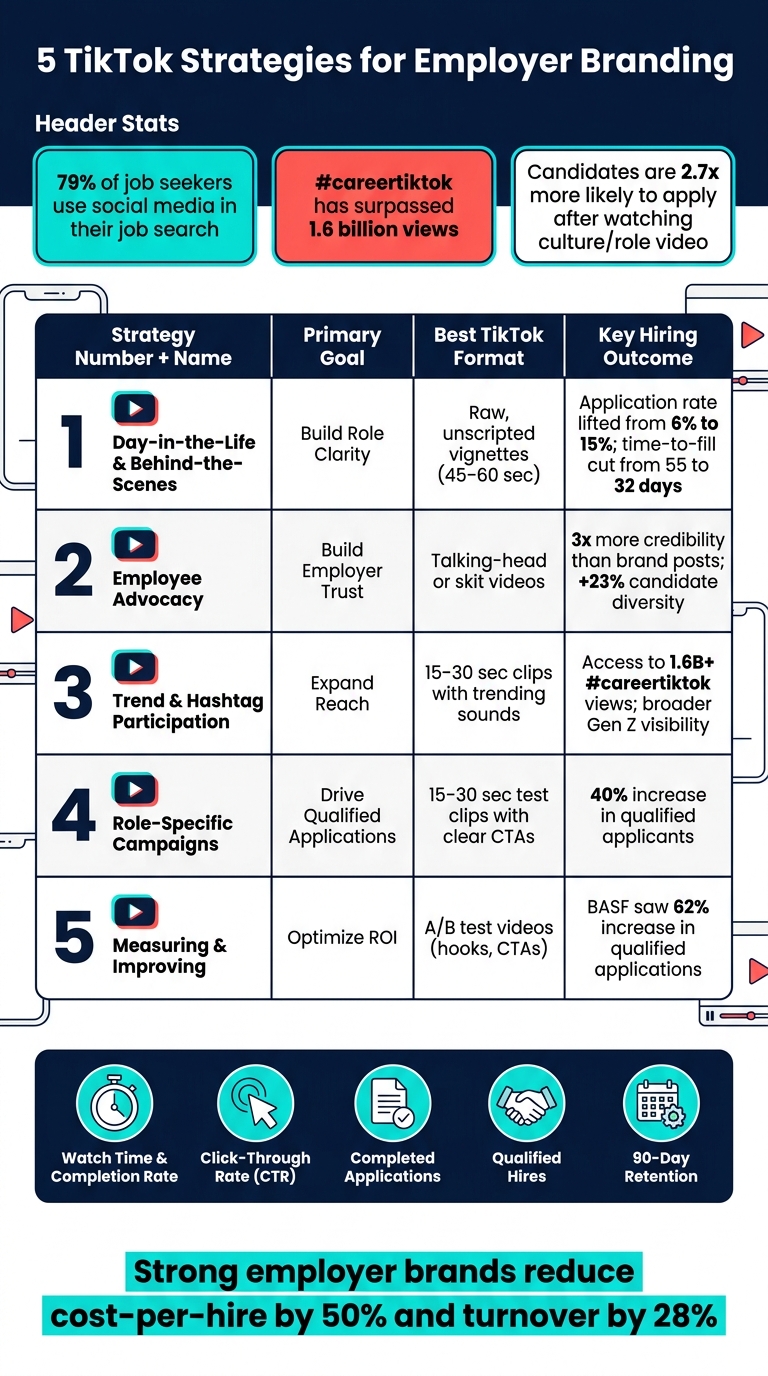
5 TikTok Strategies for Employer Branding: Tactics, Goals & Hiring Outcomes
Quick Comparison
| Tactic | What it does for you | Hiring outcome |
|---|---|---|
| Day-in-the-life content | Shows the job as it is | Better-fit applicants, less screening waste |
| Employee-led video | Puts staff voices at the centre | More trust, stronger engagement |
| Trend and hashtag use | Extends reach to the right audience | More visibility for open roles |
| Role-specific campaigns | Ties content to one vacancy | More qualified applicants |
| Measurement and testing | Links content to ATS or CRM data | Better ROI and lower wasted spend |
If you want TikTok to work, the rule is simple: treat it like an embedded hiring channel, not a vanity channel.
sbb-itb-a23bd6a
Why TikTok Works for Employer Branding
TikTok’s biggest edge is discovery. Its algorithm can put employer content in front of the right candidates, even if your account doesn’t have a big following [3].
That matters for hiring teams that need reach without waiting months to build an audience. You’re not stuck speaking only to people who already know your brand. Good content can travel fast, and that gives you a shot at reaching talent earlier in the decision process.
The format also forces clarity. Short-form video rewards a sharp opening and a clear point. In hiring terms, that means more repeated exposure to your employer brand, with less room for vague brand language. What tends to work is simple, direct, workplace content, not polished messaging that says little.
U.S. candidates want proof, not polish. Gen Z and Millennial candidates want proof: salary ranges, hybrid schedules, team diversity, and how the company behaves under pressure. Employee voices carry 3x the credibility of official brand channels [2]. Give employees themes, not scripts, so the content stays natural. That trust gap is why employee-led content performs so well.
TikTok works best as a top-of-funnel discovery channel. Organic posts help build trust. Spark Ads can then push the best-performing content further and drive role-specific applications [2].
This works best when your hiring team can move fast. If inbound interest comes in and nobody replies, the value drops off quickly. The strongest place to start is simple: show the work, show the team, and show how the company operates day to day.
1. Day-in-the-Life and Behind-the-Scenes Videos
Show the job as it actually looks. That means standups, code reviews, debugging, and the day-to-day rhythm of the team.
This kind of video helps people self-select before they apply. They get a clearer view of pace, tools, team dynamics, and the working setup. For hiring teams, that can mean better-fit applicants, less wasted screening time, and faster hiring. Film in real workspaces so the content feels grounded and believable.
Keep the content role-specific. Use themes and niche hashtags like #techjobs or #nurselife to get in front of the right talent pool [3].
The impact can show up in the numbers. A mid-sized SaaS company ran a series of 45-second day-in-the-life TikToks with real engineers. Application rates went from 6% to 15%, time-to-fill fell from 55 days to 32 days, and 90-day retention climbed from 86% to 95% [4]. That matters because transparency doesn’t just drive views. It helps you bring in people who know what they’re signing up for.
A few simple production choices make a big difference:
- Add text overlays and auto-captions so the video works on mute
- Open with a candid moment, a bold visual, or a direct question
- End with one clear call to action, like "link in bio" or a comment prompt
Use this format to show the work. The next strategy shifts the focus from the role itself to employee voices.
2. Employee-Driven Content and Advocacy
Behind-the-scenes videos show the work. Employee advocates make people believe it. Staff stories carry weight in a way branded posts usually can’t.
Keep employee videos casual, specific, and unscripted.
Give employees a theme, not a script, and let them speak in their own words. Themes like "Why I joined" or "What my team actually does" give enough direction without pushing people into a rehearsed tone.
One U.S. fintech firm lifted candidate diversity by 23% after switching to short employee videos and reviewing them for inclusive language and accessibility [4].
That works best when the content still feels native to TikTok. A light review helps keep videos in line with workplace guidelines without cutting out the honesty that makes them land. Auto-captions matter too. A lot of people watch on mute, and accessibility affects reach as well as engagement.
Track profile clicks, saves, shares, and applications by post. That’s how you see which stories drive attention, and which ones move people into the hiring funnel.
Once the voice feels natural, pair it with trends, sounds, and hashtags that help extend reach.
3. Trend, Sound, and Hashtag Participation
Once employee advocacy gives your brand a human voice, trends can help your content go further. The key is simple: use trending sounds and hashtags only when they fit your brand voice and workplace culture. If the fit is off, people can tell.
Used well, trends can make your employer brand feel current, visible, and credible.
The scale is hard to ignore. The hashtag #careertiktok has reached 1.6 billion views, while industry tags like #techjobs have reached 151.5 million views [3]. For hiring teams, that means more than reach for the sake of it. It means a better shot at getting your roles in front of the right people, without relying only on paid spend or different recruitment models.
A smart hashtag mix can help here:
- Broad tags for reach
- Niche tags for relevance
- Branded tags for recall and consistency
As Nanit‘s Social Media Director Kayla Klein notes, trend selection works best when it matches a niche audience’s interests [3].
That’s why it helps to let employees flag trends they already use. It keeps participation natural and cuts the risk of content feeling forced. In practice, this can save your team time and lead to stronger engagement because the content feels like it belongs on the platform.
Reformation used values-based hashtags to attract candidates aligned with its culture [1]. That approach does more than drive views. It helps filter for fit earlier, which can save time in the hiring process and improve applicant quality.
Use trends to spark interest, then direct viewers to the open role. A clear call to action, like "link in bio" or a comment prompt, helps turn attention into applicants. Once a trend earns attention, the next move is content tied to specific roles and openings.
4. Role-Specific Recruitment Campaign Content
Role-specific campaigns are what move viewers toward applying. General employer branding tells people your company is a good place to work. Role-specific content shows what the job is actually like, on this team, day to day. That matters because most candidates want one thing first: a clear picture of the role, which is why many companies are moving toward recruitment as a service models to improve transparency.
One SaaS company reported a 40% increase in qualified applicants after launching 30-second engineering challenge videos on TikTok [4]. That kind of content works because it is specific, practical, and tied to the work itself.
The best format depends on the role. For technical and specialist hiring, problem walkthroughs from a senior developer or team lead help people see the work, the skills, and the level of judgment the role needs [4]. For operations or frontline hiring, showing the workspace and workflow sets expectations early [1][4]. For early-career roles, simple team and culture snapshots can help people picture themselves in the job [1][3].
A short video series can also help you make the message easier to follow. One simple three-part sequence tied to a single open role works well:
- Why I took this role
- What a typical week looks like
- How success is measured
This breaks your employer value proposition into smaller, clearer pieces [2]. It also gives you sharper data on what drives qualified applicants.
Each video should end with a role-specific call to action. Skip broad wording like Apply Now. Use direct phrasing such as Join our Engineering team or See our Graphic Designer opening [6]. The closer the message matches the role, the easier it is to track which content brings in the right applicants.
Gen Z candidates cross-check TikTok against Glassdoor and LinkedIn, so every claim needs to match the real job [3][5].
5. Measuring and Improving Hiring Impact
Once your role-specific TikToks are live, the goal is simple: measure hiring impact, not vanity metrics, or rate your recruitment process to identify gaps. Views alone won’t tell you much. What matters is watch time, completion rate, CTR, completed applications, and qualified hires. If candidates are watching 80% or more of your videos, that’s a strong sign the content is keeping attention and pushing people into your pipeline [9].
To see which formats are pulling their weight, track each post back to the application source. Use UTM parameters on your "link in bio" and career site links so your ATS or CRM can show which videos drove traffic and completed applications [4]. That gives you a clear line between content and hiring output.
BASF tested TikTok recruitment in one department and saw a 62% increase in qualified applications, along with better cost efficiency than more standard channels [7]. That’s the kind of result hiring leaders care about. More of the right applicants, with less waste.
Treat TikTok like a performance channel. Test your first 3 seconds to find out which hooks stop the scroll. Compare CTA formats too, including "link in bio" versus a comment-to-apply flow, and see which one gets more completed applications. Small changes at the top of the funnel can have a big effect on cost per applicant and recruiter time spent chasing poor-fit leads.
Then look past the click. Monitor 90-day retention for TikTok-sourced hires [4]. If those hires stay beyond 90 days and meet performance expectations, your content is doing its job. It’s not just bringing in more applicants, it’s bringing in people who fit the role and stick.
Use these metrics to compare content formats and put more budget and effort behind what brings the best applicant quality.
Content Formats and Employer Branding Impact at a Glance
Use this table to line up each TikTok tactic with a hiring goal. It gives you a quick way to compare format, purpose, and hiring impact so you can put time and budget into the content most likely to move results.
| Strategy | Primary Goal | Best Use Case | Best TikTok Format | Key Branding Outcome |
|---|---|---|---|---|
| 1. Day-in-the-Life & BTS | Build trust | Office tours, daily workflows, team rituals | Raw, unpolished, unscripted vignettes | Realistic job expectations and stronger culture awareness |
| 2. Employee Advocacy | Build trust in your employer brand | Employee Q&As, "Why I joined" stories | Employee-led talking-head videos or skits | Higher engagement than brand posts [10] |
| 3. Trend & Hashtag Participation | Expand reach | Trend-based posts, branded challenges | 15 to 30-second clips with trending sounds | Broader brand visibility and Gen Z connection |
| 4. Role-Specific Campaigns | Drive applications | Role explainers, project spotlights | 15 to 30-second test clips with clear CTAs | Improved pipeline quality and faster time-to-fill |
| 5. Measuring & Improving | Improve ROI | Testing hooks, CTAs, and creative frameworks | 15 to 30-second A/B test videos | Better conversion |
For hiring leaders, the point is simple. Not every TikTok format does the same job. Some formats help people understand what it feels like to work with you. Others help you get in front of more people, sharpen message fit, or turn attention into applications.
That matters when you’re hiring at pace. If your team in SaaS, Technology, Fintech, Engineering, Security, Insurance, or Professional Services is trying to cut time-to-fill or improve applicant fit, choosing the right content type can save wasted spend and reduce hiring drag.
Execution Tips for U.S. Employers
Getting views is easy. Turning those views into applications is what matters.
To do that, you need content your team can publish fast, leaders can approve without friction, and recruiters can track back to hiring results. These four habits, along with our other recruitment resources, help close that gap.
Keep the language natural. Give employees a theme, not a script. A prompt like "What surprised you most about working here?" works well. Let people speak in their own words. If the video feels too polished, trust drops fast.
One video, one goal. Each video should stick to one message and one call to action. Don’t cram too much into 30 seconds. Keep it simple: link in bio, DM for the role, or join a live recruiter Q&A. That makes the next step clear, and clear posts tend to drive more applications.
Get written consent before posting employee videos. Make sure you have clear, documented consent from any employee featured in your videos before publishing[4]. This protects your business and keeps your process clean. Add captions, text overlays, and strong contrast so the content is easier to follow for more people.
Tie each post to one open role and track the path to apply. Once a post goes live, connect it to one active role and one tracking path. Keep the bio link up to date, and use UTM tags or ATS/CRM data to track clicks[4]. If you can’t trace a post back to role interest or applications, it’s hard to know what’s working, and even harder to improve spend, recruiter time, or hiring output.
Conclusion
TikTok works best as an always-on employer brand channel, not a one-off campaign. Used together, these five tactics turn TikTok from a content channel into a hiring channel.
That matters because employer brand has a direct commercial effect. Companies with strong employer brands can reduce cost-per-hire by 50% and turnover by 28% [8]. Used well, TikTok shortens the gap between employer brand awareness and application intent. For smaller employers, that can create a practical edge.
The next constraint is operational. Respond fast, track results, and keep the process simple. TikTok only works when recruiting follow-up is quick and consistent.
For high-growth teams that need more recruiter capacity, Rent a Recruiter can embed recruiters directly into your process and keep hiring moving.
Track applications, not views, and scale the formats that convert.
FAQs
How often should we post hiring content on TikTok?
Consistency matters more than posting every day. The goal is to build a content calendar your team can actually keep up with, tied to hiring milestones and the roles that matter most.
A solid starting point is 2 to 4 videos per month for each active hiring priority. That gives you enough output to stay visible without turning content into a drain on your team’s time.
Whatever pace you choose, stick with it. Regular posting beats short bursts every time because it keeps your hiring message in front of the market and helps build traction over time.
What should we avoid when using TikTok for employer branding?
Avoid content that feels too polished, scripted, or corporate. People spot it fast, and when they do, they scroll on. If it doesn’t feel real, it won’t build trust.
You also shouldn’t push employees to take part. Advocacy only works when people want to join in. Voluntary beats forced every time, because genuine employee content carries more weight and does a better job of showing what it’s like to work at your company.
Your content also needs to match the day-to-day reality of the workplace. If the picture you present feels off, or worse, misleading, that gap can hurt your employer brand and make hiring harder.
And there’s another part companies often miss: response. If you ignore comments or leave applications sitting without follow-up, people notice. That can damage your reputation and put off future applicants, especially in tight talent markets where word travels fast.
How can we connect TikTok content to actual hires?
Treat every candidate like a lead. That means lining up your recruitment funnel with your social strategy, so you can see how attention turns into hiring outcomes.
Use UTM tags or ATS and CRM integrations to track the path from video views to applications, then through to hires. If you can’t measure that journey, you’re left judging content by reach alone, and views don’t fill roles.
Add clear calls to action that make the next step obvious. A link in your bio works. A dedicated comment funnel can work too. The point is to remove friction and make it easy for interested people to apply.
Then look at the engagement data with a commercial lens. Focus on the content that drives completed applications, not just clicks or views. That’s how you turn social content from a brand activity into a hiring channel you can actually manage.