
Hiring reactively costs time, money, and growth opportunities. Talent mapping flips the script.
Instead of scrambling to fill roles when they open, talent mapping helps you plan ahead. It identifies the skills your business will need in the next 1–3 years, assesses your current workforce, and analyzes external talent pools. The result? Faster hiring, up to 50% lower recruitment costs, and fewer disruptions to your operations.
For scaling companies, this approach ensures you’re not just hiring for today but building the capabilities needed for tomorrow.
What You Gain with Talent Mapping:
- Faster Hiring: Reduce time-to-fill for critical roles by 40%.
- Lower Costs: Save up to 50% compared to traditional hiring methods.
- Stronger Teams: Develop internal talent while building external pipelines.
- Future-Proofing: Plan for emerging skills and market shifts well in advance.
The takeaway? Talent mapping isn’t just an HR exercise – it’s a business strategy that keeps you ahead of the curve.
What Is Talent Mapping?
Talent Mapping Defined
Talent mapping is a forward-thinking approach that aligns your hiring strategy with your business objectives, focusing on future needs rather than immediate gaps. It identifies the skills your organization will require over the next 1–3 years and pinpoints where to find them, creating a roadmap for building the workforce you need to achieve your growth targets.
This process involves evaluating your current team to uncover untapped strengths and potential leaders, while also analyzing external talent pools. By doing so, you can track competitors, identify emerging skill gaps, and build connections with top talent before a role even opens up. Instead of rushing to fill a vacancy, talent mapping ensures you’re already ahead of the curve.
"Talent mapping is not just a tool for HR; it’s a strategic imperative that ensures your organization can face future challenges with confidence." – Marc Trillou, CEO, TieTalent [5]
Grasping these basics helps clarify how talent mapping sets itself apart from traditional recruitment methods.
How Talent Mapping Differs from Standard Recruitment
Unlike traditional recruitment, which reacts to immediate needs, talent mapping takes a proactive stance. Traditional hiring often asks, "Who can fill this role right now?" Talent mapping, on the other hand, asks, "What skills will we need a year from now, and where can we find them?"
This difference in approach is crucial. Standard recruitment typically focuses on active job seekers applying to posted roles. Talent mapping, however, goes deeper, offering insights into the broader talent market, including passive candidates who aren’t actively job hunting but could be the perfect fit in the future. For fast-growing small and medium-sized enterprises, this proactive strategy transforms hiring into a planned and strategic advantage, rather than a reactive challenge.
sbb-itb-a23bd6a
How To Map Talent in 4 Steps
Mapping your talent is a critical component of a successful recruitment strategy.
Why High-Growth SMEs Need Talent Mapping
Taking a proactive approach to hiring can make a world of difference for scaling businesses. Talent mapping not only speeds up recruitment but also strengthens your reputation as an employer and ensures your workforce is prepared for future challenges.
Faster Hiring and Lower Costs
Treating every open position as an emergency drains both time and money. Talent mapping changes this by creating a pipeline of qualified candidates before roles even become available. Companies that adopt this strategy report hiring cycles that are up to 30% faster [7] and save as much as 50% on recruitment costs [1].
Take the example of a fintech company in 2025 facing a shortage of AI/ML engineers. By rolling out a year-long talent mapping plan that combined internal training with targeted external recruitment, they cut their time-to-hire for these critical roles by half [1]. The key? They had already built relationships with potential candidates and knew exactly where to find the talent they needed.
This approach isn’t just about external hires. By auditing internal skills, businesses often uncover employees ready for promotion or lateral moves, saving significantly compared to hiring externally [2]. Teams that focus on mapping critical roles report a 40% reduction in time-to-fill [1], allowing them to shift focus from constant hiring struggles to growth opportunities. And as a bonus, this proactive mindset boosts your brand reputation.
Building a Stronger Employer Brand
In competitive industries like tech and SaaS, how candidates perceive your company matters. Talent mapping allows you to engage with potential hires long before you need them, creating a relationship-driven hiring process.
"Top AI talent rarely responds to cold outreach. Talent mapping lets teams identify and build relationships with future-fit candidates months in advance. When a role opens, you’re continuing a conversation, not competing from scratch."
– Samara Garcia, Fonzi.ai [7]
This approach also ensures that your hiring process is consistent and professional. By standardizing skill definitions and evaluation criteria, you create a seamless experience for candidates [7]. With over 60% of U.S. companies planning to expand their teams in early 2025 [6], standing out as a preferred employer is more important than ever. Internally, talent mapping helps you identify hidden potential within your team, offering clear career paths and development opportunities that lead to a 25% improvement in employee retention [7].
A strong employer brand doesn’t just attract top talent – it lays the foundation for effective workforce planning.
Better Workforce Planning and Succession Readiness
Beyond faster hiring and better engagement, talent mapping equips businesses to handle long-term challenges. High-growth companies can’t afford leadership gaps or unexpected skill shortages. With talent mapping, you gain a 6–36 month view of your workforce needs, helping you plan for clusters of skills – like LLM platform engineering – rather than just individual roles [7][4].
This foresight also highlights which internal candidates are ready for promotion now versus those who might need 6–12 months of development [7][2]. It minimizes last-minute scrambling when key employees leave or when new projects demand specialized skills. As Vicky Liu from Juicebox.ai aptly puts it:
"Waiting for an open req is like waiting for a storm to hit before checking the forecast."
– Vicky Liu, Juicebox.ai [1]
The results speak for themselves. Over a 27-month period ending in 2026, MasterTech embedded a dedicated Talent Partner to implement talent mapping. This led to 29 placements, a 4:1 CV-to-interview ratio, and $123,000 in savings compared to traditional recruitment agency fees [4]. Similarly, Unique coordinated 291 interviews and delivered 17 offers across five global offices within just a few months, resulting in 10 successful high-priority hires [4].
For high-growth SMEs, talent mapping isn’t just an HR tool – it’s a strategic guide that ensures you’re ready to face future challenges with clarity and control.
How to Implement Talent Mapping: A Step-by-Step Process
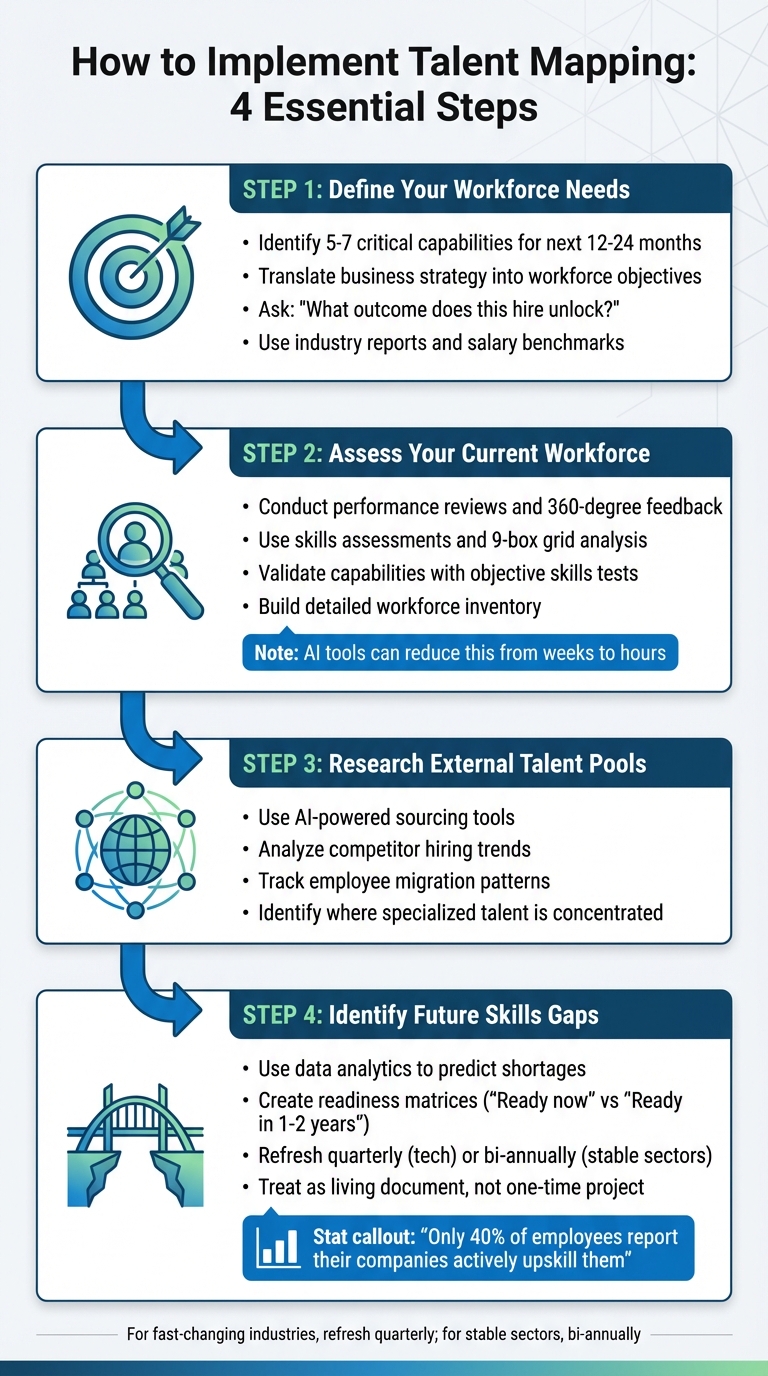
4-Step Talent Mapping Implementation Process for SMEs
If you’re ready to align your hiring strategy with long-term business goals, here’s how to build a talent mapping framework that connects the dots.
Step 1: Define Your Workforce Needs
Start by working with leadership to translate your company’s strategy into clear workforce objectives. What skills will the business need in the next one, three, or five years? Instead of just creating an org chart, focus on identifying 5–7 critical capabilities that will drive success in the next 12–24 months [4].
Ask yourself: What outcome does this hire unlock, and what happens if it’s delayed by three months? This question helps you prioritize strategic roles over reactive hiring [4]. To inform these decisions, use industry reports and salary benchmarks to define realistic profiles for the talent you need [6].
Once you’ve outlined these strategic capabilities, take stock of your current workforce to see where you stand.
Step 2: Assess Your Current Workforce
Before planning for future needs, you need a clear picture of your team’s current strengths. Combine performance reviews, 360-degree feedback, and skills assessments to build a detailed inventory of your workforce [2][8]. Tools like the 9-box grid are especially helpful for identifying high-potential employees and spotting any risks in succession planning [2][9].
Avoid relying too heavily on self-reported skills – these can be misleading. Instead, use objective skills tests to validate your team’s capabilities [2]. AI tools can speed up this process, turning what could take weeks into just a few hours, even for smaller HR teams [1].
Once you’ve mapped your internal talent, it’s time to look outward to understand the external talent landscape.
Step 3: Research External Talent Pools
With a clear view of your internal capabilities, shift your focus to external talent. AI-powered sourcing tools can help you analyze hiring trends among competitors and identify where specialized talent is concentrated [1][9]. Tracking employee migration patterns – such as where people are leaving and where they’re going – can provide valuable insights into the broader market.
By comparing this external data with your internal strengths, you can begin to pinpoint where future skill gaps might emerge.
Step 4: Identify Future Skills Gaps
The next step is to identify where your current capabilities fall short of your future needs. Use data analytics and headcount planning software to predict potential shortages [2][6]. With only 40% of employees reporting that their companies are actively upskilling them, it’s clear that many businesses will need to focus on both internal development and external hiring to stay competitive [8].
Visual tools, like matrices that show employee readiness (e.g., “Ready now” vs. “Ready in 1–2 years”), can help simplify complex data for leadership [2]. For fast-changing industries like tech, refresh your talent maps quarterly. In more stable sectors, bi-annual updates may suffice [1]. Remember, workforce planning today assumes constant change, so treat your talent map as a living document, not a one-time project [4].
How Rent a Recruiter Supports Talent Mapping
Once you’ve developed a solid talent mapping strategy, the next step is putting it into action. For many high-growth SMEs, this can be challenging due to limited HR resources and ambitious hiring goals. Rent a Recruiter steps in to bridge this gap, embedding experienced recruiters into your team in as little as five days[4]. This approach transforms your talent map into a fully functional hiring pipeline. Let’s break down how our tailored talent mapping reports and services make this happen.
Customized Talent Mapping Reports
Our talent mapping reports are designed to give you a clear, actionable picture of the talent landscape. These reports go beyond identifying talent pools – they also pinpoint skills gaps and establish hiring benchmarks. To give you a competitive edge, we include Attraction & Retention and Employer Branding assessments, offering a complete view of your standing in the talent market[10].
This data-driven approach has helped businesses across various sectors build stronger pipelines and make smarter hiring decisions aligned with their long-term growth plans.
Integrated with Embedded Recruitment Services
The real power of talent mapping lies in its execution. Rent a Recruiter’s embedded recruitment model integrates these insights directly into your hiring process, turning workforce planning into a dynamic, results-driven strategy[4]. Your embedded recruiter uses the mapping data to build targeted pipelines, focus on critical roles, and manage hiring efforts across multiple locations.
Take Unique as an example. By leveraging this integrated model, they streamlined international hiring across Berlin, Zurich, New York, London, and Singapore. Within just a few months, their embedded recruiter coordinated 291 interviews, extended 17 offers, and secured 10 successful hires globally[4]. This approach not only simplifies execution but also drives measurable cost efficiencies.
Cost Savings and Scalability
Unlike traditional recruitment agencies that charge 15–30% per hire, Rent a Recruiter operates on a fixed monthly rate, offering SMEs savings of 30% to 70%. This model also provides flexibility, allowing you to scale recruitment efforts up or down based on demand – without being locked into long-term contracts or incurring unnecessary expenses[10].
Clients frequently highlight the value of predictable pricing combined with strategic hiring insights, as reflected in our 4.9/5 rating from over 20 reviews[10].
"Our embedded recruiter… has been a great asset to the current status of the recruitment needs of the company and cannot commend her enough for the work she does."
– Noelle Harnett, HR Operations Manager, Silver Stream Healthcare Group[10]
This flexibility is especially vital in the unpredictable 2026 market, where hiring mistakes can have a major impact on SMEs[4]. By combining talent mapping with embedded recruitment, you’re not just planning ahead – you’re safeguarding your business against costly errors and ensuring a more resilient hiring strategy.
Tools and Strategies for Talent Mapping
Tools for Effective Talent Mapping
The right tools can transform talent mapping from a tedious task into a strategic advantage. For smaller businesses, skills inventories are a straightforward way to start. Using scorecards or spreadsheets, you can evaluate employees based on performance and potential, making it easier to spot future leaders or promotion-ready team members without investing in costly software[3]. For organizations with more complex needs, HRIS and talent management platforms centralize data from performance reviews and assessments, enabling smarter, data-driven decisions[2].
When it comes to external talent mapping, AI-powered sourcing tools are reshaping the game. Take this example: using the PeopleGPT AI workflow in 2026, a recruiter searching for software engineers specializing in distributed systems in Austin, TX, generated a list of over 150 qualified candidates from 60+ platforms in under two minutes. This task, if done manually, would have taken more than 15 hours[1]. These tools analyze vast amounts of career data, freeing up recruiters to focus on more strategic tasks[1].
Visual mapping tools also play a critical role in presenting workforce data to leadership teams. Tools like matrices, heat maps, and 9-box grids help illustrate "readiness levels", showing how long it might take to prepare an internal candidate for a specific role[2]. Additionally, an optimized ATS/CRM system ensures that pre-qualified candidates remain accessible, streamlining vacancy management and pipeline tracking[6]. With the global talent management software market expected to reach $29.9 billion by 2030 (up from $12.8 billion in 2023), it’s clear these tools are becoming indispensable for strategic workforce planning[1].
When to Use Project-Based vs. Continuous Talent Mapping
timing is just as important as the tools you use, as we often discuss on our recruitment blog. Deciding between project-based and continuous talent mapping depends on your company’s stage and needs.
Project-based talent mapping is ideal for companies just getting started or tackling specific challenges like launching a new product, entering a new market, or securing funding[11]. This approach allows you to focus on a few critical roles without stretching your resources too thin. It’s also a great way to test your strategy and demonstrate ROI before scaling it up across the organization[1][6].
On the other hand, continuous talent mapping becomes crucial as businesses grow, especially in fast-paced industries like tech or finance where skills and roles evolve quickly[2][1]. For technical or rapidly changing roles, refreshing talent maps quarterly keeps your hiring strategy aligned with current needs. For more stable roles, a bi-annual update is often enough. One fintech company, for example, reduced its time-to-hire for AI/ML positions by 50% through a proactive approach that combined internal training with targeted sourcing from competitors over a 12-month period[1].
Your choice between these approaches should reflect your industry’s pace, hiring demands, and the sophistication of your HR tech. Many high-growth small and medium enterprises start with project-based mapping and shift to continuous mapping as they expand[6][11].
Conclusion
Talent mapping takes your hiring approach from putting out fires to building a proactive strategy that aligns your workforce with your business goals. For high-growth SMEs in today’s unpredictable market, the benefits are clear: lower hiring costs, faster fills for critical roles, stronger retention through internal mobility, and the ability to safeguard revenue before disruptions hit.
Companies that align talent strategies with business priorities consistently outperform competitors during economic challenges[4]. With turnover costs soaring 33% year-over-year as of 2026[9], the need for a strategic approach has never been more pressing. Alisha Moberly, Talent Enablement Partner at Paychex, highlights this perfectly:
"In 2026’s rapidly evolving talent market, organizations that master talent mapping don’t just fill roles. They anticipate needs, stay ahead of disruption, and turn workforce strategy into competitive advantage."[9]
By prioritizing planning, businesses unlock scalable and cost-effective growth. As this guide has shown, talent mapping delivers real results for SMEs – cutting hiring cycles by 30% and achieving notable savings through embedded recruitment models.
Whether you’re preparing for post-funding expansion, launching new products, or tired of scrambling to fill roles, talent mapping equips you with the foresight to tackle tomorrow’s challenges today. It transforms hiring from a back-office task into a driver of growth.
Ready to future-proof your talent strategy? Discover how Rent a Recruiter works and how our talent mapping solutions and embedded recruitment model can seamlessly integrate into your team in just five days[4].
FAQs
When should my company start talent mapping?
Getting ahead of your hiring needs is crucial, especially during periods of growth or strategic planning. Talent mapping allows you to forecast future workforce requirements, align your team’s capabilities with long-term business goals, and identify areas where skills are lacking.
By starting early, you’ll build a reliable talent pipeline, cut down the time it takes to fill critical roles, and position your company for steady growth. This is especially valuable for high-growth SMEs facing expansion challenges or navigating talent shortages.
What data do I need to create a talent map?
Start by collecting data that reflects both your company’s current workforce and its future needs. This involves looking inward at employee skills, experience levels, and career trajectories. At the same time, assess external factors like industry trends, market conditions, and the availability of candidates in your field.
With this combination of insights, you can create detailed candidate profiles and spot where skill gaps exist. This approach not only helps with strategic workforce planning but also ensures you’re building a reliable talent pipeline to meet upcoming demands.
How often should we update our talent map?
Talent maps need regular updates – ideally, at least once a year – to keep pace with changing strategic priorities and market dynamics. Consistent reviews ensure your talent pipeline stays aligned with your business needs, making workforce planning more effective.