
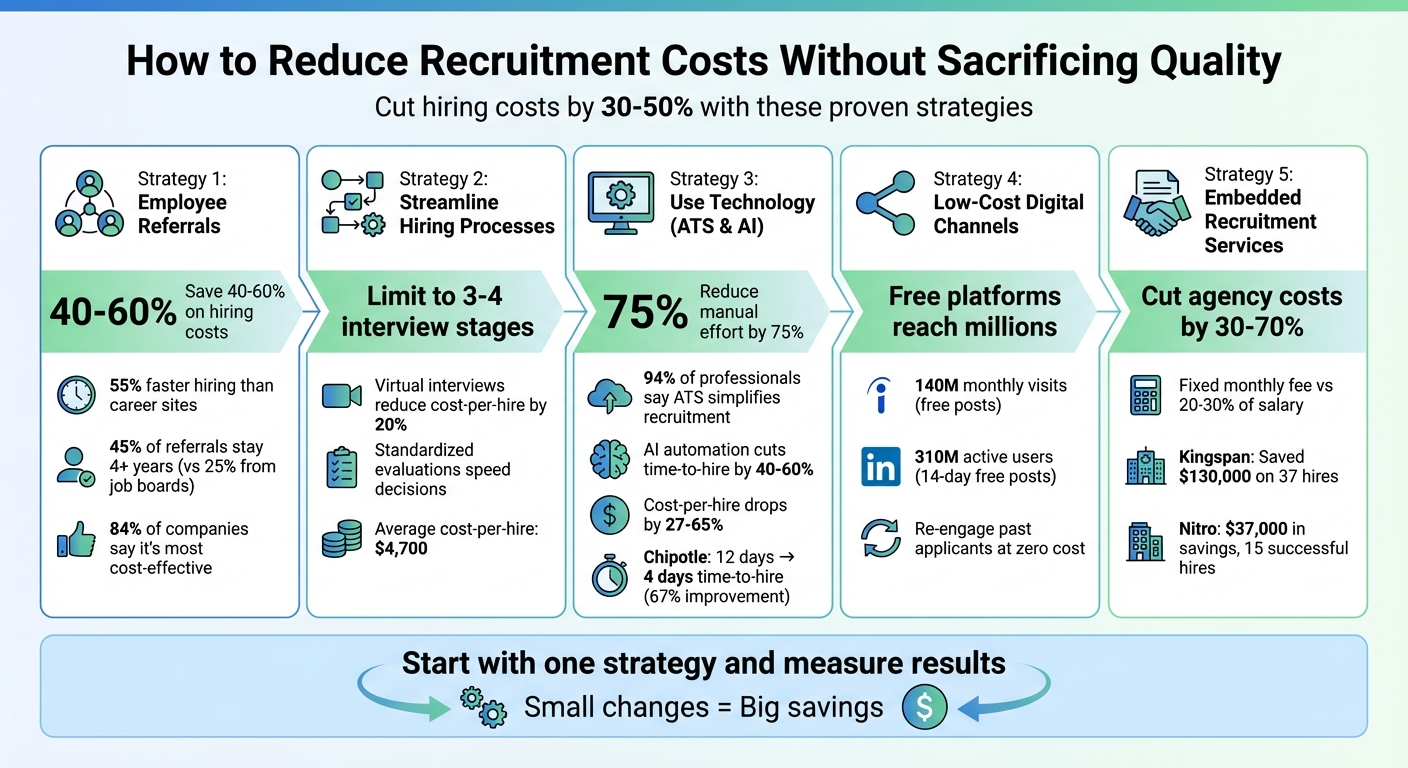
Recruitment is expensive, but you can cut costs by 30%–50% without compromising on hiring quality. Here’s how:
- Employee Referrals: Save 40%–60% on hiring costs by leveraging your team’s network. Referred hires are faster to onboard and stay longer.
- Streamline Hiring Processes: Limit interviews to 3–4 stages, use virtual interviews, and standardize evaluations to save time and money.
- Use Technology: Tools like Applicant Tracking Systems (ATS) and AI-powered screening reduce manual effort by up to 75%.
- Tap Into Affordable Channels: Free job boards, re-engaging past applicants, and internal hiring save thousands in external fees.
- Embedded Recruitment Services: Fixed-fee models like Rent a Recruiter cut agency costs by 30%–70%.
These strategies help you hire efficiently while staying within budget. Start by focusing on one area – like referrals or ATS tools – and measure the impact. Small changes can lead to big savings.
5 Proven Strategies to Reduce Recruitment Costs by 30-70%
Ways to Reduce Hiring Costs (What Most Companies Overlook)
sbb-itb-a23bd6a
Use Employee Referrals to Lower Costs and Improve Hiring
Employee referrals offer a faster, more affordable way to hire, making them a smart addition to any recruitment strategy. Referred candidates are hired 55% faster than those found through career sites, cutting the average time-to-hire from 39 to 29 days. Plus, referrals can slash your cost-per-hire by 40% to 60%, saving you from hefty job board fees and agency commissions that often claim 20% to 30% of a role’s first-year salary.
The benefits go beyond cost and speed. Employees already familiar with your company culture naturally recommend candidates who are more likely to fit in. 45% of referrals stay for more than four years, compared to just 25% of hires from job boards. Since employees put their own reputation on the line, they’re motivated to refer only high-quality candidates.
How to Set Up a Referral Program
Keep the process simple and fast – employees should be able to submit referrals in under a minute. Use a standardized form to collect the candidate’s name, contact details, and a brief explanation of why they’d be a good fit. Track these submissions through your applicant tracking system to ensure transparency and efficiency.
Design your incentives based on the complexity of the role. Cash bonuses typically range from $500 to $2,000, with entry-level positions starting at $1,000 and senior or technical roles going up to $3,000. To encourage retention, split the reward: pay half when the candidate is hired and the other half after they complete a 90-day probationary period.
Some companies have found success by thinking outside the box. For example, GoDaddy boosted its referral rate from 17% to 33% by reducing cash bonuses from $3,000 to $1,000 and adding personalized, symbolic rewards like engraved mirrors to encourage employees to “see” potential candidates in their network. PURE Insurance takes a different approach, asking new hires to recommend candidates within their first 30 days to tap into their initial enthusiasm.
Make open positions visible and easy to share. Use Slack, newsletters, or all-hands meetings to spread the word. Provide ready-to-use email templates and social media scripts to simplify the process. To keep employees engaged, consider smaller rewards like $100 to $200 when a referred candidate reaches the interview stage.
Why Employee Referrals Work
The numbers speak for themselves. 84% of companies believe referrals are the most cost-effective way to find talent. Salesforce, for instance, fills 41% of its positions through referrals, offering a $2,000 cash bonus for successful hires. They’ve paid out over $7 million in total and keep employees engaged with initiatives like a “7-day contact rule” for referrals and “Recruitment Happy Hours” where employees can invite potential candidates in a casual setting.
Referred employees stay 70% longer than non-referred hires. This longevity stems from the fact that referred candidates enter with a clear understanding of the role and company culture, thanks to insights from their referrer. For small and medium-sized businesses with limited HR resources, referrals offer an efficient way to find strong candidates without the need for extensive resume screening.
Next, focus on refining internal processes to maximize the benefits of this cost-effective hiring method.
Improve Internal Hiring Processes for Better Efficiency
If you’re aiming to cut recruitment costs while maintaining high standards, refining your internal hiring process is key. Streamlining workflows not only reduces expenses but also improves hiring quality. With the average cost per hire hovering around $4,700, a single bad hire could cost up to $15,000 – and replacing an employee might set you back twice their salary. Clearly, there’s a lot at stake.
One way to tackle this is by eliminating unnecessary steps that drag out the hiring timeline. Redundant interview rounds, inconsistent evaluations, and manual tasks can waste both time and money. Even small adjustments can lead to big savings, speeding up the process and improving how candidates are handled along the way.
Reduce and Standardize Interview Stages
Keep your interview process concise – 3 to 4 stages at most. Adding more rounds not only delays decisions but increases the risk of losing top candidates to quicker-moving competitors. Instead of focusing solely on credentials, use competency-based assessments to evaluate a candidate’s skills, confidence, and communication abilities.
To make the process fairer and faster, standardize your evaluation criteria. Create interview guides and scorecards to ensure all interviewers assess candidates using the same benchmarks. This consistency minimizes hiring errors and speeds up decision-making. Plus, training your interviewers ensures candidates have a smooth, professional experience, which helps protect your employer brand and boosts the chances of offer acceptance.
Virtual interviews are another game-changer. They can cut travel and accommodation costs for both your company and candidates. In fact, video interviews have been shown to reduce cost-per-hire by 20%. A simple switch like this can make a big difference for businesses looking to save.
Apply Pre-Screening Tools and ATS
Applicant Tracking Systems (ATS) can handle time-consuming tasks like resume screening, candidate communication, and interview scheduling. These tools are incredibly effective – 94% of hiring professionals who use an ATS say it simplifies their recruitment process. By filtering applications for must-have qualifications, ATS software ensures hiring managers only spend time on candidates who meet the job requirements.
Companies like Chipotle and Unilever have demonstrated the power of AI and automation in hiring. In early 2024, Chipotle used an AI hiring assistant to manage applications and scheduling for 20,000 seasonal hires. The results? Application completion rates jumped from 50% to 85%, and the average time-to-hire dropped from 12 days to just 4 – a 67% improvement. Similarly, Unilever leveraged predictive analytics and AI-powered video interviews to slash its time-to-hire by 75%, saving over $1 million in recruitment costs.
Another smart move is using your ATS to maintain a database of “silver medalists” – strong candidates who weren’t selected initially but could be perfect for future roles. This approach can save you time and money on sourcing when new positions open up.
Focus on Internal Mobility and Talent Pipelines
Internal hiring can save a significant chunk of money by eliminating job board fees and recruiter commissions. It’s up to 20% more cost-effective than external hiring.
“Promoting from within helps you save on job advertising costs, external recruiter fees, and lengthy onboarding processes.” – Jen Dewar, JobScore
Adopting an “internal-first” policy is a practical way to prioritize internal talent. Announce job openings to current employees before advertising externally. Maintaining a skills inventory that tracks employees’ certifications, abilities, and career goals can make it easier to identify internal candidates for open roles. This not only saves time but also boosts morale by showing employees that growth opportunities exist within the company.
Programs like cross-training and job rotations can prepare your team for new roles, giving your business more flexibility without the costs of external hiring. Internships are another excellent pipeline, allowing you to evaluate potential hires early and convert top performers into full-time employees at a fraction of the cost.
With a streamlined internal hiring process in place, the next step is to explore digital channels to broaden your recruitment reach.
Use Low-Cost Digital Channels for Recruitment
You don’t need a massive budget to attract top talent. With efficient strategies and free or affordable tools, you can build a strong candidate pipeline without overspending. In fact, over half of recruiters say that social media is their go-to platform for finding quality hires.
Get the Most from Free Job Posting Platforms
Some of the most effective job boards and platforms offer free options to help you reach candidates. For example:
- Indeed: With 140 million visits every month, you can post up to three jobs for free in the U.S..
- LinkedIn: Offers a 14-day free job post to tap into its 310 million monthly active users. Instead of opting for LinkedIn Recruiter (which costs $8,500–$10,000 per seat annually), try using the #Hiring photo frame on your profile and join relevant industry groups to connect with candidates for free. The “People Also Viewed” feature is another great way to find similar professionals without paying for advanced filters.
For specific roles, consider specialized platforms:
- GitHub and Stack Overflow: Perfect for finding developers and other technical talent.
- Craigslist: A reliable option for service roles and hourly positions.
- Handshake: Ideal for reaching recent graduates and interns, offering free access to over 20 million students across 1,500+ campuses.
Want to show up in Google search results? Add JobPosting schema markup to your career page. Listings with clear salary ranges rank higher, as Google prioritizes posts with compensation details.
Additionally, tools like Apollo.io and Hunter.io can help you find candidate contact information. While email outreach has a lower response rate (15–25%) compared to LinkedIn InMail (35–45%), it’s a cost-effective option for small businesses.
Build Talent Pools from Past Applicants
Don’t overlook candidates who’ve already shown interest in your company. Re-engage “silver medalists” – those who made it far in the hiring process but didn’t get the job. They’re already familiar with your business, making them quicker and less expensive to onboard. Use your Applicant Tracking System (ATS) to organize past applicants by skills and experience, so you can easily find matches for new openings.
Keeping these relationships warm is crucial. Always provide feedback to candidates who weren’t selected, and use automated but personalized email campaigns to keep them updated about your company and future opportunities. Former employees, often called “boomerang” candidates, are another great resource. They already understand your company culture, which reduces onboarding time and effort.
Finally, track the performance of your job postings by attaching UTM codes to links. This helps you identify which platforms are delivering the best candidates, so you can focus your energy – and budget – where it matters most.
Work with Rent a Recruiter for Embedded Recruitment Services
If you’re looking for ways to streamline your hiring process while keeping costs in check, embedded recruitment could be the solution. Once you’ve maximized the potential of job boards and tapped into talent pools, embedded recruitment offers an additional way to save money. Here’s how it works: instead of paying 20–30% of a new hire’s salary in traditional agency fees, you pay a fixed monthly fee for a recruiter who becomes part of your team. This approach can slash recruitment expenses by 30% to 70% compared to agency costs. Plus, it integrates seamlessly with your existing digital and referral-based strategies.
What Rent a Recruiter Offers
Rent a Recruiter provides small and medium-sized businesses with three adaptable service models to optimize their recruitment efforts:
- Embedded Recruitment: This service gives you a dedicated Talent Acquisition Specialist who operates as part of your team. They handle tasks like sourcing, screening, and coordinating interviews – all for a flat monthly fee, with no additional charges per hire.
- Contract Staffing: Ideal for short-term needs, this option provides access to pre-vetted professionals for temporary roles, seasonal demands, or maternity cover. It allows for flexible scaling without long-term commitments.
- One-off Placements: For strategic, niche, or leadership roles, this model offers targeted recruitment support without the need for ongoing services.
Why Embedded Recruitment Works for SMEs
One of the biggest advantages of embedded recruitment is predictable costs. With a fixed monthly fee, you avoid unexpected invoices typical of traditional agency models. For example, Kingspan Water and Energy used this approach between 2023 and 2024 to fill 37 roles in just seven months – saving $130,000 compared to agency commissions.
This model also speeds up hiring. With a dedicated recruiter focused solely on your roles, the time-to-hire shrinks significantly. VicReturn, for instance, filled 18 senior positions in just four months, screening 1,481 applicants and saving their HR team over 600 hours of admin work.
Another benefit? You get the expertise of a recruitment professional without the overhead of a full-time hire. These recruiters immerse themselves in your company, learning your culture and ensuring your employer brand is consistently represented. As Neil Spellman, Senior Recruiter at Nitro, shared:
“The flexibility of Rent a Recruiter’s service exceeded our expectations. We greatly valued the data and insights they provided, which drove key strategic decisions.”
Nitro achieved impressive results through this model, including 15 successful hires, engagement with over 3,000 passive candidates, and $37,000 in savings – all while maintaining a strong 2:1 CV-to-interview ratio.
Free Recruitment Health Check
To get started, Rent a Recruiter offers a free Recruitment Health Check. This tool evaluates key areas like Employer Branding, Hiring Practices, Candidate Experience, and Diversity & Inclusion. You’ll receive a personalized PDF report that highlights inefficiencies and suggests actionable ways to cut costs, such as reducing time-to-hire or trimming excessive job board fees. It also pinpoints where you might be losing top talent, giving you a clear plan for improvement.
Use Technology and Data for Better Screening
Using the right technology can lower recruitment costs and improve the quality of your hires. Automation frees up time, allowing you to focus on connecting with top candidates. In fact, companies using AI-driven recruitment automation report a 40–60% reduction in time-to-hire and see cost-per-hire drop by 27–65%. Here’s how technology and data can transform your screening process.
How Applicant Tracking Systems (ATS) Help
An Applicant Tracking System (ATS) serves as the backbone of your hiring operations, covering everything from job postings to offer letters. Modern ATS platforms use AI-powered ranking systems to evaluate candidates against your job requirements, helping you quickly identify the strongest applicants. This efficiency is remarkable – automated resume screening can cut manual effort by up to 75%, reducing a 40-hour task to just 10 hours per position.
Beyond screening, an ATS simplifies interview scheduling by syncing directly with your calendar, eliminating the endless email exchanges that often frustrate candidates. It also builds a database of applicants, creating a talent pool you can revisit for future roles, saving you from paying for new job ads. This approach can save companies an average of $7,000 per role by reducing administrative workload.
While an ATS lays the foundation, advanced AI tools take these efficiencies to the next level.
Add AI and Automation to Your Process
AI tools enhance screening by processing large volumes of resumes with speed and accuracy. These systems can evaluate hundreds of resumes in minutes, match candidates to your job criteria, and even handle outreach to passive candidates. Some tools go further, automating tasks like scheduling interviews and conducting pre-screening assessments – all without a recruiter lifting a finger.
The evolution of these tools has led to what experts are calling “AI Workers.” These systems don’t just assist recruiters; they manage entire workflows, from sourcing and engaging candidates to screening them. Automating resume screening alone can reduce time-to-hire by up to 50% without sacrificing candidate quality.
However, it’s crucial to monitor these tools regularly. AI algorithms can unintentionally exclude qualified candidates, especially if they rely on biased historical data. Keeping human recruiters involved in areas like culture-fit evaluations and final conversations ensures a balance between efficiency and personal connection.
With automated screening in place, talent mapping becomes a powerful strategy for long-term hiring success.
Use Talent Mapping for Better Hiring Decisions
Talent mapping shifts recruitment from a reactive process to a proactive strategy. By maintaining a database of pre-qualified candidates – such as strong applicants who weren’t the right fit at the time – you build a “warm” talent pool that’s ready to go when a role opens. This approach can cut sourcing costs by 30% to 40%.
The data side of talent mapping is just as impactful. Tracking metrics like cost-per-hire, time-to-fill, and the effectiveness of different sourcing channels helps you allocate resources more effectively. For instance, if your referral program consistently delivers better hires faster than paid ads, you can adjust your budget to focus on what works. Companies that use recruitment data see hiring efficiency improve by 26%. Additionally, shortening your hiring cycle by 20 days can save over $6,000 per hire in productivity.
These strategies, powered by technology and data, set the stage for a streamlined and cost-effective hiring process.
Run Regular Recruitment Audits
Regular recruitment audits can highlight inefficiencies and unnecessary expenses in your hiring process. Did you know that around 70% of talent acquisition challenges stem from process inefficiencies rather than technology gaps? That means most issues can be resolved without investing in new software.
Take a closer look at the numbers. Small businesses typically spend between $4,000 and $6,000 per hire, while mid-size companies average $2,000 to $4,000. If your cost-per-hire is significantly above these averages, an audit can help pinpoint the problem. For example, in January 2026, a 500-person tech company reviewed its recruitment budget and found they were spending $120,000 annually on LinkedIn Recruiter seats, even though that platform only accounted for 12% of their hires. Meanwhile, 60% of their engineering hires came from employee referrals and GitHub, and their top-performing sales hires were linked to a $3,000/year industry association membership. By identifying these trends through a source-of-hire audit, they reallocated their budget to more effective channels.
How to Conduct a Recruitment Audit
Start by mapping your entire hiring process – from the initial planning stages to onboarding. Look for areas where candidates drop out or where time is wasted. To calculate your cost-per-hire, add up all internal expenses (like recruiter salaries and software subscriptions) and external costs (such as job board fees and agency charges), then divide by the total number of hires.
Next, analyze your source-of-hire data to determine which channels consistently deliver top candidates. Before making decisions, ensure your ATS data is accurate and up-to-date. If you uncover inefficiencies, use the “5 Whys” technique to dig deeper. For instance, if your time-to-fill is too long, keep asking “why” until you find the root cause – whether it’s delays in feedback from hiring managers or time lost to manual scheduling.
Ask your recruiters to track their tasks for one week to see how much time is spent on sourcing versus administrative work. Interview scheduling alone can take between 25 and 100 hours for every 50 interviews, and 67% of recruiters say scheduling a single interview takes 30 minutes to 2 hours. If manual scheduling is eating up too much time, consider calendar automation tools, which cost $3,000–$12,000 annually, as an alternative to hiring a recruiting coordinator with a $50,000–$65,000 salary plus benefits.
These insights can help you make smarter decisions about how to allocate your recruitment budget.
| Wasted Spending | Reallocation Opportunity |
|---|---|
| Low applicant flow from expensive job boards | Invest in an employee referral program |
| High external recruiter costs | Hire additional in-house recruiters |
| Ineffective university events | Fund technical capstone projects with better conversion rates |
| Excessive time spent on manual scheduling | Use calendar automation tools or hire a coordinator |
Once you’ve identified inefficiencies, consider using expert tools to refine your hiring strategy further.
Use Rent a Recruiter’s Assessment Tools
Rent a Recruiter offers a free Recruitment Health Check, which benchmarks your hiring performance and provides a detailed PDF report. This report includes insights on employer branding, hiring practices, and diversity, making it easier to identify areas for improvement without diving into the data yourself.
Their employer branding assessments are another valuable resource. These tools evaluate how potential candidates perceive your company, which directly affects your ability to attract talent without relying heavily on job ads or external recruiters. For small and mid-sized businesses without dedicated talent acquisition teams, these tools can be a game-changer for running effective audits and improving hiring outcomes.
Conclusion
Save on recruitment costs without sacrificing the quality of your hires. The strategies shared here combine to build a cost-effective hiring process that prioritizes both efficiency and candidate quality.
Start by improving processes like implementing standardized interviews and using an applicant tracking system (ATS). An ATS can eliminate time-consuming bottlenecks and make recruitment more efficient. Employee referral programs are another game-changer, cutting cost-per-hire by up to 25%. Digital channels and talent pools let you connect with qualified candidates without the expense of traditional advertising, while embedded recruitment services provide expert support at a fraction of the cost of traditional agencies. By using technology and automation for tasks like resume screening and interview scheduling, your team can focus on engaging with top-tier candidates.
This cohesive approach creates the groundwork for long-term recruitment success.
To keep improving, maintain strong talent pipelines and conduct regular audits. Companies with strong employer brands report a 43% lower cost-per-hire. Tapping into pipelines of past applicants and internal talent can reduce dependency on costly external sources. Regularly auditing your recruitment strategy with real data ensures you’re always refining your approach.
Start small – choose one strategy, measure its results, and expand from there. These methods are designed to help growing businesses hire effectively while staying mindful of costs. By adopting this approach, you’ll create a scalable and efficient hiring system that consistently delivers quality candidates without breaking the bank.
FAQs
Which cost-cutting tactic should I start with first?
When it comes to saving money on hiring, tapping into employee referrals is a smart first move. It’s an affordable way to find talent because your current employees do the heavy lifting by recommending people they know. This cuts down on both sourcing and prescreening costs.
To make the most of this approach, consider setting up a formal referral program with incentives. Offering rewards can motivate your team to actively participate, helping you bring in top-notch candidates without stretching your budget.
How do I measure cost-per-hire and source-of-hire correctly?
To calculate cost-per-hire, take the total recruitment expenses – such as advertising, recruiter hours, onboarding, and training – and divide that by the number of hires during a specific timeframe. This metric helps you understand the financial investment required for each new employee.
For source-of-hire, track where your successful candidates are coming from. This could include platforms like job boards, employee referrals, or social media channels. Knowing which sources deliver the best results helps you focus on the most effective and budget-friendly options.
By keeping an eye on these two metrics, you can refine your hiring strategy to ensure it stays efficient and delivers high-quality talent.
How can I use AI screening without lowering hiring quality?
AI screening can be a powerful tool when used thoughtfully. By standardizing evaluations, it helps create consistent and objective assessments across candidates. It also provides deeper insights into applicants by analyzing skills and qualifications in ways that might not be immediately obvious.
To make the most of AI in hiring, consider incorporating structured rubrics and skills-based sourcing into your process. These methods not only improve how well candidates align with job requirements but also promote fairness by focusing on measurable abilities rather than subjective impressions.
It’s crucial, however, to maintain transparency and fairness. Using explainable scoring systems ensures that decisions are clear and understandable, while DEI (Diversity, Equity, and Inclusion) safeguards help prevent unintended biases. By combining these practices with human oversight, you can balance AI’s efficiency with the need for thoughtful, high-quality hiring decisions.