If hiring is slowing down, your team structure is often the problem, not just recruiter capacity.
If you are scaling in SaaS, Technology, IT, Fintech, Engineering, Security, Insurance, or Professional Services, you need two things: clear ownership for planning and clear ownership for delivery. When one person tries to do both, req loads climb, feedback stalls, agency spend grows, and open roles start to hit revenue plans. In 2026, in-house recruiters are handling 13.4 open requisitions on average, with 40% more open roles and 93% more applications than five years ago.
Here is the short version:
- Planning roles look 6 to 18 months ahead
- Delivery roles move hires from brief to offer
- Recruiters should not carry admin alone, because scheduling can take 25% to 30% of their time
- Sourcers start to make sense when recruiter loads move past 15 concurrent roles
- RecOps often becomes needed at around 200 employees
- A first recruiter usually makes sense when you expect 20 to 25 hires per year
- Embedded recruitment adds on-demand hiring capacity without changing internal ownership
If you want a hiring function that saves time, controls cost, and keeps pace with growth, this is the split you need to get right.
HR Recruiter Roles & Responsibilities: The Ultimate 2025 Talent Acquisition Guide!
sbb-itb-a23bd6a
Defining Strategic and Operational Recruitment Roles
Building on the strategic vs. operational split, recruitment ownership breaks into two layers. Planning roles build the hiring system. Delivery roles run it day to day. Keeping those layers separate is what stops bottlenecks as hiring volume grows, and what keeps your team from living in constant reaction mode.
What Planning-Focused Recruitment Roles Own
Planning roles, usually led by the Head of TA or TA Manager, work 6 to 18 months ahead of demand. Their job is to make sure the business can hire what it needs before pressure hits.
That means leading workforce planning talks with leadership, building the annual hiring forecast, and managing the recruitment budget, including cost-per-hire targets. In plain terms, these roles build hiring capacity over time, not just fill the next open seat.
For CEOs, CFOs, and HR leaders, this is where recruitment shifts from admin to business planning. If forecast accuracy is weak, hiring costs climb, teams miss targets, and growth slows.
What Delivery-Focused Recruitment Roles Own
Delivery roles, including recruiters, sourcers, coordinators, and RecOps, focus on hiring volume. Their job is to move candidates through the pipeline with speed and consistency.
A full-cycle recruiter owns the process from job brief to offer acceptance. A sourcer focuses on finding and engaging passive talent. Sourced candidates are 5x more likely to be hired than inbound applicants [2]. A coordinator handles scheduling, logistics, and candidate communication. RecOps manages the tech stack, data compliance, and process automation.
Each role removes a specific bottleneck. If no one clearly owns these tasks, small delays in scheduling or feedback stack up fast and turn into a stalled pipeline. That costs time, slows team build-out, and puts revenue plans under pressure.
That split becomes clearer when you compare ownership, timing, and KPIs side by side.
Table: Planning Roles vs. Delivery Roles Compared
| Planning-Focused Roles | Delivery-Focused Roles | |
|---|---|---|
| Core Focus | Strategy, budget, and infrastructure | Hiring volume, conversion, and speed |
| Time Horizon | 6 to 18 months | 1 to 90 days |
| Typical Roles | Head of TA, TA Manager, Employer Brand Specialist, Talent Analyst | Sourcer, Full-cycle Recruiter, Recruiting Coordinator, RecOps |
| Primary KPIs | Forecast accuracy, quality of hire, cost-per-hire | Time-to-fill, offer acceptance rate, pipeline velocity |
| Decision Rights | Budget, tech stack, EVP, process design | Shortlisting, interview loops, closing tactics |
| Reporting Line | CHRO, CPO, or CEO | TA Manager or Head of TA |
| Business Impact | Future-proofing and scalability | Immediate headcount fulfillment |
The handoff point is offer acceptance. Onboarding starts after offer acceptance. That boundary sets up the core roles every scalable recruitment team needs.
Key Roles Inside a Scalable Recruitment Team
Leadership and Planning Roles
These responsibilities sit at different levels, but they should not sit with the same person. You need one owner for planning and one owner for delivery.
The TA Director or Head of TA links business goals to hiring capacity. This role keeps headcount plans, budget, and hiring priorities in line. The business value is simple: clear accountability.
A strong TA leader tracks quality of hire, cost per hire, and source effectiveness so you can see if the team’s work is turning into better hiring outcomes. That matters more than most companies think. Mature talent acquisition teams are linked to 18% higher revenue and 30% greater profit than low-maturity peers [2].
Once planning is clear, the next job is assigning ownership for the day-to-day hiring work.
Delivery and Process Roles
Below leadership, four roles run day-to-day hiring.
Recruiters own conversion from brief to offer. They are your conversion specialists. In 2026, the average in-house recruiter manages 13.4 concurrent open requisitions, a 56% increase from 2021 [2]. That’s a heavy load. If you want to protect speed and candidate experience, the practical cap is 13 to 15 active searches for standard roles, or 4 to 5 for hard-to-fill specialist positions [2].
Sourcers build passive pipeline at the top of the funnel. This is where a lot of hiring teams either win or stall. Sourced candidates are 5x more likely to be hired than inbound applicants [2]. Sourcers usually make sense once a recruiter’s workload goes beyond 15 concurrent requisitions [3].
Coordinators handle scheduling, candidate communication, and interview logistics. Those tasks can take up 25% to 30% of recruiter time [2]. In many teams, adding a coordinator before hiring a second recruiter is the better commercial move. Why? Because it gives your recruiter more time to focus on screening, stakeholder alignment, and offer conversion.
RecOps owns the ATS, reporting, and process design. This role often gets added when recruiter volume grows [3], but waiting too long can create a mess. Even a part-time RecOps owner at the 200-employee mark can stop process inconsistency from spreading as hiring volume climbs [2]. You can rate your recruitment process to identify where these inconsistencies might already be impacting your efficiency.
Table: Core Recruitment Roles by Responsibility and KPI
| Role | Main Tasks | Process Ownership | Key KPIs |
|---|---|---|---|
| TA Director | Strategy, budget, headcount planning, executive alignment | Workforce planning | Quality of hire, cost per hire, source effectiveness |
| Recruiter | Screening, HM calibration, interview loops, offer closing | From brief to offer | Time to fill, offer acceptance rate |
| Sourcer | Passive candidate outreach, market mapping, pipeline building | Top-of-funnel pipeline | Sourcing conversion, pipeline health |
| Coordinator | Scheduling, logistics, candidate communications, ATS management | Interview logistics | Turnaround time, candidate NPS, feedback lag |
| RecOps | ATS admin, reporting, process documentation | Workflow design and data integrity | Recruiter efficiency ratio, data accuracy, tool ROI |
With roles set out clearly, the next step is deciding how to structure them into a team model that fits your hiring stage.
How to Structure a Recruitment Team for Growth
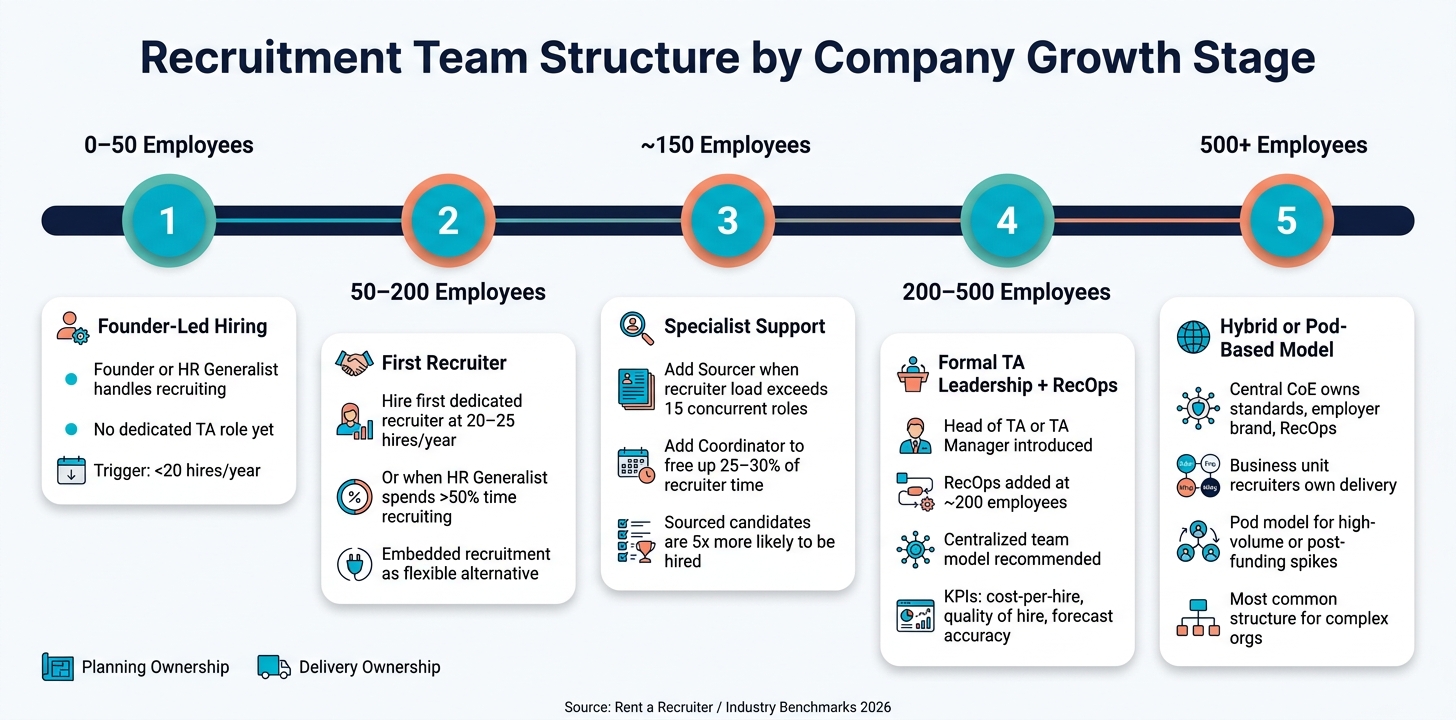
Recruitment Team Structure by Company Growth Stage
Centralized, Pod-Based, and Hybrid Team Models
Once roles are clear, the next decision is your operating model. This choice affects hiring speed, team coordination, and cost control.
A centralized model puts one TA team in charge of hiring across the whole company. Planning sits with the TA lead, while delivery runs through a shared group of recruiters. This setup works best when hiring needs look fairly similar across departments. You get more consistency in process and candidate experience, which matters when hiring quality and employer brand are tied closely to how the process feels.
A pod-based model splits the team into small units, usually a sourcer, a recruiter, and a coordinator, with each pod aligned to a business unit or a high-priority hiring push. If you’re building a new product team or dealing with a post-funding hiring spike, a dedicated pod can keep handoffs short and ownership clear. In this setup, planning stays close to the business, which often helps teams move with less friction.
A hybrid model sits in the middle. A central Center of Excellence, or CoE, owns standards, employer brand, and RecOps, while recruiters sit inside business units to deliver hiring. This is the most common setup for organisations with 500+ employees [2][3]. It can work well at scale, but only if the operating layer is clear. Without strong ownership inside the CoE, the model can slip into the same inconsistency you often see in a fully decentralised team.
How Team Structure Changes by Growth Stage
Team structure should change as hiring demand grows. What works at 40 employees usually breaks at 400.
Most companies move through a fairly clear path:
- Founder or HR generalist-led hiring at 0 to 50 employees
- A first recruiter at 50 to 200
- Specialist support from around 150 employees
- Formal TA leadership and RecOps at 200 to 500
- Hybrid or pod-based models beyond 500
That progression matters because hiring load changes fast. A lean setup may be fine early on, but once volume rises, gaps in ownership, planning, and reporting start to cost time and money.
Hire your first dedicated recruiter when you’re planning 20 to 25 hires per year, or when an HR generalist is spending more than 50% of their time on recruiting [2]. If you’re only planning 10 hires in a year, a contract recruiter is often a better fit than a full-time hire [2][1].
Table: Recruitment Team Structures Compared
The three models vary in where planning sits, how delivery works, and how much coordination they need.
| Structure | Best Fit | Speed & Scalability | Management Overhead | Planning vs. Delivery |
|---|---|---|---|---|
| Centralized | 200+ employees; similar roles across departments | High scalability; consistent standards | Moderate; needs a strong TA lead | Strong strategic planning; standardized delivery [2] |
| Pod-Based | High-volume projects; post-funding hiring spikes | Very high speed; tight handoffs | Low per pod; increases across multiple pods | High delivery focus; planning is business-unit-specific [2] |
| Hybrid | 500+ employees; complex or multi-function orgs | Balanced; scales through the CoE | High; requires a solid RecOps layer | CoE owns planning; BUs own delivery [2][3] |
Using Embedded Recruitment to Add Capacity and Structure
Where Embedded Recruiters Fit in the Team
Once the operating model is set, the next step is simple: can your team actually deliver it?
A clean centralised or pod-based model can still slow down when hiring demand climbs faster than your internal team can handle. That’s usually where pressure shows up first. Reqs pile up. Hiring managers wait longer for support. Reporting gets patchy. Small handoff issues start turning into bigger delays.
That’s where embedded recruitment comes in. Embedded recruiters work inside your existing process, systems, and team rhythm, often directly in your ATS and hiring meetings, while managing hiring end to end. They sit in the delivery layer, while internal leaders keep control of planning and governance. In practice, that means they take on the day-to-day hiring work, tighten handoffs, improve reporting, and spot bottlenecks before they start slowing hiring down. This is a strong fit for companies with 50 to 200 employees where hiring is growing faster than internal capacity [2][1].
Embedded recruitment adds delivery capacity without changing ownership.
How Rent a Recruiter Supports Planning and Delivery Needs
If you need hiring capacity now, an embedded model can close that gap fast. Rent a Recruiter places experienced recruiters directly into scaling companies, often within days, to manage hiring end to end. For funding rounds, product launches, or hiring spikes, this gives you more throughput without disrupting the structure you’ve already built.
The commercial side matters too. Fixed monthly pricing keeps costs predictable and helps you avoid adding permanent headcount too early. Companies using Rent a Recruiter can reduce hiring costs by up to 70% and save more than 80 hours per month in internal hiring admin time.
Conclusion: Choose the Right Structure and Take the Next Step
Scaling hiring comes down to two things: clear ownership and enough capacity to deliver. Planning and delivery are not the same job, and teams often run into trouble when those lines get blurred.
The right setup depends on your stage. Early-stage companies may only need embedded support once hiring reaches roughly 20 to 25 hires per year. Growth-stage teams can use it as a buffer during spikes or for hard-to-fill roles. Scaling-stage teams can use it as a dedicated pod to clear backlogs or put RecOps infrastructure in place [2][1].
The goal is not to add recruiters for the sake of it. It’s to build a hiring function that can keep up with demand, without wasting time or overspending.
FAQs
How do I know if our hiring bottleneck is structure or capacity?
Start by auditing your hiring process.
If steps don’t have clear owners, or feedback and handoffs are patchy and slow the team down, the problem is structure.
If recruiters are carrying more work than is sustainable, especially more than 13.4 open roles each, the issue is capacity.
When should we add a coordinator, sourcer, or RecOps role first?
Add the role that solves your biggest hiring bottleneck, not the one that happens to sit next on an org chart.
- Recruitment Coordinator: when scheduling, ATS upkeep, and candidate communication eat up more than 25% of a recruiter’s time
- Talent Sourcer: when recruiters spend more than 60% of their time on top-of-funnel work, or they can’t support more than 15 open reqs
- RecOps: usually once you have 10 to 20 recruiters
Which recruitment team model best fits our growth stage?
The best model depends on your hiring volume and team size, not just total employee count. For smaller companies and early-stage startups, a generalist recruiter is usually the right place to start.
Once you move beyond 50 hires per year or 100 employees, the picture changes. At that point, it often makes sense to add a recruitment coordinator to handle admin work and start building a more dedicated talent acquisition setup.
If you have multiple recruiters, specialist roles can help keep the process efficient. That usually means less time lost on admin, better ownership across the hiring process, and a setup that supports stronger hiring outcomes as you grow.