
Hiring smarter starts with cutting costs and saving time. Recruitment marketing can reduce hiring costs by up to 94% compared to traditional methods like agencies or in-house teams. It also builds a pipeline of talent before roles even open, ensuring faster, more efficient hiring.
- Recruitment marketing uses programmatic ads and employer branding to engage both active and passive candidates, driving cost-per-hire as low as $850.
- Traditional hiring relies on agencies or internal teams, often costing $7,500–$15,000 per hire for a $50,000 role, with slower hiring cycles and hidden expenses like vacancy costs.
The result? Recruitment marketing delivers predictable costs, better candidate engagement, and scalable hiring solutions – ideal for high-growth companies.
| Model | Cost-Per-Hire | Total Cost for 10 Hires |
|---|---|---|
| Recruitment Marketing | $850–$1,200 | $8,500–$12,000 |
| Recruitment Agency | $8,500 | $85,000 |
| In-House TA Team | $13,200 | $132,000 |
Why it matters: Every unfilled role costs you time and money. Recruitment marketing reduces delays, improves efficiency, and delivers better-fit candidates – helping you scale without breaking your budget.
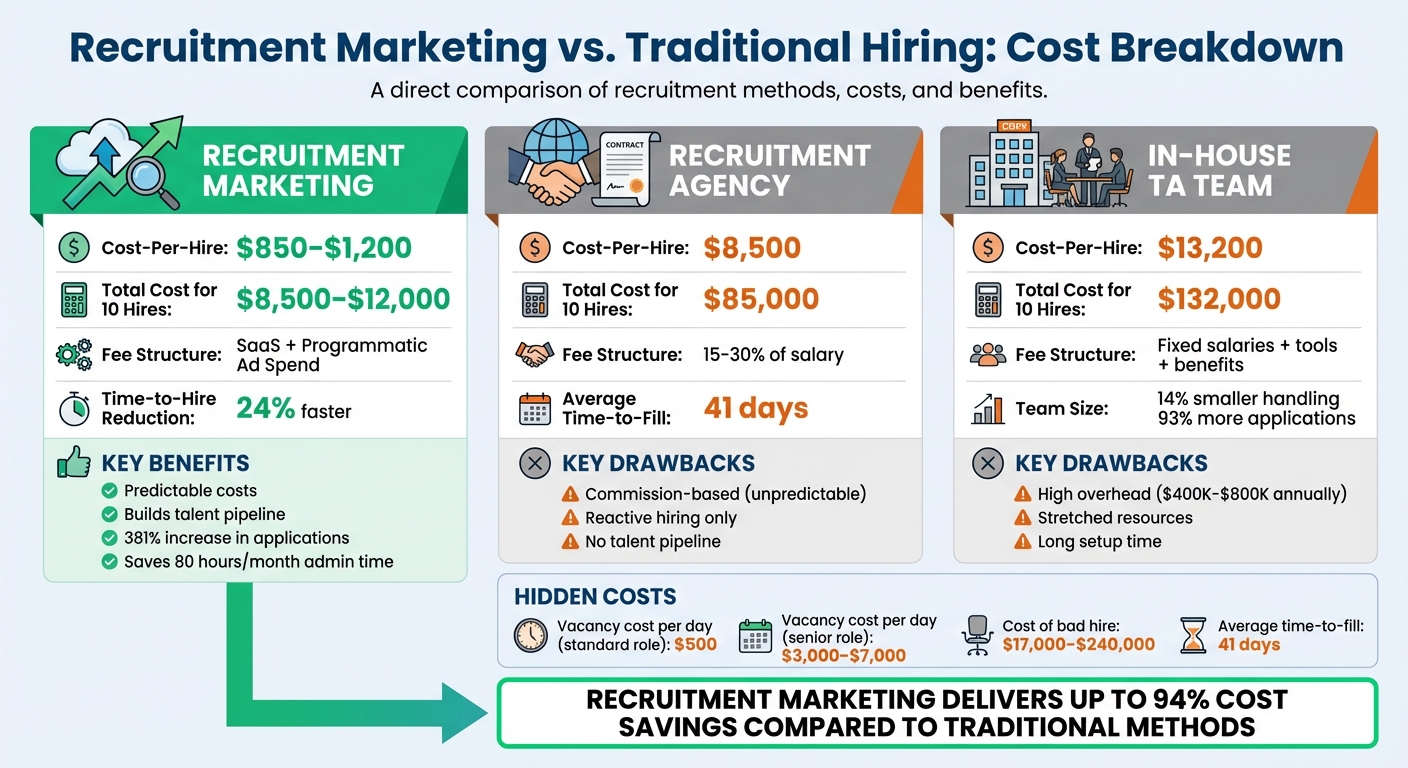
Recruitment Marketing vs Traditional Hiring Cost Comparison
What is Recruiting ROI and how to Maximize IT?!
sbb-itb-a23bd6a
What is Recruitment Marketing?
Recruitment marketing is a forward-thinking strategy that combines marketing tactics with employer branding to attract, engage, and build relationships with potential candidates – well before they apply. Instead of reacting to open roles, this approach creates a continuous talent pipeline by promoting your brand to both active and passive candidates.
Think of it as inbound marketing but for hiring. Traditional recruitment often starts with urgency – "we need someone now." Recruitment marketing flips that narrative to, "we’re building a community of future talent." By focusing on the Awareness and Consideration stages of the candidate journey, this method ensures your company is on the radar long before someone clicks "Apply." Here’s why it matters: 74% of candidates research a company’s employer brand before applying, and 61% of hiring journeys now begin online.
This shift is crucial, especially when 87% of companies report skill gaps or expect them soon. Add to that the fact that top candidates are often hired within just 10 days. Recruitment marketing helps you stay ahead of this curve by building an "always-on" presence, ensuring your brand is remembered when the right talent is ready to move.
Core Components of Recruitment Marketing
Recruitment marketing is built on interconnected elements, starting with employer branding. This involves showcasing your company’s mission, values, and what makes your workplace stand out – your Employee Value Proposition (EVP).
Here’s how it works in practice:
- Content marketing: Blogs, videos, and employee stories that give candidates a genuine feel for your company.
- Social media engagement: Platforms like LinkedIn, Instagram, and TikTok help you connect with candidates where they already spend their time.
- SEO-optimized job postings: These ensure your roles show up in search results.
- Targeted digital advertising: Using AI-driven tools, programmatic ads efficiently find the right job seekers, outperforming traditional job board postings.
- Mobile optimization: With more candidates applying via smartphones, ensuring a seamless mobile experience is now essential.
Advantages of Recruitment Marketing
One of the biggest perks? Predictable costs. Instead of paying high commissions for each hire, you invest in long-term strategies like content and branding. Companies with strong employer brands report 50% more qualified applicants and 28% lower turnover, leading to better hires and cost savings over time.
Recruitment marketing also fosters better candidate engagement. By treating potential hires as an audience to nurture, you build relationships that pay off when it’s time to hire. Candidates who are already familiar with your culture and values are more likely to convert and stay long-term. For example, PwC Sweden cut its application process from 22 clicks to just 5 by adopting data-driven recruitment marketing technology. This change provided full visibility into ROI, from the first click to hire.
This proactive approach reduces the inefficiencies and high costs often associated with traditional recruitment methods. It’s a smarter way to attract and retain the talent your business needs.
What is Traditional Hiring?
Traditional hiring kicks into gear only when a vacancy arises, leading to a frantic search for candidates. This reactive method often results in drawn-out hiring cycles as companies wait for the "perfect" candidate to appear.
The process typically involves posting jobs on platforms like Indeed or LinkedIn, comparing in-house talent vs recruitment agencies to manually sift through resumes and manage interviews [5,14]. For entry-level roles, campus recruitment and career fairs are common, but these methods rely heavily on time-consuming activities like reviewing applications, scheduling phone screens, and coordinating multiple interview rounds [5,14].
"Most companies don’t actually know what hiring costs them. They only know what they can see on the invoice."
– Sean Griffith, Managing Director, SimpleTexting
This approach creates bottlenecks. Companies often take too long trying to find the "ideal" candidate, stretching the process to three times its necessary length. Meanwhile, the best candidates are usually unavailable after just 10 days, meaning businesses frequently lose top talent while they deliberate. This inefficiency drives up costs and results in missed opportunities.
Typical Costs in Traditional Hiring
The financial burden of traditional hiring is hard to ignore. On average, hiring a new employee in the U.S. costs around $4,700 [5,14]. For technical roles, this figure jumps to $6,000–$10,000 or more, while executive hires average a staggering $28,000.
Recruitment agencies charge steep fees – usually 15% to 30% of a candidate’s first-year salary. For a $50,000 role, that’s $7,500 to $15,000 per hire. Internal recruiters, earning between $85,000 and $130,000 annually, come with additional costs like benefits (20%–30% of salary) and productivity losses from training and PTO. Altogether, a single recruiter can cost over $139,000 per year [1,14].
The hidden costs are just as concerning. Unfilled roles result in productivity losses of about $500 per day for standard positions, while vacancies in senior roles can cost between $3,000 and $7,000 daily. And if a hire goes wrong, the financial hit – including severance, rehiring, and lost productivity – can range from $17,000 to $240,000.
| Hiring Category | Average Cost Per Hire |
|---|---|
| Entry-level roles | $2,000–$3,000 |
| Technical hires | $6,000–$10,000+ |
| Executive hires | ~$28,000 |
| U.S. Average (All) | ~$4,700 |
Drawbacks of Traditional Hiring
Beyond the upfront costs, traditional hiring introduces operational inefficiencies that drive expenses even higher. The average time-to-fill for roles – whether executive or non-executive – is about 41 days. This timeline often balloons when companies hold out for the "perfect" candidate.
"In this job market I think companies are shopping for the perfect candidate like they are looking for the perfect little black dress… It ruins the recruitment process and in most cases co’s lose great candidates because they are so busy shopping they miss out on great talent."
– Robin Fischman, Talent Acquisition Leader
Commission-based agency models add another layer of unpredictability. Companies pay a percentage of the salary for every hire, leading to escalating costs during periods of rapid growth. Job boards have also shifted to pay-per-click (CPC) and pay-per-application (CPA) pricing models [4,15], further complicating budgeting as organic reach declines and "pay-to-play" strategies dominate.
High applicant volumes can also work against companies. For tech roles, the apply rate is just 7.14%, leaving recruiters overwhelmed with applications to screen. This additional workload translates directly into higher internal costs, as more time is spent reviewing resumes and coordinating interviews [4,5].
Cost Comparison: Recruitment Marketing vs. Traditional Hiring
Direct Cost Comparison Table
When you break down the numbers, the cost differences between recruitment marketing and traditional hiring methods are striking. Recruitment agencies typically charge 15% to 30% of a candidate’s first-year salary. For a $50,000 role, this means $7,500 to $15,000 per hire. On the other hand, programmatic social recruiting achieves a cost-per-hire of about $850 – dramatically lower than the industry average of $4,500.
In-house recruiting teams also come with high costs. Recruiter salaries range from $85,000 to $130,000 annually, not including benefits and technology expenses, pushing the average cost-per-hire to $13,200. Employee referrals are more cost-effective at around $1,200 per hire but often fall short for high-volume recruitment needs.
| Model | Cost-Per-Hire | Fee Structure | Total Cost for 10 Hires |
|---|---|---|---|
| Recruitment Agency | $8,500 | 15-30% of salary | $85,000 |
| In-House TA Team | $13,200 | Fixed salaries + tools | $132,000 |
| Recruitment Marketing | $850–$1,200 | SaaS + Programmatic Ad Spend | $8,500–$12,000 |
| Employee Referrals | $1,200 | Referral Bonuses | $12,000 |
For companies making 10 hires, the savings with recruitment marketing are clear. Compared to $85,000 with agencies or $132,000 with in-house teams, recruitment marketing can cost as little as $8,500 – up to 94% less. And that’s just the direct costs. Hidden expenses and delays in hiring add even more to the traditional models.
Hidden Costs and Time-to-Hire
Direct costs only tell part of the story. Hidden expenses, like vacancy costs, can significantly inflate hiring budgets. Every day a role remains unfilled costs about $500 in lost productivity for standard positions. For senior roles, that number can soar to $3,000 to $7,000 daily. With traditional hiring taking an average of 41 days to fill a role, these costs add up fast.
Internal recruiting teams are also stretched thin. They’re handling 93% more applications, often with 14% smaller teams. This means more time spent on resume screening and interview coordination, which increases internal costs.
Recruitment marketing changes this equation. AI tools can cut a recruiter’s workload by 20% – equivalent to saving a full workday each week. Asynchronous video interviews further streamline the process, replacing lengthy phone screens and allowing teams to evaluate more candidates in less time. For example, in 2025, Nexer Recruit automated social advertising with Adway, leading to a 381% increase in applications and a 24% reduction in time-to-hire. Similarly, the NFL used Greenhouse’s AI features to reduce their average time-to-fill from 63 days to 48 days – a 24% improvement – while boosting candidate satisfaction from 67% to 93%.
"Most companies don’t actually know what hiring costs them. They only know what they can see on the invoice."
– Sean Griffith, Managing Director, SimpleTexting
Maximizing ROI with Recruitment Marketing
Scalability for High-Growth Companies
Recruitment marketing offers a powerful solution for high-growth companies facing unpredictable hiring spikes. Traditional recruitment methods often struggle to keep up with rapid demand, but programmatic automation changes the game. With programmatic tools, job postings are automatically distributed across multiple channels in seconds – eliminating the need for manual posting and ensuring maximum visibility. The result? Faster access to qualified candidates without overburdening your internal team.
Programmatic job advertising has been shown to enhance targeting by 51% and improve campaign performance by 48%. For companies scaling after funding rounds or launching new products, this approach eliminates the delays tied to building in-house teams or relying on agency pipelines. Embedded recruitment models complement this strategy by providing dedicated recruiters who integrate into your team within days – all at a predictable monthly cost. This means you gain the hiring capacity you need without committing to full-time salaries or benefits.
"A programmatic model is a cost savings solution, designed to help companies reduce spend and make performance-driven decisions that will ultimately save money by replacing ineffective advertising methods."
– Aptitude Research
Recruitment marketing isn’t just about scaling quickly – it’s also about achieving financial efficiency that lasts.
Long-Term Cost Savings
The efficiencies built into recruitment marketing offer substantial cost benefits as companies grow. Embedded recruitment models, for instance, can cut hiring costs by up to 70% while saving over 80 hours of internal admin time each month. By shifting away from outdated CPC deals to smarter, data-driven strategies, businesses can eliminate wasteful spending and optimize their budgets.
It’s no surprise that 57% of companies using programmatic advertising plan to increase their investment due to its effectiveness. Beyond cost savings, this approach builds a stronger employer brand and improves apply rates, leading to better-fit candidates. Over time, this reduces turnover, shortens time-to-hire, and lowers rehiring expenses. For technology, SaaS, and fintech SMEs, recruitment marketing transforms hiring from a reactive cost into a predictable, scalable advantage.
Conclusion: Choosing the Right Hiring Strategy
Switching to recruitment marketing from traditional hiring methods can transform your approach to scaling teams. Traditional agency fees often drive up costs unnecessarily, while newer methods like recruitment marketing platforms and embedded recruitment models can bring cost-per-hire down to as little as $1,200 – all while building long-term talent pipelines.
This shift is especially impactful for high-growth companies in sectors like technology, SaaS, and fintech. Traditional hiring methods restart the process every time a role opens, wasting time and money on reactive searches. Recruitment marketing, on the other hand, creates proactive systems that engage passive candidates (who make up 82% of the workforce), automate job distribution, and shorten time-to-hire by 24%. The outcome? Faster hires, better-fit candidates, and predictable costs that align with your growth goals.
Let’s not forget the hidden costs. Every day a role remains unfilled can result in significant losses, and a bad hire can cost over $25,000. Recruitment marketing addresses both issues by reducing hiring cycles and improving candidate quality through precise, data-driven targeting. Companies using these strategies have reported 381% increases in applications and saved 80 hours a month in administrative work.
For small and medium-sized enterprises (SMEs) experiencing rapid growth, embedded recruitment models offer a cost-effective solution. Unlike building an in-house team – which can cost between $400,000 and $800,000 annually – embedded recruiters provide dedicated expertise at a fraction of the cost. This approach gives you hiring capacity almost immediately, keeps you in control of the process, and eliminates the unpredictability of commission-based fees.
See Your Potential Savings
If you’re spending over $4,800 per hire or relying on agencies charging 20%+ commissions, it’s time to rethink your approach. Rent a Recruiter helps scaling companies cut hiring costs by up to 70% while saving over 80 hours of internal time each month. Our embedded recruiters integrate directly with your team, managing the entire hiring process at a fixed monthly rate.
Whether you need short-term support to meet hiring goals or a long-term solution to build a scalable recruitment function, we provide the expertise and capacity you need – without the overhead. Schedule a call to discover your potential savings, or request a free Recruitment Health Check to evaluate your current hiring performance.
FAQs
How do I calculate my true cost-per-hire?
To figure out your true cost-per-hire, you’ll need to tally up all recruitment-related expenses – both internal and external – and divide that total by the number of hires. This includes obvious costs like recruiter salaries, referral bonuses, job postings, agency fees, recruitment software, and onboarding expenses.
But don’t overlook the hidden costs. Things like manager time spent interviewing, candidates who no-show, or inefficiencies in your hiring tools can add up quickly. Getting a full picture of these expenses gives you the clarity needed to streamline your hiring process and spot areas where you can save.
How fast can recruitment marketing reduce time-to-fill?
Recruitment marketing helps cut down the time it takes to fill roles by combining data insights with proactive candidate engagement. Businesses have seen hiring speeds improve by as much as 24%, with the average time-to-hire shrinking from 41 days to about 33 days. This acceleration comes from smarter ad spending, a well-crafted employer brand, and focused campaigns designed to draw in qualified talent more effectively.
When should I use an embedded recruiter instead of an agency?
When scaling your team, an embedded recruiter can be the solution you need. They become part of your team, giving you greater control over your hiring process while ensuring consistency and structure. This approach works particularly well during times of rapid growth, product launches, or when hiring demands spike.
The benefits? Cost savings of up to 70% compared to traditional agencies and over 80 hours saved each month on hiring-related tasks. If you’re looking to build capacity without sacrificing quality or efficiency, this could be the right move for your business.