
Recruitment communication is often overlooked but directly impacts costs, time-to-hire, and employer brand. Poor communication can lead to losing top candidates, increased hiring expenses, and public criticism of your process. For small and medium-sized enterprises (SMEs), it’s a chance to stand out by offering prompt, personal, and consistent communication – something larger competitors often struggle with.
Key Takeaways:
- 72% of candidates share poor hiring experiences publicly, hurting your reputation.
- Delayed responses cost SMEs top talent, with 60% of candidates dropping out if the process drags on.
- A bad hire can cost $15,000 to $50,000, while structured communication reduces these risks.
- Clear timelines and regular updates improve candidate experience and reduce drop-off rates.
Why it matters: SMEs can’t afford to lose candidates due to inconsistent communication. A structured approach, as outlined in this checklist, ensures better hiring outcomes, protects your brand, and saves time.
Checklist Highlights:
- Acknowledge Applications Quickly: Respond within 24-48 hours.
- Streamline Job Descriptions: Be concise, mobile-friendly, and include salaries.
- Use Standardized Templates: Avoid inconsistent messaging by aligning your team.
- Set Clear Timelines: Communicate next steps and stick to deadlines.
- Provide Feedback: Even for rejections, offer specific reasons within 3 business days.
- Simplify Interview Scheduling: Use direct calendar links and send reminders.
- Engage During Onboarding: Structured preboarding reduces no-shows by up to 28%.
For SMEs balancing multiple responsibilities, embedded recruitment offers a practical solution. By integrating a recruiter into your team, you can save over 80 hours per month and cut hiring costs by up to 70% compared to traditional agencies. Learn more about embedded recruitment or get started with a free Recruitment Health Check to identify gaps in your process.
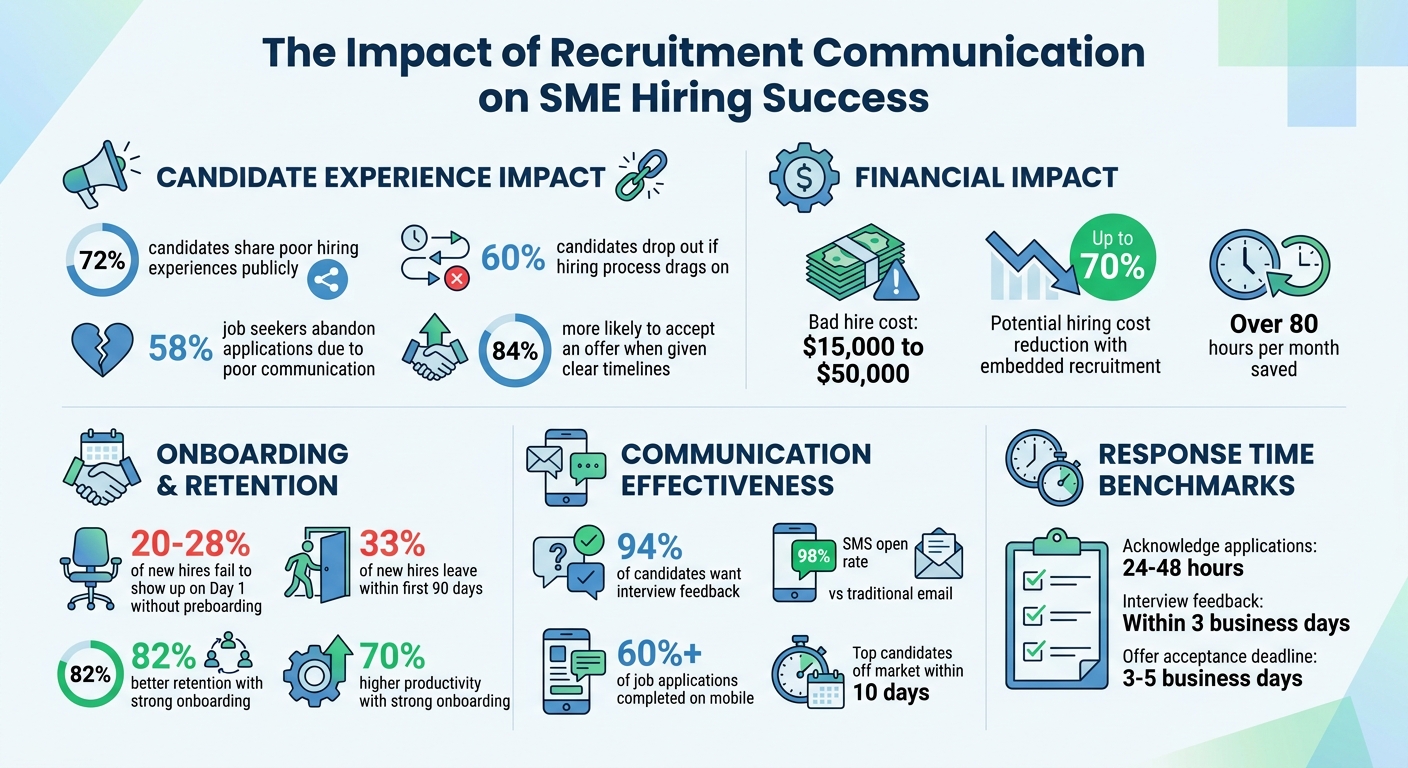
Recruitment Communication Statistics and Impact on SME Hiring Success
What if you’re not Google? Attracting talent to your SME
sbb-itb-a23bd6a
Planning Your Recruitment Communication
Before posting a job ad, take a hard look at your recruitment process. Many candidates drop off simply because they don’t receive timely updates. For instance, are you acknowledging applications within 24 to 48 hours? If not, faster-moving competitors might be scooping up your talent[5].
Start by mapping out every touchpoint in your candidate journey – from the moment they see your job ad to their onboarding. Pinpoint where communication breaks down. Are candidates waiting weeks for updates? Are they left in the dark after interviews? Identifying these gaps will help you stay ahead.
"A communication strategy that’s not thought through is prone to produce inconsistent, incoherent messaging that leaves the candidate wondering how professional your organisation really is." – Frans Lelivelt, Senior Content Manager, JOIN[1]
Review Your Current Communication Methods
Take a step back and audit how you’ve communicated with candidates during your last three hires. Did anyone wait more than three business days for interview feedback? Were messages duplicated because HR and the hiring manager weren’t aligned?
Consider this: SMS open rates are as high as 98%[6], yet many businesses still rely only on email. And don’t forget, one in four candidates prefers phone calls[6]. To get a clear picture, create a spreadsheet that outlines each hiring stage, response time, and communication method. This will help you uncover where things are falling apart.
Create Candidate Profiles and Core Messages
Clarity is key when defining roles. Before drafting a job description, list the 5–7 key tasks and skills the role needs. Skip the unnecessary extras. If you can’t sum up the role in a single paragraph, your hiring criteria might be too complicated.
Your communication style should reflect your company’s actual personality. If your team uses Slack and has a casual tone, let that come through in your recruitment emails. Avoid overly formal, legalistic language – it won’t resonate.
Structured interviews are nearly twice as effective at predicting job performance compared to unstructured ones[8]. Build a set of 5–7 behavioral questions based on your candidate profile and use them consistently.
"If you cannot define the role in one paragraph, you are not ready to hire." – FirstHR[8]
Coordinate Communication Standards Across Teams
Inconsistent communication frustrates candidates and damages your reputation. In fact, 72% of candidates who have poor hiring experiences share their feedback publicly[3].
To avoid mixed messages, establish a communication playbook. Include templates for each stage of the process, clear response deadlines (e.g., follow up on interviews within three business days), and tone guidelines[5]. Even if you’re not using an ATS, fractional recruitment services or a shared spreadsheet can help your team stay aligned. This ensures everyone has access to the same notes and timelines, preventing embarrassing errors like sending a rejection email to someone who’s about to be invited for a second interview.
Stick to a 48-hour rule: acknowledge applications within two business days and follow up on interviews within three[5]. When your team follows these standards, candidates will notice the difference. Prompt, professional communication not only enhances their experience but also gives smaller businesses a competitive edge in attracting talent.
Job Posting and Application Communication
Make your job postings and application process as clear and engaging as possible to attract the right candidates. The job description is often the first interaction a candidate has with your company, so it needs to stand out. With over 60% of job applications now completed on mobile devices [9], your posting should be easy to read and navigate. Use straightforward job titles like "Sales Associate" instead of confusing internal terms or trendy labels like "Rockstar" or "Wizard" [9]. Highlight critical details – like pay range, schedule, location, and benefits – right at the top for maximum visibility.
"Your job ad is not just a description of an open role. It’s a marketing asset, a brand moment, and often your first impression to potential candidates." – Abbigail Fox, Marketing Professional [9]
Write Clear Job Descriptions
Adopt a conversational tone in your job descriptions. Swap vague buzzwords like "fast-paced environment" for specific examples such as "weekly coaching sessions" or "peer recognition programs" [9]. Keep your requirements realistic – limit them to 3–5 skills or qualifications that are essential for success on Day 1. Overloading the list can discourage qualified candidates who could easily learn additional skills on the job [4][2]. Including salary ranges in the job description builds trust while reducing drawn-out negotiations [4].
Design your posting for mobile users by using short paragraphs, bullet points, and plenty of white space. Paint a picture of potential career growth by mentioning internal promotion rates or team expansion [9]. Use real metrics, like the size of the team or the number of clients served, to make the role feel tangible and credible [9].
Once your job ad is polished, focus on simplifying the application process.
Provide Clear Application Instructions
A complicated application process is the quickest way to lose strong candidates. Avoid requiring candidates to create an account before applying [4]. Keep the process under 15 minutes and offer simple options like applying via email or using an "Easy Apply" feature. Candidates appreciate speed and convenience [4].
"If your application process starts with ‘create an account,’ you are filtering for patience, not talent." – FirstHR [4]
Be upfront about what happens next. Add a line in your job description such as, "We respond to all applicants within 5 business days" [4]. Stating clear timelines reduces drop-off rates. Remember, top candidates are often off the market within 10 days of starting their job search [4], so moving quickly is critical.
Once applications are submitted, set clear expectations for communication to keep candidates engaged.
Set Response Time Expectations
Send an automated confirmation email within 24 hours to acknowledge receipt of applications and outline the next steps [10]. A simple message like, "We’ve received your application and will update you by Friday", can go a long way. Poor communication leads 58% of job seekers to abandon applications [10], while 84% are more likely to accept an offer when clear timelines are provided [10].
"’You will hear from me by Friday’ is the most underrated sentence in recruiting." – FirstHR [4]
Consistency and prompt communication are key to maintaining a good impression. If there’s a delay, inform candidates before the weekend to avoid losing them to other offers [4]. Quick decision-making is a competitive advantage for small and medium-sized businesses, allowing you to secure top talent before larger companies can act [2][4].
Interview Process Communication
Once candidates move beyond the application stage, the interview phase becomes your chance to build trust and showcase a well-organized process. Clear communication here is crucial – not only to prevent candidates from dropping out but also to stand out in a competitive hiring market. Companies that excel in this area are the ones that consistently secure top talent over those that lose candidates to competing offers [12].
Create a Standard Screening and Feedback Process
Structured interviews with 5–7 consistent questions can help ensure fairness and reduce bias [4]. Pair this with a 1–5 scoring rubric to make decisions based on data rather than gut feelings. To streamline communication, use three standard templates: one to confirm receipt of applications, another to send interview invitations within 48 hours, and a third to provide rejection feedback within five days [4]. At the start of every interview, clearly explain the number of rounds, the format, and when candidates can expect feedback [6, 13]. This level of transparency can ease candidate anxiety and instill confidence in your process.
"Communication is key – whether short-term or long-term, your communication represents you and your company and can make the difference for applicants."
– Patricia Kreuzburg, People & Culture, ADBAKER [11]
When rejecting candidates, avoid generic responses. Instead, include one specific piece of feedback, such as, "We were looking for more direct experience in enterprise sales" [5, 11]. This matters because 94% of candidates want feedback after interviews, and 72% of job seekers share negative experiences online. Even a brief, constructive note can set your company apart and protect your employer brand [10]. From there, focus on making the interview scheduling process as smooth as possible.
Simplify Interview Scheduling
Make it easy for candidates to book interview slots by offering direct calendar links [4]. Every invitation should include the date, time, format, names of interviewers, and a short agenda [5, 13]. To reduce no-shows, send a reminder 24 hours before the interview via email or SMS – text messages are particularly effective, with a 98% open rate [10]. During the interview, start by explaining the structure, such as: "I have 5 questions, then time for yours; we’ll wrap up in 45 minutes" [4]. Always end by giving a specific timeline for feedback, like "you’ll hear from us by next Monday", instead of vague phrases like "we’ll be in touch" [5, 13].
This approach is especially beneficial for talent acquisition strategies for scaling SMEs, which often have the flexibility to make decisions within 24–48 hours, compared to the 3–7 day turnaround typical of larger companies [4]. Once the interview is scheduled, keep candidates engaged with regular updates throughout the evaluation process.
Send Regular Updates During Evaluation
Even if a decision is still pending, a quick status update can go a long way in keeping candidates engaged. A simple message like "We’re still in review; expect a decision by next Wednesday" can prevent candidates from feeling ignored [6, 13]. If there’s a delay, let them know before the original deadline. For example, "We need two more days to finalize feedback. You’ll hear from us by Friday" [4]. These small updates help maintain your professional reputation, especially since 58% of job seekers have abandoned applications due to poor communication [10].
Personalize every message by using the candidate’s name and referencing specific details from their interview. Avoid impersonal templates like "Dear Applicant" – a little effort here can make a big difference [10].
Offer, Negotiation, and Rejection Communication
The final stages of recruitment – offer, negotiation, and rejection – are where you either secure top talent or risk losing them. Clear and thoughtful communication here isn’t just polite; it’s strategic. For instance, 84% of candidates are more likely to accept a job offer when given a clear timeline [10]. On the flip side, poor communication at this stage can damage your employer brand.
Customize Offer Presentations
Take a moment to call the candidate and personally congratulate them before sending the formal offer letter. This small gesture adds a personal touch, demonstrates excitement, and allows you to address any immediate questions. When crafting the written offer, make sure it’s thorough. Include all key details: job title, responsibilities, reporting structure, salary, bonuses, health benefits, stock options, and any additional perks.
Make it personal. Use the candidate’s name and reference specific points from your interviews that highlight their unique value to your team. This approach can increase response rates by 35% [10]. Avoid overly formal or robotic language; instead, aim for a tone that’s professional but conversational. Be sure to include a clear deadline for acceptance – typically 3 to 5 business days – to encourage a prompt response [13].
"A lack of personalization in the offer letter can make candidates feel undervalued. It is important to address their specific concerns and show appreciation for their unique skills."
– Hirex [13]
Set Clear Negotiation Timelines
Before negotiations even begin, align with your finance team and hiring manager on a defined salary and benefits range. Once discussions are underway, aim to respond to candidate requests within 24 to 48 hours. Avoid vague statements like "We’ll get back to you soon." Instead, offer concrete timelines, such as: "You’ll hear from us by Friday at 5 PM."
If approvals take longer than expected, keep the candidate informed with a quick update like: "We’re still reviewing your request and will have an answer by Thursday." This transparency prevents candidates from feeling ignored [5]. After reaching an agreement, send the final contract within 24 hours to maintain momentum and enthusiasm [5]. Always follow up verbal agreements with written confirmation to avoid any confusion about compensation or role specifics [13].
Provide Constructive Rejection Feedback
Even when rejecting a candidate, how you communicate can leave a lasting impression. While 94% of candidates want interview feedback, most never receive it [10]. Instead of sending a generic rejection email, offer a brief but actionable reason. For example: "We selected a candidate with more experience in B2B SaaS, but we’d love to stay in touch for future opportunities" [5][10].
Send rejection feedback within three business days. Use the candidate’s name and highlight specific strengths you noticed during the interview to keep the tone personal. If the candidate was a strong contender, express interest in keeping their details for future roles. This not only keeps the door open but also helps build a long-term talent pipeline. Remember, many candidates are also potential customers, and 72% of job seekers share negative experiences online [10]. A respectful rejection process can protect your employer brand.
"Candidates remember how you made them feel more than what you said."
– TalentAlly [10]
Onboarding Communication
The signed offer is just the beginning of your onboarding process. Without preboarding, 20% to 28% of new hires fail to show up on Day 1, but structured preboarding can reduce this to under 5% [14]. Even more concerning, 33% of new hires leave within their first 90 days [15]. Effective onboarding communication bridges the gap between recruitment and retention, ensuring the positive candidate experience carries over. It’s not just about a warm welcome – it directly impacts retention and productivity. Companies with strong onboarding processes report 82% better new hire retention and 70% higher productivity [15][16]. Start by greeting new hires warmly and handling all administrative tasks efficiently.
Send Pre-Start Welcome Messages
Within 24 hours of offer acceptance, send a personalized welcome email. Avoid generic templates. Ideally, this note should come from the hiring manager or even the founder, expressing genuine excitement about the new hire joining. Include essential details like the start date, arrival time, office location, parking instructions, and who will greet them. For remote hires, share tracking numbers for equipment delivery and clear IT setup instructions.
Take care of administrative essentials – W-4, I-9, NDAs, and benefits enrollment – digitally before Day 1. This allows the first day to focus on cultural integration rather than paperwork. Aim for about two touchpoints per week during this period to keep the new hire engaged without overwhelming them. The day before their start, send a short, encouraging message confirming readiness and providing a direct contact for any last-minute questions.
| Communication Phase | Timing | Key Content |
|---|---|---|
| Immediate Welcome | Day of acceptance | Congratulations, start date, and next steps |
| Admin Kickoff | Week 1 | Digital paperwork (W-4, I-9), benefits, and employee handbook |
| Culture & Connection | Weeks 2-3 | Buddy introductions, team stories, and organizational chart |
| Logistics Finalization | 1 week before | First-day agenda, parking details, dress code, and equipment tracking |
| Final Encouragement | Day before | A "Looking forward to seeing you" message and contact information |
Provide First-Day and Early-Stage Support
Make sure everything is ready for the new hire within 45 minutes of their arrival – desk, equipment, and logins. 58% of new hires experience frustration when they lack access to essential tools on their first day [17]. Being prepared signals that you value their time and are ready for them. Assign an onboarding buddy to guide them through informal cultural norms; even one meeting with a buddy can boost productivity by 56%, while eight or more meetings increase it by 97% [15].
Plan the first 90 days in stages:
- Days 1-30: Focus on learning – training, mastering tools, and building relationships.
- Days 31-60: Emphasize integration – contributing to projects and working independently.
- Days 61-90: Shift to execution – autonomous work and achieving key milestones.
Give the new hire a meaningful task within their first two weeks to build confidence and trust. At the end of Day 1, hold a quick 10-minute debrief to address any questions or additional support needs [16][18]. Continue offering support throughout their initial days and use their feedback to fine-tune your onboarding process.
Collect Feedback for Improvement
Surprisingly, only one-third of companies actively seek feedback on their onboarding process [15]. Yet, this input is crucial for improving the experience. Schedule formal check-ins at key intervals – end of Day 1, end of Week 1, and at 30, 60, and 90 days. Add these reviews to the calendar during preboarding to ensure they aren’t overlooked. At the 90-day mark, ask three targeted questions: "What worked well?", "What would you change?", and "What do you wish you had known on Day 1?" [15].
Share the insights from these surveys with your hiring team to identify recurring themes and refine processes. Use feedback from every 3-5 hires to update onboarding checklists and role-specific materials [16]. Additionally, review the entire onboarding workflow quarterly from the perspective of a new hire to catch any gaps [4]. This continuous improvement approach ensures your onboarding communication evolves alongside your company’s growth.
How Rent a Recruiter Improves Recruitment Communication
For many SMEs, the real hurdle in recruitment isn’t deciding what to say – it’s finding the time and resources to say it consistently. When you’re a CEO or operations manager, juggling your core responsibilities with the 8–15 hours per hire it takes to manage screening and follow-ups simply isn’t feasible [2]. Yet, your communication strategy is a key driver of your employer brand.
This is where a dedicated and structured approach to candidate communication becomes essential.
Embedded Recruiters Create Consistency
Rent a Recruiter places skilled recruiters directly into your team in just a few days, ensuring every candidate interaction is structured and consistent. With embedded recruiters, communication is no longer ad hoc or reactive – it becomes an intentional part of your hiring process. Using structured frameworks like the PECRO© approach, these recruiters go beyond basic updates, crafting messages that reflect your company’s values and build trust with candidates [7]. From the first LinkedIn message to the final offer, every touchpoint conveys a unified vision of your company’s culture and goals.
"Communication encompasses crafting compelling narratives, fostering genuine connections, and ultimately attracting and retaining the best candidates to your business." – Nici Jupp, Recruitment Superstar [7]
Embedded recruiters also personalize communication at scale. They reference specific details from candidates’ resumes, respond to applications within 24–48 hours, and maintain momentum even when hiring decisions take time [5]. This approach not only enhances the candidate experience but also saves your team over 80 hours per month in hiring and admin tasks. And every interaction is designed to make candidates feel valued.
Tracking these improvements is critical, and that’s where Rent a Recruiter’s Recruitment Health Check comes in.
Recruitment Health Checks Provide Actionable Insights
Consistency is important, but measuring how well you’re communicating is just as critical. Rent a Recruiter’s free Recruitment Health Check highlights exactly where your process may be falling short. By analyzing metrics like time-to-first-contact, candidate response rates, and offer acceptance rates, this tool identifies weak points that could be causing candidates to drop out [19].
The result? A detailed PDF report with tailored recommendations on employer branding, hiring practices, and even diversity strategies. Companies that act on these insights often see offer acceptance rates climb above 80% and reduce hiring costs by as much as 70% compared to traditional commission-based recruitment models [2][19].
These insights don’t just refine your messaging – they ensure your recruitment communication strategy drives better outcomes for your business.
Conclusion
Recruitment communication goes beyond just filling roles – it’s a critical part of protecting your employer brand and avoiding expensive hiring mistakes. Research highlights that 72% of candidates who have a negative hiring experience share it publicly [3], and a single bad hire can cost a business anywhere from $15,000 to $50,000 [2].
For small and medium-sized businesses, the real challenge often lies in maintaining consistent communication. When recruitment takes a backseat to daily operations, top candidates can slip away. A structured hiring process can make a big difference, cutting time-to-hire by 25 days and helping you secure the talent you need [2]. This checklist is designed to help you refine every candidate interaction and avoid those common pitfalls.
Rent a Recruiter’s free Recruitment Health Check identifies gaps in areas like response times, hiring timelines, and onboarding processes. Businesses that act on these insights often see offer acceptance rates exceed 80% and slash hiring costs by up to 70% compared to traditional agency fees [2].
If you’re ready to shift from reactive hiring to building a predictable, scalable recruitment strategy, book a call with Rent a Recruiter. With embedded recruitment, your team can save over 80 hours each month while ensuring professional, consistent communication that enhances your employer brand.
Your hiring process is a reflection of your brand – make it stand out.
FAQs
What should I track to measure recruitment communication?
To gauge the effectiveness of your recruitment communication, focus on tracking key metrics such as applicants per opening, time to fill, time to hire, source of hire, quality of hire, cost per hire, and diversity rate. These provide a clear picture of your hiring process efficiency and outreach success.
Additionally, keep an eye on candidate engagement levels. Are applicants responding promptly? Are they staying engaged throughout the process? Regularly providing status updates and personalized communication can help you understand how well your messaging resonates and where improvements might be needed.
By analyzing these data points, you can refine your strategies to create a more effective hiring process and achieve better results.
Which hiring messages should be templates vs personalized?
Effective recruitment messaging strikes a balance between efficiency and personal connection. Templates are ideal for routine updates or initial outreach, helping you save time and ensure consistency. However, when reaching out to candidates directly, personalization is key. Use their name, mention specific details about their experience, or align the message with their background. This not only grabs their attention but also builds trust and encourages engagement. Avoid overly generic communication – it’s often ignored and fails to make an impact.
When should an SME use an embedded recruiter?
SMEs should think about bringing in an embedded recruiter when they need flexible hiring support that adapts to their business needs, without locking into a long-term agency contract. This approach works especially well during periods of rapid growth, unexpected hiring surges, or when specific expertise is required to fill niche roles.
An embedded recruiter becomes part of your team, working alongside you to speed up hiring, streamline processes, and ensure you stay in control of recruitment during dynamic or transitional phases.