
Poor recruiter and hiring manager alignment costs you time, money, and hires.
If your team is missing hiring targets, the issue often is not talent supply. It is unclear role scope, slow feedback, weak scorecards, and no agreed handoffs. In the US, average cost per hire sits around $4,700, and median time-to-fill is about 44 days. When alignment slips, those numbers move the wrong way.
Here is the short version:
- Recruiters run the hiring process, from sourcing to scheduling to offers.
- Hiring managers define the role, assess fit, and make the final call.
- Shared work like intake, scorecards, pay alignment, and feedback needs clear ownership.
- Weak intake and slow feedback lead to longer time-to-fill, more rework, and higher spend.
- Simple process rules fix most of it, structured intake, 24 to 48 hour feedback SLAs, shared scorecards, and weekly pipeline reviews.
If you are scaling in SaaS, fintech, technology, engineering, security, insurance, or professional services, this is not just a process issue. It affects delivery, team output, and revenue capacity.
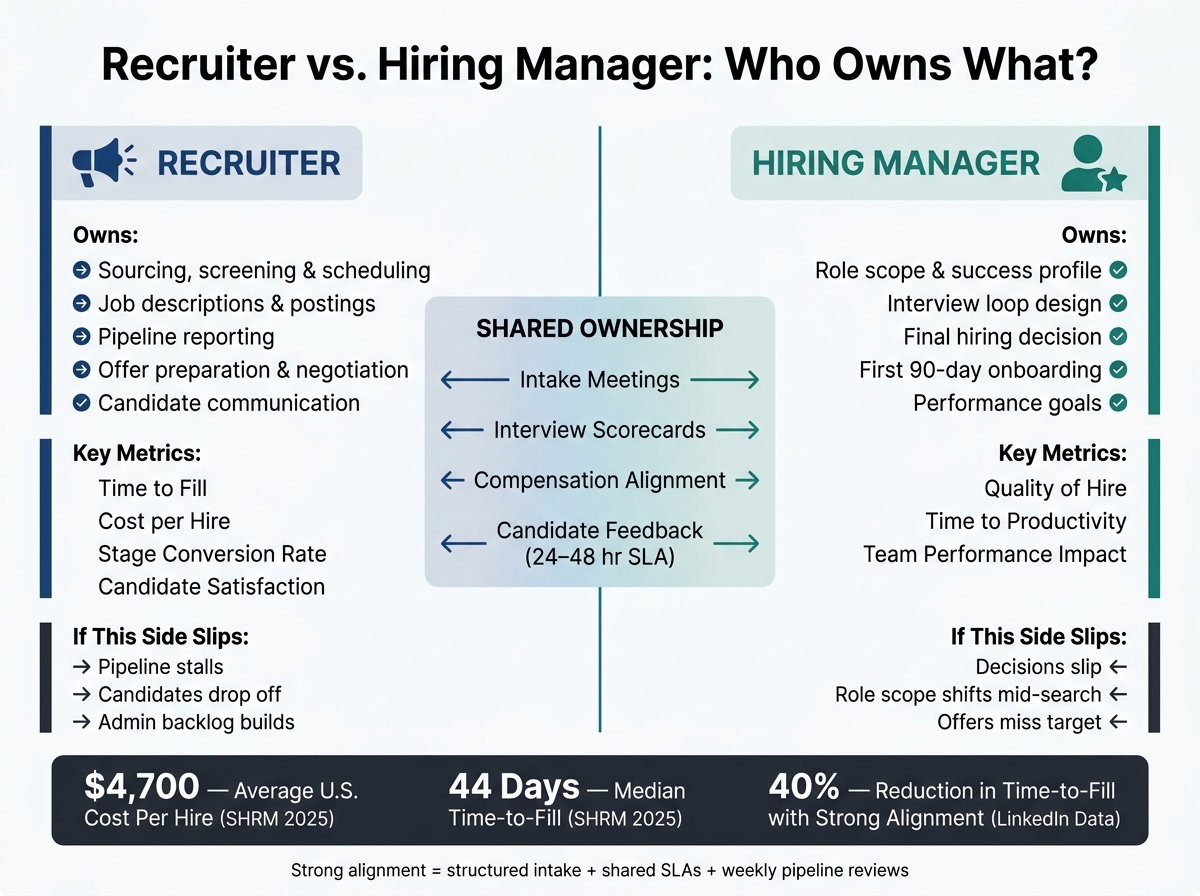
Recruiter vs. Hiring Manager: Roles, Responsibilities & Key Metrics
Fixing Hiring Manager vs Recruiter Mis-alignment
Before implementing these fixes, rate your recruitment process to identify specific gaps in your current strategy.
sbb-itb-a23bd6a
Quick comparison
| Area | Recruiter | Hiring manager |
|---|---|---|
| Main focus | Process, pipeline, speed, candidate flow | Team need, role scope, final selection |
| Owns | Sourcing, screening, scheduling, reporting, offer process | Success profile, interview input, final decision, first 90 days |
| Shared risk points | Intake, scorecards, compensation input, candidate feedback | Intake, scorecards, compensation approval, interview feedback |
| If this side is slow | Pipeline stalls, candidates drop, admin builds up | Decisions slip, role scope shifts, offers miss target |
| Best fix | Clear SLAs, reporting, structured process | Clear brief, fast feedback, decision discipline |
If you want better hiring outcomes, you need one shared brief, one set of rules, and one review rhythm. That is what the article below lays out.
Recruiter vs. hiring manager: roles, decision rights, and success metrics
Start with ownership. Clear role boundaries cut down the communication gaps that slow hiring. They give both sides the same brief, the same timeline, and the same criteria for decision-making. When ownership gets fuzzy, things slip fast. That’s usually where delays begin.
What recruiters own across the hiring funnel
Recruiters own hiring operations. That includes labor market research, writing and posting job descriptions, sourcing candidates, running initial screening calls, coordinating interviews, managing candidate communication, and producing pipeline reports. They also prepare offers, align pay with approved bands, and handle negotiation within agreed limits.
Their metrics are tied to funnel performance:
- Time to fill
- Cost per hire
- Stage conversion
- Candidate satisfaction
This is the engine room of hiring. If recruiter ownership is clear, you save time, cut rework, and keep the process moving.
What hiring managers own from role definition to final decision
Hiring managers own the business outcome.
That starts at intake. They define what success looks like in the first 6 to 12 months, separate must-have competencies from nice-to-have traits, and set the context for the role, including team structure, key projects, and limits like budget or location.
During interviews, hiring managers should own the interview loop design, assign focus areas to each interviewer, and make sure everyone uses a shared scorecard linked to the success profile. The hiring manager makes the final decision and weighs the trade-off between urgency and long-term fit.
After the hire, ownership stays with them. They own the first 90 days, performance goals, and check-ins that shape retention and time to productivity.
Their metrics reflect outcomes, not funnel speed:
- Quality of hire
- Time to productivity
- Team performance impact
That distinction matters. Recruiters move the process. Hiring managers are accountable for whether the hire works in the business.
Where ownership overlaps and confusion starts
Four areas usually sit in shared territory: intake meetings, interview scorecards, compensation alignment, and candidate feedback.
Overlap is normal. The issue is not shared involvement. The issue is failing to define who does what inside each area.
Shared areas need explicit handoffs, not assumptions.
| Area | Recruiter owns | Hiring manager owns |
|---|---|---|
| Intake | Translates business needs into the job description and sourcing plan | Defines the business need, must-haves, and success profile |
| Scorecard | Configures it in the ATS and ensures interviewers use it consistently | Defines assessed competencies and the passing standard |
| Compensation | Presents market benchmarks and internal comparators | Justifies exceptions and finalizes the band with HR/Compensation |
| Candidate feedback | Packages and delivers feedback promptly to candidates | Submits interview feedback within 24 hours |
Clear handoff rules stop the failure patterns that cost time and money. A rule such as "no interview is scheduled before a completed intake and a signed-off scorecard" cuts out a major source of rework. Without rules like that, recruiters end up guessing at the success profile, candidates get screened against the wrong criteria, and late-stage rejections push up cost per hire and time to fill.
Once ownership is clear, the next risk shows up in miscommunication at kickoff, screening, and interview feedback.
Where communication gaps happen and what they cost
Misalignment at kickoff: unclear role scope, priorities, and compensation
Most hiring issues start before sourcing begins, in the intake meeting.
When that meeting lacks structure, you end up with a loose job description, vague success criteria, and no agreed compensation range. The issue usually is not lack of effort. It is lack of agreement on what the role is there to do.
This shows up all the time in product, engineering, and go-to-market hiring. Teams pile on every skill that anyone has mentioned, leave out business context, and force the recruiter to fill in the blanks.
And that gets expensive fast.
Scope is only part of it. Compensation creates a second weak spot. If salary, equity, and benefits are not agreed before sourcing starts, candidates often drop out late or rule themselves out early. That can add weeks to the search and leave your team back at square one.
Breakdowns during screening and interview feedback
Slow or vague feedback pushes recruiters off track, drags out the process, and makes it easier for strong candidates to accept other offers.
The interview stage alone accounts for 32% of all candidate drop-off, and 42% of candidates have dropped out because interview scheduling took too long.[3][4] Top-quartile organisations submit scorecard feedback within 6 hours of an interview, while average organisations take 2.5 to 3.5 days.[5]
That gap matters.
In competitive U.S. markets, especially across engineering, fintech, and SaaS, strong candidates often have more than one offer in play. A delay of even a few days can mean you lose the hire, not because the role was weak, but because your process moved too slowly.
Once feedback starts to slip or lose direction, the cost is no longer just a process issue.
The business cost of poor recruiter-manager alignment
Poor alignment drives up direct hiring spend and increases the cost of every open seat.
SHRM-cited benchmarking puts average U.S. cost per hire at $4,700, and executive searches at $35,879.[2][6][8] When misalignment turns a target 30 to 45 day time-to-fill into 60 to 90 days, or pushes a leadership search beyond 120 days, those costs stack up fast.[7]
This is the chain reaction:
- Bad intake leads to weak screening
- Weak screening leads to slower feedback
- Slow feedback leads to missed hires and higher cost
For a scaling SME, that is a direct drag on growth. It slows teams down, stretches budgets, and keeps revenue-driving roles open longer than they should be.
The answer is a tighter operating rhythm, which the next section outlines.
How to close recruiter-hiring manager communication gaps
Set a structured intake process before sourcing starts
When intake misalignment causes delays, the fix starts before sourcing.
A 30- to 45-minute structured intake meeting, before any sourcing begins, pushes both sides to agree on what the role is and what success looks like. This is not admin. It is a working session that cuts wasted time later.
The meeting should end with six outputs:
- role purpose
- 30/60/90-day goals
- must-haves vs. nice-to-haves
- interview plan with named interviewers
- U.S. compensation range
- timeline
Right after the meeting, both sides should review and sign off on a shared intake document or ATS record. That document becomes the single reference point for the search.
Why does this matter? Because a shared brief cuts rework. It keeps sourcing tied to the agreed scope instead of drifting after the first few profiles land.
Once the brief is signed off, the next step is simple: set response times and feedback rules.
Use shared SLAs, scorecards, and weekly pipeline reviews
Once intake is done, the process needs guardrails. That means shared SLAs, a common scorecard, and a weekly review rhythm.
Set SLAs that both sides can see and track in the ATS. The recruiter delivers a 3- to 5-candidate slate within 5 to 7 business days. The hiring manager gives structured feedback within 24 to 48 hours. The same turnaround applies after interviews.
This matters more than most teams think. According to a Phenom survey of 250+ recruiting professionals, 67% of recruiters said hiring managers take at least two working days to provide feedback after receiving a resume, and 59% said debrief feedback after interviews also takes two or more working days.[10] A clear SLA helps close that gap.
The scorecard then turns feedback into decisions.
It should convert the intake discussion into a shared tool with three to five outcome-based criteria, specific competencies, behavioral indicators for strong versus weak performance, and a simple rating scale. Every interviewer uses the same scorecard. That makes decisions faster and more consistent because the team is judging against agreed criteria, not gut feel.
The table below shows how commitments split across both roles:
| Area | Recruiter Commits To | Hiring Manager Commits To |
|---|---|---|
| Intake prep | Market data, draft intake template | Business goals, role priorities, team context |
| Role definition | Advise on title, leveling, market fit | Own final scope, responsibilities, success metrics |
| Candidate sourcing | Deliver agreed slate within 5 to 7 business days | Review slate and provide feedback within 24 to 48 hours |
| Interview process | Design stages, coordinate scheduling | Participate in interviews using shared scorecards |
| Feedback SLAs | Share candidate feedback within agreed timeframe | Enter feedback in the ATS within 24 to 48 hours after each interview |
| Pipeline reviews | Prepare funnel data, flag risks and blockers | Attend weekly reviews and commit to unblocking actions |
| Offer and closing | Advise on compensation and market competitiveness | Make final hiring decision, approve offer in U.S. dollars |
Weekly pipeline reviews keep all of this moving.
These reviews should be short, 20 to 30 minutes, with a standard agenda: funnel volume by stage, conversion rates, stalled candidates, and current blockers. The recruiter brings the data. The hiring manager brings business context. Each review should end with two or three clear actions, then those actions get checked the following week.
LinkedIn data indicates that organizations with strong recruiter-hiring manager alignment can reduce time-to-fill by up to 40%.[9][12] A weekly cadence is one of the most direct ways to get there.
To make this work across multiple hires, the workflow needs to be documented.
Build visibility with repeatable tools and documented workflows
Scaling hiring needs repeatable tools, not ad hoc effort.
The core toolkit is simple: standardized intake templates, interview guides by job family, shared candidate scorecards, and a dashboard that tracks stage movement, stalled candidates, and decision bottlenecks.
For U.S. scaling teams, the most useful dashboard metrics are:
- days-open per role
- average time-to-hire
- where candidates most often stall
That data gives you something hard to act on. If the hiring manager screen is always the slowest stage, you can see it early and fix it before the search slips.
Workflows should also spell out, step by step, how a role is opened, how intake runs, how decisions are made, and how offers go out. Keep that process documented and consistent. When a new hiring manager joins or a new role opens, you should not have to rebuild the process from scratch.
That is where teams save time. The work becomes easier to run, easier to track, and easier to repeat across every new hire.
Conclusion: Turn recruiter-manager alignment into a hiring advantage
Recruiter-hiring manager alignment is an operating discipline that shapes speed, cost, and hiring quality. The answer is not more effort. It is a clearer operating rhythm between recruiters and hiring managers. Undefined ownership, uneven feedback standards, and unclear decision timing create most hiring friction.
Key takeaways for HR leaders and business stakeholders
Recruiters run the process. Hiring managers define the role and make the final call. Both sides owe fast feedback. When that cadence is clear, hiring moves faster, stays cleaner, and takes less effort to manage.
According to SHRM’s 2025 Recruiting Benchmarking Report, the median time-to-fill is 44 days and the average cost-per-hire is $4,700.[1] Gartner research backs this up: when hiring managers are not aligned on role requirements, organisations are 41% more likely to change requisitions mid-search, leading to a 38% increase in time-to-fill.[11]
The fix is repeatable:
- A structured intake before sourcing
- Shared SLAs and scorecards
- A steady weekly review rhythm
These are not one-off fixes for when things go wrong. They are the standard operating model for every search.
Next step: review and improve your hiring operating model
Audit three bottlenecks: intake, feedback, and approvals, or take a recruitment health check to identify hidden issues. These are common sources of avoidable delay in a typical hiring process.
If your team is scaling, Rent a Recruiter places experienced recruiters into your team within days, adding structure and consistency to hiring while cutting hiring cost and admin time.
FAQs
How do I know if recruiter-manager misalignment is hurting hiring?
Look for clear signs of friction: roles staying open longer than usual, a thin pipeline of qualified candidates, high candidate drop-off, shifting role requirements, vague feedback like “not a good culture fit”, or no structured scorecards.
This stuff adds up fast. A slow, messy process doesn’t just delay hiring. It burns team time, weakens decision-making, and can push up cost-per-hire.
Misalignment often means recruiters and hiring managers are working from different versions of the role. One side is hiring for today’s need. The other is searching for something else entirely.
If ownership is unclear, feedback slows beyond 24 to 48 hours, or decisions rely on gut instinct instead of shared criteria, hiring is likely suffering. And when that happens, you don’t just lose speed. You lose control of hiring outcomes.
What should a hiring intake meeting include?
A hiring intake meeting should run for 45 to 60 minutes and include all decision-makers. The aim is simple: turn a hiring request into a clear, written agreement before any sourcing starts.
This is where hiring either gets sharp or goes off the rails.
If key people skip the meeting, or if the brief stays vague, you usually pay for it later in lost time, misaligned interviews, and hires that don’t solve the problem you set out to fix.
Use the meeting to lock down:
- The role’s purpose
- The business problem it solves
- Success metrics at 6, 12, and 24 months
- Required skills vs. flexible skills
- Salary range in U.S. dollars
- Hiring timeline
- Interview responsibilities
- Final sign-off authority
That last point matters more than most teams think. If you don’t know who has final sign-off authority before sourcing begins, decision-making slows down fast. Pipelines stall. Good candidates drift. Internal teams end up reworking the brief halfway through the process.
A solid intake meeting gives you a hiring plan people can actually follow. It cuts back-and-forth, keeps interviewers aligned, and helps you move with more speed and less waste.
Who owns candidate feedback and scorecards?
Candidate feedback and scorecards are a shared responsibility across every interviewer, including the hiring manager. Each interviewer should submit their own scorecard, backed by clear evidence and notes, ideally within 24 to 48 hours.
Recruiters run the process day to day. They chase missing feedback, lead debriefs, and keep all interview data in the Applicant Tracking System. That matters because slow or vague feedback creates delays, weakens decision-making, and puts good hires at risk.
The hiring manager makes the final call.