
Hiring great talent requires personalization, but doing it manually doesn’t scale. Personalized outreach delivers 3x to 5x higher response rates than generic emails, yet creating tailored messages for every candidate can consume up to 25 hours a week for small teams. For scaling companies, this is a bottleneck.
The solution? A structured, multi-layered approach combining automation, AI, and expert recruiters. This method lets you balance scale and quality, boosting response rates to as high as 18% while cutting time spent on manual tasks. Here’s how you can achieve it:
- Segment candidates by shared traits, motivations, and value.
- Use a 3-layer personalization system: automated basics, AI-assisted insights, and targeted manual research for top-tier prospects.
- Leverage AI tools to customize messages and automate follow-ups.
- Combine automation with embedded recruitment expertise to ensure outreach feels professional and relevant.
Scaling outreach doesn’t mean sacrificing quality. With the right processes and tools, you can reduce hiring costs by up to 70% (calculate your potential savings) and save 80+ hours per month on admin. Ready to rethink your recruitment strategy? Rent a Recruiter embeds experienced recruiters into your team, delivering results without the hefty agency fees.
AI Outreach for Recruiters to Personalize Communication at Scale
sbb-itb-a23bd6a
Step 1: Build a Multi-Layer Personalization System
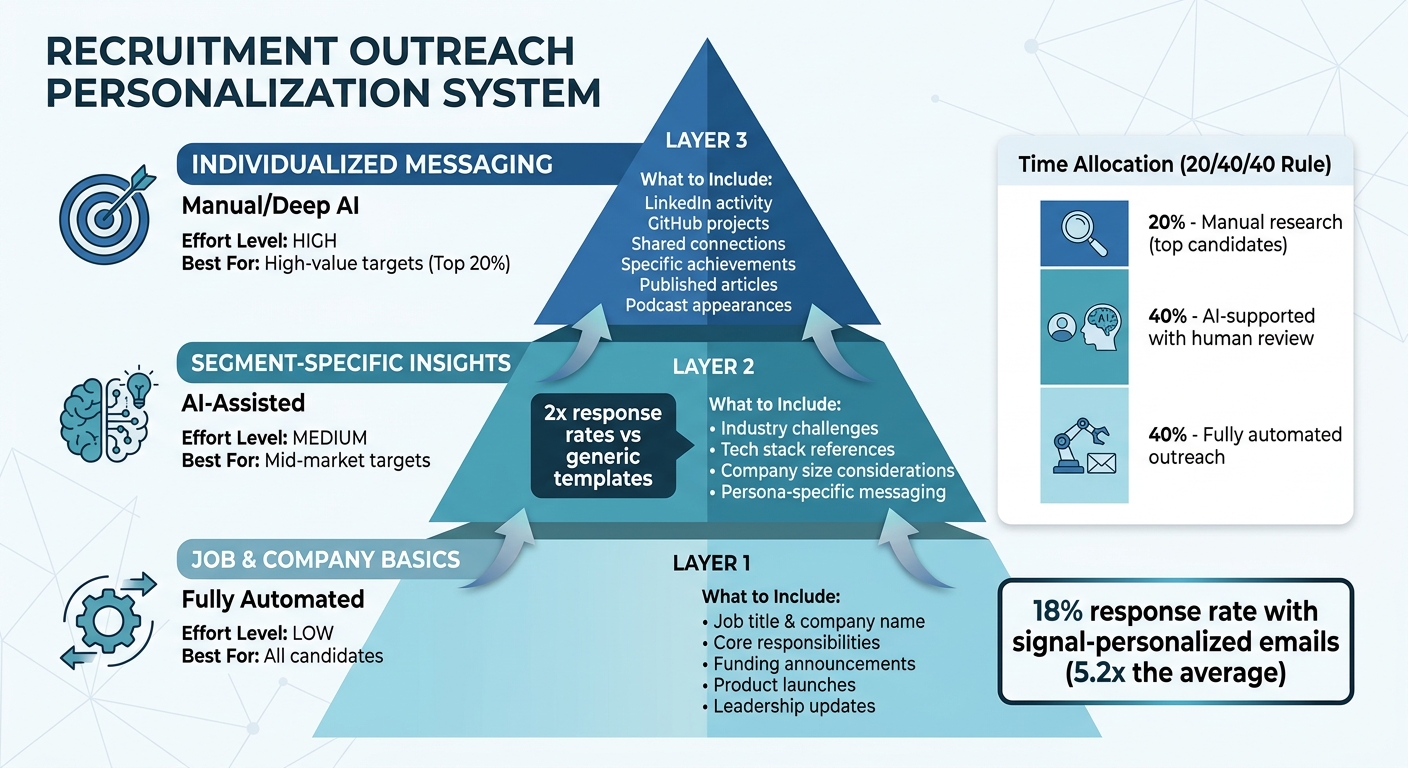
3-Layer Candidate Personalization System for Recruitment Outreach
Streamline your outreach process without sacrificing quality. Instead of crafting every message from scratch or treating all candidates the same, use a three-layer system that tailors effort based on candidate value. Picture it as a pyramid: broad, general relevance at the base, segment-specific messaging in the middle, and personalized details at the top.
"The goal isn’t to write every message from scratch. It’s to create intelligent frameworks that adapt based on data." – Team Appendment [4]
This method keeps standards high while scaling your reach. Allocate your time wisely: invest in manual research for top-priority candidates while using automated tools for broader outreach. The system works in three layers – Layer 1 is fully automated, Layer 2 uses AI-driven assistance, and Layer 3 focuses on manual research for high-value prospects. This structured approach is particularly effective when implementing embedded recruitment for startups to ensure quality at speed.
Layer 1: Job and Company Basics
Start with foundational details that apply to all candidates. Include the job title, company name, and core responsibilities. Add company-specific triggers like funding announcements, product launches, or leadership updates [3]. For example, if your company just secured Series B funding or expanded into a new market, mention it. These details position the role within a dynamic, growing context. This layer is fully automated, requiring minimal effort while ensuring your outreach feels relevant rather than generic.
Layer 2: Segment-Specific Insights
Group candidates by shared traits – such as industry, company size, tech stack, or career level. A software engineer at a small startup faces different challenges than one at a large enterprise. Use adaptable templates that retain a core message but tweak the opening for each segment. For instance, startup candidates might appreciate messaging about building systems from scratch, while enterprise candidates might value discussions around scaling solutions. AI-assisted research powers this layer, often doubling response rates compared to generic templates [6].
Layer 3: Individualized Messaging
For top-tier candidates, add a unique, professional touch. Reference something specific from their profile, such as a recent LinkedIn post, a GitHub project, a published article, or a podcast appearance [1][3]. Avoid overly personal details; stick to professional signals. Since this layer demands the most effort, use it sparingly for high-value prospects. A common approach is the 20/40/40 rule: spend 20% of your time on manual research for top candidates, 40% on AI-supported research with human review, and 40% on fully automated outreach [3].
| Personalization Layer | What to Include | Effort Level | Best For |
|---|---|---|---|
| Layer 1: Job/Company | Job title, company name, funding news, product launches | Low (Automated) | All candidates |
| Layer 2: Segment | Industry challenges, tech stack, company size, persona-specific messaging | Medium (AI-Assisted) | Mid-market targets |
| Layer 3: Individual | LinkedIn activity, GitHub projects, shared connections, specific achievements | High (Manual/Deep AI) | High-value targets |
With this system in place, you can balance scalability with meaningful outreach. The next step? Segment your candidates to ensure your messaging hits the mark.
Step 2: Group Candidates for Targeted Messages
After setting up your personalization framework, it’s time to group candidates by shared motivations to make your messages more relevant. Segment candidates into meaningful groups based on factors that influence how they’ll engage with your outreach. This method ensures your messaging stays precise while scaling efficiently.
Go beyond surface-level demographics. Dig into what drives their career decisions – whether it’s making an impact, earning competitive compensation, finding stability, or enjoying remote flexibility [7]. Messages aligned with these motivations are far more effective. For example, signal-personalized emails deliver an 18% response rate – 5.2x the average [2]. From here, define segments that match your roles and the key motivators of your target candidates.
Define Your Candidate Segments
Start by identifying the most relevant criteria for your open roles. Company size is a major factor – working at a 20-person startup is a vastly different experience compared to a 5,000-person enterprise. Startup candidates often value the chance to build systems from the ground up and take on diverse responsibilities, while enterprise candidates may focus on scaling existing solutions or leveraging established processes.
Career stage and seniority also play a big role in shaping how candidates view opportunities. For example, entry-level engineers are often drawn to roles offering mentorship and skill development, while senior leaders are more likely to prioritise strategic impact and opportunities to build and lead teams [9]. A common mistake is offering the same value proposition to all experience levels – it simply doesn’t resonate.
You can also categorise candidates by their potential value to your company. Use a tiered system to prioritise your efforts:
- Tier 1 (top 20%): Candidates with rare skills or a perfect cultural match. These deserve deep, manual research.
- Tier 2 (next 40%): Strong matches who meet most requirements. Here, AI tools with human review can help.
- Tier 3 (bottom 40%): Volume candidates who meet basic qualifications. Automation is ideal for this group [3].
"The difference is not AI versus human. It is relevant versus irrelevant." – Semir Jahic, CEO & Co-Founder, Salesmotion [2]
To keep your outreach focused, apply the 15-5-1 rule: for every 15 signals you identify, 5 should lead to outreach, and 1 should receive highly personalised attention [2]. This ensures you’re targeting candidates most likely to respond.
Use Templates with Dynamic Fields
Once you’ve segmented your candidates, create tailored templates that speak to each group’s specific motivations. Use template modules that maintain a consistent core message but allow you to swap out elements like the opening line, industry references, or motivational triggers based on the segment [1][8].
Dynamic fields can do a lot more than just insert names or companies. Include details like relevant skills, location, or recent company news [10]. For example, if you’re contacting backend engineers, reference their expertise in specific programming languages. For fintech candidates, differentiate between those at recently funded companies and those at bootstrapped startups.
Batch your outreach by shared signals rather than by account or candidate list. Instead of messaging "all software engineers", group candidates by common triggers. For instance, on Monday, contact those at companies with recent Series B funding; on Tuesday, reach out to candidates who recently posted about a specific technology [2]. This keeps your messaging consistent and reduces the mental effort of frequently switching contexts.
Keep your templates fresh by updating them quarterly or after reaching 500 prospects [8]. Outdated copy can hurt deliverability and make your messages feel generic.
Structure your templates for quick readability. Use a four-line format:
- Signal-based hook
- Relevance to the candidate
- One-sentence value proposition
- Clear call-to-action [3]
Aim for 25–50 words total – concise messages consistently outperform longer ones [2]. Hooks tied to recent events perform especially well, achieving a 10.01% reply rate, compared to 4.39% for standard problem-statement hooks [2].
With your segments in place and templates fine-tuned, you’re ready to create outreach messages that feel personal without requiring hours of individual effort.
Step 3: Write Effective Outreach Messages
Once your candidate groups and templates are set, it’s time to craft messages that get responses. By combining segmented candidate data with dynamic templates, you can create outreach messages that truly resonate. The key? Focus on three elements: a personalized hook, a clear value statement, and a low-commitment ask. This structure ensures your messages grab attention and spark interest.
Keep your messages short – 25 to 50 words is ideal[2].
Open with a Personalized Detail
Start with something the candidate genuinely cares about. Avoid generic openers like mentioning your company’s size or location (the kind of details anyone can Google). Instead, tie your opening to a professional signal – something specific to their work, achievements, or recent activity.
For example, referencing a recent event or accomplishment outperforms generic intros. Timeline-based hooks, such as mentioning recent funding or a project they contributed to, achieve a 10.01% reply rate, compared to 4.39% for general problem-statement openers[2]. So, skip "I see you’re a senior engineer" and try something like:
- "Congrats on the recent Series B funding – curious if you’re open to exploring opportunities in scaling infrastructure?"
- "I came across your GitHub repo on [specific project], and your approach stood out. Would you be open to a quick chat?"
"The first line of your email should reference something the prospect cares about, not something you sell." – Salesmotion Blog[2]
Focus on professional signals – like LinkedIn posts or project contributions – rather than personal details, which can feel intrusive.
Explain What’s in It for Them
After your hook, show the candidate why this opportunity aligns with their goals or skills. Don’t just list job requirements; connect the role to what’s relevant to them right now. For instance, if their company just announced funding, highlight how your role could help them build on their experience with scaling teams or launching new initiatives.
"The reader probably doesn’t care about you or your company at all (yet). So focus on what this means for them." – Metaview Blog[1]
When you tailor your value statement to the candidate’s career stage or motivations, you can boost response rates by 15%[1].
Include a Simple Call-to-Action
Wrap up with a straightforward, low-pressure question. Instead of asking for a full meeting or demo, try something like: "Would you be open to a quick chat about how this role aligns with your goals?"
The easier it is to respond, the more likely candidates are to engage. Campaigns with smaller, targeted lists (50 recipients or fewer) consistently see better reply rates than mass outreach[2].
Core Components of an Effective Outreach Message
| Message Component | What to Include | What to Avoid |
|---|---|---|
| Hook | Mutual connection, specific project, recent company news | Generic flattery, Wikipedia facts, unnecessary personal details |
| Value | Tie to their career goals, explain "why now" | Listing job requirements, focusing only on your company’s needs |
| Ask | Simple, low-pressure question | Asking for long meetings, demos, or multiple actions |
Step 4: Apply AI and Automation Tools
Once you’ve nailed down your segmentation and message templates, it’s time to scale your outreach using AI and automation. These tools don’t just stop at merging names into emails; they analyze candidate profiles, pick up on career signals, and craft messages tailored to individual achievements. This approach, called contextual personalization, is what makes some messages stand out while others are ignored[12][5].
The results speak for themselves. Recruiters using a 4-step AI outreach sequence see twice the replies, a 68% increase in interest rates, and find that 82% of responses come from follow-ups[12]. The secret is blending AI-driven insights with automation that adapts to how candidates engage.
Use AI for Message Customization
AI tools can take your personalization efforts to the next level. By scanning candidate profiles, they can pull in specific details – like recent projects, publications, or contributions – and weave them into a core message template. For instance, if someone recently worked on an open-source project, the AI can highlight that in the opening line.
This method, known as modular personalization, keeps a consistent core message while adding a tailored "Why Them" section based on real data[13]. The result? Messages that feel both personal and professional, even when sent at scale. Research shows that AI-personalized outreach can boost positive response rates by 5-12% compared to generic templates[12].
"You don’t have a sourcing problem – you have an attention problem. Top candidates decide in minutes whether your message feels real or generic." – Ameya Deshmukh, EverWorker.ai[5]
For high-priority candidates, combining AI with human review can further improve the quality of your outreach. Human oversight ensures a natural tone and accuracy, especially for key roles[13][3]. However, for large-scale hiring, AI can handle everything – from identifying candidates to drafting and sending messages[14][12].
When setting up AI prompts, clarity is crucial. Be specific about avoiding generic phrases like "impressive profile" and ensure the tool doesn’t fabricate details. Always rely on real signals to maintain credibility.
Automate Send Times and Follow-Ups
Timing plays a big role in outreach success. Automation tools can schedule messages to hit candidates’ inboxes during their local business hours, avoiding awkward times like weekends or late nights[5]. These tools also handle follow-ups, saving you from manually tracking every interaction.
A proven follow-up strategy is the "3-7-7" pattern: send messages on Day 1, Day 3, Day 10, and Day 17. This approach captures 93% of potential replies while keeping the process manageable for candidates[12]. Surprisingly, the final message in the sequence often generates the most responses – 32%, to be exact[12].
"The final message in a well-constructed sequence generates the highest percentage of responses. This is counterintuitive, because most recruiters assume follow-ups have diminishing returns." – Yuma Heymans, HeroHunt.ai[12]
Using multiple channels – like LinkedIn, email, and SMS – can significantly boost your response rates. Multichannel sequences see a 287% higher response rate than single-channel efforts[12]. For example, you might start with a LinkedIn connection request to build familiarity, follow up with a detailed email, and use SMS for urgent roles. SMS, in particular, shines with a 95-99% open rate and a 45% average response rate, making candidates 7.5x more likely to respond compared to email[12].
Before launching any automated campaign, make sure your email authentication is up to date. Without proper SPF, DKIM, and DMARC configurations, your messages could get blocked entirely[12]. For LinkedIn InMails, keep messages under 400 characters, as shorter messages see a 22% higher response rate than longer ones[12].
| Channel | Avg. Response Rate | Best Practice |
|---|---|---|
| Email (Cold) | 3.43% | Use 4-step sequences; ensure SPF/DKIM/DMARC[12] |
| LinkedIn InMail | 10-25% | Keep under 400 characters[12] |
| SMS | 45% | Use for high-volume or time-sensitive roles; opt-in only[12][5] |
| Personalized Video | 10-30% | Best for executive or high-value technical roles[12] |
Lastly, give candidates a break before re-engaging. Wait at least 90 days before restarting contact with non-responsive candidates[3]. This avoids fatigue and keeps your outreach from feeling spammy.
Step 5: Add Expert Recruitment Support
AI and automation are great for streamlining recruitment tasks, but they can only take you so far. To truly connect with top talent, you need the human touch. Expert recruiters bring authenticity to your hiring process, ensuring that outreach feels personal and aligned with your employer brand. While AI handles repetitive tasks like profile research, message drafting, and follow-up scheduling, skilled recruiters craft tailored interactions that resonate with candidates. This balance between automation and human expertise ensures your outreach stands out in a crowded market[5].
How Embedded Recruiters Make a Difference
Rent a Recruiter embeds experienced recruiters directly into your team, working as if they were part of your internal staff. They manage the entire hiring process, from sourcing to onboarding, while maintaining a consistent and personalized approach to candidate engagement. Unlike traditional agencies, this model eliminates high commissions and long delays, giving you both speed and control.
Embedded recruiters take on time-consuming tasks like manual candidate research, freeing up your internal team to focus on building relationships and closing offers. When a candidate responds, they get immediate, tailored attention – not an automated reply. This hands-on approach improves every stage of the candidate journey, ensuring a cost-effective and high-quality recruitment process[5][15].
Save Time While Cutting Costs
With Rent a Recruiter, you pay a fixed monthly fee, avoiding the unpredictability of per-hire commissions. This setup can lower recruitment costs by up to 70% compared to traditional agency fees, while also saving over 80 hours per month on admin and hiring tasks. For fast-growing companies in sectors like technology, SaaS, fintech, and engineering, this efficiency is a game-changer when hiring demands spike.
Whether you need short-term help to meet hiring goals or a long-term solution to scale your recruitment efforts, embedded recruiters simplify the process. They also boost your chances of hiring top talent. Candidates sourced through proactive outreach are 5× more likely to be hired than those who apply inbound, and passive candidates – who make up about 70% of the global workforce – are far more likely to engage when approached by a dedicated expert[1].
Step 6: Track and Improve Outreach Results
Once your personalized outreach is live, tracking the right metrics is what turns raw data into meaningful improvements. This isn’t just about numbers; it’s about refining your strategy to boost response rates and engagement. Start by keeping a close eye on deliverability metrics like hard bounce rates and spam complaints. Aim for hard bounce rates under 2% and spam complaints as close to 0% as possible. If these numbers spike, your messages might not even land in candidates’ inboxes, let alone get read[16].
Next, dive into engagement metrics to see if your messages are hitting the right notes. Track open rates, click-to-open rates, and how quickly candidates respond. For LinkedIn outreach, maintaining an InMail response rate of at least 13% is key to staying in good standing with the platform[16]. Also, pay attention to how your sequence performs. Interestingly, the final follow-up in a well-structured sequence often generates 32% of total responses, compared to just 17.65% from the initial message[12]. This underscores the importance of persistence.
Monitor These Key Metrics
The metrics you track should directly tie to hiring outcomes, not just activity levels. For example, pipeline quality metrics like sourced-to-screen conversion rates, interview rates, and offer rates will show if your outreach is attracting qualified candidates or just producing empty replies[16]. Meanwhile, velocity metrics such as time-to-slate (how quickly you present a shortlist) and time-to-schedule (how fast you secure an interview after a positive reply) can pinpoint process bottlenecks[16].
Here are some benchmarks to measure your outreach performance:
| Metric | Target Benchmark | Purpose |
|---|---|---|
| Hard Bounce Rate | < 2% | Protects domain reputation[16] |
| InMail Response Rate | ≥ 13% | Meets LinkedIn’s minimum standard[16] |
| Positive Reply Rate | > 2% | Gauges the appeal of your proposition[3] |
| Meeting Booked Rate | > 1% | Tests the effectiveness of your call-to-action[3] |
| Meeting Shown Rate | > 80% | Evaluates targeting accuracy[3] |
To dig deeper, categorise responses into "interested", "maybe later", or "not a fit" to measure genuine engagement. Regularly audit these metrics across demographic groups and rate your recruitment process to ensure your outreach doesn’t unintentionally exclude or disadvantage certain candidates[16].
Use Data to Adjust Your Approach
Your data isn’t just for tracking – it’s your guide to fine-tuning every part of your outreach. Use the segmentation and messaging frameworks from earlier steps and A/B test one variable at a time, such as subject lines or CTAs, across at least 150 candidates for reliable results[12]. For instance, soft CTAs like "Would you be open to learning more?" often deliver a 30% success rate, which is double that of hard-sell approaches[17]. On the flip side, ending an email with "Let me know your thoughts" can lower meeting booking rates by 20%[17].
Analyse performance by signal type, such as new executive hires, funding rounds, or product launches, to identify which triggers resonate most for specific roles. If your company-level signals aren’t doubling reply rates compared to industry-only messages, your personalization might need more depth. Stick to the 15-5-1 approach outlined earlier: focus your most tailored efforts on your top prospects. Also, refresh your outreach templates quarterly or after every 500 prospects to avoid stale messaging and maintain high deliverability rates[11].
Conclusion
Scaling personalized outreach effectively means finding the right balance between automation and human expertise. By using a layered personalization strategy, you can focus your efforts where they matter most – on high-value prospects – while automating broader outreach efforts. This approach, powered by AI-driven message customization and market signals, transforms response rates from the typical 1–5% to a far more impressive 18–25% range[18]. With this foundation, experienced recruiters can step in to refine candidate engagement and build meaningful connections.
The numbers speak for themselves: sourced candidates are five times more likely to be hired than inbound applicants[1], and personalized outreach achieves a 15% higher response rate compared to generic messaging[1]. Achieving these results, however, requires careful tracking of metrics and a commitment to continuously improving your approach. As Salesmotion aptly put it:
"The difference is not AI versus human. It is relevant versus irrelevant."[2]
AI tools can handle the repetitive tasks – researching profiles and drafting initial messages – but embedded recruiters bring the human touch that high-value interactions demand. They ensure outreach aligns with your brand, build trust with candidates during interviews, and focus on prospects that matter most. This combination not only personalizes your recruitment efforts but also delivers measurable business benefits: reducing hiring costs and saving over 80 hours each month in administrative work. By shifting the focus from volume to relevance, you enhance both candidate experience and hiring outcomes.
Next Steps
Ready to create a scalable recruitment strategy that works? Rent a Recruiter places experienced recruiters directly into your team in just days, blending expert judgment with structured, consistent processes. As shown, combining AI-powered tools with embedded recruitment expertise leads to real results – companies lower hiring costs by up to 70% and save over 80 hours per month on internal hiring tasks.
Start with a free Recruitment Health Check to evaluate your current hiring performance. You’ll receive a tailored PDF report with actionable insights to improve outreach, employer branding, and overall recruitment processes – all designed for your specific growth stage. No commitment, just practical steps to elevate your hiring strategy. Get started today.
FAQs
How do I decide which candidates get Layer 3 personalization?
To determine which candidates should receive Layer 3 personalization, start by segmenting your target list based on value. Prioritize high-value candidates who are more likely to engage and convert. For these individuals, dig deeper – conduct thorough research to understand their background, recent accomplishments, or other notable details. Use this information to craft outreach that feels personal and directly relevant to their unique profile. This approach ensures your efforts resonate and leave a lasting impression.
What signals should I use to segment candidates effectively?
Effective ways to segment candidates include focusing on their current job title, specific skills, employment status, recent activity, and engagement history. Pay close attention to details like recent job changes or standout skills – they can help you tailor your outreach to feel more timely and relevant. By personalizing messages using these insights, you’ll boost response rates and ensure your outreach aligns with the candidate’s current circumstances.
How can I use AI without sending inaccurate or “fake” personalization?
To steer clear of inaccurate or insincere personalization, leverage AI to analyze real, relevant data about candidates, such as their professional background or current situation. The key is to craft outreach that feels meaningful by referencing genuine insights rather than leaning on generic, surface-level templates. Always take the time to review AI-generated content before sending it. This ensures the message is accurate, tailored, and shows genuine effort, helping you avoid coming across as spammy or disingenuous.