Recruitment without personalization is costing you hires. Generic outreach, like mass emails or templated LinkedIn messages, leads to dismal response rates – just 2–6% in 2026. Worse, it damages your employer brand and pushes top talent toward competitors. For scaling companies in tech, SaaS, fintech, and engineering, personalization isn’t optional anymore; it’s the edge you need to secure the best candidates.
What does personalization deliver?
- Higher engagement: AI-assisted, personalized outreach achieves reply rates of 15–25%, compared to 3–5% for generic campaigns.
- Better hires: Candidates sourced through tailored messaging are 5x more likely to be hired.
- Stronger employer brand: 47% of candidates drop out of hiring processes due to poor communication. Personalization builds trust and keeps them engaged.
- Cost and time efficiency: AI tools cut research time from 15 minutes to 2–5 minutes per candidate.
Why does this matter for your business?
- Lost opportunities: Impersonal outreach means losing talent to competitors with better communication strategies.
- Brand damage: 77% of candidates share negative hiring experiences within their network.
- Retention risk: 56% of candidates are less likely to remain customers of a company after a poor hiring experience.
Scaling companies can’t afford to ignore this. Personalization isn’t just about better messaging; it’s about building trust, increasing engagement, and setting the stage for better hiring outcomes. If you’re struggling with capacity, embedded recruitment can help scale personalization without adding pressure to your team.
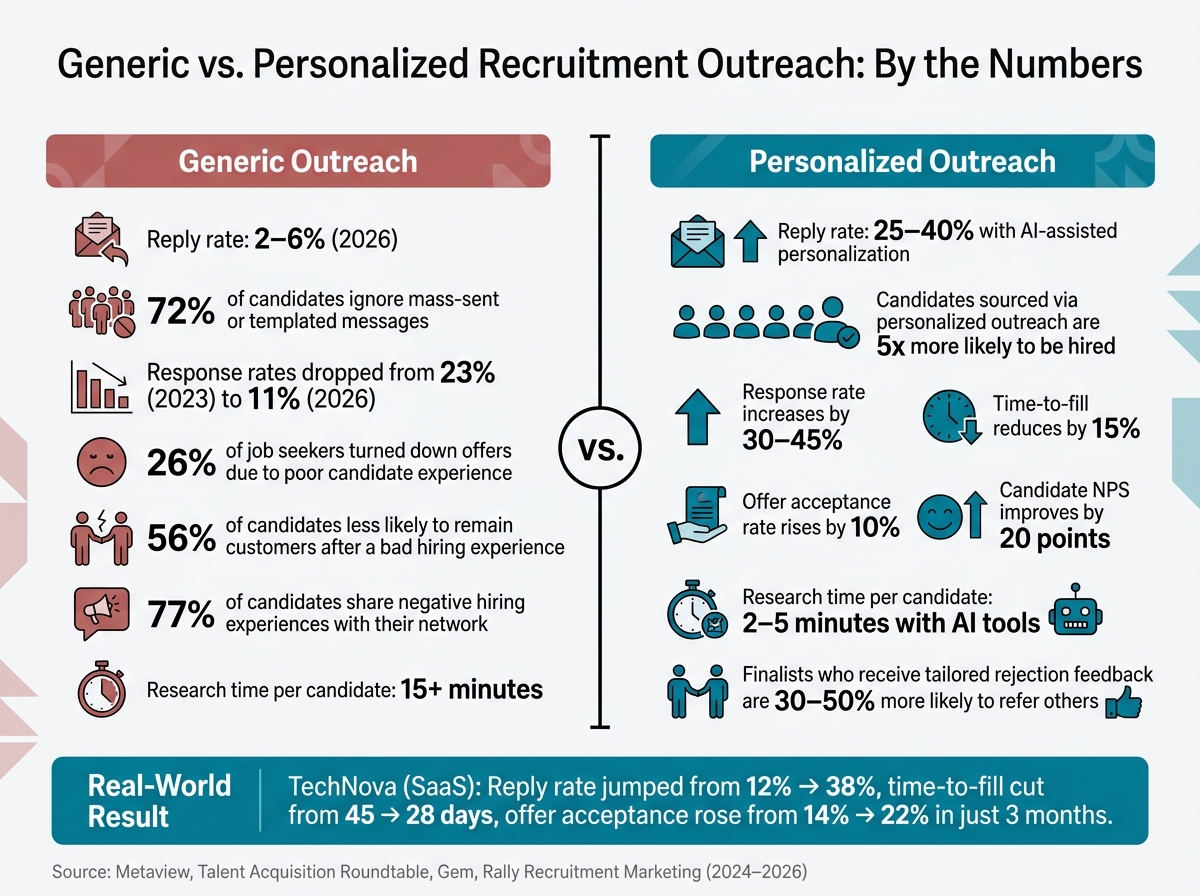
Generic vs. Personalized Recruitment Outreach: Key Stats
The Cost of Generic Outreach on Hiring Outcomes
Why Generic Messaging Reduces Response Rates
Response rates have plummeted, dropping from 23% in 2023 to just 11% by 2026 [6]. In just three years, more than half of candidate engagement has been lost, and generic messaging is a key culprit.
72% of candidates admit they ignore outreach that feels mass-sent or templated [5]. It’s not that they aren’t open to new opportunities; the problem lies in messages that fail to provide a compelling reason to engage. A participant from the Talent Acquisition Roundtable in 2025 summed it up perfectly:
"Candidates ignore outreach when it lacks a compelling reason to respond." – Talent Acquisition Roundtable, 2025 [5]
In competitive industries, candidates often receive over 30 outreach messages each month [10]. They’ve developed a radar for spotting impersonal messages, with phrases like "I came across your profile" instantly flagged as recruiter spam. These are dismissed within seconds, often without a second thought [4]. The result? Reply rates for generic outreach have nosedived to just 2–6% in 2026, a stark contrast to the higher response rates seen with personalized approaches [4].
This isn’t just about fewer replies. It’s about the broader impact these tactics have on your hiring strategy and reputation.
How Impersonal Hiring Hurts Your Employer Brand
The fallout from generic outreach doesn’t stop at unanswered emails. When candidates feel like they’re nothing more than a name on a list, it leaves a lasting impression of your company – and not a good one.
77% of candidates who have a negative, impersonal experience will share it with their network [3]. In tight-knit industries like tech or fintech, this kind of feedback spreads fast. If your company positions itself as innovative and people-focused but delivers a robotic recruitment experience, candidates will notice the disconnect [8].
Beyond perception, there’s a tangible cost. High-volume, impersonal campaigns lead to higher bounce and unsubscribe rates, damaging your domain’s reputation [9]. This makes it harder to reach candidates, even if you improve your messaging later.
Once trust is lost, it’s not just your employer brand that suffers – you risk losing the best candidates to competitors.
Losing Top Candidates to Competitors
When candidates disengage due to generic outreach, your competitors have the upper hand. Tailored, thoughtful messaging resonates with top talent, giving other companies a clear advantage. In 2024, 26% of job seekers turned down job offers because of a poor candidate experience, even when the role and salary aligned with their expectations [7]. Worse still, 56% of candidates are less likely to remain or become customers of a company after a bad hiring experience [3].
The message is clear: companies that prioritize relevant, well-researched outreach consistently outperform those relying on volume. As one Talent Acquisition Leader from a Series C tech company noted:
"Candidates respond to relevance, not volume. The message that shows you did your homework will always outperform the message that shows you have a big database." – Talent Acquisition Leader, Series C Tech Company [5]
How Personalization Improves Recruitment Results
Better Engagement and Higher-Quality Hires
Personalized AI outreach delivers reply rates of 25–40% [10], far outpacing the 10–15% seen with generic templates and the mere 2.1% from high-volume cold campaigns [1]. The key difference? Relevance. When a message highlights something specific – like a candidate’s recent project, a talk they gave, or a career milestone – it grabs attention in ways a generic message simply cannot. As Metaview explains:
"Personalization earns a reply when it grounds the message in something specific the candidate didn’t expect a recruiter to know." – Metaview [1]
But it’s not just about getting replies. Candidates sourced through targeted, personalized outreach are five times more likely to be hired than those who apply through inbound channels [2]. This means fewer wasted interviews, quicker hiring decisions, and stronger hires overall.
Higher engagement also nurtures trust, a crucial element in keeping candidates interested throughout the process.
Building Candidate Trust Through Better Communication
Poor communication is one of the top reasons candidates drop out of the hiring process. Personalization helps solve this by showing candidates that recruiters have taken the time to understand them – not just the role they’re trying to fill. While generic outreach often fails to make an impression, personalized messaging keeps candidates engaged through thoughtful follow-ups and tailored feedback. This approach ensures candidates feel valued and respected at every stage.
A winning strategy often includes three simple steps: start with a personalized hook that reflects genuine research, present a clear value proposition, and end with a low-pressure call to action [2]. This creates a professional, conversational tone instead of a sales-like pitch. Eddie Stewart, Owner of ES Talent Solutions, sums it up well:
"The strategy is treating every candidate like their time and attention matter." [12]
Even when candidates don’t land the job, personalized feedback can leave a lasting impression. Finalists who receive tailored feedback after a rejection are 30–50% more likely to refer others to the company [3], transforming unsuccessful candidates into advocates for your brand.
Scaling Personalization for Fast-Growing SMEs
For fast-growing small and medium-sized enterprises (SMEs), scaling personalization doesn’t have to mean sacrificing efficiency. The key is tailoring your approach to the complexity of each role. Senior or niche positions may require 15+ minutes of detailed research per candidate, while higher-volume roles can be managed using modular templates with dynamic fields like [RecentProject] or [SharedConnection] [1].
AI tools make this process more manageable. Generative AI, for example, can reduce research time from 15+ minutes to just 2–5 minutes by summarizing career histories, identifying tenure patterns, and pulling relevant company news [12]. Companies like Brex have saved 50 hours per month by incorporating AI into their recruitment workflows [1]. This time can then be reinvested in building stronger candidate relationships, addressing the low engagement and impersonal outreach that often hinder hiring success.
For SMEs without the internal resources to implement structured, personalized hiring, embedded recruitment offers a practical solution. Rent a Recruiter places experienced recruiters directly into your team, equipping you with the tools, processes, and communication expertise needed to scale personalization – without slowing down your hiring efforts.
How to Add Personalization to Your Recruitment Process
Segment Candidates and Build Personas
Start by creating detailed candidate personas based on real data, not assumptions. Talk to your current employees, recent hires, and your team to understand what attracted successful candidates, their concerns, and what ultimately made them say yes to your offer [13]. Dive into your ATS data to uncover patterns – who’s accepting offers, who’s turning them down, and the reasons behind their decisions.
The best personas go deeper than just job titles. They explore what motivates candidates to make a career move – whether it’s autonomy, career advancement, mentorship, or stability – and highlight potential objections, like burnout or limited growth opportunities [13]. Lori Sylvia, Founder & CEO of Rally Recruitment Marketing, explains:
"Candidate personas don’t become operational by accident. They become operational when your team knows exactly what to do differently for each audience." [13]
Once your personas are in place, segment your candidates by both seniority and behavior. For example, candidates engaging with "leadership development" content likely have different priorities than those clicking on "flexible work" posts. Use these behavioral signals to tailor your messaging.
With these insights, you can craft outreach that feels personal and relevant to each group.
Write Outreach Messages That Speak to the Candidate
With your personas defined, your outreach should reflect each candidate’s unique strengths and interests. If your message could be sent to 100 people without any changes, it’s too generic – and it’s likely to be ignored [12].
Good outreach is built on specific, personal details: a project the candidate led, a unique career move, or a skill they’ve demonstrated. Mentioning something they wouldn’t expect a recruiter to know grabs their attention. Keep subject lines under 40 characters – 61% of emails are opened on mobile – and keep your messages concise, ideally 50 to 150 words, with three to five personalized details [1][11].
Tailor your opening line to match the persona. For a senior engineering candidate, highlight opportunities for technical leadership and platform-building. For someone early in their career, focus on mentorship and growth. Each persona needs a different hook [13].
And don’t stop at one message. Most positive responses come after the second, third, or even fourth touchpoint. Each follow-up should add fresh information rather than repeating the same pitch [1].
"Sending a 4-stage sequence using email instead of InMail can increase your response rate by about 2x. A 68% increase in positive response rate just from sending three follow-ups." – Steve Bartel, Co-founder & CEO, Gem [1]
Use Technology to Personalize at Scale
Once you’ve segmented your candidates and tailored your messaging, technology can help you maintain personalization without overwhelming your team. Use AI tools to handle the research phase before drafting messages. AI can summarise career histories, flag patterns in tenure, or highlight recent achievements, giving you the foundation for a personalized message [12].
"The problem in recruiter outreach didn’t get better with GenAI. For most teams, it got worse… They’re asking AI to write a message. They should be asking AI to research a person and then write a message." – Eddie Stewart, Founder, ES Talent Solutions [12]
AI notetakers can also be game-changers for intake calls. They capture the hiring manager’s exact words, which you can weave into your outreach for a message that feels directly tied to the role, not just a generic job description [1]. Tools like Metaview even offer 500 free contact enrichment credits per month, helping you access verified emails and phone numbers [2].
When it comes to follow-ups, plan a four-touch sequence over two to three weeks. Bombarding candidates with four messages in four days can come across as pushy and often results in lower-quality responses [1][2]. Thoughtful spacing, combined with persona-specific hooks and AI-driven research, allows you to deliver personalized communication without exhausting your team’s resources.
sbb-itb-a23bd6a
Measuring the Impact of Personalization in Recruitment
Metrics That Show Whether Personalization Is Working
Once your personalized outreach is in motion, it’s time to assess its impact with measurable results. Start with your reply rate – this is often the clearest indicator of success. Personalized, targeted messages typically achieve a reply rate of 5.8%, compared to just 2.1% for generic, high-volume campaigns [1]. If your reply rate isn’t improving, it’s a sign to tweak your messaging or refine your audience segmentation.
Beyond reply rates, there are four key metrics to evaluate:
| Metric | Impact of Personalization |
|---|---|
| Response Rate | Increases by 30–45% [14] |
| Time-to-Fill | Reduces by 15% [14] |
| Candidate Net Promoter Score (cNPS) | Improves by 20 points [14] |
| Offer Acceptance Rate | Rises by 10% [14] |
One standout metric is Candidate Net Promoter Score (cNPS), which measures how likely candidates are to recommend your hiring process – even if they didn’t land the job. This offers a direct glimpse into how well your communication resonates. A drop in cNPS can serve as an early warning sign of disengagement or frustration.
Keep a close eye on your application drop-off rate at every stage. If candidates are ghosting after interviews or declining offers, it’s often a sign that personalization faltered somewhere beyond the initial outreach.
These metrics provide a solid foundation to refine your strategy and make data-driven improvements.
Using Data to Improve Your Approach Over Time
Metrics are only part of the story. To sharpen your personalization strategy, incorporate A/B testing into your process. Test one variable at a time – such as subject line length, the type of personalization detail you include, or the timing of your outreach – to understand what’s driving results [11][3].
Don’t overlook the value of candidate feedback. Short post-interview surveys, sent immediately after key stages, can provide fresh insights before candidates move on. Use this feedback to calculate cNPS and pinpoint areas where the experience felt impersonal or inefficient. For example, TechNova, a mid-size SaaS company, leveraged AI-driven tools to reference specific candidate projects in their outreach. Over three months (February to May 2026), they saw their reply rate jump from 12% to 38%, reduced their time-to-fill from 45 days to 28 days, and increased offer acceptance rates from 14% to 22% [14].
Pay attention to silence and objections as well. A “not right now” response – or no response at all – provides valuable insight into how your messaging is landing. As Metaview explains:
"Every reply teaches the next sourcing brief. The captured-signal flywheel compounds." [1]
Each interaction, whether positive or negative, helps refine future outreach. By continuously adjusting your templates based on what’s working, you transform personalization into an ongoing, compounding advantage.
Outreach Tips for Recruiters: Writing Emails That Get More Replies
Conclusion: Making Personalization a Core Part of How You Hire
Personalization is key to attracting top talent. Generic outreach doesn’t just fall flat – it harms your brand and hurts your hiring outcomes. On the other hand, thoughtful and targeted communication helps you stand out and connect with candidates in a meaningful way.
The approach is straightforward: pay attention to candidate signals early, create templates that leave room for customization, prioritize efforts based on role complexity, and use data to refine your process over time. As Sean McHugh, Senior Director of Talent Acquisition at Sprinklr, explains:
"Personalization within recruitment is really about listening to learn and understand the candidate’s true needs and motivations." [15]
This philosophy – listening first and tailoring your message second – turns personalization into a long-term strength rather than a one-off tactic. It’s a strategic shift that positions your hiring process for sustainable success.
Work with Rent a Recruiter to Hire with More Precision
For scaling SMEs, the biggest obstacle to personalized hiring often boils down to capacity. That’s where Rent a Recruiter steps in.
Rent a Recruiter embeds skilled recruiters into your team within days, giving you the tools and capacity to scale personalized outreach. Companies working with Rent a Recruiter typically cut hiring costs by up to 70% compared to traditional commission-based agencies and save over 80 hours per month on hiring admin. Whether you’re scaling after a funding round or handling a hiring surge, this support ensures your personalization efforts don’t get lost in the rush.
FAQs
What counts as “personalization” in recruiter outreach?
Personalization in recruiter outreach is about creating messages that genuinely connect with a candidate’s unique experiences, skills, and aspirations. It’s more than just addressing them by name – it’s about referencing specific details, like a project they spearheaded or a standout skill they’ve honed.
Done right, personalized outreach demonstrates clear intent, relevance, and explains how the opportunity aligns with their career path. By blending automated tools for the basics with thoughtful, tailored research, you can maintain authenticity while reaching candidates at scale.
How can we personalize at scale without adding headcount?
You can achieve personalization at scale without expanding your team by blending automation, AI, and human expertise. A tiered strategy works best: automate routine outreach, use AI tools to engage mid-level candidates, and dedicate your team’s time to high-priority prospects. AI can generate tailored messages based on individual profiles, increasing engagement and response rates. With Rent a Recruiter, scaling companies gain access to embedded recruiters who bring clarity and structure to the hiring process – without the need to grow your permanent workforce.
Which metrics show personalization improves hiring?
To measure how personalization influences recruitment success, focus on these critical metrics:
- Response rates: Tailored outreach often achieves reply rates between 18% and 24%, significantly outperforming generic efforts.
- Engagement quality: Keep an eye on open rates and how effectively candidates move from initial outreach to scheduled interviews.
- Pipeline efficiency: Dive into your pipeline data to spot any slowdowns and ensure candidates advance without unnecessary delays.
Rent a Recruiter specializes in refining hiring strategies and cutting recruitment costs, paving the way for scalable business growth. Learn more about embedded recruitment.