
One remote hire in the wrong country can turn a low-cost growth plan into back taxes, local filings, and months of finance clean-up.
If you hire across borders, permanent establishment, or PE, is the tax risk you need to check before the offer goes out. In simple terms, a remote employee can create a taxable business presence for you overseas, even if you have no local company set up. That can mean corporate tax, payroll duties, penalties, interest, and extra admin cost.
Here’s the short version:
- Location matters. A full-time home office abroad can create risk if the setup is business-led.
- Activity matters. Sales, country launch, leadership, and client-facing deal work carry more risk than support roles.
- Control matters. If someone abroad negotiates terms, shapes deals, or helps close contracts, your tax exposure goes up.
- Process matters. Pre-approval, location tracking, and tight role scope can cut cost and save your team time.
For CEOs, CFOs, HR leaders, and Talent Leaders, the business issue is simple: PE risk can slow hiring, distort forecasts, and add costs you did not plan for. The fix is not to stop cross-border hiring. It is to put checks into your hiring process early, so you keep speed and control.
If you are building international teams in SaaS, Technology, IT, Fintech, Engineering, Security, Insurance, or Professional Services, this article shows where PE risk tends to show up and what you should review before headcount turns into tax exposure. For more insights on navigating international hiring challenges, visit The Talent Fix Recruitment Blog.
The Tax Implications Of Working Remotely
sbb-itb-a23bd6a
What Is Permanent Establishment in Remote Work?
Under most tax treaties, permanent establishment (PE) means a fixed place of business through which a company carries on operations. Once a PE is recognised, the host country can tax the profits linked to that activity.[17][3][19][23] For growing SMEs, that matters because a remote worker can shift from being a talent acquisition decision to becoming a tax presence.
A fixed-place PE usually needs a physical location, company control over that space, some permanence, and business activity that goes beyond preparatory or support work.[3][6][23] In plain English, if someone is working full-time from a home office and doing core business work, that setup can meet the test.
What Permanent Establishment Means for a Growing Business
For a scaling SME, a PE finding creates tax and compliance friction straight away. You may need local registration, tax filings, profit allocation, and ongoing compliance support.[11] That means more cost, more admin, and less speed when you’re trying to grow.
This is where remote hiring gets tricky. The business presence may not look like an office or branch. It may just be one person working in another country. But from a tax point of view, that can still trigger obligations that eat into time and budget.
Why Remote and Hybrid Work Make the Rules Harder to Apply
PE rules were built around clear physical business locations such as offices, branches, and factories. Remote and hybrid work blur that picture.
Risk tends to go up when your company intentionally hires into a country and uses that location for core business activity. On the other hand, short-term remote work or employee-led arrangements often carry less exposure. Temporary, government-mandated home working has generally not been treated as creating a new PE because it was exceptional rather than business-led.[12][13][10][14][15][16]
That distinction matters for hiring leaders and finance teams. The tax risk often depends less on the job title alone and more on why the person is there, how permanent the setup is, and whether the work supports revenue-generating activity.
The next issue is which roles and work patterns create the highest exposure.
How Remote Work Creates Permanent Establishment Risk for High-Growth SMEs
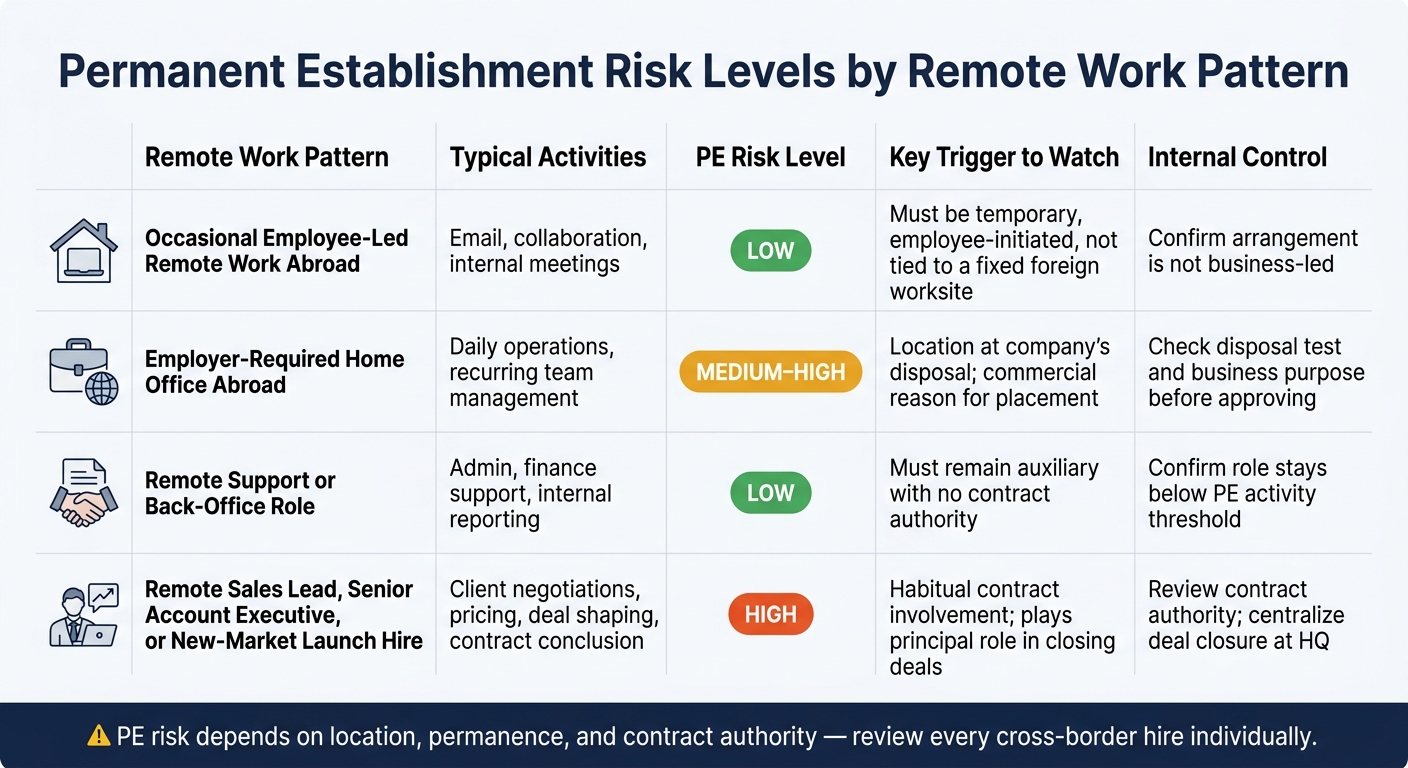
PE Risk Levels by Remote Work Pattern: What Every Employer Must Know
PE risk goes up when remote work creates a stable, material business presence in another country. The line between low-risk flexibility and a genuine PE issue often comes down to two things: where the employee works and what that person is doing. In practice, the clearest risks start there.
When a Home Office Can Become a Fixed Place of Business
Risk climbs when a company places an employee in a foreign home office to serve a market, and that space is treated as being at the company’s disposal. That can happen if the employer pays for the space, lists it as a business address, or uses it for client meetings.[10][24][26]
For SMEs, one of the clearest high-risk cases is a country manager or regional lead working full-time from a home office overseas, meeting local clients, and publicly representing the company in that market. That setup can meet both the time threshold and the commercial reason test, which makes PE exposure a serious issue.[24][9][26]
How Sales and Contract Authority Increase Dependent Agent Risk
Dependent agent PE does not need a fixed office. It can arise when a remote employee habitually concludes contracts, or plays the main role in getting them over the line, even if HQ gives the final sign-off.[6][22][25]
A remote senior account executive who regularly negotiates pricing and scope with clients, or a regional business development director who drives long-term service agreements in their host country, can create dependent agent PE exposure, even without formally signing contracts.[4][9][26]
By contrast, marketing outreach, lead generation, and sharing early-stage information tend to carry much lower risk, so long as final contract decisions stay with a central team in the home jurisdiction.[4][22][9]
PE Risk Levels Across Common Remote Work Scenarios
The table below shows which remote setups tend to create the most PE risk.
| Remote Work Pattern | Typical Activities | PE Risk Level | What to Review Internally |
|---|---|---|---|
| Occasional employee-led remote work abroad | Email, collaboration, internal meetings | Low | Confirm it is temporary, employee-initiated, and not tied to a fixed foreign worksite.[10][8] |
| Employer-required home office abroad | Daily operations, recurring team management | Medium to high | Check whether the location is at the company’s disposal and whether there is a commercial reason for the arrangement.[10][1][8] |
| Remote support or back-office role | Admin, finance support, internal reporting | Low | Confirm it stays auxiliary and does not include contract authority.[20][28] |
| Remote sales lead, senior account executive, or fractional recruitment services for a new-market launch | Client negotiations, pricing, deal shaping, contract conclusion | High | Review contract authority, habitual deal involvement, and whether the person plays the main role in concluding contracts.[20][27] |
These patterns are tested under fixed-place and dependent-agent rules, with treaty details deciding the final outcome.
Legal and Tax Frameworks That Shape Remote Work PE Risk
The OECD Model Tax Convention is the starting point for most PE analysis, but it is only a template. The final outcome depends on domestic law, tax treaties, and local practice. In plain terms, the same remote working setup can be fine in one country and risky in another.
For high-growth SMEs, that has a direct business impact. If you hire across borders before checking PE risk, you can create tax exposure, extra admin, and legal costs that are much harder to fix later. The key point for employers is simple: know which test applies before the hire is signed off.
The Core PE Tests Employers Should Know
If an employee spends less than 50% of total working time in a foreign home or another non-company location over any rolling 12-month period, that location is generally not treated as a fixed place of business.[5][34][21] What matters here is actual working patterns, not just what the contract says.
Once time spent in that location goes above that level, the next question is whether the setup serves a real business purpose rather than personal convenience.[5][34][2]
For dependent agent PE, the focus shifts. The test is whether the person habitually concludes contracts, or plays the principal role in closing contracts, on behalf of the company in that country.[31][32][33] That rule applies just as much to video calls and email as it does to in-person meetings. Digital communication does not change the analysis.[29][18]
Why Local Rules and Treaty Details Still Matter
The OECD framework gives embedded recruitment teams a useful starting point, but it is not a universal answer. Bilateral tax treaties between the home and host countries can narrow or expand PE definitions, carve out certain activities, or add special clauses that do not appear in the OECD model.[7]
Then there is the local layer. Domestic tax law and local practice can change the picture again. Some jurisdictions publish specific safe harbors for short-term remote work. Others use different materiality thresholds or read "habitual" more broadly than OECD guidance suggests.[16][30]
That is why each remote hiring decision needs a country-by-country review. You are not just approving a hire. You are making a tax and operating decision. Once the rule set is clear, you can cut exposure through role design, approval controls, and clean documentation.
How to Reduce Permanent Establishment Risk in Remote Teams
Once a role moves into fixed-place or dependent-agent territory, you need controls that limit where work happens and who can act for the company. In most cases, PE risk comes down with clear rules, tight role scope, and simple tracking. The next move is to turn those rules into hiring controls.
Set Clear Remote Work Rules Before Hiring Across Borders
One of the best ways to reduce risk is a written cross-border remote work policy in place before someone starts working from another country. That policy should spell out which countries employees can work from, how long they can stay there, and which activities are not allowed where you do not have a legal entity.
In practice, that means employees must declare their work location and get pre-approval from HR or finance before working abroad. If a cross-border setup could go past local PE thresholds, approval should be mandatory.
Sales, leadership, and market-entry roles need tighter control. These roles carry more risk, so the policy should clearly ban contract negotiations, deal closure, and strategic decision-making from countries where the company has no registered entity.
Design Roles and Workflows to Keep Higher-Risk Activities Centralized
Role design matters just as much as location. The goal is to separate lower-risk support work from activities that can trigger dependent agent PE, especially contract negotiation, deal closure, and other binding business decisions.
Keep support work remote. But keep contract negotiation, deal closure, and binding decisions in one central place. That helps you hold commercial activity inside the business where you can see it and control it, even if the team is spread across countries.
The same applies to executives. Core decision-making should stay in the U.S. or in places where you already have an entity. Just as important, document where those decisions happen. If tax authorities ever review your setup, that paper trail matters.
Track Location, Activities, and Documentation in One Process
Controls fall apart when location and activity data sit in different places. Track location, time, and activity in one system, with alerts as people get close to threshold levels. For each cross-border arrangement, keep a clear record showing whether the move was personal or driven by the business.
Quarterly reviews help HR and finance spot people nearing risk thresholds early enough to change duties, limit time in-country, or move the work elsewhere before exposure is established.
The table below sums up the main risk categories, what to watch for, and the control tied to each one:
| Risk category | Warning sign | Internal control |
|---|---|---|
| Fixed place of business (home office) | Employee lists home address as company office; hosts regular client meetings at home | Ban use of home addresses as company offices |
| 50% working-time benchmark | Employee spends ≥50% of working time in a foreign country over any 12-month period | Location and time tracking with alerts when approaching threshold; pre-approval required to exceed limits |
| Dependent agent PE (sales) | Remote worker abroad habitually negotiates and concludes contracts | Limit foreign workers to lead generation and support; conclude and sign contracts from a central U.S. entity |
| Executive/management PE | Senior leaders make binding decisions from countries where the company has no entity | Require core decision-making to be based in the U.S. or established jurisdictions; document meeting locations |
| Business-led remote work | Company relocates staff abroad for market development without creating a local entity | Mandatory tax review before any business-led relocation; consider an Employer of Record or subsidiary where commercial reason is strong |
Build these checks into hiring approval and workforce planning. That gives you a cleaner process, fewer tax surprises, and more control as your remote team grows.
Building a Compliance-Ready Remote Hiring Model That Scales
These controls only hold up as hiring grows if they sit inside the hiring process itself. If you want PE controls to scale, they need to show up in the workflow before any offer goes out.
Build PE Checks Into Hiring Approval and Workforce Planning
The simplest way to do this is with a standardized pre-hire checklist for every cross-border role before offer stage. That checklist should record the candidate’s expected work country and location type, whether the role includes contract authority or client-facing decision-making, and which legal entity or employer-of-record structure will employ them.
Some roles need tighter sign-off from the start. Sales, country manager, and senior leadership hires should need finance and HR approval before the role even opens.
Just as important, give each step a clear owner. Track PE checks in your hiring system, and make approval mandatory before any cross-border offer is sent. That way, PE review happens by default, not as a last-minute scramble.
When PE data is recorded at the job opening stage, finance gets an early view of where exposure is building before it turns into a tax issue. That gives your team room to decide whether a local entity makes sense or whether the role should stay below higher-risk thresholds.
Put simply, this shifts PE review from a one-off task into a repeatable approval step.
How Rent a Recruiter Supports Structured, Scalable Hiring
As hiring volume grows, the hard part is applying that process the same way every time. Rent a Recruiter helps by placing experienced recruiters directly into your team, so PE-aware processes are used from the first job opening instead of being added after issues appear.
Because embedded recruiters work inside your workflows with HR, finance, and leadership, they can make sure work country, location type, authority levels, and risk tiers are recorded properly on every role. That kind of structure helps you scale international hiring without losing control of compliance.
Conclusion: Manage PE Risk Without Slowing Growth
Remote work does not automatically create a permanent establishment problem. But the outcome always comes back to the facts. PE risk depends on location, permanence, and contract authority.
The aim is not to slow hiring. It’s to make cross-border growth repeatable, controlled, and safe. That means using written rules, role controls, and pre-hire approval to keep risk contained. Build those checks into your hiring workflow, rather than treating them as a separate tax task.
For high-growth SMEs hiring across borders, structured hiring helps cut tax surprises and keeps expansion moving.
Because treaty and local rules vary, treat every cross-border hire as a case-by-case review.
With the right controls in place, remote hiring can scale without creating avoidable tax exposure. Talk to Rent a Recruiter about building a compliant cross-border hiring process.
FAQs
How do I know if a remote hire creates PE risk?
Look closely at how much control your company will have over the remote hire’s day-to-day work, and whether the role sits close to your core business activity. If you set their schedule, direct priorities, and manage daily tasks, or the role is tied tightly to business operations, PE risk may be higher.
That matters commercially. A misstep here can lead to tax exposure, payroll issues, and extra legal spend, all of which add cost and slow hiring plans.
Because worker status depends on how the work is carried out in practice, not just what the contract says, review each remote role before you open a requisition. Then audit classifications quarterly against IRS and Department of Labor guidelines.
Which remote roles are most likely to trigger PE?
Remote roles tied closely to your core revenue activity are the ones most likely to create permanent establishment (PE) risk. The risk climbs fast if that person can negotiate deals or sign contracts on your behalf.
Senior hires can also create tax exposure when they run key day-to-day business activity in-market. In practice, the work matters more than the job title. If the role is deeply embedded in how your business operates, the PE risk is higher.
For CEOs, CFOs, and HR leaders, that has a direct commercial impact. One hire in the wrong setup can lead to tax filings, local compliance work, penalties, and extra admin you did not plan for.
What should we check before approving cross-border remote work?
Before you approve cross-border remote work, run a compliance audit first. It cuts legal exposure, avoids tax surprises, and gives you a clear record of who approved what, and why.
Check the right worker classification under Department of Labor and IRS rules. Then review labour, tax, and registration duties in the employee’s location. This matters because one wrong call on status or setup can lead to payroll issues, penalties, or extra entity-related costs.
Keep approvals centralised. Tie each case back to formal budget sign-off and headcount records, so you have a clean audit trail if Finance, HR, or legal teams need to review it later.
In practice, that means you should document:
- worker classification
- local labour and tax checks
- approval owner
- budget source
- approved headcount
For scaling teams, this is not admin for admin’s sake. It protects cash, saves leadership time, and stops remote hiring from turning into a compliance mess.