
Use the wrong hiring document, and you can create legal cost, slow down start dates, and lock your team into terms you did not mean to promise.
If you hire in the U.S., the rule is simple. Offer letters help you move fast. Employment contracts lock in enforceable terms. Get that split right, and you cut rework, avoid term mismatches, and keep control of at-will hiring. Get it wrong, and even a short offer letter can trigger disputes over severance, pay, or termination terms.
Here’s the short version:
- Offer letters are usually short and high level
- Employment contracts are longer and legally binding
- At-will wording matters, especially in the U.S.
- Senior, IP-sensitive, and variable-pay roles often need more than an offer letter
- Digital signing workflows can cut turnaround times by 80%+
- A clear document rule saves time across 20, 50, or 100 hires
If you are scaling in SaaS, Technology, IT, Fintech, Engineering, Security, Insurance, or Professional Services, this is not just a legal drafting point. It is a hiring process issue tied to cost, control, and time to start.
Employment Agreement vs Offer Letter – Which One is Better?
sbb-itb-a23bd6a
Quick Comparison
| Document | Main job | Legal effect | Best use |
|---|---|---|---|
| Offer Letter | Confirm the role and main terms | Often non-binding if drafted that way | Standard at-will hires |
| Employment Contract | Set full employment terms | Binding once signed | Executive, IP-sensitive, or complex hires |
I’ll break down the difference, when each document makes sense, and where poor wording can cost you time and money.
Offer Letters and Employment Contracts: What Each One Is
Once you’ve made the business case for getting hiring documents right, the next step is simple: which document starts the hire, and which one locks in the terms? It comes down to how much you want to set out now, and how much you want to make enforceable later.
Offer letter: confirming the role and headline terms
An offer letter is a short document, usually 1 to 3 pages, that confirms the role and the main terms a candidate needs to decide whether to accept [7].
A standard offer letter will usually cover:
- Job title
- Base salary or hourly rate in U.S. dollars
- Pay frequency
- Start date
- Work location
- Reporting manager
- Employee status
- Brief benefits summary [2][7]
In the U.S., it’s smart to keep offer letters non-binding and at-will. Why? Because loose wording can create implied contract risk in some states, even though at-will employment is the default in almost every state except Montana [2][5][8].
That means you should avoid language that sounds like a promise. Be plain about it. State that the offer letter is not a binding contract and that employment is at-will [2][5].
Employment contract: detailed and binding obligations
An employment contract is a legally binding agreement that sets out the full enforceable terms of employment. It often runs 3 to 8+ pages and may cover duties, confidentiality, IP assignment, notice, termination, and any restrictive covenants allowed under state law [7][2][1].
Once both sides sign, the contract is enforceable, and changes will usually need mutual agreement [9].
You should also include a merger clause stating that the contract overrides prior offer letters and verbal discussions [1]. That can save you trouble later if there’s a dispute about what was said or promised during the hiring process.
Those differences are easier to see in the side-by-side comparison next.
Offer Letter vs. Employment Contract: Key Differences
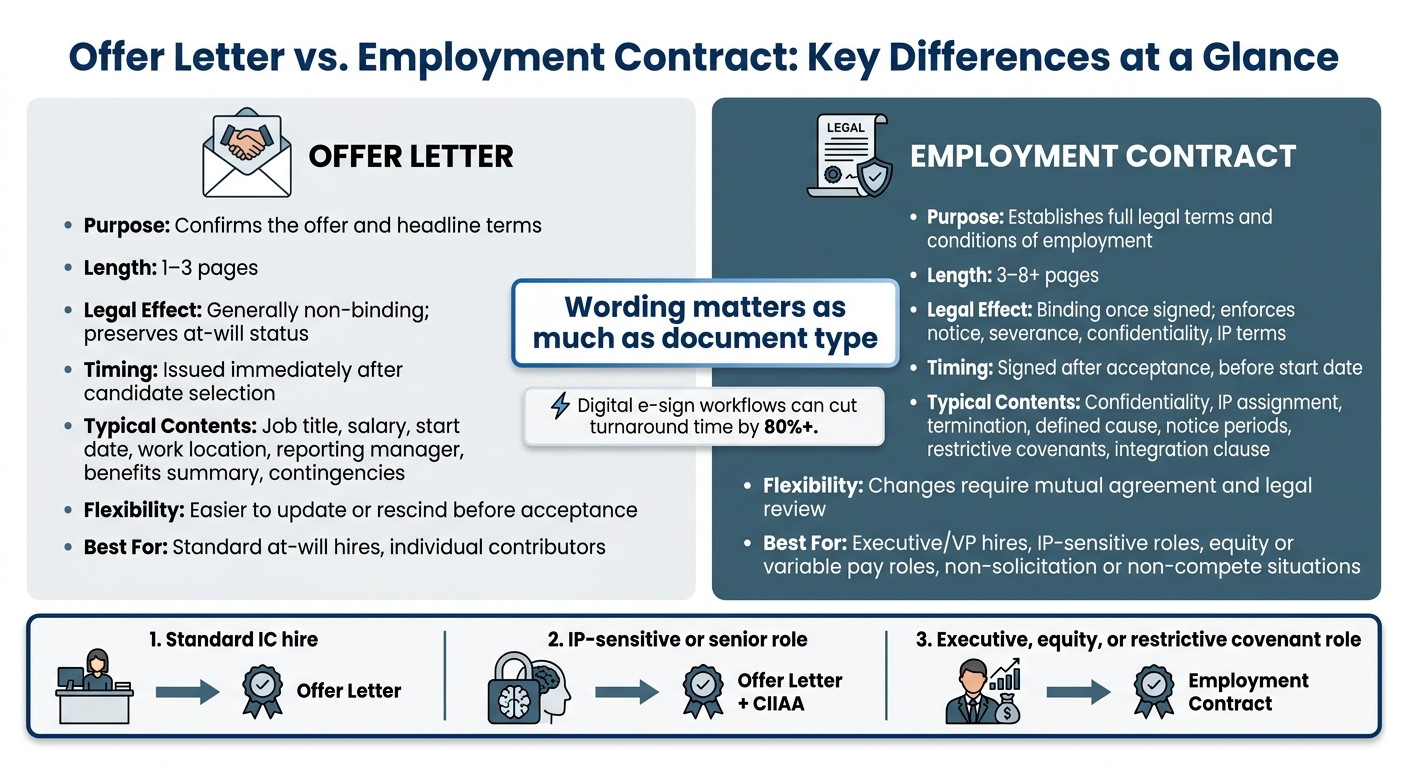
Offer Letter vs. Employment Contract: Key Differences at a Glance
Side-by-side comparison table
An offer letter confirms your intent to hire and sums up the main terms. An employment contract sets out the full legal terms and conditions of employment.
| Category | Offer Letter | Employment Contract |
|---|---|---|
| Purpose | Confirms the offer and headline terms | Establishes the full legal terms and conditions of employment |
| Level of detail | Short, high-level, and conversational | Detailed and broad |
| Legal enforceability | Generally non-binding; preserves at-will status [10][2] | Binding once signed; can impose enforceable notice, severance, confidentiality, and IP terms [10][8] |
| Timing in hiring process | Issued immediately after candidate selection | Usually signed after acceptance, before the start date |
| Typical contents | Title, salary, start date, and contingencies | Confidentiality, IP assignment, termination, and notice periods |
| Flexibility to amend | Easier to update or rescind before acceptance | Changes usually require mutual agreement and legal review |
The key point is simple: wording matters as much as document type.
That matters for scaling companies because a signed offer letter can still become binding if it makes firm promises on pay, start dates, or other terms. So this is not just a paperwork issue. It can affect hiring speed, legal risk, and your room to change course if plans shift.
What these differences mean for scaling companies
For growing teams, the goal is straightforward. You want speed for low-risk hires and tighter protection for higher-risk roles.
In practice, that means using the lightest document that still fits the risk of the role. A lean offer letter often works well for standard individual contributor hires. An employment contract makes more sense for senior, executive, or sensitive-IP roles.
This is where many hiring teams get stuck. They either over-lawyer every hire and slow the process down, or they move too fast and leave gaps around confidentiality, IP, or termination terms.
A two-step approach often works well:
- Send a fast offer letter to secure acceptance.
- Follow with a formal employment contract or a Confidential Information and Invention Assignment Agreement (CIIAA) before the start date to protect intellectual property. [2]
For CEOs, CFOs, and HR leaders, the business impact is clear. The right document mix helps you hire fast without taking on risk you did not mean to accept.
Legal and Drafting Issues Employers Should Watch
How wording can change your legal exposure
Once the difference between the two documents is clear, the next issue is drafting. This is where employers often get caught out.
Most disputes over hiring documents come down to the words on the page, not what the employer meant. Put plainly, the biggest risk is not intent. It is wording.
In Prozinski v. Northeast Real Estate Services, LLC, severance wording in an offer letter was enforced because it promised one year of pay if employment ended within 24 months. [3] That matters because annualised pay language can suggest a fixed term, rather than at-will employment. In many U.S. jurisdictions, casual phrasing can open the door to implied-contract claims. [2] And if the offer letter reads like a binding agreement, later restrictive covenants may fail for lack of new consideration. [4]
This is where loose drafting starts to cost you. A few unclear lines in an offer letter can create legal risk, lead to back-and-forth with counsel, and slow hiring when speed matters.
Employment contracts need precise terms. Define termination. Define cause. Add an integration clause that overrides earlier promises. Write for enforceability, not convenience. In Moore v. LGH Medical Group, LLC, the Massachusetts Superior Court found that an offer letter was not enforceable because it clearly stated that it was not a legally binding document and that a formal employment contract would follow. [6]
Drafting points that cut confusion and rework
The practical fix is simple: standardise the clauses that tend to cause the most disputes. If you get these documents right the first time, you save time, cut legal review cycles, and avoid avoidable rework.
| Drafting Term | Why It Matters | Where It Belongs |
|---|---|---|
| At-will disclaimer | Prevents the document from being read as a fixed-term contract | Offer letter; any contract that preserves at-will status |
| Pay-frequency or annualized-pay wording | Avoids implying a guaranteed one-year employment term | Offer letter |
| Contingencies | Ties the offer to background checks, drug screening, and Form I-9 | Offer letter |
| Avoid mandatory bonus or raise promises | Keeps variable pay discretionary and avoids entitlement claims | Offer letter & contract |
| Integration (merger) clause | Supersedes all prior verbal and written promises | Employment contract |
| IP assignment | Ensures the company owns work created by the employee | Employment contract |
| Defined "cause" for termination | Sets clear boundaries for ending the relationship | Employment contract |
One rule should run through the whole document: keep the at-will disclaimer clear, prominent, and consistent.
Those drafting choices shape whether an offer letter will do the job, or whether a contract gives you better protection.
When to Use Each Document and How to Build a Better Process
When an offer letter is enough and when a contract is the better choice
Once the legal line is clear, the next move is simple: use the lightest document that still covers the role.
Use an offer letter for routine at-will hires. Use a contract when the role needs enforceable IP, confidentiality, compensation, or restrictive covenant terms.
A formal employment contract is usually the better fit for C-suite and VP hires, roles with direct access to source code or trade secrets, roles with equity or variable pay, any hire that needs enforceable non-solicitation terms, and relocation-heavy roles that need clear pre-start obligations.[2]
| Situation | Use This |
|---|---|
| Standard at-will hire, individual contributor | Offer letter |
| Role touching core IP | Offer letter + CIIAA |
| Role touching core IP plus seniority or restrictive covenants | Employment contract |
| Executive or VP hire | Employment contract |
| Roles with equity or variable pay | Employment contract |
| Non-solicitation or non-compete required | Employment contract |
| Fixed-term engagement | Employment contract |
If you use both documents, sign the contract before day one.[2][4]
That matters more than it sounds. If your team handles senior hires one way and technical hires another, delays creep in fast. Legal gets pulled in late. Start dates slip. Hiring managers lose time. A simple rule cuts that drag.
Standardize your documentation to save time and reduce hiring costs
A decision rule only helps if people actually follow it.
The companies that move fastest usually do three things well: they keep approved templates ready, they set clear rules on which document to use, and they make signed-before-day-one the default.
That reduces back-and-forth, cuts rework, and keeps offers from stalling in email threads. For scaling teams, that means less admin and more time spent getting roles filled.
Digital workflows and e-sign technology can reduce candidate speed-to-sign turnaround times by over 80%.[1]
If you’re hiring across SaaS, Technology, IT, Fintech, Engineering, Security, Insurance, or Professional Services, that kind of process discipline adds up. One messy document flow might not look like a big deal, but it contributes to the biggest challenges in recruitment. Across 20, 50, or 100 hires, it becomes a cost problem.
Conclusion: Match the document to the level of risk
Offer letters confirm the hire. Contracts lock in the legal terms.
The right choice comes down to the role, the risk, and how well your hiring process is set up. Get the drafting right. Standardize your templates. Make sure the document you send matches the hire you’re making. That’s where much of the risk sits, and where much of the time saving sits too.
FAQs
Can an offer letter become legally binding?
Yes. An offer letter is usually not a legally binding contract, but it can cross that line if the wording makes promises.
If your letter suggests guaranteed employment, sets a fixed term, or spells out termination terms in detail, a court may view it as an implied contract. That creates legal risk you may not have meant to take on.
If you want to keep the letter non-binding, add a clear at-will disclaimer and state plainly that the offer letter is not an employment contract.
When should I use both an offer letter and a contract?
In most cases, don’t use both in a two-step offer.
If you send an offer letter first and then follow with a separate employment agreement, you can create legal risk you didn’t mean to create. A court may treat the first offer as a binding contract, even if you planned for the later agreement to be the main document.
A cleaner approach is to use one clear document from the start.
For general staff, that usually means a standard offer letter. For higher-risk or senior roles, use a well-drafted employment agreement.
That keeps the process simpler, cuts down on confusion, and helps you avoid disputes later.
What wording can weaken at-will employment?
To protect at-will employment, keep the wording tight and clear.
Avoid language that sounds like you’re promising permanent or long-term employment. That includes phrases like “we look forward to a long and successful career together” or “we’re a family company.” On the surface, those lines may feel warm. In practice, they can create legal risk.
The same goes for any statement that suggests a fixed employment period, promises “job security,” or implies someone can only be dismissed for cause.
A good rule here is simple: if the wording sounds like a promise, rewrite it.